Japanese researchers create 'time machine' simulations for studying the lifecycle of ancestor galaxy cities

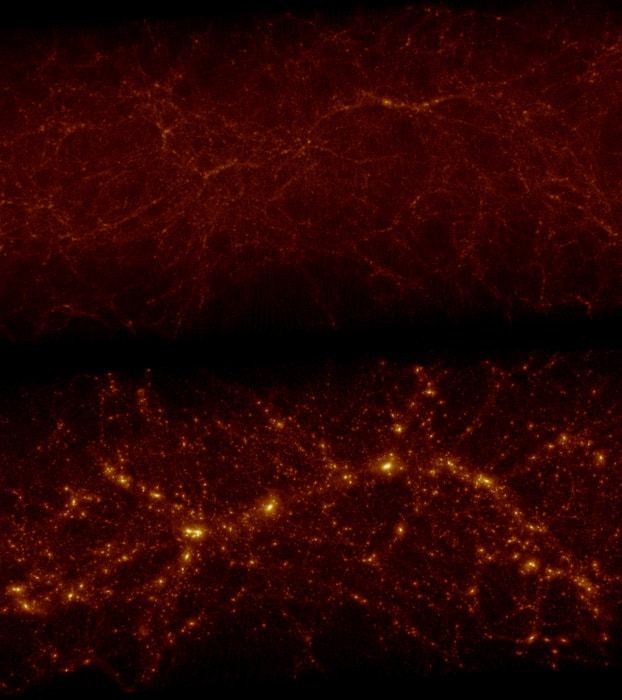
For the first time, researchers have created simulations that directly recreate the full life cycle of some of the largest collections of galaxies observed in the distant universe 11 billion years ago. Screenshots from the simulation show (top) the distribution of matter corresponding to the observed galaxy distribution at a light travel time of 11 billion years (when the Universe was only 2.76 billion years old or 20% its current age), and (bottom) the distribution of matter in the same region after 11 billion lights years or corresponding to our present time.  CREDIT Ata et al.

Cosmological simulations are crucial to studying how the universe became the shape it is today, but many do not typically match what astronomers observe through telescopes. Most are designed to match the real universe only in a statistical sense. Constrained cosmological simulations, on the other hand, are designed to directly reproduce the structures we observe in the universe. However, most existing simulations of this kind have been applied to our local universe, meaning close to Earth, but never for observations of the distant universe. 

A team of researchers, led by the Kavli Institute for the Physics and Mathematics of the Universe Project Researcher and Metin Ata and Project Assistant Professor Khee-Gan Lee, were interested in distant structures like massive galaxy protoclusters, which are ancestors of the present-day galaxy clusters before they could clump under their gravity. They found current studies of distant protoclusters were sometimes oversimplified, meaning they were done with simple models and not simulations. 

“We wanted to try developing a full simulation of the real distant universe to see how structures started out and how they ended,” said Ata. 

Their result was COSTCO (COnstrained Simulations of The COsmos Field).

Lee said developing the simulation was much like building a time machine. Because light from the distant universe is only reaching Earth now, the galaxies telescopes observe today are a snapshot of the past.

“It’s like finding an old black-and-white picture of your grandfather and creating a video of his life,” he said. 

In this sense, the researchers took snapshots of “young” grandparent galaxies in the universe and then fast-forwarded their age to study how clusters of galaxies would form. 

The light from galaxies the researchers used traveled a distance of 11 billion light-years to reach us.

What was most challenging was taking the large-scale environment into account.

“This is something that is very important for the fate of those structures whether they are isolated or associated with a bigger structure. If you don’t take the environment into account, then you get completely different answers. We were able to take the large scale environment into account consistently, because we have a full simulation, and that’s why our prediction is more stable,” said Ata.

Another important reason why the researchers created these simulations was to test the standard model of cosmology, that is used to describe the physics of the universe. By predicting the final mass and final distribution of structures in a given space, researchers could unveil previously undetected discrepancies in our current understanding of the universe.

Using their simulations, the researchers were able to find evidence of three already published galaxy protoclusters and disfavor one structure. On top of that, they were able to identify five more structures that consistently formed in their simulations. This includes the Hyperion proto-supercluster, the largest and earliest proto-supercluster known today that is 5000 times the mass of our Milky Way galaxy, which the researchers found out will collapse into a large 300 million light-year filament.

Their work is already being applied to other projects including those to study the cosmological environment of galaxies, and absorption lines of distant quasars to name a few.

NC State researchers build model that finds best sites for electric vehicle charging stations

Researchers from North Carolina State University have developed a computational model that can be used to determine the optimal places for locating electric vehicle (EV) charging facilities and how powerful the charging stations can be without placing an undue burden on the local power grid. Photo credit: Michael Fousert.

“Ultimately, we feel the model can be used to inform the development of EV charging infrastructure at multiple levels, from projects aimed at supporting local commuters to charging facilities that serve interstate highway travel,” says Leila Hajibabai, corresponding author of a paper on the work and an assistant professor in NC State’s Fitts Department of Industrial and Systems Engineering.

Identifying the best sites for charging facilities is a complicated process since it has to account for travel flow and user demand, as well as the needs of the regional power infrastructure. In other words, where will people use it? And can it be supported by the power grid?

“We have developed a model that allows planners to optimize these decisions, serving the greatest number of people without taxing the power system,” Hajibabai says.

While a lot of work has been done on how to deploy EV charging facilities, the researchers found that most previous efforts focused on siting these facilities based on what would work best for the power system, or what would work best from a transportation standpoint.

“Very little work has been done that addresses both,” Hajibabai says. “And those cases that looked at both power and transportation systems did not take into account the decisions that users make. Where do they want to charge their vehicles? What are their travel plans?

“The best location for a charging facility from the power system’s standpoint is often not the best location from a transportation systems standpoint. And the best location from a user’s standpoint is often a third option. Our model looks at power systems, transportation systems, and user decision-making in order to find the best compromise.”

The power system component of the model accounts for the limitations of the power distribution network – its power flow, voltage, current, and so on. The transportation component of the overarching model accounts for the number of travelers, the routes that they take when traveling, and how far their vehicles can go before they need to be recharged. To account for user decision-making, the model tries to identify locations that will minimize travel time for users.

“People often don’t want to go out of their way to charge their vehicles, so our model takes that into account,” Hajibabai says.

The researchers are currently in discussions with state and local government officials, as well as power utilities, to use the model to inform the development of EV charging infrastructure in North Carolina.

The paper, “Joint Power Distribution and Charging Network Design for Electrified Mobility with User Equilibrium Decisions,” is published open access in the journal Computer-Aided Civil and Infrastructure Engineering. The paper was co-authored by Asya Atik, a Ph.D. student at NC State, and Amir Mirheli, a former Ph.D. student at NC State.

Japan's NICT demos the World's first transmission of 1 petabit per second in a standard cladding diameter multi-core fiber

Wide-band wavelength division multiplexing technology significantly expands transmission capacity allowing Pb/s transmission in only 4 spatial channels Figure 1 This transmission system

Researchers from the Network Research Institute at the National Institute of Information and Communications Technology (NICT, President: TOKUDA Hideyuki, Ph.D.) report the world's first demonstration of more than 1 petabit per second in a multi-core fiber (MCF) with a standard diameter of 0.125 mm. The researchers, led by Benjamin J. Puttnam, constructed a transmission system that supports a record optical bandwidth exceeding 20 THz by exploiting wavelength division multiplexing (WDM) technology. It incorporates the commercially adopted optical fiber transmission windows known as C and L-bands and extends the transmission bandwidth to include the recently explored S-band. Two kinds of doped fiber amplifiers along with Raman amplification with pumps added in a novel multi-core pump combiner enabled transmission of 801 wavelength channels over the 20 THz optical bandwidth. A large number of wavelength channels were transmitted in each core of a 4-core MCF that is notable for having the same cladding diameter as a standard optical fiber. Such fibers are compatible with current cabling technologies. They do not require the complex signal processing needed for unscrambling signals in multi-mode fibers, meaning conventional transceiver hardware may be used. 4-core MCFs are the most likely of the new advanced optical fibers for early commercial adoption. This demonstration shows their information-carrying potential and is a significant step toward the realization of backbone communication systems that supports the evolution of Beyond 5G information services. 

Demand for enhanced data transmission capacity has inspired both investigations of new spectral transmission windows and advanced optical fibers exploiting parallelization in the spatial domain. In recent years, advanced fibers with the same cladding diameter as standard single-mode optical fibers, but able to support multiple propagation paths have been proposed. These fibers can multiply the transmission capacity but are still compatible with existing manufacturing processes and have emerged as a likely candidate for near-term commercial adoption of these transformative communications technology. NICT has achieved various world records by constructing various transmission systems using new optical fibers and in December 2020 succeeded in the first 1 petabit per second transmission demonstration in a standard diameter fiber using a 15-mode optical fiber. However, such fibers require complex MIMO(Multiple-input-multiple-output) digital signal processing to unscramble the signals which are mixed during transmission, and practical deployment is expected to require large-scale development of dedicated integrated circuits.

NICT constructed the transmission system using 4-core MCF with standard 0.125 mm cladding diameter, WDM technology, and mixed optical amplification systems. The system allowed transmission of 1.02 petabit per second over 51.7 km. Previously, 610 terabits per second were achieved in a similar fiber but only using part of the S-band. In this experiment, by broadening the Raman amplification bandwidth to the full S-band and using customized thulium-doped fiber amplifiers (TDFAs) for S-band and extended L-band erbium-doped fiber amplifiers (EDFAs), we were able to use a record 20 THz optical spectrum with a total of 801 x 25 GHz spaced wavelength channels, each with dual-polarization-256 QAM modulation for high spectral density in all wavelength bands.

The 4-core MCF with standard cladding diameter is attractive for the early adoption of new space-division multiplexing (SDM) fibers in high-throughput and long-distance links since it is compatible with conventional cable infrastructure and is expected to have mechanical reliability compared to standard single-mode fibers. Beyond 5G, an explosive increase in data traffic from new information and communication services is expected and it is, therefore, crucial to demonstrate how new fibers can meet this demand. It is hoped that this result will help the realization of new communication systems able to support new bandwidth-hungry services.

Future Prospects

NICT will continue to promote research and development of advanced optical fibers for both near and long-term applications, seeking continuous improvement in optical communication systems for the benefit of society. They will further develop wide-band transmission systems and explore technologies for additional increases in transmission capacity of low-core-count multi-core fibers and other novel fibers. NICT will also aim to extend the transmission range of ultra-high-capacity systems.

The paper containing these results was presented at the International Conference on Laser and Electro-Optics (CLEO) 2022, (Sunday, May 15 to Friday, May 20), one of the largest international conferences related to optical devices and systems, having been selected as a postdeadline paper. The post-deadline session is a special session at the end of the conference to showcase the latest important research achievements and was held on Thursday, May 19 at the local time of 7 pm.