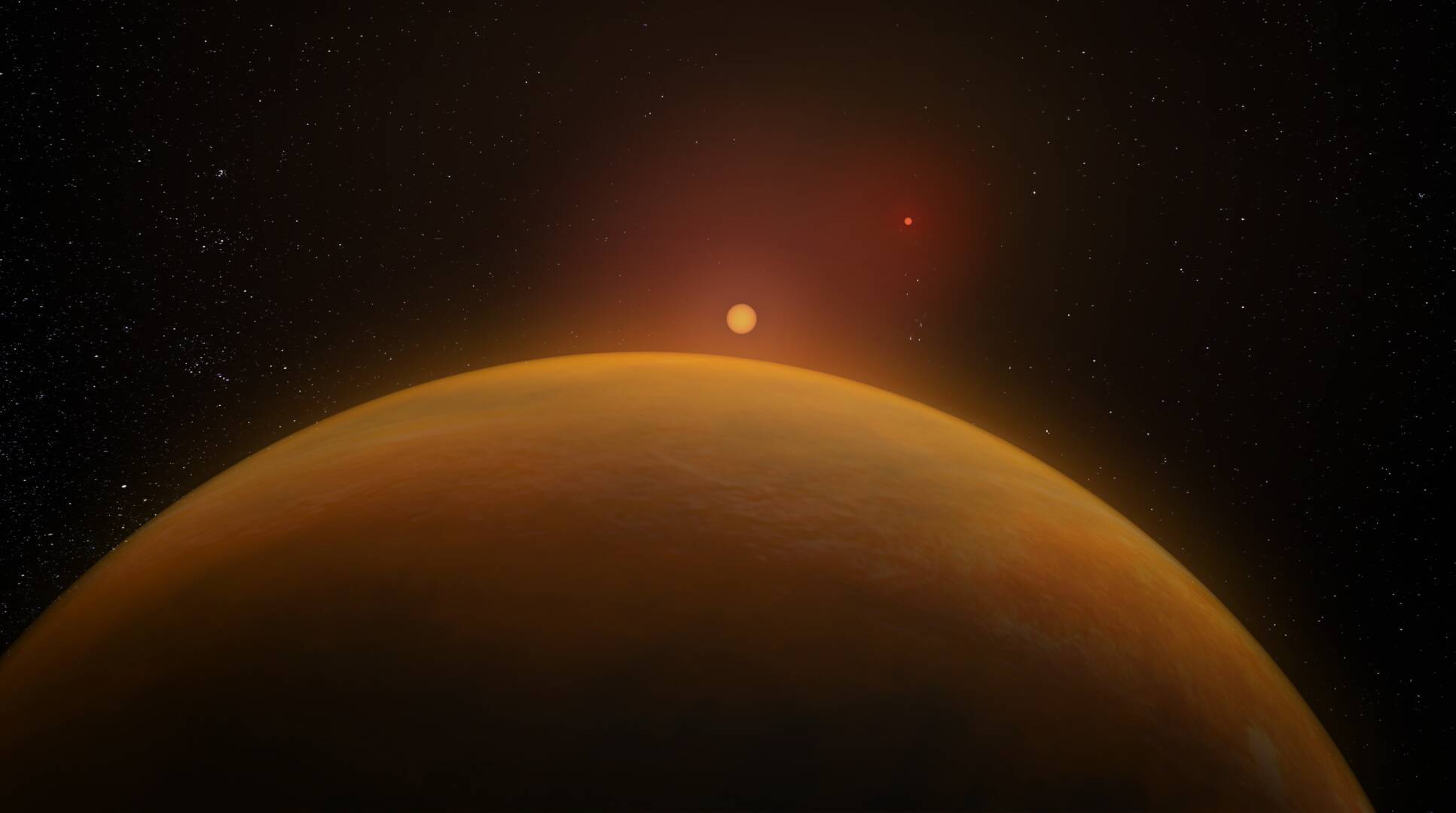
VLBA produces first full 3D view of binary star-planet system

By precisely tracing a small, almost imperceptible, wobble in a nearby star’s motion through space, astronomers have discovered a Jupiter-like planet orbiting that star, which is one of a binary pair. Their work, using the National Science Foundation’s Very Long Baseline Array (VLBA), produced the first-ever determination of the complete, 3-dimensional structure of the orbits of a binary pair of stars and a planet orbiting one of them. This achievement, the astronomers said, can provide valuable new insights on the process of planet formation. Credit: Sophia Dagnello, NRAO/AUI/NSF.

Though more than 5,000 extrasolar planets have been discovered so far, only three have been discovered using the technique — called astrometry — that produced this discovery. However, the feat of determining the 3-D architecture of a binary-star system that includes a planet “cannot be achieved with other exoplanet discovery methods,” said Salvador Curiel, of the National Autonomous University of Mexico (UNAM).

“Since most stars are in binary or multiple systems, being able to understand systems such as this one will help us understand planet formation in general,” Curiel said.

The two stars, which together are called GJ 896AB, are about 20 light-years from Earth — close neighbors by astronomical standards. They are red dwarf stars, the most common type in our Milky Way galaxy. The larger one, around which the planet orbits, has about 44 percent of the mass of our Sun, while the smaller one is about 17 percent as massive as the Sun. They are separated by about the distance of Neptune from the Sun and orbit each other once every 229 years.

For their study of GJ 896AB, the astronomers combined data from optical observations of the system made between 1941 and 2017 with data from VLBA observations between 2006 and 2011. They then made new VLBA observations in 2020. The continent-wide VLBA’s supersharp resolution — the ability to see fine detail — produced extremely precise measurements of the stars’ positions over time. The astronomers performed an extensive analysis of the data that revealed the stars’ orbital motions as well as their common motion through space.

Detailed tracing of the larger star’s motion showed a slight wobble that revealed the existence of the planet. The wobble is caused by the planet’s gravitational effect on the star. The star and planet orbit a location between them that represents their common center of mass. When that location, called the barycenter, is sufficiently far from the star, the star’s motion around it can be detectable.

The astronomers calculated that the planet has about twice the mass of Jupiter and orbits the star every 284 days. Its distance from the star is slightly less than Venus’ distance from the Sun. The planet’s orbit is inclined roughly 148 degrees from the orbits of the two stars.

“This means that the planet moves around the main star in the opposite direction to that of the secondary star around the main star,” said Gisela Ortiz-León, of UNAM and the Max Planck Institute for Radioastronomy. “This is the first time that such dynamical structure has been observed in a planet associated with a compact binary system that presumably was formed in the same protoplanetary disk,” she added.

“Additional detailed studies of this and similar systems can help us gain important insights into how planets are formed in binary systems. There are alternate theories for the formation mechanism, and more data can possibly indicate which is most likely,” said Joel Sanchez-Bermudez, of UNAM. “In particular, current models indicate that such a large planet is very unlikely as a companion to such a small star, so maybe those models need to be adjusted,” he added.

The astrometric technique will be a valuable tool for characterizing more planetary systems, the astronomers said. “We can do much more work like this with the planned Next Generation VLA (ngVLA),” said Amy Mioduszewski, of the National Radio Astronomy Observatory. “With it, we may be able to find planets as small as the Earth.”

Caltech prof shows how coastal ocean currents increase Antarctic ice shelf melt

A new model developed by Caltech and JPL researchers suggests that Antarctica's ice shelves may be melting at an accelerated rate, which could eventually contribute to a more rapid sea level rise. The model accounts for an often-overlooked narrow ocean current along the Antarctic coast and simulates how rapidly flowing freshwater, melted from the ice shelves, can trap dense warm ocean water at the base of the ice, causing it to warm and melt even more. 

The study was conducted in the laboratory of Andy Thompson, professor of environmental science and engineering, and appears in the journal Science Advances on August 12.

Ice shelves are outcroppings of the Antarctic ice sheet, found where the ice juts out from land and floats on top of the ocean. The shelves, which are each several hundred meters thick, act as a protective buffer for the mainland ice, keeping the whole ice sheet from flowing into the ocean (which would dramatically raise global sea levels). However, a warming atmosphere and warming oceans caused by climate change are increasing the speed at which these ice shelves are melting, threatening their ability to hold back the flow of the ice sheet into the ocean.  

"If this mechanism that we've been studying is active in the real world, it may mean that ice shelf melt rates are 20 to 40 percent higher than the predictions in global climate models, which typically cannot simulate these strong currents near the Antarctic coast," Thompson says.

In this study, led by senior research scientist Mar Flexas, the researchers focused on one area of Antarctica: the West Antarctic Peninsula (WAP). Antarctica is roughly shaped like a disk, except where the WAP protrudes out of the high polar latitudes and into lower, warmer latitudes. It is here that Antarctica sees the most dramatic changes due to climate change. The team has previously deployed autonomous vehicles in this region, and scientists have used data from instrumented elephant seals to measure temperature and salinity in the water and ice. 

The team's model takes into account the narrow Antarctic Coastal Current that runs counterclockwise around the entire Antarctic continent, a current which many climate models do not include because it is so small. 

"Large global climate models don't include this coastal current, because it's very narrow—only about 20 kilometers wide, while most climate models only capture currents that are 100 kilometers across or larger," Flexas explains. "So, there is a potential for those models to not represent future melt rates very accurately."

The model illustrates how freshwater that melts from ice at the WAP is carried by the coastal current and transported around the continent. The less-dense freshwater moves along quickly near the surface of the ocean and traps relatively warm ocean saltwater against the underside of the ice shelves. This then causes the ice shelves to melt from below. In this way, increased meltwater at the WAP can propagate climate warming via the Coastal Current, which in turn can also escalate melting even at West Antarctic ice shelves thousands of kilometers away from the peninsula. This remote warming mechanism may be part of the reason that the loss of volume from West Antarctic ice shelves has accelerated in recent decades.

"There are aspects of the climate system that we are still discovering," Thompson says. "As we've made progress in our ability to model interactions between the ocean, ice shelves, and atmosphere, we're able to make more accurate predictions with better constraints on uncertainty. We may need to revisit some of the predictions of sea level rise in the next decades or century—that's work that we'll do going forward."

The paper is titled "Antarctic Peninsula warming triggers enhanced basal melt rates throughout West Antarctica." In addition to Flexas and Thompson, additional coauthors are Michael Schodlok and Hong Zhang of JPL, and Kevin Speer of Florida State University. Funding was provided by the National Science Foundation, the NASA Physical Oceanography program and Cryospheric Sciences program, NASA's Internal Research and Technology Development program (Earth 2050 project), JPL, and Caltech. Caltech manages JPL for NASA.

Australian prof builds models to fight malaria in Africa

Researchers have created a mathematical model to predict genetic resistance to antimalarial drugs in Africa to manage one of the biggest threats to global malarial control.

Malaria is a life-threatening disease caused by parasites and spread to humans through infected mosquitos. It is preventable and curable, yet resistance to current antimalarial drugs is causing avoidable loss of life. The World Health Organisation estimated there were 241 million cases of malaria worldwide in 2020, with more than 600,000 deaths. Families receiving malaria bed nets. Ghana. Photo: © Arne Hoel / The World Bank

In research published today in PLOS Computational Biology, an international research team used data from the WorldWide Antimalarial Resistance Network (WWARN), a global, scientifically independent collaboration, to map the prevalence of genetic markers that indicate resistance to Plasmodium falciparum – the parasite that causes malaria.

Lead author Associate Professor Jennifer Flegg from the University of Melbourne said malaria has devastating impacts on lower-income countries and effective treatment is key to elimination.

“The antimalarial drug sulfadoxine-pyrimethamine (SP) is commonly used in various preventative malaria treatment programs in Africa, particularly for infants, young children, and during pregnancy. But we know its efficacy as a treatment is threatened in areas where resistance to SP is high,” Associate Professor Flegg said.

“The statistical mapping tool we have developed is critical for health organizations to understand the spread of antimalarial resistance. The model takes in the data that is available and fills in the gaps by making continuous predictions in space and time.

“Health agencies can use this tool to understand when and where SP is appropriate to use as part preventive malaria treatments and where other antimalarial methods may need to be explored.”

Professor Karen Barnes, Head of WWARN Pharmacology and Elimination, said there is a rapidly increasing need for malaria chemoprevention (drugs that prevent malaria infections), but there are limited treatment options available.

“This timely evidence of the extent of SP resistance across Africa will help to inform where SP preventive treatment, alone or in combination with other antimalarials, would be most likely to have the greatest impact,” Professor Barnes said.

Professor Feiko ter Kuile, Head of WWARN’s Malaria in Pregnancy Scientific Group, said the updated model of SP resistance in Africa was long overdue.

“A lot of the resistance mapping has understandably focused on the emerging resistance to the artemisinin-based antimalarials used for treating malaria. Increasing resistance of the malaria parasite to sulfadoxine-pyrimethamine in Africa has been a concern for several decades. However, easily accessible resistance data was lacking,” Professor ter Kuile said.

“This study combines all the available SP resistance data from the last two decades in a single model. It allows national malaria control programs and researchers to get much-needed data on the degree of resistance in a given area in a given year. This allows us to understand better the impact of sulfadoxine-pyrimethamine resistance on the effectiveness of these preventive interventions and determine if and when to consider alternative drugs for chemoprevention.”

Associate Professor Flegg said, “This research tool should help guide health policies that will bring the World Health Organisation's ambitious target of eliminating malaria by 2030 one step closer.” 

The team included researchers from the University of Melbourne, the University of Oxford, Johnson C. Smith University, the University of Cape Town, and the University of Witwatersrand.

The research received funding from the Bill & Melinda Gates Foundation, the Smith Institute for Applied Research, and the Australian Research Council.