Oregon State builds AI to predict whether a pesticide will harm bees

Researchers in the Oregon State University College of Engineering have harnessed the power of artificial intelligence to help protect bees from pesticides. pesticide toxicity graphic

Cory Simon, assistant professor of chemical engineering, and Xiaoli Fern, associate professor of computer science, led the project, which involved training a machine learning model to predict whether any proposed new herbicide, fungicide, or insecticide would be toxic to honey bees based on the compound’s molecular structure.

The findings, featured on the cover of The Journal of Chemical Physics in a special issue, “Chemical Design by Artificial Intelligence,” is important because many fruits, nut, vegetable, and seed crops rely on bee pollination.

Without bees to transfer the pollen needed for reproduction, almost 100 commercial crops in the United States would vanish. Bees’ global economic impact is annually estimated to exceed $100 billion.

“Pesticides are widely used in agriculture, which increase crop yield and provide food security, but pesticides can harm off-target species like bees,” Simon said. “And since insects, weeds, etc. eventually evolve resistance, new pesticides must continually be developed, ones that don’t harm bees.”

Graduate students Ping Yang and Adrian Henle used honey bee toxicity data from pesticide exposure experiments, involving nearly 400 different pesticide molecules, to train an algorithm to predict if a new pesticide molecule would be toxic to honey bees.

“The model represents pesticide molecules by the set of random walks on their molecular graphs,” Yang said.

A random walk is a mathematical concept that describes any meandering path, such as on the complicated chemical structure of a pesticide, where each step along the path is decided by chance, as if by coin tosses.

Imagine, Yang explains, that you’re out for an aimless stroll along a pesticide’s chemical structure, making your way from atom to atom via the bonds that hold the compound together. You travel in random directions but keep track of your route, and the sequence of atoms and bonds that you visit. Then you go out on a different molecule, comparing the series of twists and turns to what you’ve done before.

“The algorithm declares two molecules similar if they share many walks with the same sequence of atoms and bonds,” Yang said. “Our model serves as a surrogate for a bee toxicity experiment and can be used to quickly screen proposed pesticide molecules for their toxicity.”

RUB builds AI for RNA folding

The spatial structure of RNA molecules is crucial for their function. But predicting it is a challenge.

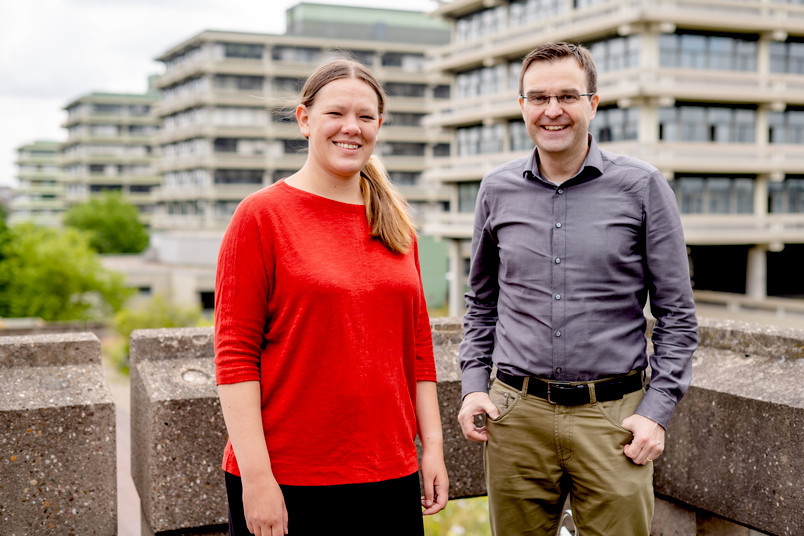
Part of the Bochum research team: Vivian Brandenburg (left) and Axel Mosig © RUB, Marquard

For the function of many biomolecules, their three-dimensional structure is crucial. Researchers are therefore not only interested in the sequence of the individual building blocks of biomolecules, but also their spatial structure. With the help of artificial intelligence (AI), bioinformaticians can already reliably predict the three-dimensional structure of a protein from its amino acid sequence. For RNA molecules, however, this technology is still in its infancy. Researchers at Ruhr-Universität Bochum (RUB) have described a way to use AI to reliably predict the structure of certain RNA molecules from their nucleotide sequence.

For the work, the teams led by Vivian Brandenburg and Professor Franz Narberhaus from the RUB Chair of Biology of Microorganisms cooperated with Professor Axel Mosig from the Bioinformatics Competency Area of the Bochum Centre for Protein Diagnostics.

The cell environment must be taken into account

“RNA is often only seen as a messenger between genomic DNA and proteins”, says Axel Mosig. “But many RNA molecules take over cellular functions.” Their spatial structure is important for this. Similar regions in a nucleotide sequence can cluster together to form three-dimensional arrangements.

“Identifying these self-similarities in an RNA sequence is like a mathematical puzzle”, explains Vivian Brandenburg. There is a biophysical model for this puzzle with corresponding prediction algorithms. However, the model cannot take into account the cellular environment of the RNA – and this also influences the folding process. “If the RNA were isolated and floating in aqueous solution, the model could predict the structure very accurately”, says Brandenburg. But a living cell contains many other components.

This is where artificial intelligence comes into play. The AI can learn subtle patterns from the cellular environment based on known structures. It could then incorporate these findings into its structural predictions. For the learning process, however, the AI needs sufficient training data – and this is lacking in practice.

Obtaining training data with a trick

To solve the problem of the missing training data, the Bochum team used a trick: the researchers worked with known RNA structural motifs. Using a kind of reverse gear, they could generate almost any number of nucleotide sequences from the energy models of these structures that would fold into these spatial structures. With the help of this so-called inverse folding, the researchers generated many pairs of nucleotide sequences and structures with which they could train the AI.

New structures are reliably predictable

The researchers then confronted the AI with a new task: it had to predict the structure of certain bacterial RNA molecules. These molecules – called transcription terminators – are important stop signals in the translation of genomic DNA in bacteria. Often, like many other RNA molecules with important cellular functions, they are hidden in the genome and difficult to distinguish from areas with other functions.

The artificial intelligence was able to reliably recognize and predict the typical structure of the transcription terminators, which is reminiscent of a hairpin. The research team was able to prove this using publicly available experimental data.

“While AI approaches are now almost inevitable in the prediction of protein structures, the development of RNA structures is only just beginning”, Axel Mosig summarises.

University of Washington scientists design new energy-efficient switches

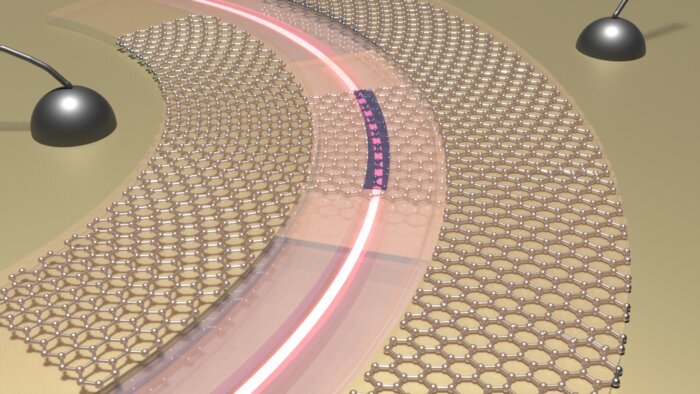
Data centers enable everything from cloud supercomputing to video streaming. In the process, they consume a large amount of energy transferring data back and forth inside the center. With demand for data growing exponentially, there is increasing pressure for data centers to become more energy efficient. An artistic rendering of a silicon-based switch that manipulates light through the use of phase-change material (dark blue segment) and graphene heater (honeycomb lattice).  CREDIT Zhuoran Fang
Data centers house servers for the supercomputer that talk to each other through interconnects, which are physical connections that allow for the exchange of data. One way to reduce energy consumption in data centers is to use light to communicate information with electrically controlled optical switches controlling the flow of light, and therefore information, between servers. These optical switches need to be multi-functional and energy-efficient to support the continued expansion of data centers.

A team led by University of Washington scientists has documented the design of an energy-efficient, silicon-based non-volatile switch that manipulates light through the use of a phase-change material and graphene heater.

“This platform really pushes the limits of energy efficiency,” said co-corresponding author Arka Majumdar, a UW associate professor of physics and electrical and computer engineering, and a faculty member at the UW Institute for Nano-Engineered Systems and the Institute for Molecular & Engineering Sciences. “Compared with what is currently being used in data centers to control photonic circuits, this technology would greatly reduce the energy needs of data centers, making them more sustainable and environmentally friendly.”

Silicon photonic switches are widely used in part because they can be made using well-established semiconductor fabrication techniques. Traditionally, these switches have been tuned through thermal effect, a process where heat is applied — often by passing a current through a metal or semiconductor — to change the optical properties of a material in the switch and thus changing the path of the light. However, not only is this process not energy-efficient, but the changes it induces are not permanent. As soon as the current is removed, the material reverts to its previous state, and the connection — and flow of information — is broken.

To address this, the team, which includes researchers from Stanford University, the Charles Stark Draper Laboratory, the University of Maryland, and the Massachusetts Institute of Technology, created a “set and forget” switch capable of maintaining the connection without any additional energy. They used a phase-change material that is non-volatile, meaning the material is transformed by briefly heating it, and it remains in that state until it receives another heat pulse, at which point it reverts back to its original state. This eliminates the need to input energy to maintain the desired state constantly.

Previously, researchers have used doped silicon to heat the phase-change material. Silicon alone doesn’t conduct electricity, but when selectively doped with different elements like phosphorus or boron, silicon is able to both conduct electricity and propagate light without any excess absorption. When a current is pumped through the doped silicon, it can act like a heater to switch the state of the phase-change material on top of it. The catch is that this is also not a very energy-efficient process. The amount of energy needed to switch the phase-change material is similar to the amount of energy used by traditional thermo-optic switches. This is because the entire 220 nanometers (nm) thick doped silicon layer has to be heated to transform only 10 nm of phase-change material. A lot of energy is wasted heating such a large volume of silicon to switch to a much smaller volume of phase-change material.

“We realized we had to figure out how to reduce the volume that needed to be heated in order to boost the efficiency of the switches,” said lead and co-corresponding author Zhuoran (Roger) Fang, a UW doctoral student in electrical and computer engineering.

One approach would be to make a thinner silicon film, but silicon doesn't propagate light well if it is thinner than 200 nm. So instead, they used an un-doped 220 nm silicon layer to propagate light and introduced a layer of graphene between the silicon and phase-change material to conduct electricity. Like metal, graphene is an excellent conductor of electricity, but unlike metal, it is atomically thin — it consists of just a single layer of carbon atoms arranged in a two-dimensional honeycomb lattice. This design eliminates wasted energy by directing all heat generated by the graphene to go toward changing the phase-change material. In fact, the switching energy density of this setup, calculated by taking the switching energy divided by the volume of the material being switched, is only 8.7 attojoules (aJ)/nm3, a 70-fold reduction compared to the widely used doped silicon heaters, the current state-of-the-art. This is also within one order of magnitude of the fundamental limit of switching energy density (1.2 aJ/nm3).

Even though using graphene to conduct electricity induces some optical losses, meaning some light is absorbed, graphene is so thin that not only are the losses minimal, but the phase-change material can still interact with the light propagating in the silicon layer. The team established that a graphene-based heater can reliably switch the state of the phase-change material for more than 1,000 cycles. This is a notable improvement over the doped silicon heaters, which have only been shown to have an endurance of around 500 cycles.

“Even 1,000 is not enough,” said Majumdar. “Practically speaking, we need about a billion cycles endurance, which we are currently working on.”

Now that they have demonstrated that light can be controlled using a phase-change material and graphene heater, the team plans to show that these switches can be used for optical routing of information through a network of devices, a key step towards establishing their use in data centers. They are also interested in applying this technology to silicon nitride for routing single photons for quantum supercomputing.

“The ability to be able to tune the optical properties of a material with just an atomically thin heater is a game-changer,” said Majumdar. “The exceptional performance of our system in terms of energy efficiency and reliability is really unheard of and could help advance both information technology and quantum computing.”