

HITS MD simulations produce insights into protein complexes in cell migration

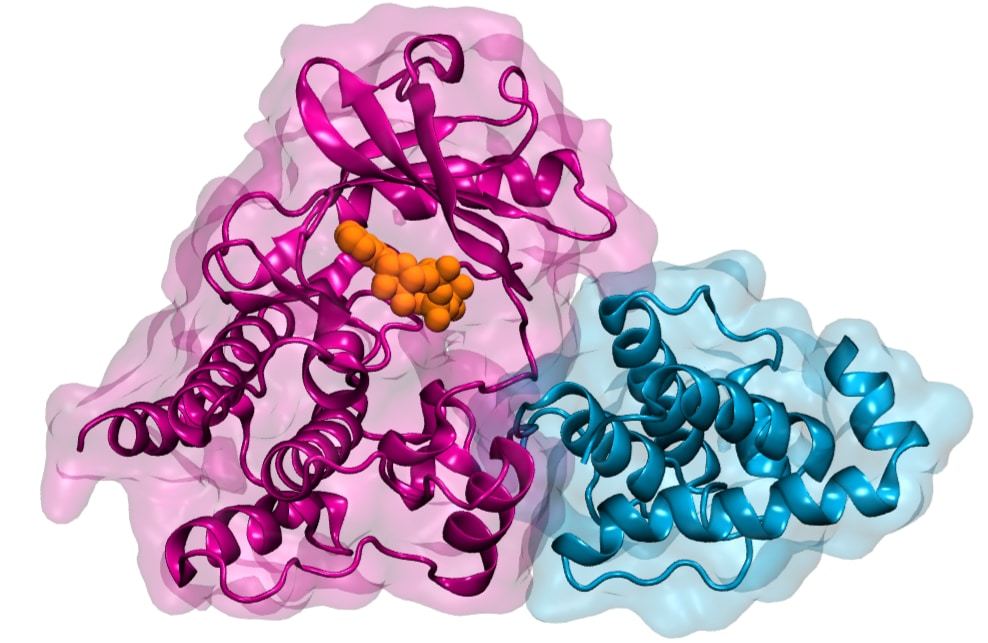
Getting from A to B can be a tricky business, especially for cells on the move. An international team of researchers from the Heidelberg Institute for Theoretical Studies (HITS), established in 2010 by SAP co-founder, Klaus Tschira, and the University of Helsinki have zoomed in on the biochemical and biomechanical processes underlying cell migration by taking a closer look at one of the major players, the pseudokinase ILK. The results of their study improve our understanding of this intriguing protein. Illustration of Integrin-linked Kinase (ILK) (pink) binding to its partner parvin (blue). Both proteins are represented as a ribbon diagram overlayed with the proteins´ outlines. The small molecule ATP bound to ILK is represented as orange spheres. (Image: HITS)
While the vast majority of cells stay roughly where they are during their lifetime and only travel short distances, there are a few specialized cells that need to move freely and quickly to fulfill their tasks, such as immune cells or the so-called fibroblasts the researchers used in this case, which for example move during wound healing. But whether fast or slow, inert or agile, they need to find the right balance between structural stability and flexibility by sensing and responding to a broad variety of biochemical and mechanical signals from their neighboring cells and the matrix to which they adhere.

Large protein complexes mediate this signal transduction between the cell and the matrix. One crucial protein in this complex is integrin-linked kinase (ILK). “As a pseudokinase, ILK is not capable to catalyze a chemical reaction, as conventional kinases do,” says first author Isabel Martin from the “Molecular Biomechanics” group (MBM) at HITS. “It was therefore interesting to us why ILK still binds ATP, the small molecule normally used for catalysis, and how that relates to  cell motion.”

By combining molecular dynamics simulations with cell biology involving traction force microscopy – the latter two carried out by Sara Wickström’s lab at Helsinki University – Martin and her colleagues investigated the role of ATP-binding to human ILK, and examined the altered kinase dynamics and cell behavior as a result of ATP removal.

“Only by using simulations, we could analyze ILK in molecular detail and were able to see that ATP gives structural stability to ILK. This effect is the result of an internal force propagation pathway from ATP to residues that bind an important adaptor protein,” Martin says. “Our idea now is that ATP in ILK adopted a new and unforeseen function, namely, to aid ILK to relay mechanical forces by giving it structural stability.”
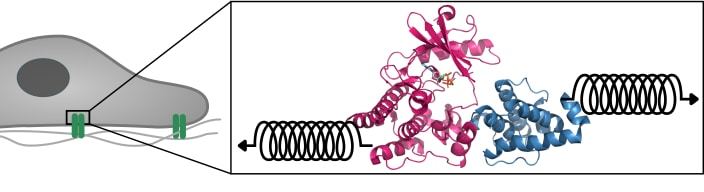
The cell is attached to the underlying matrix over focal adhesions (green). Inside those, Integrin-linked Kinase (ILK, pink) and parvin (blue) are subjected to mechanical force which can be simulated by virtual springs. (Image: HITS)In a further step, they verified the predictions from the simulations and moved beyond their time- and length scales to study the large-scale cellular effects of retained ATP-binding to ILK, for which they joined forces with colleagues in Finland.

“Motivated by the new insights from the computer simulations done at HITS, we tested the predictions by generating cells that contained a mutated ILK protein that is not able to bind ATP. Indeed these cells moved less efficiently than the normal cells where ATP was able to bind and strengthen ILK”, says Sara Wickström, Professor of Cell and Developmental Biology, Faculty of Medicine and Helsinki Institute of Life Science, who led the research at the University of Helsinki.

The surprise was that ATP here does not carry its conventional biochemical role, but is a mechanical stabilizer – a small molecule making a big difference. And Frauke Graeter, head of the MBM group at HITS and co-author of the study, summarizes: “Our findings add another piece in the puzzle to improve our understanding of how cells can stay where they are supposed to but move when they are required to.”
Mayo Clinic researchers use AI to predict antidepressant outcomes in youth

Mayo Clinic researchers have taken the first step in using artificial intelligence (AI) to predict early outcomes with antidepressants in children and adolescents with major depressive disorder, in a study published in The Journal of Child Psychology and Psychiatry. This work resulted from a collaborative effort between the departments of Molecular Pharmacology and Experimental Therapeutics, and Psychiatry and Psychology, at Mayo Clinic, with support from Mayo Clinic's Center for Individualized Medicine.

"This preliminary work suggests that AI has promise for assisting clinical decisions by informing physicians on the selection, use, and dosing of antidepressants for children and adolescents with major depressive disorder," says Paul Croarkin, D.O., a Mayo Clinic psychiatrist and senior author of the study. "We saw improved predictions of treatment outcomes in samples of children and adolescents across two classes of antidepressants."

In the study, researchers identified variation in six depressive symptoms: difficulty having fun, social withdrawal, excessive fatigue, irritability, low self-esteem, and depressed feelings.

They assessed these symptoms with the Children's Depression Rating Scale-Revised to predict outcomes to 10 to 12 weeks of antidepressant pharmacotherapy:

  • The six symptoms predicted 10- to 12-week outcomes at four to six weeks in fluoxetine testing datasets, with an average accuracy of 73%.
  • The same six symptoms predicted 10- to 12-week outcomes at four to six weeks in duloxetine testing datasets, with an average accuracy of 76%.
  • In placebo-treated patients, predicting response and remission accuracy was significantly lower than for antidepressants at 67%.

These outcomes show the potential of AI and patient data to ensure children and adolescents receive treatment that has the highest likelihood of delivering therapeutic benefits with minimized side effects, explains Arjun Athreya, Ph.D., a Mayo Clinic researcher and lead author of the study.

"We designed the algorithm to mimic a clinician's logic of treatment management at an interim time point based on their estimated guess of whether a patient will likely or not benefit from pharmacotherapy at the current dose," says Dr. Athreya. "Hence, it was essential for me as a computer engineer to embed and observe the practice closely to not only understand the needs of the patient but also how AI can be consumed and useful to the clinician to benefit the patient."

Next steps

The research findings are a foundation for future work incorporating physiological information, brain-based measures, and pharmacogenomic data for precision medicine approaches in treating youth with depression. This will improve the care of young patients with depression, and help clinicians initiate and dose antidepressants in patients who benefit most.

"Technological advances are understudied tools that could enhance treatment approaches," says Liewei Wang, M.D., Ph.D., the Bernard and Edith Waterman Director of the Pharmacogenomics Program and Director of the Center for Individualized Medicine at the Mayo Clinic. "Predicting outcomes in children and adolescents treated for depression is critical in managing what could become a lifelong disease burden."

How sanctions on Russia play out for the world

An advanced simulation by the Complexity Science Hub Vienna shows in detail how shocks on the Russian economy spread through the world's economic networks

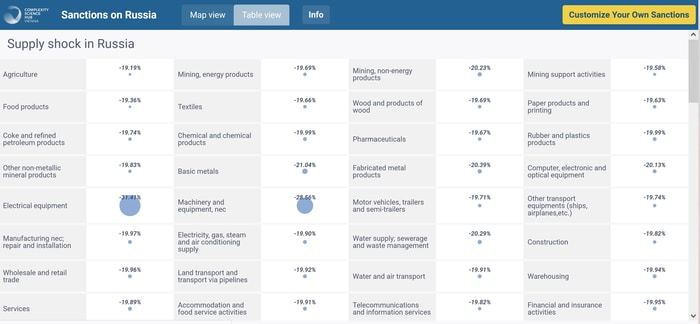
The international sanctions imposed on Russia are expected to lead to a double-digit contraction of the Russian economy, according to a new Policy Brief by the Complexity Science Hub Vienna (CSH). Considering China and India follow the current sanctions imposed by Western countries, the Russian economy would contract by 17%. With a worldwide embargo on Russian oil and gas, the country’s economy would shrink by another 12.4%. The interactive visualization tool shows the effects of an economic shock on Russia, such as the currently imposed sanctions. https://vis.csh.ac.at/sanctions-on-russia/  CREDIT CSHVienna/Liuhuaying Yang

"We use a combination of economic models that allow us to estimate supply and demand shocks of many economies simultaneously," the senior author of the policy brief, Stefan Thurner, points out. "Our extension to classical input-output analyses shows shock waves which started in one place running through the world's economies and give us a feeling of how strong they play out in a global context," says the CSH President.

The methods consider economic networks, thus allowing the scientists not only to estimate the direct broadscale effects of sanctions imposed on Russia and the sanction-imposing countries but also to estimate indirect outcomes of an economic shock.

Two scenarios

The CSH team analyzed two scenarios. The first one models the effects of the current set of economic sanctions imposed on Russia by Western countries. The second scenario simulates the effects of a hypothetical global embargo on Russian oil and gas. The scientists used data from 66 countries and 45 industries provided by the Organization for Economic Co-operation and Development (OECD).

In the first scenario, the simulations indicate an expected contraction of the Russian economy by 6%. If India and China follow the sanctions, the decline is 17%. The most affected industry sectors in Russia are Motor vehicles (–52%), Electrical equipment (–39%) and Machinery (–36%), followed by Manufacturing of other transport equipment (–34%) and Computer, electronic, and optical equipment (–33%).

In contrast, the demand shock effects for European countries from missing Russian exports are marginal and are often below the percent range, says Tobias Reisch, the first author of the policy brief. "However, there will be supply chain disruptions that we can presently not model and that could cause much more severe damage," he adds.

A global ban?

Simulating the short to medium-term effects of a hypothetical worldwide embargo on Russian oil and gas, the modeling predicts an additional 12% contraction of the Russian economy. Assuming that the international demand for fuel remains constant and is satisfied by other countries, the global ban on Russian fossil energy exports would benefit Saudi Arabia, Norway, the US, and Australia. The Saudi Arabian mining and oil and gas extraction sectors could grow up by 6.9%, the same sectors in the US and China by 6.7% and 6.4%, respectively, according to this paper.

The CSH team also created an interactive visualization tool that allows users to explore the effects of economic shocks in different countries and on various economic sectors. Users can even impose their sanctions and watch how they play out. The tool can be accessed via https://vis.csh.ac.at/sanctions-on-russia/