SUPERCOMPUTING NEWS SUPERCOMPUTING NEWS
    • MEDIA KIT
    • MOST READ
    • RSS FEED
    • ACADEMIA
    • AEROSPACE
    • APPLICATIONS
    • ASTRONOMY
    • AUTOMOTIVE
    • BIG DATA
    • BIOLOGY
    • CHEMISTRY
    • CLIENTS
    • CLOUD
    • DEFENSE
    • DEVELOPER TOOLS
    • EARTH SCIENCES
    • ECONOMICS
    • ENGINEERING
    • ENTERTAINMENT
    • GAMING
    • GOVERNMENT
    • HEALTH
    • OIL & GAS
    • INDUSTRY
    • INTERCONNECTS
    • MANUFACTURING
    • MIDDLEWARE
    • MOVIES
    • NETWORKS
    • PHYSICS
    • PROCESSORS
    • RETAIL
    • SCIENCE
    • STORAGE
    • SYSTEMS
    • VISUALIZATION
    • AcyMailing subscription form

    • ADD YOUR VIDEOS
    • MANAGE VIDEOS
    • CONVERSATION INBOX
    • SOCIAL ADVERTISER
    • SOCIAL NETWORK VIDEOS
    • SURVEYS
    • GROUPS
    • PAGES
    • MARKETPLACE LISTINGS
    • APPLICATIONS BROWSER
    • PRIVACY CONFIRM REQUEST
    • PRIVACY CREATE REQUEST
    • LEADERBOARD
    • POINTS LISTING
      • BADGES
    • TRADE SHOWS
Sign In
Tyler O'Neal, Staff Editor GOVERNMENT March 24, 2022, 10:37 am

Osaka University improves the performance heat flux modeling

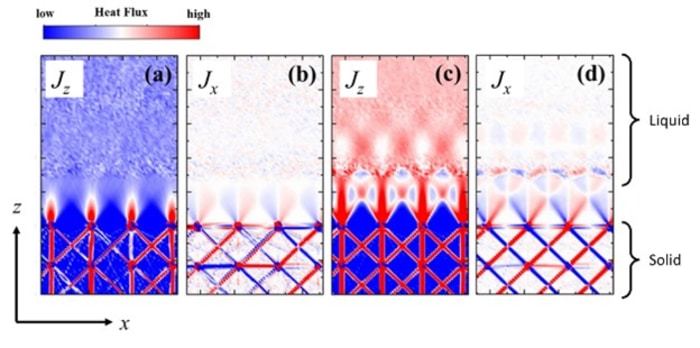
Researchers at Osaka University in Japan used a supercomputer simulation to model to flow of heat at the surface of a solid-liquid interface with atomic resolution, which may help in the development of novel nanoscale manufacturing methods Structure of two-dimensional heat flux at a solid-liquid interface where the temperature gradient is in the z direction, under (a,b) poor or (c,d) good wettability conditions. *Simulation conditions are different from the results in the paper.  CREDIT Kunio Fujiwara and Masahiko Shibahara

Scientists at Osaka University have simulated heat transport at the smallest scales using a molecular dynamics computer simulation. By studying the motions of the individual particles that make up the boundary between a solid and a liquid, they have been able to calculate heat flux with unprecedented precision. This work may lead to significant improvements in our ability to fabricate nanoscale devices, as well as functional surfaces and nanofluidic devices.

The process by which heat is transferred at the point where a solid meets a liquid may seem to be a simple physics problem. Traditionally, macroscopic quantities - such as density, pressure, temperature, and heat capacity - were used to compute the rate at which thermal energy moves between materials. However, properly accounting for the motion of individual molecules, while observing the laws of conservation of energy and momentum, adds a great deal of complexity. Improved atomic-scale computer simulations would be invaluable to more accurately understanding a wide array of real-world applications, especially within the field of nanotechnology.

Now, a team of researchers at Osaka University has developed a new numerical technique to visualize a modeled heat flux at the atomic scale for the first time. “To fundamentally understand thermal transport through a solid-liquid interface, the transport properties of atoms and molecules must be considered,” the first author of the study Kunio Fujiwara explains. “We modeled the heat flux near a solid-liquid interface region with the sub-atomic spatial resolution by using classical molecular dynamics simulations. This allowed us to create images of the three-dimensional structure of the energy flow while the heat was being transferred between the layers.”

Using the popular Lennard–Jones potential to calculate the interactions between adjacent atoms, the team found that the direction of heat flux strongly depends on the sub-atomic stresses in the structures of the solids or liquids.

“Before, there was no good way to visualize heat flux at the atomic scale,” senior author Masahiko Shibahara says. “These findings should allow us to elucidate and modify the thermal transport based on the 3D heat flux configuration.”

This may allow for customized nanoscale manufacturing to be carried out more efficiently.

Swedish researchers map the movement of white dwarfs of the Milky Way

Tyler O'Neal, Staff Editor GOVERNMENT March 24, 2022, 5:00 am

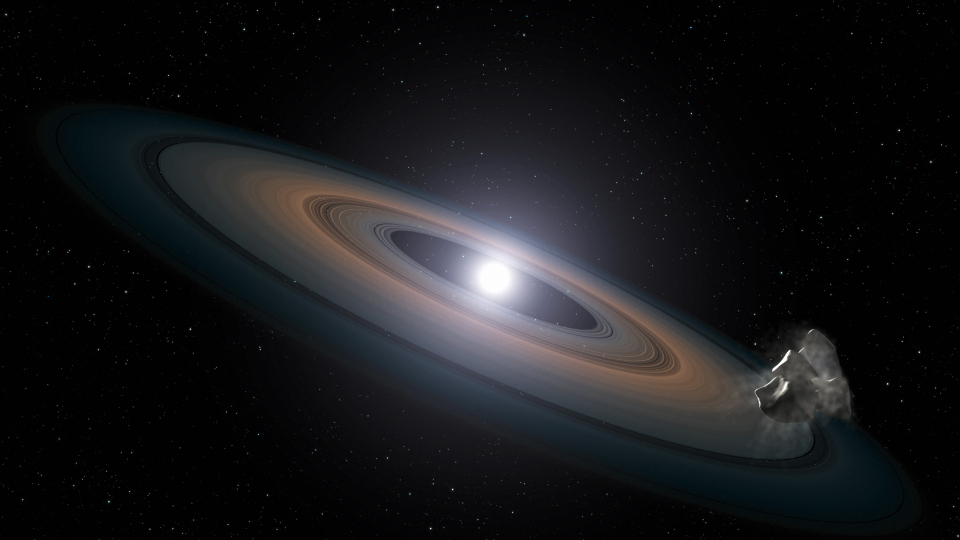
White dwarfs were once normal stars similar to the Sun but then collapsed after exhausting all their fuel. These interstellar remnants have historically been difficult to study. However, a recent study from Lund University in Sweden and one of northern Europe's oldest universities, reveals new information about the movement patterns of these puzzling stars. Illustration of a white dwarf ( Image: NASA, ESA, STScI, and G. Bacon (STScI)

White dwarfs have a radius of about 1 percent of the Sun’s. They have about the same mass, which means they have an astonishing density of about 1 tonne per cubic centimeter. After billions of years, white dwarfs will cool down to a point where they stop emitting visible light and turn into so-called black dwarfs.

The first white dwarf that was discovered was 40 Eridani A. It is a bright celestial body 16.2 light-years from Earth, surrounded by a binary system consisting of the white dwarf 40 Eridani B and the red dwarf 40 Eridani C. Ever since it was discovered in 1783, astronomers have tried to learn more about white dwarfs to gain a deeper understanding of the evolutionary history of our home galaxy.

In a study, a research team present new findings of how the collapsed stars move.

“Thanks to observations from the Gaia space telescope, we have for the first time managed to reveal the three-dimensional velocity distribution for the largest catalog of white dwarfs to date. This gives us a detailed picture of their velocity structure with unparalleled detail”, says Daniel Mikkola, a doctoral student in astronomy at Lund University.

Thanks to Gaia, researchers have measured positions and velocities for about 1.5 billion stars. But only recently have they been able to completely focus on the white dwarfs in the Solar neighborhood.

“We have managed to map the white dwarfs' velocities and movement patterns. Gaia revealed that there are two parallel sequences of white dwarfs when looking at their temperature and brightness. If we study these separately, we can see that they move in different ways, probably as a consequence of them having different masses and lifetimes”, says Daniel Mikkola.

The results can be used to develop new simulations and models to continue to map the history and development of the Milky Way. Through increased knowledge of the white dwarfs, the researchers hope to be able to straighten out many question marks surrounding the birth of the Milky Way.

“This study is important because we learned more about the closest regions in our galaxy. The results are also interesting because our own star, the Sun, will one day turn into a white dwarf just like 97 percent of all stars in the Milky Way”, concludes Daniel Mikkola.

Mizzou team uses AI to advance knowledge of Type 1 diabetes

Tyler O'Neal, Staff Editor GOVERNMENT March 22, 2022, 6:55 am

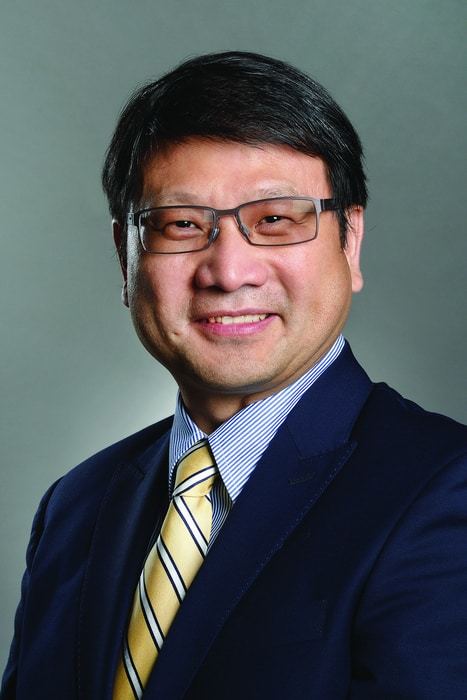
University of Missouri data scientists are collaborating with clinicians at Children’s Mercy Kansas City and Texas Children’s Hospital on the study. Chi-Ren Shyu
An interdisciplinary team of researchers from the University of Missouri, Children’s Mercy Kansas City, and Texas Children’s Hospital has used a new data-driven approach to learn more about persons with Type 1 diabetes, who account for about 5-10% of all diabetes diagnoses. The team gathered its information through health informatics and applied artificial intelligence (AI) to better understand the disease.

In the study, the team analyzed publicly available, real-world data from about 16,000 participants enrolled in the T1D Exchange Clinic Registry. By applying a contrast pattern mining algorithm developed at the MU College of Engineering, the team was able to identify major differences in health outcomes among people living with Type 1 diabetes who do or do not have an immediate family history of the disease.

Chi-Ren Shyu, the director of the MU Institute for Data Science and Informatics (MUIDSI), led the AI approach used in the study and said the technique is exploratory.

“Here we let the computer do the work of connecting millions of dots in the data to identify only major contrasting patterns between individuals with and without a family history of Type 1 diabetes and to do the statistical testing to make sure we are confident in our results,” said Shyu, the Paul K. and Dianne Shumaker Professor in the MU College of Engineering.

Erin Tallon, a graduate student in the MUIDSI and the lead author of the study, said the team’s analysis resulted in some unfamiliar findings.

“For instance, we found individuals in the registry who had an immediate family member with Type 1 diabetes were more frequently diagnosed with hypertension, as well as diabetes-related nerve disease, eye disease, and kidney disease,” Tallon said. “We also found a more frequent co-occurrence of these conditions in individuals who had an immediate family history of Type 1 diabetes. Additionally, individuals who had an immediate family history of Type 1 diabetes also more frequently had certain demographic characteristics.”

Tallon’s passion for this project began with a personal connection and quickly grew as a result of her experience working as a nurse in an intensive critical care unit (ICU). She would often see patients with Type 1 diabetes who were also dealing with other co-existing conditions such as kidney disease and high blood pressure. Knowing that a person’s Type 1 diabetes diagnosis often occurs only when the disease is already very advanced, she wanted to find better ways for prevention and diagnosis, starting with finding a way to analyze the large amounts of publicly available data already collected about the disease.

In 2019, Mark Clements, who is a pediatric endocrinologist at Children’s Mercy Kansas City, professor of pediatrics at University of Missouri-Kansas City, and corresponding author on the study, was invited to speak at the Midwest Bioinformatics Conference hosted by BioNexus KC. While Tallon wasn’t able to attend Clements’ presentation, she followed up with a phone call to share her proposal for helping people better understand Type 1 diabetes. He was intrigued. Eventually, Tallon introduced Clements to Shyu, and ongoing research collaboration was born. 

Tallon said the results of the collaboration speak to the power and value of using real-world data.

“Type 1 diabetes is not a single disease that looks the same for everybody — it looks different for different people — and we’re working on the cutting-edge to address that issue,” Tallon said. “By analyzing real-world data, we can better understand risk factors that may cause someone to be at higher risk for developing poor health outcomes.”  

While the results are promising, Tallon said researchers were limited by not having a population-based data set to work with.

“It is important to note here that our findings do have a limitation that we hope to address in the future by using larger, population-based data sets,” Tallon said. “We’re looking to build larger patient cohorts, analyze more data and use these algorithms to help us do that.”  

Personalizing medicine

Clements hopes the approach can be adopted as a way to help develop personalized treatment options for people with diabetes.

“In order to get the right treatment to the right patient at the right time, we first need to understand how to identify the patients who are at a higher risk for the disease and its complications — by asking questions such as if there are characteristics early in someone’s life that can help identify an individual with high risk for an outcome years down the road,” Clements said. “Having all of this information could one day help us establish a more complete picture of a person’s risk, and we can use that information to develop a more personalized approach for both prevention and treatment.”  

“Contrast pattern mining with the T1D Exchange Clinic Registry reveals complex phenotypic factors and comorbidity patterns associated with familial versus sporadic Type 1 diabetes,” was published in Diabetes Care, a journal of the American Diabetes Association. MU graduate students Danlu Liu and Katrina Boles, and Maria Redondo at Texas Children’s Hospital, also contributed to the study.

The study’s authors would like to thank the funding agency of the T1D Exchange Clinic Registry, the Helmsley Charitable Trust, the investigators located across the country who drove the data collection for the registry, as well as all of the registry’s participants and their families who were willing to share their medical information.


  1. Russian scientists build model that will accelerate creation of alloys with specified properties
  2. China enhances historical climate model data using super-resolution technology

Page 35 of 85

  • 30
  • 31
  • 32
  • 33
  • 34
  • 35
  • 36
  • 37
  • 38
  • 39
POPULAR RIGHT NOW
  • AI supercharges the hunt for stronger magnets: Iowa State researchers launch a new era of intelligent materials discovery
    AI supercharges the hunt for stronger magnets: Iowa State researchers launch a new era of intelligent materials discovery
  • IBM's Historic stock collapse raises questions for the future of enterprise supercomputing
    IBM's Historic stock collapse raises questions for the future of enterprise supercomputing
  • Could a novel dark matter theory simultaneously resolve multiple cosmic enigmas? Supercomputer simulations provide a compelling, albeit currently unverified, potential solution
    Could a novel dark matter theory simultaneously resolve multiple cosmic enigmas? Supercomputer simulations provide a compelling, albeit currently unverified, potential solution
  • Melting icebergs may be reshaping Earth’s greatest ocean current
    Melting icebergs may be reshaping Earth’s greatest ocean current
  • Supercomputers replace ‘bathtub’ flood maps with physics-based digital twins of Britain’s coastline
    Supercomputers replace ‘bathtub’ flood maps with physics-based digital twins of Britain’s coastline
  • Supercomputers push neural quantum simulation beyond previous limits
    Supercomputers push neural quantum simulation beyond previous limits
  • Intel’s AI supercomputing revival: Q2 financial surge signals new era for CPU-powered HPC infrastructure
    Intel’s AI supercomputing revival: Q2 financial surge signals new era for CPU-powered HPC infrastructure
  • AI infrastructure financing fears shake semiconductor sector
    AI infrastructure financing fears shake semiconductor sector
  • AWS supercomputing investment reaches historic scale as Amazon’s AI strategy powers record financial results
    AWS supercomputing investment reaches historic scale as Amazon’s AI strategy powers record financial results
  • Catching the wave of the future: Supercomputers unlock the hidden dynamics of Venus
    Catching the wave of the future: Supercomputers unlock the hidden dynamics of Venus
THIS YEAR'S MOST READ
  • Wall Street wants to trade supercomputing power like oil
    Wall Street wants to trade supercomputing power like oil
  • Beamforming the future: BeammWave's 6G push signals the rise of orbital-terrestrial wireless networks
    Joakim Axmon
    Joakim Axmon
  • Cosmic ambition at scale: UK’s supercomputer unlocks a 2.5 petabytes universe
    Cosmic ambition at scale: UK’s supercomputer unlocks a 2.5 petabytes universe
  • Hidden order, revealed at scale: Supercomputing, electron ptychography uncover the inner workings of relaxor ferroelectrics
    Hidden order, revealed at scale: Supercomputing, electron ptychography uncover the inner workings of relaxor ferroelectrics
  • Intel's Q1 results signal supercomputing surge driving Xeon momentum
    Intel's Q1 results signal supercomputing surge driving Xeon momentum
  • When stars fall apart: Supercomputing reveals the hidden physics of black holes
    When stars fall apart: Supercomputing reveals the hidden physics of black holes
  • Multi-layer simulations reveal the hidden supply chain of solar prominences
    Multi-layer simulations reveal the hidden supply chain of solar prominences
  • Japanese scientists decode dolphin speed with supercomputing: Turbulence, vortices, and the hidden physics of propulsion
    Japanese scientists decode dolphin speed with supercomputing: Turbulence, vortices, and the hidden physics of propulsion
  • Cosmic feedback at scale: Supercomputing reveals how quasars regulate the early Universe
    Cosmic feedback at scale: Supercomputing reveals how quasars regulate the early Universe
  • Modeling life at the microscopic scale: A computational breakthrough in oxygen transport
    Modeling life at the microscopic scale: A computational breakthrough in oxygen transport
MOST READ OF ALL-TIME
  • Largest Computational Biology Simulation Mimics The Ribosome
    Details
    112129
    The amino acid (green) slithers into the chemical reaction center, moving through an evolutionarily ancient corridor of the ribosome (purple). The amino acid is delivered to the reaction core by the transfer RNA molecule (yellow).
    The amino acid (green) slithers into the chemical reaction center, moving through an evolutionarily ancient corridor of the ribosome (purple). The amino acid is delivered to the reaction core by the transfer RNA molecule (yellow).
  • Silicon 'neurons' may add a new dimension to chips
    Details
    81042
    Silicon 'neurons' may add a new dimension to chips
  • Linux Networx Accelerators Expected to Drive up to 4x Price/Performance
    Details
    75564
  • Complex Concepts That Really Add Up
    Details
    73695
    Complex Concepts That Really Add Up
  • Blue Sky Studios Donates Animation SuperComputer to Wesleyan
    Details
    68167
    Each rack holds 52 Angstrom Microsystem-brand “blades,” with a memory footprint of 12 or 24 gigabytes each. (Photos by Olivia Bartlett Drake)
    Each rack holds 52 Angstrom Microsystem-brand “blades,” with a memory footprint of 12 or 24 gigabytes each. (Photos by Olivia Bartlett Drake)
  • Humanities, HPC connect at NERSC
    Details
    57974
  • TeraGrid ’09 'Call for Participation'
    Details
    54977
  • Turbulence responsible for black holes' balancing act
    Details
    52341
  • Cray Wins $52 Million SuperComputer Contract
    Details
    50163
  • SDSC Researchers Accurately Predict Protein Docking
    Details
    46116
  • FRONTPAGE
  • LATEST
  • POPULAR
  • REGISTER
  • SOCIAL
  • VIDEO
  • SUBSCRIPTION
  • RSS
  • GUIDELINES
  • PRIVACY
  • TOS
  • ABOUT
  • +1 (816) 799-4488
  • editorial@supercomputingonline.com
© 2001 - 2026 SuperComputingOnline.com, LLC. All rights reserved. This material may not be published, broadcast, rewritten or redistributed without permission.
Sign In
  • FRONT PAGE
  • LATEST
    • MEDIA KIT
    • MOST READ
    • RSS FEED
    • ACADEMIA
    • AEROSPACE
    • APPLICATIONS
    • ASTRONOMY
    • AUTOMOTIVE
    • BIG DATA
    • BIOLOGY
    • CHEMISTRY
    • CLIENTS
    • CLOUD
    • DEFENSE
    • DEVELOPER TOOLS
    • EARTH SCIENCES
    • ECONOMICS
    • ENGINEERING
    • ENTERTAINMENT
    • HEALTH
    • INDUSTRY
    • INTERCONNECTS
    • GAMING
    • GOVERNMENT
    • MANUFACTURING
    • MIDDLEWARE
    • MOVIES
    • NETWORKS
    • OIL & GAS
    • PHYSICS
    • PROCESSORS
    • RETAIL
    • SCIENCE
    • STORAGE
    • SYSTEMS
    • VISUALIZATION
  • VIDEOS
    • ADD YOUR VIDEOS
    • MANAGE VIDEOS
  • COMMUNITY
    • TRADE SHOWS
    • SOCIAL NETWORK VIDEOS
    • SURVEYS
    • APPLICATIONS BROWSER
    • CONVERSATION INBOX
    • SOCIAL ADVERTISER
    • GROUPS
    • MARKETPLACE LISTINGS
    • PAGES
    • LEADERBOARD
    • POINTS LISTING
      • BADGES
    • PRIVACY CONFIRM REQUEST
    • PRIVACY CREATE REQUEST

Hey there! We noticed you’re using an ad blocker.