

Penn engineers build lithography-free photonic chip that offers speed, accuracy for AI

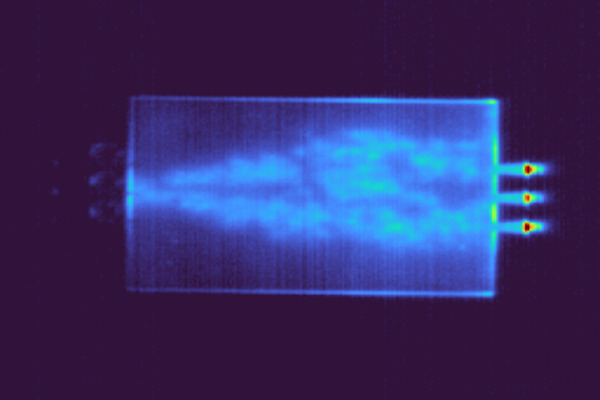
Photonic chips have revolutionized data-heavy technologies. On their own or in concert with traditional electronic circuits, these laser-powered devices send and process information at the speed of light, making them a promising solution for artificial intelligence’s data-hungry applications.Light creates a computational network on a piece of unpatterned semiconductor wafer. The Feng Lab team’s achievement allows for on-chip processing with no lithographic etching, signaling cheaper and easier manufacturing and superior accuracy for AI applications.
In addition to their incomparable speed, photonic circuits use significantly less energy than electronic ones. Electrons move relatively slowly through hardware, colliding with other particles and generating heat, while photons flow without losing energy, generating no heat at all. Unburdened by the energy loss inherent in electronics, integrated photonics is poised to play a leading role in sustainable computing.

Photonics and electronics draw on separate areas of science and use distinct architectural structures. Both, however, rely on lithography to define their circuit elements and connect them sequentially. While photonic chips don’t make use of the transistors that populate electronic chips’ ever-shrinking and increasingly layered grooves, their complex lithographic patterning guides laser beams through a coherent circuit to form a photonic network that can perform computational algorithms.

But now, for the first time, researchers at the University of Pennsylvania School of Engineering and Applied Science have created a photonic device that provides programmable on-chip information processing without lithography, offering the speed of photonics augmented by superior accuracy and flexibility for AI applications.

Achieving unparalleled control of light, this device consists of spatially distributed optical gain and loss. Lasers cast light directly on a semiconductor wafer, without the need for defined lithographic pathways.

Liang Feng, Professor in the Departments of Materials Science and Engineering (MSE) and Electrical Systems and Engineering (ESE), along with Ph.D. student Tianwei Wu (MSE) and postdoctoral fellows Zihe Gao and Marco Menarini (ESE), introduced the microchip in a recent study.

Silicon-based electronic systems have transformed the computational landscape. But they have clear limitations: they are slow in processing signals, they work through data serially and not in parallel, and they can only be miniaturized to a certain extent. Photonics is one of the most promising alternatives because it can overcome all these shortcomings.

“But photonic chips intended for machine learning applications face the obstacles of an intricate fabrication process where lithographic patterning is fixed, limited in reprogrammability, subject to error or damage, and expensive,” says Feng. “By removing the need for lithography, we are creating a new paradigm. Our chip overcomes those obstacles and offers improved accuracy and ultimate reconfigurability given the elimination of all kinds of constraints from predefined features.”

Without lithography, these chips become adaptable data-processing powerhouses. Because patterns are not pre-defined and etched in, the device is intrinsically free of defects. Perhaps more impressively, the lack of lithography renders the microchip impressively reprogrammable, able to tailor its laser-cast patterns for optimal performance, be the task simple (few inputs, small datasets) or complex (many inputs, large datasets).

In other words, the intricacy or minimalism of the device is a sort of living thing, adaptable in ways no etched microchip could be.

“What we have here is something incredibly simple,” says Wu. “We can build and use it very quickly. We can integrate it easily with classical electronics. And we can reprogram it, changing the laser patterns on the fly to achieve real-time reconfigurable computing for on-chip training of an AI network.”

An unassuming slab of semiconductor, the device couldn’t be simpler. It’s the manipulation of this slab’s material properties that is the key to the research team’s breakthrough in projecting lasers into dynamically programmable patterns to reconfigure the computing functions of the photonic information processor.

This ultimate reconfigurability is critical for real-time machine learning and AI.

“The interesting part,” says Menarini, “is how we are controlling the light. Conventional photonic chips are technologies based on passive material, meaning its material scatters light, bouncing it back and forth. Our material is active. The beam of pumping light modifies the material such that when the signal beam arrives, it can release energy and increase the amplitude of signals.”

“This active nature is the key to this science, and the solution required to achieve our lithography-free technology,” adds Gao. “We can use it to reroute optical signals and program optical information processing on-chip.”

Feng compares the technology to an artistic tool, a pen for drawing pictures on a blank page.

“What we have achieved is the same: pumping light is our pen to draw the photonic computational network (the picture) on a piece of an unpatterned semiconductor wafer (the blank page).”

But unlike indelible lines of ink, these beams of light can be drawn and redrawn, their patterns tracing innumerable paths to the future.
TU Dresden harnesses the power of supercomputer simulations to investigate how proteins regulate bone formation

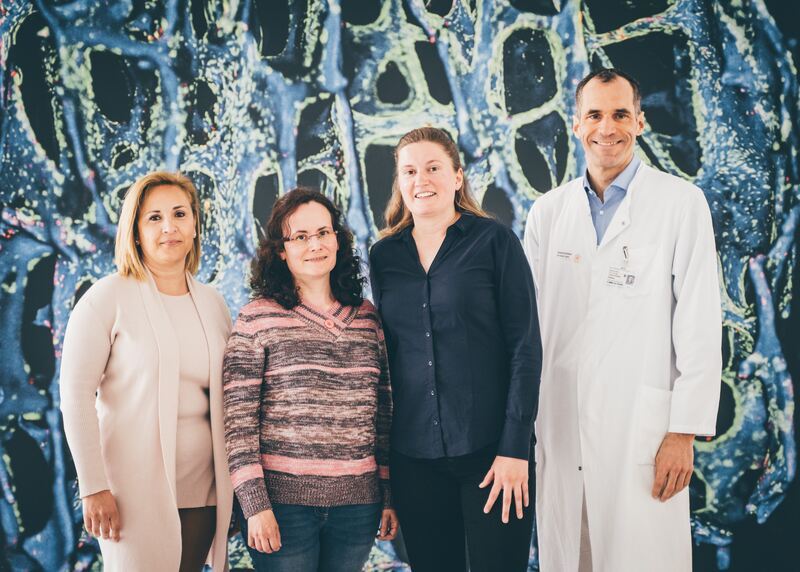
People’s ability to regenerate bones declines with age and is further decreased by diseases such as osteoporosis. To help the aging population, researchers are looking for new therapies that improve bone regeneration. Now, an interdisciplinary team of researchers from the Biotechnology Center (BIOTEC) and the Medical Faculty of TU Dresden, one of the 10 largest universities in Germany, along with a group from Max Bergmann Center of Biomaterials (MBC) developed novel bio-inspired molecules that enhance bone regeneration in mice. The results were published in the journal Biomaterials. The team: Prof. Maria Teresa Pisabarro, Dr. Gloria Ruiz Gómez, Dr. Juliane Salbach-Hirsch und Prof. Lorenz Hofbauer © TUD/Magdalena Gonciarz

As people age, their ability to regenerate bones decreases. Fractures take longer to heal and diseases like osteoporosis only add to it. This represents a serious health challenge to the aging population and an increasing socioeconomic burden for society. To help combat this issue, researchers are looking for new therapeutic approaches that can improve bone regeneration.

A team of scientists from Dresden used supercomputer modeling and simulations to design novel bio-inspired molecules to enhance bone regeneration in mice. The new molecules can be incorporated into biomaterials and applied locally to bone defects. These new molecules are based on glycosaminoglycans, which are long-chained sugars such as hyaluronic acid or heparin.

A Sweet Solution for an Old Bone

“Thanks to our group’s work and the work of other researchers, we know a distinct molecular pathway that regulates bone formation and repair. In fact, we can narrow it down to two proteins that work together to block bone regeneration, sclerostin, and dickkopf-1” explains Prof. Lorenz Hofbauer, “The big challenge for developing drugs that improve bone healing is to efficiently turn off both of these proteins, which act as brake signals, at the same time.”

An interdisciplinary approach was key to this challenge. The Structural Bioinformatics group led by Prof. Maria Teresa Pisabarro at the Biotechnology Center (BIOTEC) of TU Dresden and the Functional Biomaterials group led by PD Dr. Vera Hintze at the Max Bergmann Center of Biomaterials (MBC), Institute of Materials Science of TU Dresden combined their know-how with bone expert Prof. Lorenz Hofbauer at the Medical Faculty of TU Dresden.

“For several years, we have harnessed the power of computer simulations to investigate how proteins regulating bone formation interact with their receptors. All this is to design new molecules that can efficiently interfere with these interactions. We worked in tandem between the computer and the bench, designing new molecules and testing them, feeding the results back to our molecular models and learning more about the molecular properties required for our goal,” explains Prof. Pisabarro.

Finally, the team of Lorenz Hofbauer’s Bone Lab used a biomaterial loaded with new molecules on bone defects in mice to test their effectiveness. The group found that materials containing the novel molecules outperformed the standard biomaterial and enhanced bone healing by up to 50%, which indicates their potential for improving bone regeneration.

Value-Added Chain: From Computer to the Lab Bench and Back

The multidisciplinary team used rational drug design to create novel molecules with tailored properties and minimal side effects. By using computational methods to predict and refine the properties of the designed molecules, the team was able to develop a series of candidates with the greatest potential for turning off the proteins that block bone regeneration.

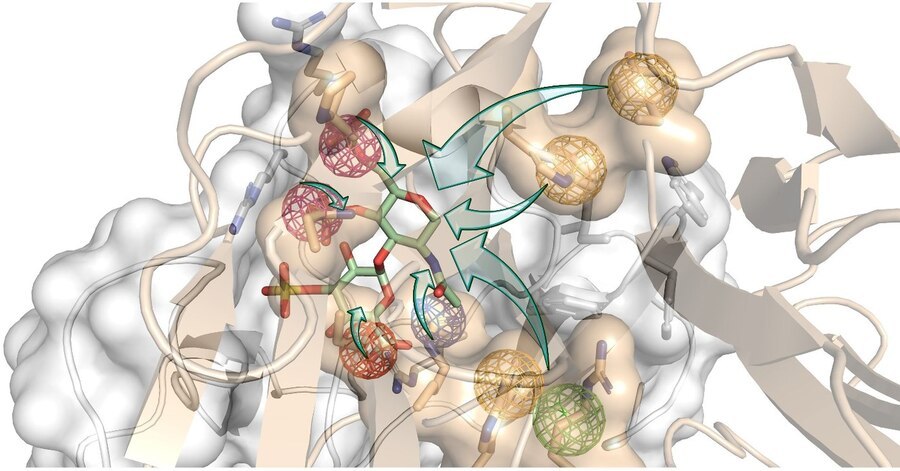
Pisabarro group’s expertise allowed the thorough analysis of the three-dimensional (3D) structures of the two proteins that block bone regeneration. With that, they were able to model their interaction with their receptors in 3D and identify so-called hot spots, i.e., specific physicochemical and dynamic properties that are essential for the biological interaction to occur.

“We used molecular modeling to design new structures that mimic relevant receptor interactions with both proteins. We wanted this binding to be stronger than their natural interactions. In this way, our novel molecules would simultaneously hijack the proteins and effectively turn them off to turn the bone regeneration on,” explains Prof. Pisabarro.

“The molecules designed by Pisabarro’s group were synthesized by our colleagues at the Free University of Berlin and then analyzed regarding their protein binding properties via biophysical interaction analysis,” says PD Dr. Hintze. “For each of the molecules we were able to measure the binding strength with the proteins and their interference with natural receptor binding of the proteins. Thus, we could reveal empirically how effective each of the small molecules could be at turning off the inhibitory proteins.” Hofbauer group then tested the biological relevance of these interaction studies in a cell culture model and later in mice.

The results of such iterative testing are a valuable asset that enhances the current molecular models of the Pisabarro group and can be used to guide the development of novel and better molecules in the future. Such an approach also ensures that animal research is minimized and enters the project only in its final phase.

On the Way to Drug Development

The team's findings represent an exciting step forward in preclinical development. The newly designed molecules could potentially be used to turn off the proteins that block bone regeneration and lead to the development of novel, more effective treatments for bone fractures and other bone-related conditions.

The team continues to work together. “We are applying for funding for a pre-clinical study that will further develop the molecules and biomaterial-based bone booster to lay the ground for studies in humans,” says Prof. Hofbauer.

Fostering an Interdisciplinary Environment

The research was supported by the German Research Foundation (DFG). The groups were part of the Transregio 67 research consortium “Functional biomaterials for controlling healing processes in bone and skin tissue – from material to clinic (Dresden/Leipzig—TRR67 subprojects A3, A7, A8, B2, and Z3)”. Over more than 12 years, the three partners have worked in cooperation with other groups in Germany to generate novel insight into molecular mechanics and develop techniques as well as the necessary know-how to improve delayed bone regeneration.

First image of a black hole expelling a powerful jet (ESOcast 260 Light)

First image of a black hole expelling a powerful jet (ESOcast 260 Light)

With the help of ALMA, astronomers have obtained a new image of the supermassive black hole at the centre of the M87 galaxy. Credits: ESO Directed by: Angelos Tsaousis and Martin Wallner. Editing: Angelos Tsaousis. Web and technical support: Gurvan Bazin and Raquel Yumi Shida. Written by: Jonas Enander. Music: Stellardrone — Eternity. Footage and photos: ESO/L. Calçada, M. Kornmesser, Digitized Sk...

Read more