Swiss geophysicists show how volcanoes light up the night sky of this planet

On Earth, plate tectonics is not only responsible for the rise of mountains and earthquakes. It is also an essential part of the cycle that brings material from the planet's interior to the surface and the atmosphere and then transports it back beneath the Earth's crust. Tectonics thus has a vital influence on the conditions that ultimately make Earth habitable.

Until now, researchers have found no evidence of global tectonic activity on planets outside our solar system. A team of researchers led by Tobias Meier from the Center for Space and Habitability (CSH) at the University of Bern and with the participation of ETH Zurich, the University of Oxford, and the National Center of Competence in Research NCCR PlanetS has now found evidence of the flow patterns inside a planet, located 45 light-years from Earth: LHS 3844b. Their results were published in The Astrophysical Journal LettersTobias G. Meier, Center for Space and Habitability (CSH) and NCCR PlanetS, University of Bern  CREDIT © Universität Bern / University of Bern, Photo: Felix Meier

An extreme contrast and no atmosphere

"Observing signs of tectonic activity is very difficult because they are usually hidden beneath an atmosphere", Meier explains. However, recent results suggested that LHS 3844b probably does not have an atmosphere. Slightly larger than Earth and likely similarly rocky, it orbits around its star so closely that one side of the planet is in constant daylight and the other in the permanent night - just like the same side of the Moon always faces the Earth. With no atmosphere shielding it from the intense radiation, the surface gets blisteringly hot: it can reach up to 800°C on the dayside. The night side, on the other hand, is freezing. Temperatures there might fall below minus 250°C. "We thought that this severe temperature contrast might affect material flow in the planet's interior", Meier recalls.

To test their theory, the team ran supercomputer simulations with different strengths of material and internal heating sources, such as heat from the planet's core and the decay of radioactive elements. The supercomputing included the large temperature contrast on the surface imposed by the host star.

Flow inside the planet from one hemisphere to the other

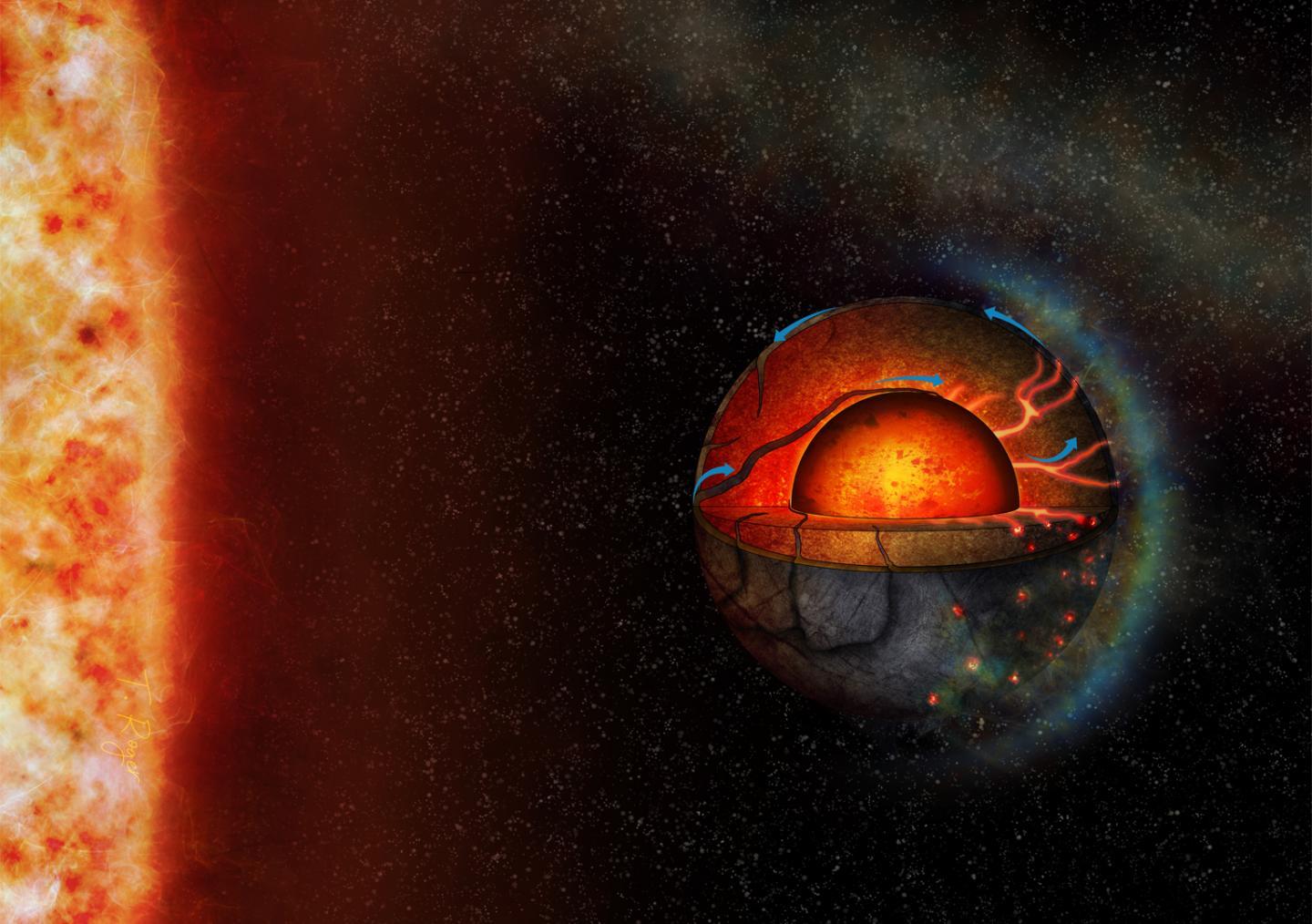
"Most simulations showed that there was only upwards flow on one side of the planet and downwards flow on the other. Material, therefore, flowed from one hemisphere to the other", Meier reports. Surprisingly, the direction was not always the same. "Based on what we are used to from Earth, you would expect the material on the hot dayside to be lighter and therefore flow upwards and vice versa", co-author Dan Bower at the University of Bern and the NCCR PlanetS explains. Yet, some of the teams' supercomputer simulations also showed the opposite flow direction. "This initially counter-intuitive result is due to the change in viscosity with temperature: cold material is stiffer and therefore doesn't want to bend, break or subduct into the interior. Warm material, however, is less viscous - so even solid rock becomes more mobile when heated - and can readily flow towards the planet's interior", Bower elaborates. Either way, these results show how a planetary surface and interior can exchange material under conditions very different from those on Earth. Dr. Dan J. Bower, Center for Space and Habitability (CSH) and NCCR PlanetS, University of Bern  CREDIT © Universität Bern / University of Bern, Photo: D. Bower

A volcanic hemisphere

Such material flow could have bizarre consequences. "On whichever side of the planet the material flows upwards, one would expect a large amount of volcanism on that particular side", Bower points out. He continues "similar deep upwelling flows on Earth drive volcanic activity at Hawaii and Iceland". One could therefore imagine a hemisphere with countless volcanoes - a volcanic hemisphere so to speak - and one with almost none.

"Our simulations show how such patterns could manifest, but it would require more detailed observations to verify. For example, a higher-resolution map of surface temperature could point to enhanced outgassing from volcanism or detection of volcanic gases. This is something we hope future research will help us to understand", Meier concludes.

Bernese space exploration: With the world's elite since the first moon landing 

When the second man, "Buzz" Aldrin, stepped out of the lunar module on July 21, 1969, the first task he did was to set up the Bernese Solar Wind Composition Experiment (SWC) also known as the "solar wind sail" by planting it in the ground of the moon, even before the American flag. This experiment, which was planned and the results analyzed by Prof. Dr. Johannes Geiss and his team from the Physics Institute of the University of Bern, was the first great highlight in the history of Bernese space exploration.

Ever since Bernese space exploration has been among the world's elite. The numbers are impressive: 25 times were instruments flown into the upper atmosphere and ionosphere using rockets (1967-1993), 9 times into the stratosphere with balloon flights (1991-2008), over 30 instruments were flown on space probes, and with CHEOPS the University of Bern shares responsibility with ESA for a whole mission. This artist's illustration represents the possible interior dynamics of the super-Earth exoplanet LHS 3844b. The planet's interior properties and the strong stellar irradiation might lead to a hemispheric tectonic regime.  CREDIT © Universität Bern / University of Bern, Illustration: Thibaut Roger
The successful work of the Department of Space Research and Planetary Sciences (WP)from the Physics Institute of the University of Bern was consolidated by the foundation of a university competence center, the Center for Space and Habitability (CSH). The Swiss National Fund also awarded the University of Bern the National Center of Competence in Research (NCCR) PlanetS, which it manages together with the University of Geneva.

Geisinger, Tempus scientists use AI to predict new atrial fibrillation, stroke risk

A team of scientists from Geisinger and Tempus has found that artificial intelligence can predict the risk of new atrial fibrillation (AF) and AF-related stroke. Tempus is a technology company advancing precision medicine through the practical application of artificial intelligence in healthcare. 

Atrial fibrillation is the most common cardiac arrhythmia and is associated with numerous health risks, including stroke and death. The study, published in Circulation, used electrical signals from the heart--measured from a 12-lead electrocardiogram (ECG)--to identify patients who are likely to develop AF, including those at risk for AF-related stroke.

"Each year, over 300 million ECGs are performed in the U.S. to identify cardiac abnormalities within an episode of care. However, these tests cannot generally detect the future potential for negative events like atrial fibrillation or stroke," said Joel Dudley, chief scientific officer at Tempus. "This critical work stems from our major investments in cardiology to generate algorithms that make existing cardiology tests, such as ECGs, smarter and capable of predicting future clinical events. Our goal is to enable clinicians to act earlier in the course of the disease."

To develop their model, the team of data scientists and medical researchers used 1.6 million ECGs from 430,000 patients over 35 years of patient care at Geisinger. These data were used to train a deep neural network--a specialized class of artificial intelligence--to predict, among patients without a previous history of AF, who would develop AF within 12 months. The neural network performance exceeded that of current clinical models for predicting AF risk. Furthermore, 62% of patients without known AF who experienced an AF-related stroke within three years were identified as high risk by the model before the stroke occurred.

"Not only can we now predict who is at risk of developing atrial fibrillation, but this work shows that the high-risk prediction precedes many AF-related strokes," said Brandon Fornwalt, M.D., Ph.D., co-senior author and chair of Geisinger's Department of Translational Data Science and Informatics. "With that kind of information, we can change the way these patients are screened and treated, potentially preventing such severe outcomes. This is huge for patients."

Leicester's virtual clinical trials revolutionize the way new drugs are developed

New cutting-edge research undertaken at the University of Leicester could revolutionize the way new drugs are developed and the way patients are cared for, through a pioneering new approach using virtual clinical trials.

Following a £500,000 Royal Academy of Engineering research funding award, Dr. Himanshu Kaul will expand research with his 'virtual asthma patient' to participate in virtual clinical trials, which could help make more accurate and timely predictions around which new drugs are successful and can offer benefits to patients.

Virtual clinical trials could also help doctors gain a better understanding of individual patient's disease progression, allowing them to tailor therapies to patients' individual needs and improve outcomes in a wider range of cases.

Currently, medications must meet a number of robust milestones over several years before human trials may begin, meaning that potentially life-saving drugs are often years away from patient use.

Dr. Kaul, Royal Academy of Engineering Research Fellow, said: "In a nutshell, more than 90% of drugs fail to reach the market. This is because we lack the capacity to predict the impact of drugs at the systems level, and this comes at a huge cost to pharmaceutical companies.

"In contrast, when aeronautical companies design a new plane, they run their design through rigorous mathematical models to predict how well the design will perform and optimize performance.

"There is no practical equivalent of this in the pharma industry, which will significantly drop the costs. My long-term research vision is to create software that will allow clinicians and pharmaceutical companies to predict how well a drug will perform in patients and offer a way to optimize its therapeutic efficacy."

Using agent-based modeling, Dr Kaul is collaborating with experts from the University of Leicester's Schools of Engineering and Mathematics and Department of Respiratory Sciences on his pioneering research project, titled 'The Lung Pharmacome'.

The project aims to produce working in silico lung by 2024, with the ambition of conducting patient-specific virtual clinical trials' by 2025 at the earliest. The initial area of focus for the research will be lung diseases, specifically asthma and chronic obstructive pulmonary disease (COPD), with scientists and clinicians at the National Institute for Health Research (NIHR) Leicester Biomedical Research Centre's respiratory theme, based at Glenfield Hospital.

Dr. Kaul continued: "Lung diseases are a major source of socio-economic burden globally. In the UK alone, lung diseases are the third-worst killers, affecting one in five people, and responsible for a death, on average, every five minutes.

"Outside of that, the cost to the economy given a number of missed workdays and inpatient bed days is £11billion a year."

And identifying the right environment for his Fellowship was important to Dr. Kaul, who added: "The University of Leicester was an obvious choice as the institution to carry out this research vision due to its strong clinical expertise, the synergy between engineering and healthcare outcomes, and a focus on precision medicine.

"Its clinical partners make it an exceptionally strong science complex with research efforts in engineering and biomedical sciences that extend from the molecular to the clinical scale.