Dutch supercomputer simulations show how wind farms benefit from strong 'low-level jets' in atmosphere

The height of the latest generation of wind turbines gives rise to effects that are unforeseen. The effects, in terms of performance, are positive in most cases: at these heights, powerful airflows in the lower atmosphere start playing a role and will enable a wind farm to harvest extra energy. University of Twente researchers present their work on this, in the Journal of Renewable and Sustainable Energy.

Strong airflows in the lower atmosphere, so-called ‘low-level jets’, have an impact on the performance of wind farms. The height at which this jet moves, makes the difference: does it flow above the turbines, at the level of the turbines, or even below? This determines if all turbines benefit from it, or just the front row, researchers of the University of Twente demonstrate in their paper in the Journal of Renewable and Sustainable Energy.
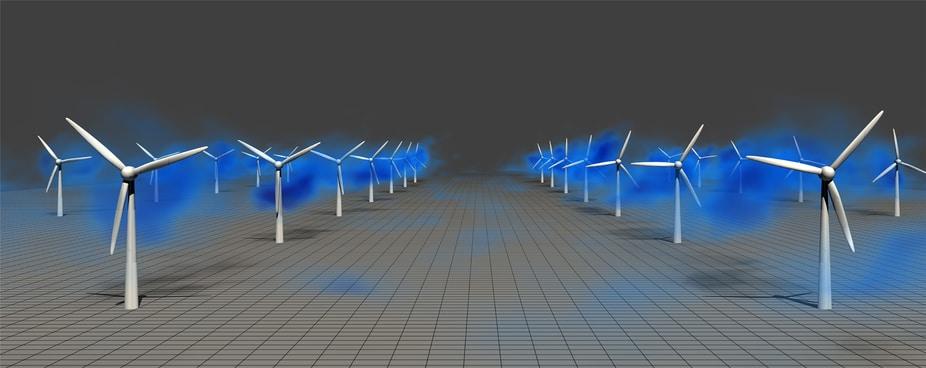
Simulation of a wind farm, showing the wake behind each turbine
Wind turbines, making up a growing share of our ‘energy mix’, have increased in height over the years: the early generations had heights of 50 meter and below, the latest generation exceeds heights of 250 meter, with rotor blades of over 100 meter in length. Effects that are seen in boundary layers in the lower atmosphere, typically at heights between 50 and 1000 meters, start playing an important role. For smaller wind turbines, these effects typically take place above the wind turbine, while for the current sizes, they can play a role at the level of the turbine or even below that. The ‘rivers of air’, called low-level jets (LLJ’s), were observed at many places in the world including the North Sea region.

Researchers Srinidhi Gadde and Richard Stevens did extensive supercomputer simulations on a wind farm consisting of 40 turbines, four by ten, to study the effect of LLJ’s on performance. Earlier research showed that the wake of each turbine influences the next turbine in the row. This wake also plays an unexpected role in attracting the low-level jet.

In case the jet flows in the direction of the wind farm, at the level of the wind turbines, it is just the first row of turbines that benefits from it: it has no effect on the turbines further downstream. If the jet is above the wind turbines, however, the turbulent flow behind each turbine causes the jet to move down. Extra energy is harvested by the wind farm as a whole. The most remarkable effect takes place at jets flowing below turbine level: these jets are pushed upward by an effect called negative wind shear, resulting in higher levels of energy for turbines further downstream.

These new insights can help to design the wind turbines and to position them in a wind farm. Further research will have to shed light on effects like the transition from land to sea and several temperature effects.

The research was done in the Physics of Fluids group of the University of Twente. It is part of the Computational Sciences for Energy Research program of Dutch Research Council NWO and Shell.

The paper ‘Effect of low-level jets height on windfarm production’, by Srinidhi Gadde and Richard Stevens, is in the latest edition of the Journal of Renewable and Sustainable Energy (JRSE).

Rice bioinformatics tool accurately tracks synthetic DNA

Rice computer scientists show benefits of bioinformatics with PlasmidHawk

Tracking the origin of synthetic genetic code has never been simple, but it can be done through bioinformatic or, increasingly, deep learning computational approaches.

Though the latter gets the lion’s share of attention, new research by computer scientist Todd Treangen of Rice University’s Brown School of Engineering is focused on whether sequence alignment and pan-genome-based methods can outperform recent deep learning approaches in this area.

“This is, in a sense, against the grain given that deep learning approaches have recently outperformed traditional approaches, such as BLAST,” he said. “My goal with this study is to start a conversation about how to combine the expertise of both domains to achieve further improvements for this important computational challenge.”

Treangen, who specializes in developing computational solutions for biosecurity and microbial forensics applications, and his team at Rice have introduced PlasmidHawk, a bioinformatics approach that analyzes DNA sequences to help identify the source of engineered plasmids of interest.Todd Treangen

“We show that a sequence alignment-based approach can outperform a convolutional neural network (CNN) deep learning method for the specific task of lab-of-origin prediction,” he said.

The researchers led by Treangen and lead author Qi Wang, a Rice graduate student, reported their results in an academic journal. The open-source software is available here: https://gitlab.com/treangenlab/plasmidhawk.

The program may be useful not only for tracking potentially harmful engineered sequences but also for protecting intellectual property.

“The goal is either to help protect intellectual property rights of the contributors of the sequences or help trace the origin of a synthetic sequence if something bad does happen,” Treangen said.

Treangen noted a recent high-profile paper describing a recurrent neural network (RNN) deep learning technique to trace the originating lab of a sequence. That method achieved 70% accuracy in predicting the single lab of origin. “Despite this important advance over the previous deep learning approach, PlasmidHawk offers improved performance over both methods,” he said. Qi Wang

 The Rice program directly aligns unknown strings of code from genome data sets and matches them to pan-genomic regions that are common or unique to synthetic biology research labs

“To predict the lab-of-origin, PlasmidHawk scores each lab based on matching regions between an unclassified sequence and the plasmid pan-genome, and then assigns the unknown sequence to a lab with the minimum score,” Wang said.

In the new study, using the same dataset as one of the deep learning experiments, the researchers reported the successful prediction of “unknown sequences’ depositing labs” 76% of the time. They found that 85% of the time the correct lab was in the top 10 candidates.

Unlike the deep learning approaches, they said PlasmidHawk requires reduced pre-processing of data and does not need retraining when adding new sequences to an existing project. It also differs by offering a detailed explanation for its lab-of-origin predictions in contrast to the previous deep learning approaches.Ryan Leo Elworth

“The goal is to fill your computational toolbox with as many tools as possible,” said co-author Ryan Leo Elworth, a postdoctoral researcher at Rice. “Ultimately, I believe the best results will combine machine learning, more traditional computational techniques, and a deep understanding of the specific biological problem you are tackling.”

Rice graduate students Bryce Kille and Tian Rui Liu are co-authors of the paper. Treangen is an assistant professor of computer science.

Army, Northeastern University collaboration leads to 2D polymer discovery

Army researchers reached a breakthrough in the nascent science of two-dimensional polymers thanks to a collaborative program that enlists the help of lead scientists and engineers across academia known as joint faculty appointments.

Researchers from the U.S. Army Combat Capabilities Development Command, now known as DEVCOM, Army Research Laboratory partnered with Prof. Steve Lustig, a joint faculty appointment at Northeastern University, to accelerate the development of 2D polymers for military applications.

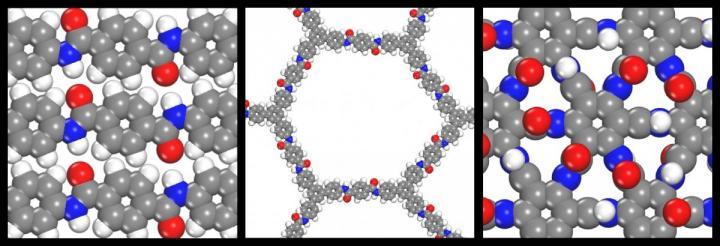
The collaboration with ARL Northeast led to a groundbreaking study published in the peer-reviewed scientific journal Macromolecules. Editors featured the research in a cover articleArmy researchers conduct a comparison study that examines the thermal stability of Kevlar (left), amide covalent organic framework (center) and graphamid (right).  CREDIT Dr. Steve Lustig

"2D polymers have been studied very seriously from a synthetic viewpoint for only about 10 years," said Dr. Eric Wetzel, research area leader for Soldier Materials at the laboratory. "They represent a new, relatively unexplored class of materials with tremendous potential."

According to Wetzel, 2D polymers have a very repeatable, symmetric pattern akin to "chicken wire," which offers access to more structural enhancements compared to one-dimensional, linear polymers like Kevlar.

In an effort to gauge the full potential of these materials, Army researchers have started to computationally design 2D polymers in the hopes that they may develop a superior alternative to conventional aramid fibers for applications such as armor and fire-resistant clothing.

Prof. Steve Lustig, a joint faculty appointment at Northeastern University, uses his industry experience with DuPont to help Army researchers calculate the environmental durability of simulated 2D polymers.

In order to properly create a 2D polymer that can withstand real-world conditions, Army researchers sought the aid of Lustig, who previously worked at DuPont Central Research & Development for over two decades before he became an associate professor with tenure at Northeastern University.

"The idea of the 2D polymer project is essentially to make a 2D version of Kevlar," Lustig said. "I had over a decade of experience working with the Kevlar business in various aspects of liquid crystalline polymer polymerization, processing, and properties. The ARL team believed that my background would be helpful."

Lustig explained that he had first learned about the laboratory in the mid-2000s when he came in contact with Dr. Kenneth Strawhecker, an Army scientist who had reached out to DuPont in search of industry collaborations.

At the time, Lustig worked as a lead scientist in DuPont's polymer physics group and specialized in the development of novel tools for statistical mechanics, statistical thermodynamics, and molecular simulations.

In addition to his expertise on the computational side of industrial research, he also conducted experiments in chemical synthesis, polymer processing, polymer material property characterization, and atomic force microscopy.

"I have never had the patience to stay in one place and become a master in just one very small area," Lustig said. "I've always tried to solve problems holistically using experiments, theory, and computers."

Once Lustig met with Strawhecker, the two began a series of informal collaborations that focused on the use of atomic force microscopy to understand not only the structure of Kevlar materials but also their response to tensile strain and bending mechanics.

The scientific journal Macromolecules features the Army-led study on the inside cover of its latest issue.

The American Chemical Society later published the outcome of this research as the cover of the academic journal Applied Materials & Interfaces in 2020.

Even after Lustig left DuPont in 2016, he continued his collaborations with the laboratory as a visiting scientist. Shortly after one of his seminar presentations at the lab, he met Wetzel, who immediately recognized the value of Lustig's industry experience.

Over the course of his continued interaction with Strawhecker and Wetzel, Lustig obtained the opportunity to become an ARL Joint Faculty Appointment after he joined the Department of Chemical Engineering at Northeastern University.

Due to his close proximity to ARL's Northeast campus, both Strawhecker and Wetzel saw Lustig as a top candidate for the position.

"The ARL Open Campus Initiative provides a way to tap into outside expertise that may not exist within our laboratory," Wetzel said. "The joint faculty appointment is a new construct within Open Campus that has only existed for a few years, but we were able to integrate an expert with years of experience at DuPont into our research program thanks to this mechanism."

According to Wetzel, Lustig's long history with high-performance fiber development projects at DuPont provided Army researchers with access to unique modeling capabilities as well as invaluable guidance on the methods and techniques that would enhance the stability of their conceptual 2D polymers.

As a joint faculty appointment, Lustig analyzed the environmental durability of the lab's 2D polymer designs and ran computer simulations that determined how well they endure extreme conditions such as intense heat.

Lustig worked alongside Dr. Jan Andzelm, an Army scientist and ARL fellow whose expertise in the molecular simulations of polymers was critical for running the calculations.

Through these computer simulations, the researchers compared the thermal stability of the 1D polymer Kevlar, a 2D polymer called an amide covalent organic framework, known as amCOF, and a hypothetical 2D polymer designed by the laboratory called graphamid.

"We performed a series of very accurate, high-level quantum mechanical calculations called ab initio molecular dynamics and studied the changes in the structure between the three molecules we looked at," Lustig said. "Once we confirmed that our method could accurately describe a well-known molecule like Kevlar, we could apply it to molecules we didn't know like graphamid and make accurate predictions about their behavior and properties."

The results of the comparison study showed that graphamid could potentially withstand temperatures as high as 700 degrees Celsius, which exceeded the limits of both Kevlar and the amCOF material.

Given the study's acceptance as a cover article, Lustig said he believes that the team's latest success clearly highlights the importance of ARL Open Campus initiatives such as the joint faculty appointments.

Lustig expressed his gratitude to the laboratory for his position and mentioned how he viewed the opportunity as an excellent way for him to help the Army with its efforts.

"I got involved with Kevlar in the first place because my father was career Army, so the idea of protecting guys like my dad is really important to me." Lustig said. "I feel very excited that we'll be able to offer Soldiers new materials to make their work easier and safer."