

Mohamed bin Zayed University of Artificial Intelligence, Weizmann Institute of Science launch joint AI Program

New collaborative projects will facilitate joint research projects, training programs, conferences, student exchange programs, and more

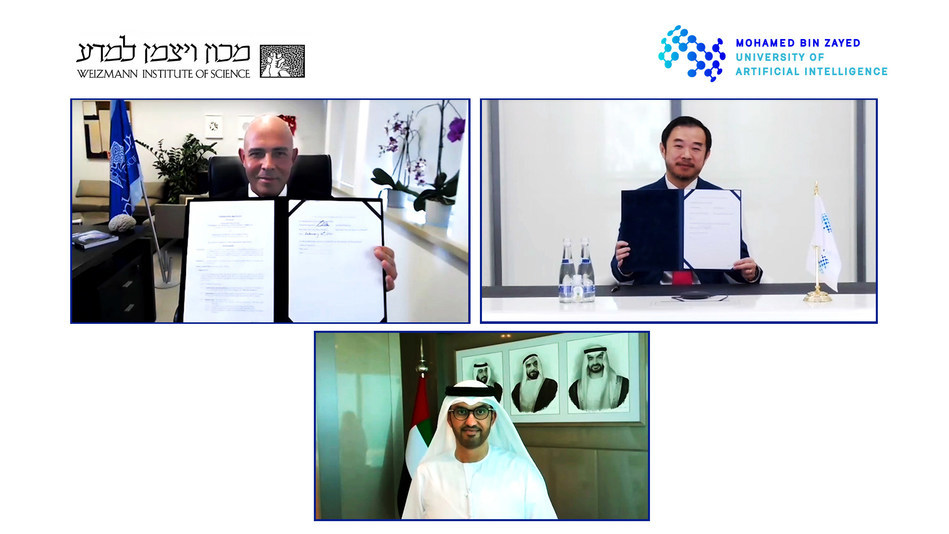
The Mohamed bin Zayed University of Artificial Intelligence (MBZUAI) and the Weizmann Institute of Science (WIS) have announced the establishment of the MBZUAI-WIS Joint Program for Artificial Intelligence Research (the AI Program). The new program will promote collaborative initiatives in fundamental artificial intelligence research and will explore AI applications in domains such as healthcare, genomics, and more. H.E. Dr. Sultan Ahmed Al Jaber, UAE Minister of Industry and Advanced Technology and Chairman of the MBZUAI Board of Trustees, Professor Eric Xing, President of MBZUAI, and Professor Alon Chen, President of Weizmann Institute of Science
Drawing upon the combined expertise of MBZUAI and the Weizmann Institute, the AI Program will carry out both basic and applied research in Machine Learning, Computer Vision, Natural Language Processing, Computational Biology, Neural Sciences, and more, toward the vision of Artificial General Intelligence (AGI). The collaboration will encompass joint research projects, joint training programs, mutual visits, AI conferences and workshops, and student and staff exchange programs.

Professor Eric Xing, President of MBZUAI, and Weizmann Institute President, Professor Alon Chen, inked the new partnership agreement during a virtual ceremony in the presence of officials from both establishments.

H.E. Dr. Sultan Ahmed Al Jaber, UAE Minister of Industry and Advanced Technology and Chairman of the MBZUAI Board of Trustees, attended the event and delivered opening remarks. Speaking on the announcement, he said: "The collaboration between MBZUAI and WIS aligns with our leadership's vision of extending and strengthening bridges of collaboration in the service of our nation and humanity and seeks to enable socio-economic progress through AI innovation. We are confident that partnerships that leverage talent, technological and research capabilities will deliver breakthroughs in AI that will empower the Fourth Industrial Revolution, and contribute towards finding solutions for the greatest challenges we face as an international community – such as COVID-19, food security, and more. MBZUAI is proud to work with leading institutes such as the Weizmann Institute of Science, to bring about a future built on knowledge, sustainability and resilience."

Professor Alon Chen said: "The implications of AI are vast, and will affect every aspect of our lives. Through the MBZUAI-WIS Joint Program for Artificial Intelligence, we are bringing together some of the greatest minds in the fields of AI, natural and exact sciences, with the ambition of extending boundaries and empowering our scientists with access to exceptional resources. Together we will advance AI, discovering new means of leveraging the immense possibilities of this diverse and exciting technology for the benefit of humanity."

Professor Eric Xing said: "Collaborative efforts amongst leaders in the field of AI will enable us to achieve significant progress. The establishment of the AI Program further strengthens our partnership with the Weizmann Institute, laying the foundation to enhance the global AI ecosystem and further advance in areas of science, technology, and higher education. This will provide our students and faculty with access to world-class resources beyond our own University, fostering a culture of international partnership and knowledge-sharing."
Open data on malaria genomes helps combat drug resistance

This release represents the world's largest resource of genomic data on malaria parasite evolution and drug resistance

Genome variation data on more than 7,000 malaria parasites from 28 endemic countries is released today (24 February) in Wellcome Open Research. It has been produced by MalariaGEN, a data-sharing network of groups around the world who are working together to build high-quality data resources for malaria research and disease control.

This open data release represents the world's largest resource of genomic data on malaria parasite evolution and drug resistance. It provides benchmark data on parasite genome variation that is needed in the search for new drugs and vaccines, and the development of surveillance tools for malaria control and elimination.

Malaria is a major global health problem causing an estimated 409,000 deaths in 2019, with 67 percent of deaths occurring in children under five years of age*. This data resource focuses on Plasmodium falciparum, the species of malaria parasite that is responsible for the most common and deadliest form of the disease. 

The Malaria Genomic Epidemiology Network (MalariaGEN) provides researchers and control programs in malaria-endemic countries with access to DNA sequencing technologies and tools for genomic analysis. Founded in 2005, MalariaGEN now has partners in 39 countries, each leading their own studies into different aspects of malaria biology and epidemiology, with the common goal of finding ways to improve malaria control.

This latest publication represents the work of 49 partner studies at 73 locations in Africa, Asia, South America, and Oceania, who together contributed 7,113 samples of P. falciparum for genome sequencing. At the Wellcome Sanger Institute, each sample was analyzed for over 3 million genetic variants and the data were carefully curated before returning to partners for use in their own research. This paper brings together the data from all the partner studies to provide an open data resource for the wider scientific community.

Dr. Richard Pearson, the co-author from the Wellcome Sanger Institute, said: "We have created a data resource that is 'analysis ready' for anyone to use, including those without specialist genetics training. Each annotated dataset sample includes key features that are relevant to malaria control, such as resistance to six major antimalarial drugs, and whether it carries particular structural changes that cause diagnostic malaria tests to fail. Like the Human Genome Project was a resource for the analyses of human genome sequence data, we hope this will be one of the main resources for malaria research."

One of MalariaGEN's core principles is to provide clear attribution and recognition of all the groups that have contributed to a data resource. In this dataset, each sample is listed against the partner study that it belongs to, with a description of the scientific aims of the study and the local investigators that led the work.

Professor Dominic Kwiatkowski, the co-author from the Wellcome Sanger Institute and the Big Data Institute at the University of Oxford, said: "It has been a huge privilege to collaborate with our MalariaGEN partners around the world to build this data resource. We are proud to see these genomic data being used in publications by our colleagues in malaria-endemic studies and others in the malaria research community. We hope that the new features in this data release will make it accessible to an even wider audience, and our team is now hard at work to produce the next version."

Professor Abdoulaye Djimde, the co-author from the University of Science, Techniques, and Technologies of Bamako, Mali, said: "A quantitative assessment of how malaria parasites respond to public health interventions is key for a successful and sustainable elimination campaign. Over time, this openly available resource will facilitate research into the malaria parasite's evolutionary processes, which will ultimately inform effective and sustainable malaria control and elimination strategies that will be key in ending this devastating disease."

Reclusive neutron star may have been found in famous supernova

Since astronomers captured the bright explosion of a star on February 24, 1987, researchers have been searching for the squashed stellar core that should have been left behind. A group of astronomers using data from NASA space missions and ground-based telescopes may have finally found it.

As the first supernova visible with the naked eye in about 400 years, Supernova 1987A (or SN 1987A for short) sparked great excitement among scientists and soon became one of the most studied objects in the sky. The supernova is located in the Large Magellanic Cloud, a small companion galaxy to our own Milky Way, only about 170,000 light-years from Earth.

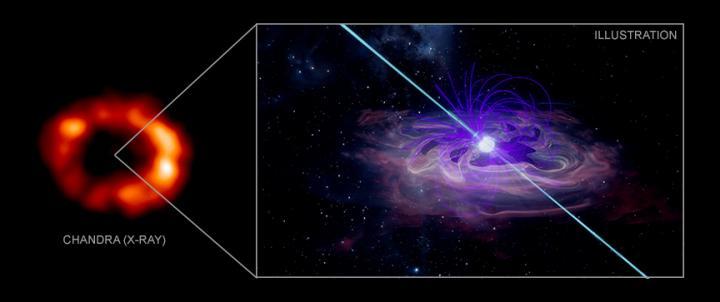
While astronomers watched debris explode outward from the site of the detonation, they also looked for what should have remained of the star's core: a neutron star. The panel on the left contains a 3D computer simulation, based on Chandra data, of the supernova debris from SN 1987A crashing into a surrounding ring of material. The artist's illustration (right panel) depicts a so-called pulsar wind nebula, a web of particles and energy blown away from a pulsar, which is a rotating, highly magnetized neutron star.  CREDIT Chandra (X-ray): NASA/CXC/Univ. di Palermo/E. Greco; Illustration: INAF-Osservatorio Astronomico di Palermo/Salvatore Orlando{module INSIDE STORY}

Data from NASA's Chandra X-ray Observatory and previously unpublished data from NASA's Nuclear Spectroscopic Telescope Array (NuSTAR), in combination with data from the ground-based Atacama Large Millimeter Array (ALMA) reported last year, now present an intriguing collection of evidence for the presence of the neutron star at the center of SN 1987A.

"For 34 years, astronomers have been sifting through the stellar debris of SN 1987A to find the neutron star we expect to be there," said the leader of the study, Emanuele Greco, of the University of Palermo in Italy. "There have been lots of hints that have turned out to be dead ends, but we think our latest results could be different."

When a star explodes, it collapses onto itself before the outer layers are blasted into space. The compression of the core turns it into an extraordinarily dense object, with the mass of the Sun squeezed into an object only about 10 miles across. These objects have been dubbed neutron stars because they are made nearly exclusively of densely packed neutrons. They are laboratories of extreme physics that cannot be duplicated here on Earth. 

{media load=media,id=252,width=350,align=left,display=inline}

Rapidly rotating and highly magnetized neutron stars, called pulsars, produce a lighthouse-like beam of radiation that astronomers detect as pulses when its rotation sweeps the beam across the sky. There is a subset of pulsars that produce winds from their surfaces - sometimes at nearly the speed of light - that create intricate structures of charged particles and magnetic fields known as "pulsar wind nebulae."

With Chandra and NuSTAR, the team found relatively low-energy X-rays from SN 1987A's debris crashing into the surrounding material. The team also found evidence of high-energy particles using NuSTAR's ability to detect more energetic X-rays.

There are two likely explanations for this energetic X-ray emission: either a pulsar wind nebula or particles being accelerated to high energies by the blast wave of the explosion. The latter effect doesn't require the presence of a pulsar and occurs over much larger distances from the center of the explosion.

On a couple of fronts, the latest X-ray study supports the case for the pulsar wind nebula -- meaning the neutron star must be there -- by arguing against the scenario of blast wave acceleration. First, the brightness of the higher energy X-rays remained about the same between 2012 and 2014, while the radio emission detected with the Australia Telescope Compact Array increased. This goes against expectations for the blast wave scenario. Next, the authors estimate it would take almost 400 years to accelerate the electrons up to the highest energies seen in the NuSTAR data, which is over 10 times older than the age of the remnant.

"Astronomers have wondered if not enough time has passed for a pulsar to form, or even if SN 1987A created a black hole," said co-author Marco Miceli, also from the University of Palermo. "This has been an ongoing mystery for a few decades and we are very excited to bring new information to the table with this result."

The Chandra and NuSTAR data also support a 2020 result from ALMA that provided possible evidence for the structure of a pulsar wind nebula in the millimeter wavelength band. While this "blob" has other potential explanations, its identification as a pulsar wind nebula could be substantiated with the new X-ray data. This is more evidence supporting the idea that there is a neutron star left behind.

If this is indeed a pulsar at the center of SN 1987A, it would be the youngest one ever found.

"Being able to watch a pulsar essentially since its birth would be unprecedented," said co-author Salvatore Orlando of the Palermo Astronomical Observatory, a National Institute for Astrophysics (INAF) research facility in Italy. "It might be a once-in-a-lifetime opportunity to study the development of a baby pulsar."

The center of SN 1987A is surrounded by gas and dust. The authors used state-of-the-art supercomputer simulations to understand how this material would absorb X-rays at different energies, enabling a more accurate interpretation of the X-ray spectrum, that is, the amount of X-rays at different energies. This enables them to estimate what the spectrum of the central regions of SN 1987A is without the obscuring material.

A paper describing these results was accepted into publication and is being published this week in The Astrophysical Journal.

As is often the case, more data are needed to strengthen the case for the pulsar wind nebula. An increase in radio waves accompanied by an increase in relatively high-energy X-rays in future observations would argue against this idea. On the other hand, if astronomers observe a decrease in the high-energy X-rays, then the presence of a pulsar wind nebula will be corroborated.

The stellar debris surrounding the pulsar plays an important role by heavily absorbing its lower energy X-ray emission, making it undetectable at the present time. The model predicts that this material will disperse over the next few years, which will reduce its absorbing power. Thus, the pulsar emission is expected to emerge in about 10 years, revealing the existence of the neutron star.