

SUPERCOMPUTING NEWS SUPERCOMPUTING NEWS
    • MEDIA KIT
    • MOST READ
    • RSS FEED
    • ACADEMIA
    • AEROSPACE
    • APPLICATIONS
    • ASTRONOMY
    • AUTOMOTIVE
    • BIG DATA
    • BIOLOGY
    • CHEMISTRY
    • CLIENTS
    • CLOUD
    • DEFENSE
    • DEVELOPER TOOLS
    • EARTH SCIENCES
    • ECONOMICS
    • ENGINEERING
    • ENTERTAINMENT
    • GAMING
    • GOVERNMENT
    • HEALTH
    • OIL & GAS
    • INDUSTRY
    • INTERCONNECTS
    • MANUFACTURING
    • MIDDLEWARE
    • MOVIES
    • NETWORKS
    • PHYSICS
    • PROCESSORS
    • RETAIL
    • SCIENCE
    • STORAGE
    • SYSTEMS
    • VISUALIZATION
    • AcyMailing subscription form

    • ADD YOUR VIDEOS
    • MANAGE VIDEOS
    • CONVERSATION INBOX
    • SOCIAL ADVERTISER
    • SOCIAL NETWORK VIDEOS
    • SURVEYS
    • GROUPS
    • PAGES
    • MARKETPLACE LISTINGS
    • APPLICATIONS BROWSER
    • PRIVACY CONFIRM REQUEST
    • PRIVACY CREATE REQUEST
    • LEADERBOARD
    • POINTS LISTING
      • BADGES
    • TRADE SHOWS
Sign In
Tyler O'Neal, Staff Editor GOVERNMENT February 23, 2021, 11:44 am

Martin Luther University Halle-Wittenberg develops production method to make crystalline microstructures universally usable

New storage and information technology require new higher performance materials. One of these materials is yttrium iron garnet, which has special magnetic properties. Thanks to a new process, it can now be transferred to any material. Developed by physicists at Martin Luther University Halle-Wittenberg (MLU), the method could advance the production of smaller, faster, and more energy-efficient components for data storage and information processing. The physicists have published their results in the journal "Applied Physics Letters."

Magnetic materials play a major role in the development of new storage and information technologies. Magnonics is an emerging field of research that studies spin waves in crystalline layers. Spin is a type of intrinsic angular momentum of a particle that generates a magnetic moment. The deflection of the spin can propagate waves in a solid body. "In magnonic components, electrons would not have to move to process information, which means they would consume much less energy," explains Professor Georg Schmidt from the Institute of Physics at MLU. This would also make them smaller and faster than previous technologies. 257164 web 1 1c38epink: YIG-bridge, green: glue, gray: sapphire{module INSIDE STORY}
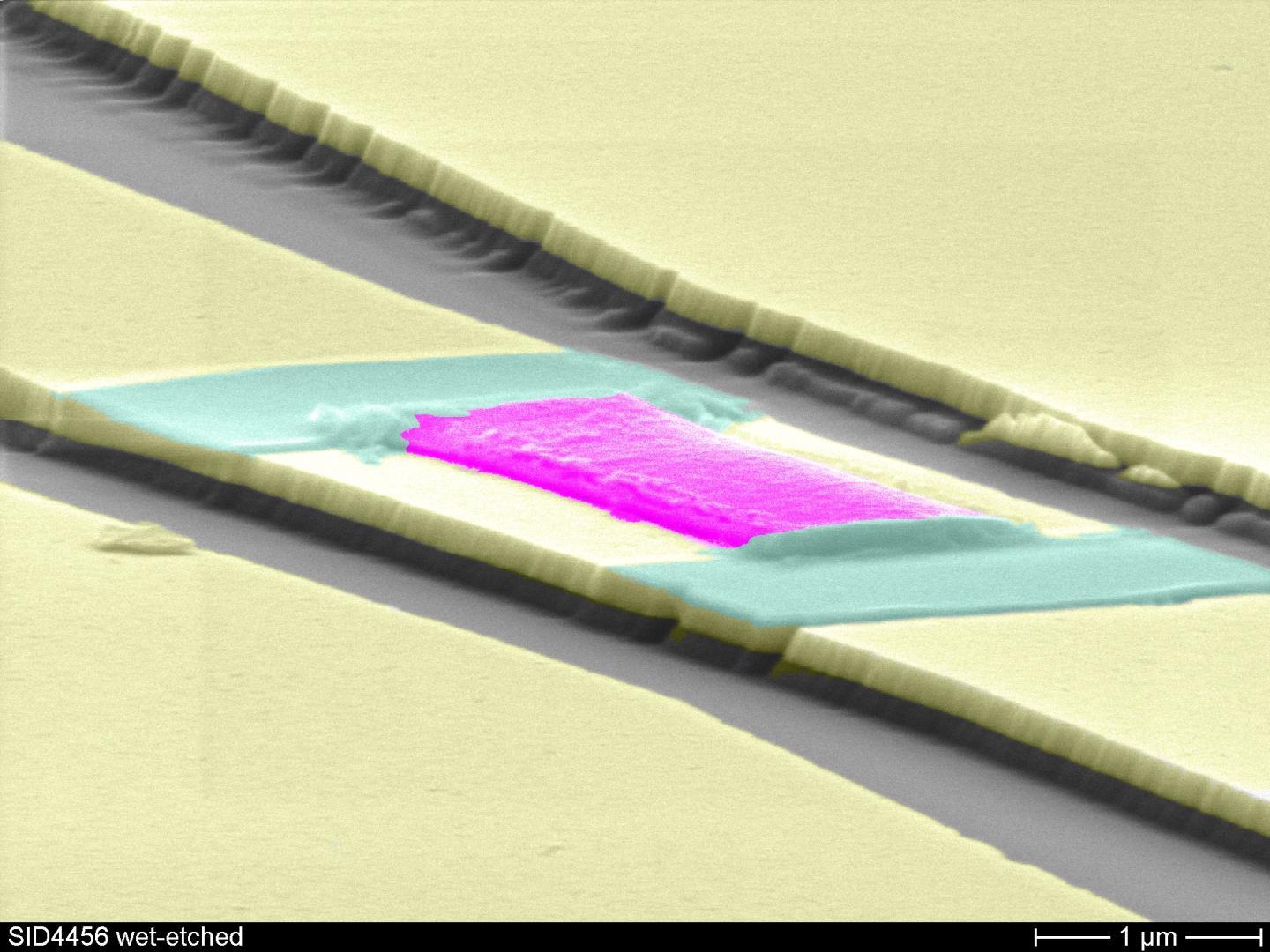
But until now, it has been very costly to produce the materials needed for this. Yttrium iron garnet (YIG) is often used because it has the right magnetic properties. "The problem so far has been that the very thin, high-quality layers that are required can only be produced on a specific substrate and cannot be detached," explains Schmidt. The substrate itself has unfavorable electromagnetic properties.

The physicists have now resolved this issue by getting the material to form bridge-like structures. This enables it to be produced on the ideal substrate and later removed. "Then, in theory, these small platelets can be stuck to any material," says Schmidt. The method was developed in his laboratory and is based on a manufacturing process that can be conducted at room temperature. In the current study, the scientists glued the platelets, which are only a few square micrometers in size, onto sapphire and then measured their properties. "We have also had good results at low temperatures," says Schmidt. This is necessary for many high-frequency experiments carried out in quantum magnonics.

"The yttrium iron garnet platelets could also be glued to silicon, for example," says Schmidt. This semiconductor is very frequently used in electronics. In addition, other thin-film microstructures of any shape can be produced from YIG. According to Schmidt, this is particularly exciting for hybrid components in which spin waves are coupled with electrical waves or mechanical vibrations.
Spanish researcher develops algo to analyze the evolution of the cosmic web

Tyler O'Neal, Staff Editor GOVERNMENT February 22, 2021, 3:24 pm

The Instituto de Astrofísica de Canarias (IAC) has led an international team that has developed an algorithm called COSMIC BIRTH to analyze large-scale cosmic structures. This new computation method will permit the analysis of the evolution of the structure of dark matter from the early universe until the formation of present-day galaxies. This work was recently published in the journal Monthly Notices of the Royal Astronomical Society (MNRAS).

The IAC researcher, a co-author of the article and leader of the group of Cosmology and Large Scale Structure (LSS) Francisco-Shu Kitaura explains that one of the key aspects of this algorithm "consists in expressing the observations as if they had been detected in the early universe, which simplifies many of the calculations".

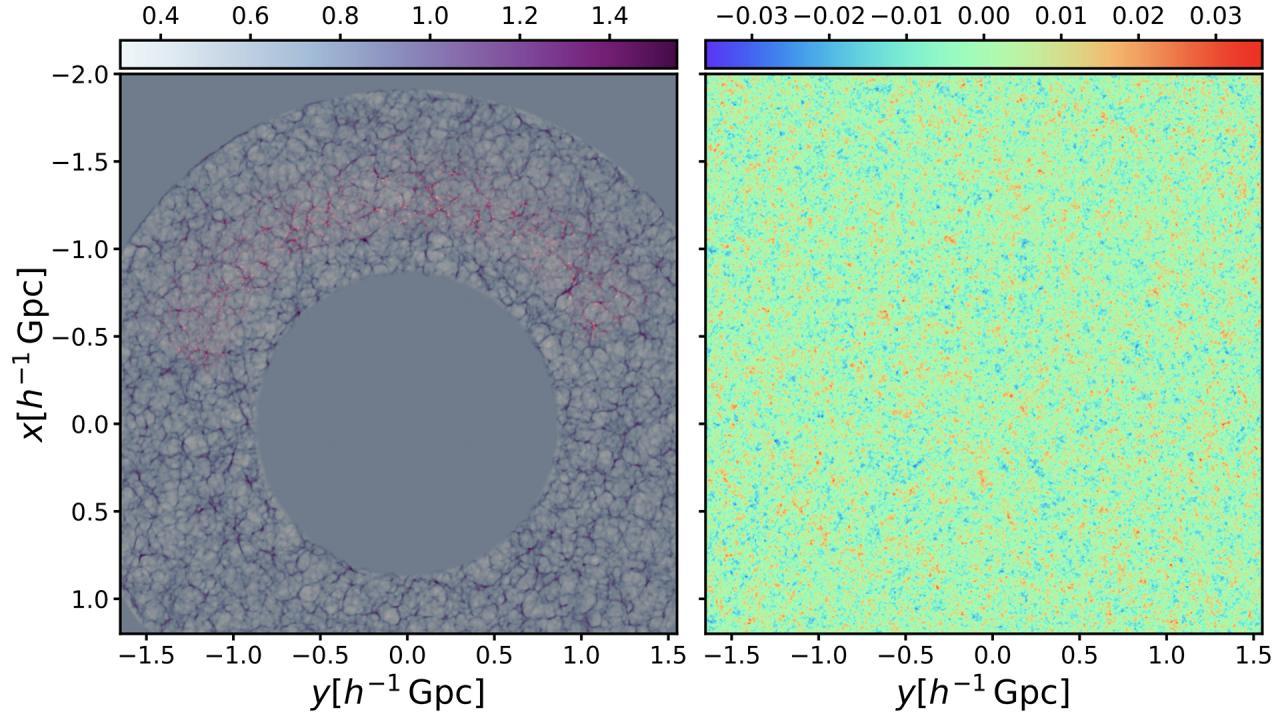
"Our algorithm uses sampling techniques designed to deal with high dimensional spaces and is the product of more than four years of development. That is why I thank the funding programs Ramon y Cajal and Excelencia Severo Ochoa which have allowed us to make scientific journeys which are such a challenge and a risk", he adds. Reconstruction of the cosmic web (shaded areas in grey in the left panel) based on a distribution of galaxies (in red in the left panel) and the primordial fluctuations (right panel). Credit: Francisco-Shu Kitaura (IAC).{module INSIDE STORY}

"It is fascinating to use the methods of classical mechanics to reconstruct the large scale structure of huge cosmic volumes", says Mónica Hernández Sánchez, a doctoral student at the IAC and the University of La Laguna (ULL), and first author of another linked article, who has shown that an idea of the particle physicists from 30 years ago has proved useful in the present context.

"It has been exciting to explore, using Big Data techniques, the structures which include the formation of galaxy clusters emerging at "cosmic noon". That is the moment when the Universe lit up the galaxies with stars", notes Metin Ata, a researcher at the Kavli Institute for Physics and Mathematics of the Universe (IPMU), in Japan, and leader of the application of the COSMIC BIRTH algorithm to the combination of five studies of distant clusters in the COSMOS (Cosmic Evolution Survey) fields.

The authors have dedicated this last work to the French astrophysicist Olivier Le Fèver, who participated in the study and who unfortunately died while it was being completed.

Tomorrow's pharmaceuticals could be discovered by quantum simulators

Tyler O'Neal, Staff Editor GOVERNMENT September 23, 2020, 7:43 pm

With their enormous supercomputing power, quantum computers are expected to solve important and complex problems in medicine

No more testing the way forward: Tomorrow's pharmaceuticals will be discovered by quantum simulators

Trial and error define today's approach to developing new pharmaceutical drugs. But with their enormous computing power, quantum computers are expected to solve important and complex problems in medicine, biology and chemistry, while speeding up the discovery of effective medications. Researchers at the University of Copenhagen have just received DKK 108.6 million (EUR 14.6m) from the Novo Nordisk Foundation for two new centers that will develop and use quantum simulators to help create tomorrow's pharmaceuticals.

10,000 years of work in 3.5 minutes. This was the conclusion of a tech giant in its initial bid for how long it would take a quantum computer to calculate a complex equation -- a calculation that would require 10,000 years of work by today's best supercomputers to solve.

This same processing power will now be customized to develop new pharmaceutical drugs, currently an extremely time-consuming and complex process. Such increased processing power holds great potential. Researchers at the University of Copenhagen's Niels Bohr Institute and Department of Mathematical Sciences have received a total of DKK 108.6 million (EUR 14.6m) from the Novo Nordisk Foundation to develop and use quantum simulators to develop new drugs. {module INSIDE STORY}

"The development of new pharmaceutical drugs currently involves a great deal of testing because conventional methods are unable to calculate how proteins and other complex systems will respond to new drugs. Quantum technologies present us with new opportunities to develop specialized quantum simulators that can be tailored to tackle these processes," explains Professor Peter Lodahl of the University of Copenhagen's Niels Bohr Institute.

Professor Lodahl is receiving 60 million kroner (EUR 8m) for his research and will head the "Solid-State Quantum Simulators for Biochemistry" center, known as "Solid-Q". The center will work on applying and integrating two types of quantum simulation hardware which can perform quantum mechanical calculations of complex biomolecules.

The other centre is called "Quantum for Life" and is headed by Professor Matthias Christandl of UCPH's Department of Mathematical Sciences. This project aims to develop mathematical algorithms that can be used for the quantum simulation of biomolecules, which will in turn make it possible to study complex biochemical processes.

"The centre will develop and use customized quantum algorithms, and in doing so, allow us to open up a new chapter in 'computational life-sciences' here in Denmark. With the new center, I am pleased that the quantum mathematics we work on will be able to be used to solve important issues surrounding fundamental biological processes," says Professor Matthias Christandl, who has received DKK 48.6 million (EUR 6.5m) for his research.


  1. NAU researcher wins $3.75 million NCI grant for advanced cancer research software
  2. Gao’s SIS patch modeling shows impact of human mobility on disease spread

Page 64 of 85

  • 59
  • 60
  • 61
  • 62
  • 63
  • 64
  • 65
  • 66
  • 67
  • 68
POPULAR RIGHT NOW
  • AI supercharges the hunt for stronger magnets: Iowa State researchers launch a new era of intelligent materials discovery
    AI supercharges the hunt for stronger magnets: Iowa State researchers launch a new era of intelligent materials discovery
  • IBM's Historic stock collapse raises questions for the future of enterprise supercomputing
    IBM's Historic stock collapse raises questions for the future of enterprise supercomputing
  • Could a novel dark matter theory simultaneously resolve multiple cosmic enigmas? Supercomputer simulations provide a compelling, albeit currently unverified, potential solution
    Could a novel dark matter theory simultaneously resolve multiple cosmic enigmas? Supercomputer simulations provide a compelling, albeit currently unverified, potential solution
  • Melting icebergs may be reshaping Earth’s greatest ocean current
    Melting icebergs may be reshaping Earth’s greatest ocean current
  • Supercomputers replace ‘bathtub’ flood maps with physics-based digital twins of Britain’s coastline
    Supercomputers replace ‘bathtub’ flood maps with physics-based digital twins of Britain’s coastline
  • Supercomputers push neural quantum simulation beyond previous limits
    Supercomputers push neural quantum simulation beyond previous limits
  • Intel’s AI supercomputing revival: Q2 financial surge signals new era for CPU-powered HPC infrastructure
    Intel’s AI supercomputing revival: Q2 financial surge signals new era for CPU-powered HPC infrastructure
  • AI infrastructure financing fears shake semiconductor sector
    AI infrastructure financing fears shake semiconductor sector
  • AWS supercomputing investment reaches historic scale as Amazon’s AI strategy powers record financial results
    AWS supercomputing investment reaches historic scale as Amazon’s AI strategy powers record financial results
  • Catching the wave of the future: Supercomputers unlock the hidden dynamics of Venus
    Catching the wave of the future: Supercomputers unlock the hidden dynamics of Venus
THIS YEAR'S MOST READ
  • Wall Street wants to trade supercomputing power like oil
    Wall Street wants to trade supercomputing power like oil
  • Beamforming the future: BeammWave's 6G push signals the rise of orbital-terrestrial wireless networks
    Joakim Axmon
    Joakim Axmon
  • Cosmic ambition at scale: UK’s supercomputer unlocks a 2.5 petabytes universe
    Cosmic ambition at scale: UK’s supercomputer unlocks a 2.5 petabytes universe
  • Hidden order, revealed at scale: Supercomputing, electron ptychography uncover the inner workings of relaxor ferroelectrics
    Hidden order, revealed at scale: Supercomputing, electron ptychography uncover the inner workings of relaxor ferroelectrics
  • Intel's Q1 results signal supercomputing surge driving Xeon momentum
    Intel's Q1 results signal supercomputing surge driving Xeon momentum
  • When stars fall apart: Supercomputing reveals the hidden physics of black holes
    When stars fall apart: Supercomputing reveals the hidden physics of black holes
  • Multi-layer simulations reveal the hidden supply chain of solar prominences
    Multi-layer simulations reveal the hidden supply chain of solar prominences
  • Japanese scientists decode dolphin speed with supercomputing: Turbulence, vortices, and the hidden physics of propulsion
    Japanese scientists decode dolphin speed with supercomputing: Turbulence, vortices, and the hidden physics of propulsion
  • Cosmic feedback at scale: Supercomputing reveals how quasars regulate the early Universe
    Cosmic feedback at scale: Supercomputing reveals how quasars regulate the early Universe
  • Modeling life at the microscopic scale: A computational breakthrough in oxygen transport
    Modeling life at the microscopic scale: A computational breakthrough in oxygen transport
MOST READ OF ALL-TIME
  • Largest Computational Biology Simulation Mimics The Ribosome
    Details
    112127
    The amino acid (green) slithers into the chemical reaction center, moving through an evolutionarily ancient corridor of the ribosome (purple). The amino acid is delivered to the reaction core by the transfer RNA molecule (yellow).
    The amino acid (green) slithers into the chemical reaction center, moving through an evolutionarily ancient corridor of the ribosome (purple). The amino acid is delivered to the reaction core by the transfer RNA molecule (yellow).
  • Silicon 'neurons' may add a new dimension to chips
    Details
    81041
    Silicon 'neurons' may add a new dimension to chips
  • Linux Networx Accelerators Expected to Drive up to 4x Price/Performance
    Details
    75563
  • Complex Concepts That Really Add Up
    Details
    73694
    Complex Concepts That Really Add Up
  • Blue Sky Studios Donates Animation SuperComputer to Wesleyan
    Details
    68166
    Each rack holds 52 Angstrom Microsystem-brand “blades,” with a memory footprint of 12 or 24 gigabytes each. (Photos by Olivia Bartlett Drake)
    Each rack holds 52 Angstrom Microsystem-brand “blades,” with a memory footprint of 12 or 24 gigabytes each. (Photos by Olivia Bartlett Drake)
  • Humanities, HPC connect at NERSC
    Details
    57973
  • TeraGrid ’09 'Call for Participation'
    Details
    54976
  • Turbulence responsible for black holes' balancing act
    Details
    52339
  • Cray Wins $52 Million SuperComputer Contract
    Details
    50162
  • SDSC Researchers Accurately Predict Protein Docking
    Details
    46115
  • FRONTPAGE
  • LATEST
  • POPULAR
  • REGISTER
  • SOCIAL
  • VIDEO
  • SUBSCRIPTION
  • RSS
  • GUIDELINES
  • PRIVACY
  • TOS
  • ABOUT
  • +1 (816) 799-4488
  • editorial@supercomputingonline.com
© 2001 - 2026 SuperComputingOnline.com, LLC. All rights reserved. This material may not be published, broadcast, rewritten or redistributed without permission.
Sign In
  • FRONT PAGE
  • LATEST
    • MEDIA KIT
    • MOST READ
    • RSS FEED
    • ACADEMIA
    • AEROSPACE
    • APPLICATIONS
    • ASTRONOMY
    • AUTOMOTIVE
    • BIG DATA
    • BIOLOGY
    • CHEMISTRY
    • CLIENTS
    • CLOUD
    • DEFENSE
    • DEVELOPER TOOLS
    • EARTH SCIENCES
    • ECONOMICS
    • ENGINEERING
    • ENTERTAINMENT
    • HEALTH
    • INDUSTRY
    • INTERCONNECTS
    • GAMING
    • GOVERNMENT
    • MANUFACTURING
    • MIDDLEWARE
    • MOVIES
    • NETWORKS
    • OIL & GAS
    • PHYSICS
    • PROCESSORS
    • RETAIL
    • SCIENCE
    • STORAGE
    • SYSTEMS
    • VISUALIZATION
  • VIDEOS
    • ADD YOUR VIDEOS
    • MANAGE VIDEOS
  • COMMUNITY
    • TRADE SHOWS
    • SOCIAL NETWORK VIDEOS
    • SURVEYS
    • APPLICATIONS BROWSER
    • CONVERSATION INBOX
    • SOCIAL ADVERTISER
    • GROUPS
    • MARKETPLACE LISTINGS
    • PAGES
    • LEADERBOARD
    • POINTS LISTING
      • BADGES
    • PRIVACY CONFIRM REQUEST
    • PRIVACY CREATE REQUEST

Hey there! We noticed you’re using an ad blocker.