Duke's Mattingly presents 2021 SIAM Block Community Lecture at AN21 online

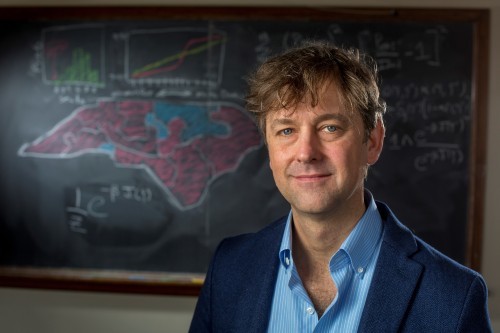
Jonathan Christopher Mattingly of Duke University has been selected to deliver the 2021 I.E. Block Community Lecture. He will be presenting the lecture at the SIAM Annual Meeting (AN21) which will be taking place virtually July 19 -23, 2021. Dr. Mattingly has been a proud and engaged member of SIAM for years. “SIAM was central to my scientific formation as an applied (stochastic) dynamicist,” Mattingly says. “I gave some of my first talks at SIAM Conferences and have been a regular at the SIAM Conference on Applications of Dynamical System for years as well as regularly attending many others. I feel strongly that the application of mathematics is important to our society and that the best applications breed great mathematics.” Jonathan Christopher Mattingly of Duke University
Dr. Mattingly grew up in Charlotte, North Carolina. He graduated from the NC School of Science and Mathematics and received a B.S. is Applied Mathematics with a concentration in physics from Yale University. After two years abroad with a year spent at ENS Lyon studying nonlinear and statistical physics on a Rotary Fellowship, he returned to the U.S. to attend Princeton University where he obtained a Ph.D. in Applied and Computational Mathematics in 1998 under the supervision of Yakov Sinai. After four years as a Szegö assistant professor at Stanford University and one year as a member of the IAS in Princeton, he moved to Duke in 2003, where he is currently James B. Duke Professor of Mathematics and a Professor of Statistical Science.

Since 2013 he has also been working to understand and quantify gerrymandering and its interaction with a region's geopolitical landscape. This has led him to testify in several court cases including Common Cause v. Rucho, which went all the way to the U.S. Supreme Court. He was also involved with a sequence of North Carolina state court cases which led to the NC congressional and both NC legislative maps being deemed unconstitutional and replaced for the 2020 elections. He was awarded the Defender of Freedom award by the Common Cause for his work on Quantifying Gerrymandering.

More info about the 2021 I. E. Block Community Lecture will be available in the coming months, but Dr. Mattingly gave us a preview of his work in gerrymandering that will be presented: The group at Duke has been centered on understanding and quantifying gerrymandering. The interaction between our laws and the geopolitical structure of our states is complicated enough that it resists simple reductive principles as a means of analysis. We have used computational sampling methods to create normative ensembles of maps that can be used as a baseline against which other maps can be compared. Central to this work has been a dialogue between lawyers and policy advocates and mathematicians. There are challenges in how to formulate the policy questions mathematically, in how to perform the needed collations in a computationally feasible way, and then in how to best transmit the results to empower policymakers, the courts, and the polis at large by increasing their understanding of the issues in play.

“It is important for people to understand gerrymandering and its effect on our election system,” he says. “My hope is to give a framework so that everyone can formulate the central issues in gerrymandering and be empowered to enter into the conversation both in the classroom and our political forums.”Dr. Mattingly is the recipient of an NSF CAREER award, a Presidential Early Career Award for Scientists and Engineers (PECASE), and a Sloan Foundation Faculty Fellowship. He is a fellow of the Institute for Mathematical Statistics (IMS) and the American Mathematics Society (AMS) and has served on the advisory boards for several NSF institutes. The I. E. Block Community Lecture is given each year at the SIAM Annual Meeting and is free and open to the public. Due to COVID-19, SIAM AN21 and the 2021 Block Lecture are happening virtually; the date and time will be announced in April.
Japanese simulation method predicts the performance of methane conversion solid catalyst

Japanese researchers performed supercomputation of reaction kinetic information from first-principles calculations based on quantum mechanics, and developed methods and programs to carry out kinetic simulations without using experimental kinetic results. This method is expected to accelerate the search for various materials to achieve a carbon-free society.

Japanese researchers have developed a simulation method to theoretically estimate the performance of heterogeneous catalysts by combining first-principles calculation and kinetic calculation techniques. Up to now, simulation studies mainly focused on a single or limited number of reaction pathways, and it was difficult to estimate the efficiency of a catalytic reaction without experimental information.

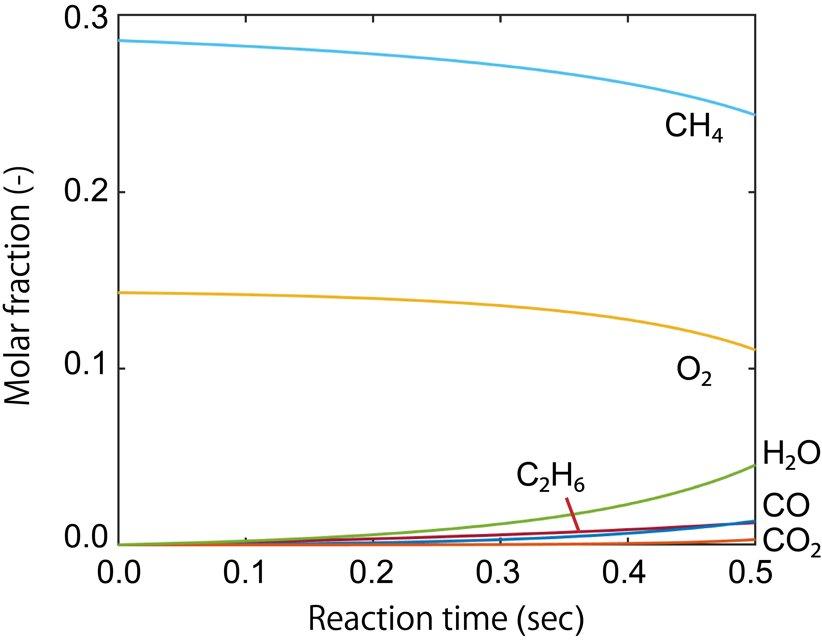
Figure 1. Mole fraction changeMole fraction along the reaction time (s) calculated by the reactor simulation. The inlet gas consisted of CH4, O2, and He (as inert gas). The total pressure was set to P = 1 bar, and the partial pressure ratio of CH4, O2, and He was set to 2:1:4. The volumetric flow rate was set to 1 mL/s, and the reaction temperature was 700 °C. The catalyst weight was 1 g. ©Atsushi Ishikawa

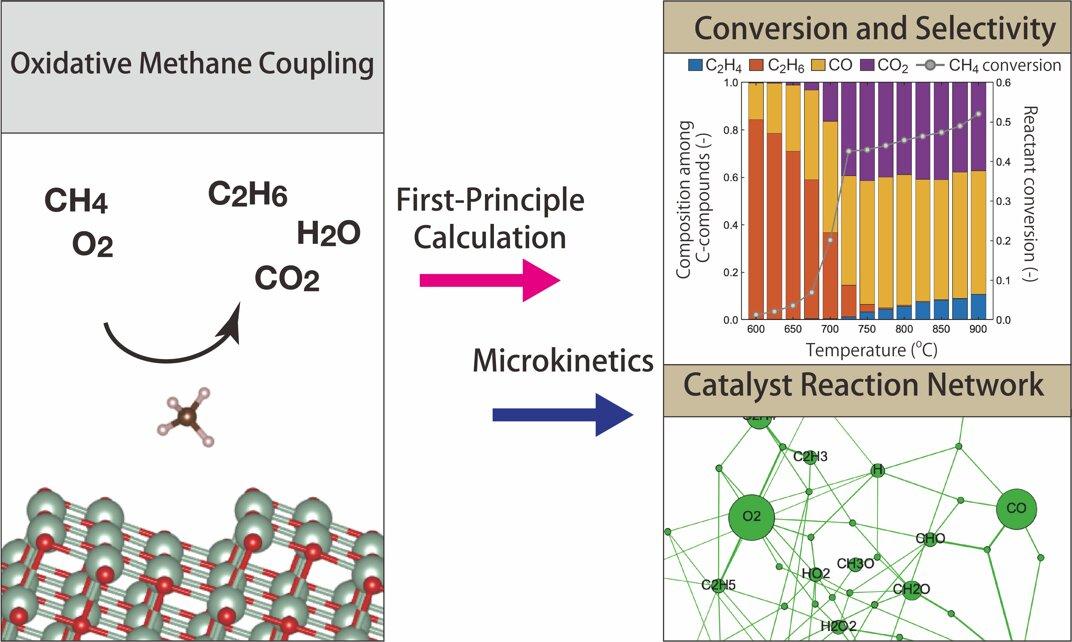
Atsushi Ishikawa, Senior Researcher, Center for Green Research on Energy and Environmental Materials, National Institute for Materials Science (NIMS), performed computation of reaction kinetic information from first-principles calculations based on quantum mechanics, and developed methods and programs to carry out kinetic simulations without using experimental kinetic results. Then he applied the findings to the oxidative coupling of methane (OCM) reaction, which is an important process in the use of natural gas. He could successfully predict the yield of the products, such as ethane, without experimental information on the reaction kinetics. He also predicted changes in yield depending on the temperature and partial pressure, and the results reproduced faithfully the existing experimental results.

This research shows that the supercomputer simulation enables the forecasting of the conversion of reactants and the selectivity of products, even if experimental data are unavailable. The search for catalytic materials led by theory and calculation is expected to speed up. Furthermore, this method is highly versatile and can be applied not only to methane conversion catalysts but also to other catalyst systems such as automobile exhaust gas purification, carbon dioxide reduction, and hydrogen generation, and is expected to contribute to the realization of a carbon-free society. Figure 2. Concept of the studyGraphical concept figure showing the combined approach of first-principle calculation and microkinetics. Catalytic activities such as conversion and selectivity are predicted. The catalytic reaction network is also obtained thus detailed analysis on the catalyst reaction is possible. ©Atsushi Ishikawa

Russian researcher shows how Molybdenum disulfide will usher in era of post-silicon photonics

Researchers of the Center for Photonics and Two-Dimensional Materials at MIPT, together with their colleagues from Spain, Great Britain, Sweden, and Singapore, including co-creator of the world's first 2D material and Nobel laureate Konstantin Novoselov, have measured giant optical anisotropy in layered molybdenum disulfide crystals for the first time. The scientists suggest that such transition metal dichalcogenide crystals will replace silicon in photonics. Birefringence with a giant difference in refractive indices, characteristic of these substances, will make it possible to develop faster yet tiny optical devices. The work is published in an academic journal.

The Scandinavian Vikings were the first, among others, to observe polarizing effects in optics. They discovered that objects appeared doubled when viewed through Iceland spar (clear calcite). That phenomenon was later called birefringence. The effect is due to the asymmetrical arrangement of atoms in some materials. As a result, a light beam refracts differently in the material, depending on the direction in which it propagates, splitting into two linearly polarized beams (the ordinary and extraordinary) and creating a doubled image.

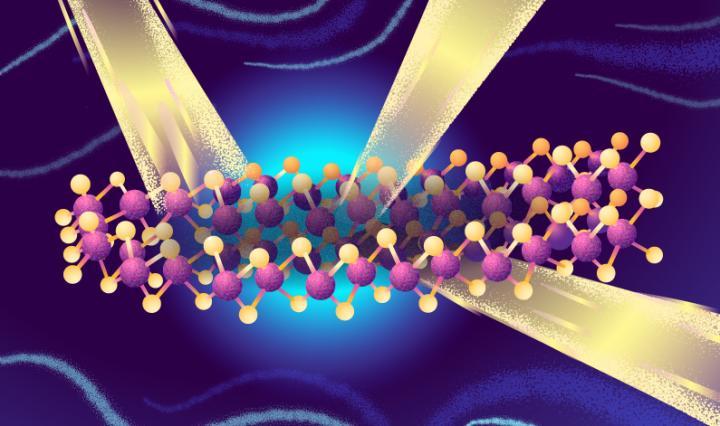
It turns out that the phenomenon of birefringence is very practical. For example, the Vikings used double refraction of some crystals for navigation. Present-day liquid crystal monitors use the birefringence effect in liquid crystals to create images. The phenomenon is also used to build polarizers, wave plates, and other optical components. It is desirable that the refractive indices of ordinary and extraordinary beams differ as much as possible - then the desired effect can be achieved when light passes through a thinner plate, thus helping reduce the size of the device, and in some applications, increase its speed. Researchers have recently demonstrated the possibility of building ultra-compact waveguides with anisotropic materials to reach and even overcome the diffraction limit. The effect requires materials with a birefringence value greater than 1. So far, the BaTiS3 perovskite layered crystals and the hexagonal boron nitride h-BN have held the record for birefringence (0.8). The desire to make modern optics more and more compact has stimulated the search for natural materials with huge optical anisotropy greater than 1. Transition metal dichalcogenides are extremely promising in this respect. These compounds based on sulfur, selenium, tellurium, and 3d-elements of the Mendeleev's Periodic Table have a layered structure. For example, molybdenum disulfide (MoS2) consists of alternating layers rotated with respect to each other by 1800 and held together by weak van der Waals forces. Molybdenum disulfide  CREDIT Daria Sokol/MIPT Press Office

"From the task of measuring the optical properties of molybdenum disulfide, we have arrived at a completely different problem - namely, to study anisotropy and find promising applications of the anisotropy of such crystals in photonics," Georgy Ermolaev, a Ph.D. student at MIPT and first author of the study, explains the authors' motivation. This anisotropic structure could not but affect the material's optical properties. This fact was known already in the second half of the twentieth century. However, quantitative measurements of the anisotropy were non-existent. That was due, among other things, to considerable experimental difficulties. To overcome them, the researchers have combined methods of near and far electric fields. In other words, in addition to irradiating the material at different angles and detecting the signal, the authors studied the propagation of waveguide modes in the material. This approach enabled them to unambiguously determine the birefringence of the material, which is 1.5 in the near-infrared and up to 3 times in the visible range. These values are several times greater than those of previous record-breakers.

"We used a combination of techniques - spectral ellipsometry and near-field optical microscopy and verified our data with numerical calculations. The work required the efforts of a large number of scientists from different scientific teams in different countries and with different competencies. For all of us, this work was the beginning of large-scale research on anisotropic transition metal dichalcogenides nanophotonics," commented Aleksey Arsenin, a leading researcher at MIPT.

The data obtained were compared with quantum calculations, which, to the researchers' surprise, produced exactly the same result, thus confirming the correctness of the constructed quantum mechanical model of layered materials and suggesting that the theory and conclusions published in the article are applicable to the entire class of transition metal dichalcogenides.

The researchers have completely rediscovered for the world a class of materials with enormous optical anisotropy. The discovery offers an additional degree of freedom in the development of compact photonic devices and. For example, it makes it possible to reach the diffraction limit in optics for wave-guiding systems with characteristic dimensions of about 100 nanometers.

The work was led by Professor Valentyn Volkov. He moved from the University of Southern Denmark to MIPT in September 2019 to head the Center for Photonics and Two-Dimensional Materials. "Whereas previously we were limited to changes in geometry and effective refractive index to create new optical circuits and devices, giant anisotropy provides an additional degree of freedom to manipulate light," says Volkov. - Unexpectedly, we found out that naturally anisotropic materials enable us to build compact waveguides literally on the edge of the diffraction limit. It gives us an opportunity to compete with silicon photonics. Now we can safely not only talk about post-silicon photonics but also implement it.