SUPERCOMPUTING NEWS SUPERCOMPUTING NEWS
    • MEDIA KIT
    • MOST READ
    • RSS FEED
    • ACADEMIA
    • AEROSPACE
    • APPLICATIONS
    • ASTRONOMY
    • AUTOMOTIVE
    • BIG DATA
    • BIOLOGY
    • CHEMISTRY
    • CLIENTS
    • CLOUD
    • DEFENSE
    • DEVELOPER TOOLS
    • EARTH SCIENCES
    • ECONOMICS
    • ENGINEERING
    • ENTERTAINMENT
    • GAMING
    • GOVERNMENT
    • HEALTH
    • OIL & GAS
    • INDUSTRY
    • INTERCONNECTS
    • MANUFACTURING
    • MIDDLEWARE
    • MOVIES
    • NETWORKS
    • PHYSICS
    • PROCESSORS
    • RETAIL
    • SCIENCE
    • STORAGE
    • SYSTEMS
    • VISUALIZATION
    • AcyMailing subscription form

    • ADD YOUR VIDEOS
    • MANAGE VIDEOS
    • CONVERSATION INBOX
    • SOCIAL ADVERTISER
    • SOCIAL NETWORK VIDEOS
    • SURVEYS
    • GROUPS
    • PAGES
    • MARKETPLACE LISTINGS
    • APPLICATIONS BROWSER
    • PRIVACY CONFIRM REQUEST
    • PRIVACY CREATE REQUEST
    • LEADERBOARD
    • POINTS LISTING
      • BADGES
    • TRADE SHOWS
Sign In
Tyler O'Neal, Staff Editor GOVERNMENT November 22, 2019, 6:03 pm

Russian researchers produce new supercomputer model to understand solar dynamics

An international group of scientists, in cooperation with a research scientist from Skoltech, has developed a model to describe changes in the solar plasma. This will help comprehend solar dynamics and gives some clues to understanding how to predict space weather events. The results have been published in the Astrophysical Journal.

Plasma β is an important quantity to investigate the interchanging roles of plasma and magnetic pressure in the solar atmosphere. It relates to both the solar magnetic field and driving solar phenomena such as solar wind, coronal mass ejections, and flares; these phenomena affect the Space Weather directly.

Dr. Jenny Rodriguez, a scientist from the Space Center of Skolkovo Institute of Science and Technology (Russia), her colleagues from Leibniz Institut für Sonnenphysik (Germany) and Instituto Nacional de Pesquisas Espaciais (Brazil) have developed a model to estimate how plasma β changes in the solar atmosphere. Specifically, they obtain a description of the plasma β in the solar corona during previous solar cycles (~22 years). They found the strongest influence during both solar cycles from faculae and the quiet Sun regions. 

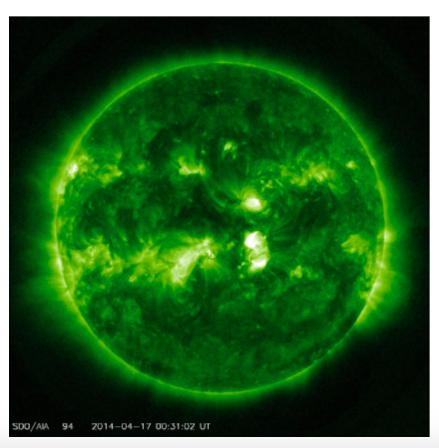
This is an image in the solar corona at 171 A.{module INSIDE STORY}

The faculae and QS regions drive variations in magnetic and kinetic pressure at coronal heights. It can directly affect space weather and the ability to predict it. These results give an interesting outlook on solar cycle dynamics.

"Plasma β is a very important quantity in the solar atmosphere. The solar atmosphere is a plasma physics laboratory near us; it allows us to know about its dynamics and to understand how many events are happening on the Sun. We believe that our findings will help comprehend the Sun's dynamics and help to forecast the Space Weather," said Dr. Jenny Rodriguez.

Warwick physicists develop sophisticated supercomputing for DUNE project

Tyler O'Neal, Staff Editor GOVERNMENT November 21, 2019, 5:11 pm

The University of Warwick has received over £900,000 to provide essential contributions to the international DUNE experiment, which aims to answer fundamental questions about our universe.

This is part of the latest UK multi-million pound investment in the DUNE global science project that brings together the scientific communities of the UK and 31 countries from Asia, Europe, and the Americas to build the world’s most advanced neutrino observatory. The DUNE project has the potential to lead to profound changes in our understanding of the universe.

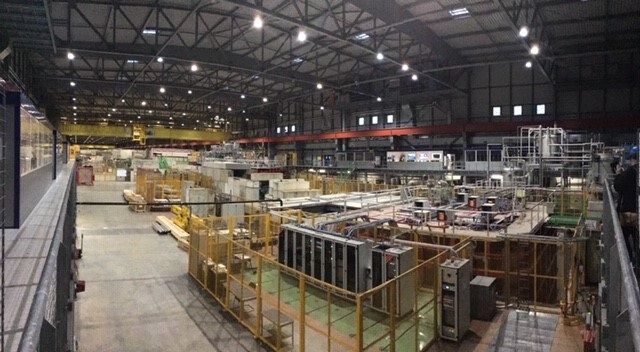
DUNE (the Deep Underground Neutrino Experiment) is a flagship international experiment hosted by Fermilab, which will be designed and operated by a collaboration of over 1,000 physicists across 32 countries. dune 2 {module INSIDE STORY}

The investment from UK Research and Innovations’Science and Technology Facilities Council (STFC) is a four-year construction grant to 13 educational institutions and to STFC’s Rutherford Appleton and Daresbury Laboratories. This grant, of £30M, is the first of two stages to support the DUNE construction project in the UK which will run until 2026 and represents a total investment of £45M.

Various elements of the experiment are under construction across the world, with the UK taking a major role in contributing essential expertise and components to the experiment and facility. UK scientists and engineers will design and produce the principle detector components at the core of the DUNE detector, which will comprise four large tanks each containing 17,000 kg of liquid argon. The UK groups are also developing a state-of-the-art, high-speed data acquisition system to record the signals from the detector, together with the sophisticated software needed to interpret the data and provide the answers to the scientific questions.

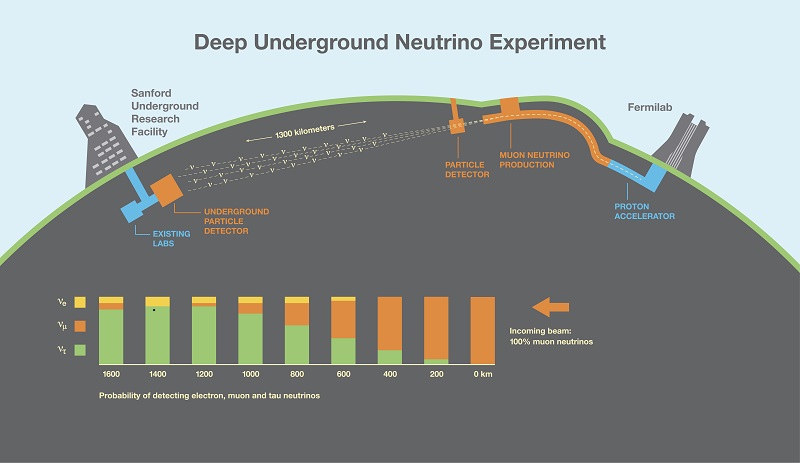
A team in Warwick, led by Dr. John Marshall, is leading the development of software algorithms capable of automatically reconstructing neutrino interactions in the DUNE detectors. The first phase of funding announced today awards the Warwick group £961,000 for this development work to continue into the construction phase of the project so that when the detector takes first data, from 2026, scientists will be in an optimal position to extract the physics. dune cartoon d6620{module INSIDE STORY}

Head of the University of Warwick experimental particle physics group, Professor Gary Barker, who is also the PI of the DUNE project in the UK, said: “Software developed by the Warwick group applies forefront computational techniques that turn the raw signals from DUNE into physics measurements. This new grant recognizes the world-leading expertise of Warwick in this area and will allow us to continue our leadership role inside the collaboration.”

The DUNE project aims to advance our understanding of the origin and structure of the universe. It will study the behavior of particles called neutrinos and their antimatter counterparts, antineutrinos. This could provide insight as to why we live in a matter-dominated universe while anti-matter has largely disappeared.

DUNE will also watch for supernova neutrinos produced when a star explodes, which will allow the scientists to observe the formation of neutron stars and black holes and will investigate whether protons live forever or eventually decay, bringing us closer to fulfilling Einstein’s dream of a grand unified theory.

Professor Stefan Soldner-Rembold, head of the Particle Physics Group at the University of Manchester as well as DUNE Co-Spokesperson, commented: “DUNE will help to answer fundamental questions that overlap particle physics, astrophysics, and cosmology.”

The UK universities involved in the project are Birmingham, Bristol, Cambridge, Edinburgh, Imperial College London, Lancaster, Liverpool, Manchester, Oxford, Sheffield, Sussex, UCL and Warwick.

Gladstone researchers use machine-learning to discover new ways of controlling the spatial organization of induced pluripotent stem cells

Tyler O'Neal, Staff Editor GOVERNMENT November 20, 2019, 2:58 pm

Model organs grown from patients' own cells may one day revolutionize how diseases are treated. A person's cells, coaxed into heart, lung, liver, or kidney in the lab, could be used to better understand their disease or test whether drugs are likely to help them. But this future relies on scientists' ability to form complex tissues from stem cells, a challenging undertaking.

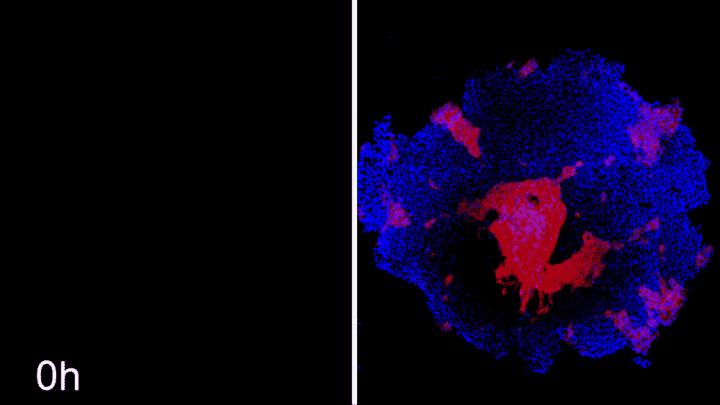
In their natural environment, stem cells form predictable patterns as they mature; over time, these patterns morph into the tissues of an adult organism. In the lab though, researchers have struggled to control the spatial organization of stem cells--an important step toward being able to create functional organs for research or therapeutic purposes. Some have turned to 3-D printing to lay out populations of stem cells in a desired shape. But the approach isn't always successful, with cells often migrating away from their printed locations. CAPTION Machine learning predicts conditions that will cause stem cell colonies to form desired patterns. (Left) Video showing simulated interactions between different stem cell populations. (Right) Stem cells grown in conditions dictated by the machine-learning program generate a colony that forms a bull's-eye pattern, as predicted.  CREDIT Photo credit: Ashley Libby, David Joy, and Iman Haghighi, Gladstone Institutes{module INSIDE STORY}
Now, scientists at Gladstone Institutes, in collaboration with researchers at Boston University, have used a computational model to learn how to coax stem cells into forming new arrangements, including those that might eventually be useful in generating personalized organs.

"We've shown how we can leverage the intrinsic ability of stem cells to organize," said Gladstone Senior Investigator Todd McDevitt, PhD, a lead author of the study, which was published in the journal Cell Systems. "This gives us a new way of engineering tissues, rather than a printing approach where you try to physically force cells into a specific configuration."

"This works exemplifies the power of applying a computational approach to stem cell biology to make sense of the complexity in these cells," said Calin Belta, director of the Boston University Robotics Lab and co-corresponding author on the new paper.

Induced pluripotent stem (iPS) cells, similar to the stem cells found in an embryo, have the potential to become nearly every type of cell in the body. Researchers have found ways to direct iPS cells to become many of these cell types, including heart and brain. Some are already using these cells to model diseases in the lab or even transplant into patients. But clumps of cells in a Petri dish aren't the same thing as functioning three-dimensional organs.

"Despite the importance of organization for functioning tissues, we as scientists have had difficulty creating tissues in a dish with stem cells," said Ashley Libby, a graduate student in the UC San Francisco Developmental & Stem Cell Biology Program and co-first author of the new paper, who worked on the project with David Joy, a graduate student in the joint Graduate Program in Bioengineering from UC Berkeley and UC San Francisco (BioE). "Instead of an organized tissue, we often get a disorganized mix of different cell types."

McDevitt and his colleagues previously showed that blocking, or "knocking down," the expression of two different genes, ROCK1 and CDH1, affected the layout of iPS cells grown in a Petri dish. The scientists wondered whether they could predict the exact arrangement of cells that would result from altering ROCK1 and CDH1 by different degrees at different timepoints. But there were so many possible variables--the timing and degree of each gene knockdown, the duration of the experiment, the proportion of cells affected--that testing every possible combination would be too time-consuming. So McDevitt's group teamed up with the Belta Lab who could help them create a model to do the job.

The researchers used a CRISPR/Cas9 gene-editing system that could be induced to block expression of ROCK1 or CDH1 at any time during an experiment by adding a drug to the iPS cells. In addition, they engineered the system so that cells fluoresced in different colors when they lost expression of ROCK1 or CDH1, making it easier to study changes to the arrangement of the cells.

McDevitt's group carried out a handful of experiments using different doses and timing of the CRISPR/Cas9 system. Then, the computational researchers started inputting the results into a machine-learning program, designed to identify patterns within a dataset.

"Machine learning can predict what movie you might like based on your viewing history, but it can also generate new insights into biological systems by mimicking them." said Demarcus Briers, co-first author of the new paper who performed the work during his graduate studies at Boston University. "Our machine-learning model allows us to predict new ways that stem cells can organize themselves, and produces instructions for how to recreate these predictions in the lab."

The machine-learning program used results from the initial stem cell experiments to infer ways that ROCK1 and CDH1 affect iPS cell organization. With the model up and running, the researchers then began to probe whether it could compute how to make entirely new patterns, like a bull's-eye or an island of cells.

"The power of this model is that it can generate thousands of data points simulating things that it could take months for me to do in a lab," said Libby.

The simulations narrowed down a set of starting conditions that might lead to the desired arrangement of cells--informing researchers exactly when, where, and how to add drugs to their iPS cells to shut off ROCK1 and CHD1. Then, McDevitt and Libby could test those suggested conditions. The machine-learning system, it turned out, was correct--at least when it came to the bull's-eye and island patterns they were after. In the lab, for the first time, the researchers were able to reliably generate concentric circles of stem cell populations looped around each other.

"I was just blown away when I first saw the results," said Bruce Conklin, MD, a Gladstone senior investigator who also worked on the new study. "Modeling cell behavior is the Holy Grail of biology and this paper takes an important step forward in doing that."

The team would like to expand the model in the future--adding in the effects of other developmental genes to get an even wider variety of possible cell configurations. They also plan to work toward designing three-dimensional shapes in addition to the two-dimensional layouts they've already studied.

"We're now on the path to truly engineering multicellular organization, which is the precursor to engineering organs," said McDevitt, who is also the director of the BioE graduate program. "When we can create human organs in the lab, we can use them to study aspects of biology and disease that we wouldn't otherwise be able to."


  1. Russian supercomputer model describes the dynamic instability of microtubules
  2. Curtin astrophysicist uses the Pawsey Supercomputing Centre, outback telescope to capture Milky Way center, discovers remnants of dead stars

Page 69 of 85

  • 64
  • 65
  • 66
  • 67
  • 68
  • 69
  • 70
  • 71
  • 72
  • 73
POPULAR RIGHT NOW
  • AI supercharges the hunt for stronger magnets: Iowa State researchers launch a new era of intelligent materials discovery
    AI supercharges the hunt for stronger magnets: Iowa State researchers launch a new era of intelligent materials discovery
  • IBM's Historic stock collapse raises questions for the future of enterprise supercomputing
    IBM's Historic stock collapse raises questions for the future of enterprise supercomputing
  • Could a novel dark matter theory simultaneously resolve multiple cosmic enigmas? Supercomputer simulations provide a compelling, albeit currently unverified, potential solution
    Could a novel dark matter theory simultaneously resolve multiple cosmic enigmas? Supercomputer simulations provide a compelling, albeit currently unverified, potential solution
  • Melting icebergs may be reshaping Earth’s greatest ocean current
    Melting icebergs may be reshaping Earth’s greatest ocean current
  • Supercomputers replace ‘bathtub’ flood maps with physics-based digital twins of Britain’s coastline
    Supercomputers replace ‘bathtub’ flood maps with physics-based digital twins of Britain’s coastline
  • Supercomputers push neural quantum simulation beyond previous limits
    Supercomputers push neural quantum simulation beyond previous limits
  • Intel’s AI supercomputing revival: Q2 financial surge signals new era for CPU-powered HPC infrastructure
    Intel’s AI supercomputing revival: Q2 financial surge signals new era for CPU-powered HPC infrastructure
  • AI infrastructure financing fears shake semiconductor sector
    AI infrastructure financing fears shake semiconductor sector
  • AWS supercomputing investment reaches historic scale as Amazon’s AI strategy powers record financial results
    AWS supercomputing investment reaches historic scale as Amazon’s AI strategy powers record financial results
  • Catching the wave of the future: Supercomputers unlock the hidden dynamics of Venus
    Catching the wave of the future: Supercomputers unlock the hidden dynamics of Venus
THIS YEAR'S MOST READ
  • Wall Street wants to trade supercomputing power like oil
    Wall Street wants to trade supercomputing power like oil
  • Beamforming the future: BeammWave's 6G push signals the rise of orbital-terrestrial wireless networks
    Joakim Axmon
    Joakim Axmon
  • Cosmic ambition at scale: UK’s supercomputer unlocks a 2.5 petabytes universe
    Cosmic ambition at scale: UK’s supercomputer unlocks a 2.5 petabytes universe
  • Hidden order, revealed at scale: Supercomputing, electron ptychography uncover the inner workings of relaxor ferroelectrics
    Hidden order, revealed at scale: Supercomputing, electron ptychography uncover the inner workings of relaxor ferroelectrics
  • Intel's Q1 results signal supercomputing surge driving Xeon momentum
    Intel's Q1 results signal supercomputing surge driving Xeon momentum
  • When stars fall apart: Supercomputing reveals the hidden physics of black holes
    When stars fall apart: Supercomputing reveals the hidden physics of black holes
  • Multi-layer simulations reveal the hidden supply chain of solar prominences
    Multi-layer simulations reveal the hidden supply chain of solar prominences
  • Japanese scientists decode dolphin speed with supercomputing: Turbulence, vortices, and the hidden physics of propulsion
    Japanese scientists decode dolphin speed with supercomputing: Turbulence, vortices, and the hidden physics of propulsion
  • Cosmic feedback at scale: Supercomputing reveals how quasars regulate the early Universe
    Cosmic feedback at scale: Supercomputing reveals how quasars regulate the early Universe
  • Modeling life at the microscopic scale: A computational breakthrough in oxygen transport
    Modeling life at the microscopic scale: A computational breakthrough in oxygen transport
MOST READ OF ALL-TIME
  • Largest Computational Biology Simulation Mimics The Ribosome
    Details
    112127
    The amino acid (green) slithers into the chemical reaction center, moving through an evolutionarily ancient corridor of the ribosome (purple). The amino acid is delivered to the reaction core by the transfer RNA molecule (yellow).
    The amino acid (green) slithers into the chemical reaction center, moving through an evolutionarily ancient corridor of the ribosome (purple). The amino acid is delivered to the reaction core by the transfer RNA molecule (yellow).
  • Silicon 'neurons' may add a new dimension to chips
    Details
    81040
    Silicon 'neurons' may add a new dimension to chips
  • Linux Networx Accelerators Expected to Drive up to 4x Price/Performance
    Details
    75563
  • Complex Concepts That Really Add Up
    Details
    73693
    Complex Concepts That Really Add Up
  • Blue Sky Studios Donates Animation SuperComputer to Wesleyan
    Details
    68166
    Each rack holds 52 Angstrom Microsystem-brand “blades,” with a memory footprint of 12 or 24 gigabytes each. (Photos by Olivia Bartlett Drake)
    Each rack holds 52 Angstrom Microsystem-brand “blades,” with a memory footprint of 12 or 24 gigabytes each. (Photos by Olivia Bartlett Drake)
  • Humanities, HPC connect at NERSC
    Details
    57973
  • TeraGrid ’09 'Call for Participation'
    Details
    54976
  • Turbulence responsible for black holes' balancing act
    Details
    52339
  • Cray Wins $52 Million SuperComputer Contract
    Details
    50162
  • SDSC Researchers Accurately Predict Protein Docking
    Details
    46115
  • FRONTPAGE
  • LATEST
  • POPULAR
  • REGISTER
  • SOCIAL
  • VIDEO
  • SUBSCRIPTION
  • RSS
  • GUIDELINES
  • PRIVACY
  • TOS
  • ABOUT
  • +1 (816) 799-4488
  • editorial@supercomputingonline.com
© 2001 - 2026 SuperComputingOnline.com, LLC. All rights reserved. This material may not be published, broadcast, rewritten or redistributed without permission.
Sign In
  • FRONT PAGE
  • LATEST
    • MEDIA KIT
    • MOST READ
    • RSS FEED
    • ACADEMIA
    • AEROSPACE
    • APPLICATIONS
    • ASTRONOMY
    • AUTOMOTIVE
    • BIG DATA
    • BIOLOGY
    • CHEMISTRY
    • CLIENTS
    • CLOUD
    • DEFENSE
    • DEVELOPER TOOLS
    • EARTH SCIENCES
    • ECONOMICS
    • ENGINEERING
    • ENTERTAINMENT
    • HEALTH
    • INDUSTRY
    • INTERCONNECTS
    • GAMING
    • GOVERNMENT
    • MANUFACTURING
    • MIDDLEWARE
    • MOVIES
    • NETWORKS
    • OIL & GAS
    • PHYSICS
    • PROCESSORS
    • RETAIL
    • SCIENCE
    • STORAGE
    • SYSTEMS
    • VISUALIZATION
  • VIDEOS
    • ADD YOUR VIDEOS
    • MANAGE VIDEOS
  • COMMUNITY
    • TRADE SHOWS
    • SOCIAL NETWORK VIDEOS
    • SURVEYS
    • APPLICATIONS BROWSER
    • CONVERSATION INBOX
    • SOCIAL ADVERTISER
    • GROUPS
    • MARKETPLACE LISTINGS
    • PAGES
    • LEADERBOARD
    • POINTS LISTING
      • BADGES
    • PRIVACY CONFIRM REQUEST
    • PRIVACY CREATE REQUEST

Hey there! We noticed you’re using an ad blocker.