Japanese scientists create an inexpensive sensor for real-time measurement of rain, wind

Have you ever been trapped in an unexpected torrential downpour? Weather forecasting systems have always tried to anticipate adverse weather events. These systems, however, are heavily dependent on bulky, stationary, expensive equipment such as weather radar, impeding timely updates on local weather conditions for personal use. Tackling this gap in knowledge and practicality, a research team from Osaka Metropolitan University and the University of Tokyo developed an attachable and lightweight sensor sheet that features a flexible resistive sensor and a reservoir computing analysis. This single device allows simultaneous real-time measurement of raindrop volume and wind speed, reporting weather information when attached to umbrellas, cars, or houses. Research lead Professor Kuniharu Takei of Osaka Metropolitan University noted, “The findings open up a promising economical approach to weather reporting, contributing to disaster preparedness and greater community safety.” A versatile, flexible sensor sheet can be easily fixed to a wide range of surfaces to simultaneously monitor rain volume and wind speed. The sensor measures the electrical resistance generated when raindrops hit its surface at different wind speeds and provides sensor data, which is analyzed through reservoir computing.  CREDIT Kuniharu Takei, OMU
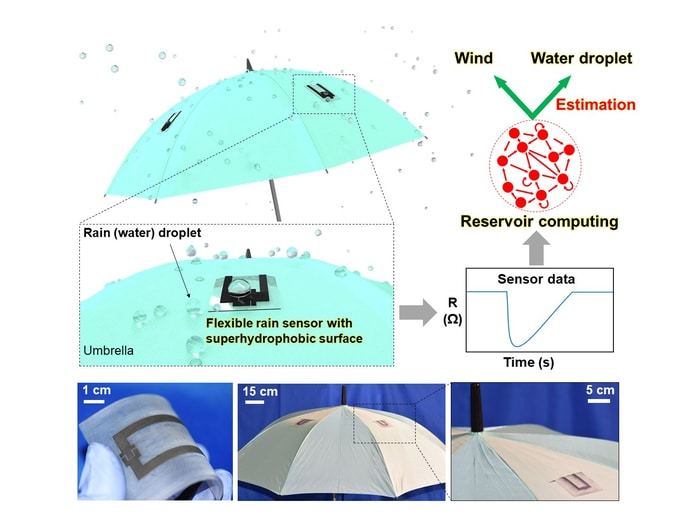
To determine rain volume, the sensor measures the electrical resistance generated when a raindrop hits its surface. It is protected by a superhydrophobic silicone sheet of polydimethylsiloxane (PDMS), which is infused with graphene and further processed with a laser. The superhydrophobic silicone repels water droplets, ensuring the durability and stability of the sensor. Laser texturing allows constant control and measurement of the behavior of water droplets, be they staying, sliding, bouncing, or splitting on the sensor surface. The sensor can be easily fixed to a wide range of surfaces and remains functional when flat or bent. Testing changes in rain volume estimations with the sensor mounted at various angles showed no significant differences, suggesting that the sensor can be attached to hand-carried items such as umbrellas. If widely adopted, it would be possible to obtain mass data that enables the development of real-time local weather maps.

Wind speed has a significant effect on water droplet behavior, indicating the need to measure wind speed at the same time as raindrop volume. Conventionally, measuring multiple pieces of weather data requires multiple sensors, increasing power consumption. Going beyond this traditional practice, the researchers made use of a machine learning algorithm called reservoir computing (RC) to analyze the output data. Changes in rain and wind conditions resulted in resistance changes, which were detected by the sensor and then recorded as time-series data. Such data was used to train the machine, which predicted the pattern and reported rain volume and wind speed as output information.

Even though there is still more work to be done to further improve its accuracy, the sensor is expected to be a mainstay of next-generation weather sensing. The study progresses the United Nations Sustainable Development Goals on resilient infrastructure, sustainable cities, and climate action. “We believe this device can contribute to realizing the ultimate Internet-of-Things society, which is safe, secure, comfortable, and disaster-free,” concluded Professor Takei, “and we would like to engage actively in industry-government-academia collaboration that promotes such practical applications.”

Rice, Waseda team up to crack complexity with modeling car tires

The complex aerodynamics around a moving car and its tires are hard to see, but not for some mechanical engineers.

Specialists in fluid dynamics at Rice University and Waseda University in Tokyo have developed their supercomputer simulation methods to the point where it’s possible to accurately model moving cars, right down to the flow around rolling tires.

The results are there for all to see in a video produced by Takashi Kuraishi, a research associate in the George R. Brown School of Engineering lab of Tayfun Tezduyar, the James F. Barbour Professor of Mechanical Engineering, and a student of alumnus Kenji Takizawa, a professor at Waseda and an adjunct professor at Rice.

“He has been escalating the complexity of his calculations, starting with a stand-alone tire and now having the rest of the car,” Tezduyar said of Kuraishi, who joined the Rice lab in 2020 and is co-supervised by Tezduyar and Takizawa.

{media id=281,layout=solo}

The video also demonstrates the efficacy of the NURBS Surface-to-Volume Guided Mesh Generation method, a technique developed by the Team for Advanced Flow Simulation and Modeling co-led by Tezduyar and Takizawa to model flow dynamics around and through complex-geometry objects. NURBS stands for Non-Uniform Rational Basis Splines, a mathematical technique to describe 3D shapes and provide computational analysis of fluid and structural mechanics problems involving such shapes.

An earlier video of fluid flow in a beating heart showed the “through.” The new simulation shows what’s happening around a moving object, in this case, the extraordinary activity around a common subject. Complicating the model is the fact that the tires are in contact with the road and deform as they roll.

“We’re dealing with near-actual car and tire geometries,” Tezduyar said. Takashi Kuraishi

A detailed description of the methods and the car simulation was published last month in the journal Computational Mechanics. Since then, the Rice-Waseda team made the video to bring the illustrations to life.

“Knowing the airflow behavior around the car and its tires will lead to a better understanding of their aerodynamic performance,” said Kuraishi, who earned undergraduate, master’s, and Ph.D. degrees at Waseda and spent a year as a postdoctoral researcher there with Takizawa before coming to Houston. “Simulations this sophisticated are important to provide realistic solutions and reliable answers in design and performance evaluation.”

Tezduyar, whose lab has also modeled recovery parachutes for NASA’s Orion capsules, said NURBS use in computational analysis has grown dramatically in recent years, combining efficiency and accuracy by lowering the number of “mesh” points necessary to model a system. Think of the mesh as a net of fluid (like air) around an object, with the mesh points living in 3D “elements.” The points and elements move when the object moves. Kenji Takizawa

In one model of a moving car, the computational flow analysis with NURBS was achieved with about 1.1 million points, a fraction of the number used in customary methods, while retaining its accuracy. That lowers the computational cost as well, Tezduyar said.

“We have a 3D mesh around the car and the tires, with more points near the tire surfaces for higher accuracy where it matters more,” he said. “As the tire rotates, the points and elements rotate with it, but the problem is that as the tire rotates, the elements moving under the tire collapse -- and this is what other methods cannot handle. Our method does, and it is key to getting an accurate simulation.”

As with the heart study, Tezduyar said their team is eager to collaborate with scientists and industry to model complex systems, including tires and vehicles.

“As time passes, naturally, new tire designs or improvements will be considered,” he said. “It would be very beneficial for tire manufacturers to do this type of simulation before they invest in generating a prototype because it would give them comprehensive and detailed numerical data about the aerodynamics around the tire that would be difficult to get in any other way.”

Tayfun TezduyarCo-authors of the paper are Satoshi Yamasaki, Zhaojing Xu, and Ryutaro Kaneko, all of Waseda University.

NIH funds CUNY SPH, West Point AI center for precision nutrition, health

The center will develop and use new computational, data science, and tech approaches to advance precision nutrition, improve health and reduce chronic diseases

The National Institutes of Health (NIH) has awarded the CUNY Graduate School of Public Health and Health Policy (CUNY SPH) and the United States Military Academy at West Point an estimated $8.1 million over five years, pending available funds, to establish the world’s first artificial intelligence (AI) and computational modeling center for precision nutrition and health. Precision nutrition is an emerging area aimed at better tailoring diets to different people’s characteristics and circumstances to achieve better health outcomes. This award is part of the Nutrition for Precision Health, powered by the All of Us Research Program (NPH) initiative, a $170 million NIH-wide effort, and the first independent study that will recruit a diverse pool of participants from All of Us to inform more personalized nutrition recommendations. The NPH and the center are part of the NIH’s Common Fund, a special program aimed at catalyzing multiple biomedical disciplines.

The center will develop state-of-the-art AI, machine learning (ML), Big Data methods, and other data science approaches to better understand and improve diet and nutrition. This will include new ways to better understand how individuals have different dietary needs and avoid potential biases and disparities that may result from various nutrition recommendations. The center will be co-led by two world-renowned AI and computational modeling experts, Bruce Y. Lee, MD, MBA, professor of health policy and management at CUNY SPH and executive director of PHICOR (Public Health Informatics, Computational, and Operations Research) and Diana M. Thomas, Ph.D., professor and research chair of mathematics at West Point. 

“As the nation’s leading urban public university, CUNY is proud to help drive cutting-edge research, in partnership with West Point, that aims to bring more equity to nutrition and health approaches,” said CUNY Chancellor Félix V. Matos Rodríguez. “The Nutrition for Precision Health initiative will leverage the expertise of CUNY SPH as well as the University’s great diversity, reach, and dedication to social justice. With their renowned work in artificial intelligence and computational modeling, Drs. Lee and Thomas are the ideal scholars to lead this ambitious new center.”

“Our society is at a key inflection point,” says Lee. “We now have much more data and technology available to guide diet and nutrition in ways that have not been previously done. This could greatly improve the health of people around the world; however, if not done correctly, it could worsen health outcomes and deepen health disparities.”

“This is the first time that leading experts in data science, statistics, and systems modeling will collaborate with the top nutrition clinical and nutrition research centers in the U.S.,” says Thomas. “The effort is unique and extremely timely as we can combine new AI approaches with unprecedented levels of computing power to develop algorithms for personalized nutrition guidance.”

The center will include multiple major projects, including one led by AI expert Samantha Kleinberg, Ph.D., associate professor at Stevens Institute of Technology, and another led by social network expert Kayla de la Haye, Ph.D., associate professor at the University of Southern California. “AI and ML have helped advance many areas of health research, but we haven’t seen the benefits in nutrition because we’ve lacked the key ingredient: large scale, high quality, data on diverse populations,” says Kleinberg. “This award grants us the opportunity to finally go beyond correlations to learn not just what factors are related to health outcomes but how diet causes them and for whom.”

The center will develop data science approaches and technology to address the whole complex system of factors that affect nutrition and health, ranging from genetics to metabolism to behavior to a person’s social and physical environment. “Studies have shown that diet and nutrition can be affected by the people and things around you and your circumstances,” says de la Haye.

The connection between CUNY SPH and West Point is unique. For the first time, the public academic institutions will collectively utilize their technologies and resources in a way that improves health inequities and advances precision nutrition and health.