Japanese researchers use diamond color centers for nonlinear photonics

Researchers at the University of Tsukuba use color center defects in diamonds to demonstrate second-order nonlinear optical effects, which may allow for extremely fast all-optical communication and computation devices.

Researchers from the Department of Applied Physics at the University of Tsukuba in Japan have demonstrated second-order nonlinear optical effects in diamonds by taking advantage of internal color center defects that break the inversion symmetry of the diamond crystals. This research may lead to faster internet communications, all-optical supercomputers, and even open a route to next-generation quantum sensing technologies. Figure 1. The nonlinear emission spectrum from diamond crystal with NV centers (NV diamond) excited with IR laser (1350 nm). Both SHG and THG are simultaneously generated at 675 nm and 450 nm, respectively. An inset photograph was taken during the nonlinear emission (SHG and THG) from the NV diamond.

Current fiber optical technology uses light pulses to transfer broad-bandwidth data that let you check your email, watch videos, and everything else on the Internet. The main drawback is that light pulses hardly interact with each other, so the information must be converted into electrical signals to allow your computer to handle it. An “all-optical” system with light-based logic processing would be much faster and more efficient. This would require new, easy-to-fabricate nonlinear optical materials that can mediate the combination or splitting of photons.

Now, a team of researchers at the University of Tsukuba have shown that synthetic diamonds can exhibit a second-order nonlinear response. Previously, scientists thought that the inversion-symmetric nature of diamond crystal lattice could only support weaker, odd-order nonlinear optical effects, which depend on the electric field amplitude raised to the power of three, five, and so on. But the team showed diamonds can support second-order nonlinear optical effects when color centers—so-called nitrogen-vacancy (NV) centers—are introduced. In these cases, two adjacent carbon atoms in the diamond’s rigid lattice are replaced with a nitrogen atom and a vacancy. This breaks the inversion symmetry and permits even-order nonlinear processes to occur, which include more useful outcomes that scale as the electric field squared. “Our work allows us to produce powerful second-order nonlinear optical effects, such as second-harmonic generation and electro-optic effect, in bulk diamonds,” senior author Professor Muneaki Hase says.

The team used chemical vapor-deposited single-crystal diamonds (from Element Six), with extra nitrogen ions implanted to encourage the formation of NV centers. The emission spectrum they observed when the diamonds were excited with 1350-nm light showed clear second-and third-order harmonic peaks (Figure 1). These observations represent the merging of two or three photons, respectively, into a single photon of higher energy. “In addition to new photonic devices, second-order nonlinear optical effect by NV centers in diamonds might be used as the basis of quantum sensing of electromagnetic fields,” first author Dr. Aizitiaili Abulikemu says. Because diamonds are already used in industrial applications, they have the advantage of being relatively easily applicable to optical uses. The work has been published in ACS Photonics as “Second-harmonic generation in bulk diamond based on inversion symmetry breaking by color centers.” (DOI: 10.1021/acsphotonics.0c01806).

Japanese researchers devise a new approach to show how ghost-like neutrinos helped shape the Universe

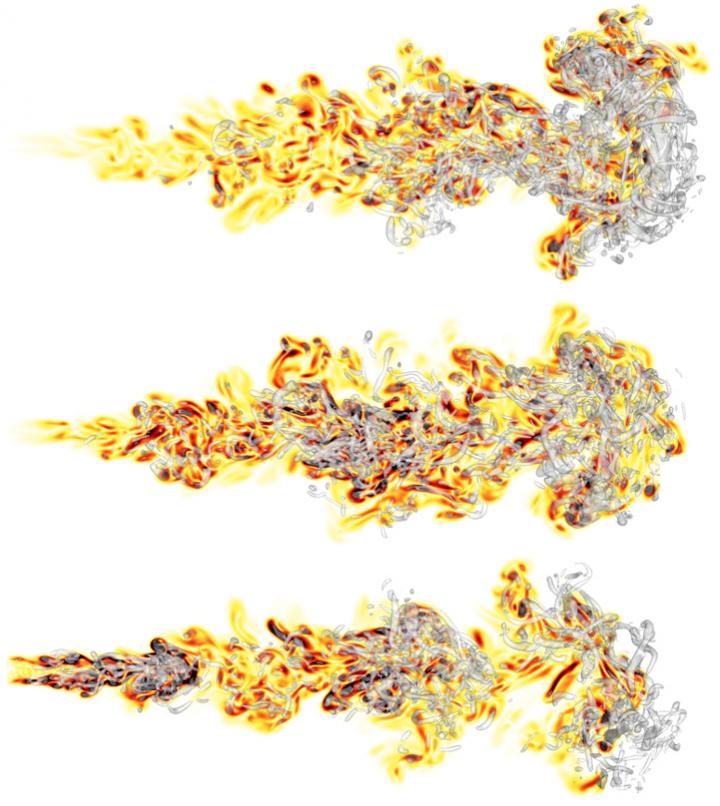
Supercomputer simulations have struggled to capture the impact of elusive particles called neutrinos on the formation and growth of the large-scale structure of the Universe. But now, a research team from Japan has developed a method that overcomes this hurdle.

In a study published this month in The Astrophysical Journal, researchers led by the University of Tsukuba present simulations that accurately depict the role of neutrinos in the evolution of the Universe.

Why are these simulations important? One key reason is that they can set constraints on a currently unknown quantity: the neutrino mass. If this quantity is set to a particular value in the simulations and the simulation results differ from observations, that value can be ruled out. However, the constraints can be trusted only if the simulations are accurate, which was not guaranteed in previous work. The team behind this latest research aimed to address this limitation.

“Earlier simulations used certain approximations that might not be valid,” says lead author of the study Lecturer Kohji Yoshikawa. “In our work, we avoided these approximations by employing a technique that accurately represents the velocity distribution function of the neutrinos and follows its time evolution.” {module INSIDE STORY} Researchers led by the University of Tsukuba devise a new approach to show how ghost-like neutrinos helped shape the Universe

To do this, the research team directly solved a system of equations known as the Vlasov–Poisson equations, which describe how particles move in the Universe. They then carried out simulations for different values of the neutrino mass and systemically examined the effects of neutrinos on the large-scale structure of the Universe.

The simulation results demonstrate, for example, that neutrinos suppress the clustering of dark matter—the ‘missing’ mass in the Universe—and in turn galaxies. They also show that neutrino-rich regions are strongly correlated with massive galaxy clusters and that the effective temperature of the neutrinos varies substantially depending on the neutrino mass.

“Overall, our findings suggest that neutrinos considerably affect the large-scale structure formation and that our simulations provide an accurate account for the important effect of neutrinos,” explains Lecturer Yoshikawa. “It is also reassuring that our new results are consistent with those from entirely different simulation approaches.”

This work represents a milestone in simulating the Universe and paves the way for further exploration of how neutrinos influence the formation and growth of the large-scale structure. For instance, the new simulation approach could be used to study the dynamics of neutrinos and unconventional types of dark matter. Ultimately, it might lead to a determination of the neutrino mass.

Korean bio simulations open a new way to reverse cell aging

Turning off a newly identified enzyme could reverse a natural aging process in cells

Research findings by a KAIST team provide insight into the complex mechanism of cellular senescence and present a potential therapeutic strategy for reducing age-related diseases associated with the accumulation of senescent cells.

Simulations that model molecular interactions have identified an enzyme that could be targeted to reverse a natural aging process called cellular senescence. The findings were validated with laboratory experiments on skin cells and skin equivalent tissues, and published in the Proceedings of the National Academy of Sciences (PNAS).

"Our research opens the door for a new generation that perceives aging as a reversible biological phenomenon," says Professor Kwang-Hyun Cho of the Department of Bio and Brain Engineering at the Korea Advanced Institute of Science and Technology (KAIST), who led the research with colleagues from KAIST and Amorepacific Corporation in Korea. The scientists conducted what is known as an ensemble model simulation to identify molecules that could be targeted to reverse cell senescence. They then used the model to predict the effects of inhibiting PDK1 in senescent cells, and confirmed the results in lab-cultured cells and skin equivalent tissue models.{module INSIDE STORY}

Cells respond to a variety of factors, such as oxidative stress, DNA damage, and shortening of the telomeres capping the ends of chromosomes, by entering a stable and persistent exit from the cell cycle. This process, called cellular senescence, is important, as it prevents damaged cells from proliferating and turning into cancer cells. But it is also a natural process that contributes to aging and age-related diseases. Recent research has shown that cellular senescence can be reversed. But the laboratory approaches used thus far also impair tissue regeneration or have the potential to trigger malignant transformations.

Professor Cho and his colleagues used an innovative strategy to identify molecules that could be targeted for reversing cellular senescence. The team pooled together information from the literature and databases about the molecular processes involved in cellular senescence. To this, they added results from their own research on the molecular processes involved in the proliferation, quiescence (a non-dividing cell that can re-enter the cell cycle), and senescence of skin fibroblasts, a cell type well known for repairing wounds. Using algorithms, they developed a model that simulates the interactions between these molecules. Their analyses allowed them to predict which molecules could be targeted to reverse cell senescence.

They then investigated one of the molecules, an enzyme called PDK1, in incubated senescent skin fibroblasts and three-dimensional skin equivalent tissue models. They found that blocking PDK1 led to the inhibition of two downstream signaling molecules, which in turn restored the cells' ability to enter back into the cell cycle. Notably, the cells retained their capacity to regenerate wounded skin without proliferating in a way that could lead to malignant transformation.

The scientists recommend investigations are next done in organs and organisms to determine the full effect of PDK1 inhibition. Since the gene that codes for PDK1 is overexpressed in some cancers, the scientists expect that inhibiting it will have both anti-aging and anti-cancer effects.