

Italian Institute of Technology explores satellite data using AI to discover hidden archaeological sites

The Cultural Landscapes Scanner pilot project will exploit Artificial Intelligence to detect the archaeological heritage of the subsoil. The project will last three years and will be carried out by IIT in collaboration with the European Space Agency

Today in Venice, Italy, the "Cultural Landscapes Scanner" (CLS) project has been launched from the collaboration between Istituto Italiano di Tecnologia (IIT- Italian Institute of Technology) and the European Space Agency (ESA) in order to detect archaeological sites from above by analyzing satellite images through artificial intelligence (AI). IIT's researchers of the Centre of Cultural Heritage Technology, led by Arianna Traviglia, will introduce AI to help archaeologists trace back the ancient presence of humans by revealing hidden traces in the soil. The AI will be able to recognize even minimal or imperceptible variations in vegetation or other particular signs of the surface that may indicate the presence of remains not yet discovered. The project will last three years and may have as an immediate outcome an improved capacity of identifying cultural heritage sites at risk of looting. The AI developed by IIT researchers will analyzing satellite images in order to detect traces of hidden archaeological sites.  CREDIT ESA/IIT
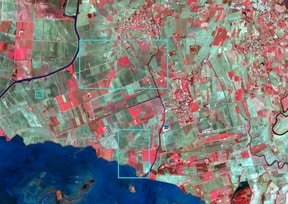
In the last decades, the identification of sub-surface cultural heritage sites has taken advantage of Remote Sensing data, a way of detecting that allows to find buried objects in the sub-soil through images in which is possible to recognize subsoil archaeological deposits from anomalies and traces in bare soils, crops or vegetation. Arianna Traviglia's previous studies have already investigated the potential advantages of developing automated remote sensing, but they have also shown that the current technologies have some limits, being able to detect only very specific objects. In this scenario, web platforms of free remote sensing datasets have known exponential growth and they are amply used by the Cultural Heritage community around the world. Among them, there is Copernicus, the free and open satellite data platform for Earth observation coordinated by the European Commission in partnership with ESA.

However, the visual analysis of data coming from these platforms is extremely complex due to a large amount of data to be managed and because the images must be viewed and human interpreted. For this reason, the real challenge for Traviglia's research group is to add machine learning and computerized artificial vision in order to make this job much easier. The group is one of the few in the world that has designed algorithms for automatic detection of archaeological and cultural heritage sites.

The "Cultural Landscapes Scanner" (CLS) project will have, thus, an innovative approach aiming to overcome the current methods based on subjective observation, making possible a wider and more precise detection thanks to advanced computational methods.

Researchers will define a broad spectrum, adaptable and robust automated recognition procedure, customized for cultural heritage sites using the tele data obtained from the Copernicus platform. Automated Remote Sensing, via machine learning, will produce a more accurate detection of the cultural heritage objects through satellite imagery and clearer identification of ancient land division systems.

Machine learning algorithms can improve automatically by gaining experience in an incremental self-learning process. Therefore, AI will be able to offer an increasingly precise identification of potential underground archaeological sites.

This AI approach will be able to see objects or irregularities that are usually impossible to see for the human eye. The combination of these elements will produce the possibility to observe traces in the vegetation, bare soils, hollows, and crop marks. Thus, AI will support current photo-interpretation practices, based on subjective observations, thanks to its accuracy in analyzing images and the possibility to explore wider spatial areas. Another aspect that will surely profit from the development of Automated Remote Sensing is the increased possibility of cultural heritage preservation. In fact, an immediate outcome will be represented by an improved capacity of response to cultural threats identifying the cultural heritage sites at risk of looting.

Leicester prof uses AI to study an aggressive form of cancer

International genomics research led by the University of Leicester has used artificial intelligence (AI) to study an aggressive form of cancer, which could improve patient outcomes.

Mesothelioma is caused by breathing asbestos particles and most commonly occurs in the linings of the lungs or abdomen. Currently, only seven percent of people survive five years after diagnosis, with a prognosis averaging 12 to 18 months.

New research undertaken by the Leicester Mesothelioma Research Programme has now revealed, using AI analysis of DNA-sequenced mesotheliomas, that they evolve along similar or repeated paths between individuals. These paths predict the aggressiveness and possible therapy of this otherwise incurable cancer.

Professor Dean Fennell, Chair of Thoracic Medical Oncology at the University of Leicester and Director of the Leicester Mesothelioma Research Programme, said:

"It has long been appreciated that asbestos causes mesothelioma, however, how this occurs remains a mystery.

"Using AI to interrogate genomic big data, this initial work shows us that mesotheliomas follow ordered paths of mutations during development and that these so-called trajectories predict not only how long a patient may survive, but also how to better treat cancer - something Leicester aims to lead on internationally through clinical trial initiatives."

While the use of asbestos is now outlawed - and stringent regulations in place on its removal - each year around 25 people are diagnosed with mesothelioma in Leicestershire and 190 are diagnosed in the East Midlands. Cases of mesothelioma in the UK have increased by 61% since the early 1990s.

Until very recently, chemotherapy was the only licensed choice for patients with mesothelioma. However, treatment options start to become limited once people stop responding to their treatment.

Professor Fennell in collaboration with the University of Southampton recently made a major breakthrough in treating the disease by demonstrating that the use of an immunotherapy drug called nivolumab increased survival and stabilized the disease for patients. This was the first-ever trial to demonstrate improved survival in patients with relapsed mesothelioma.

Göttingen, Auckland astrophysicists simulate microscopic clusters from the Big Bang

The very first moments of the Universe can be reconstructed mathematically even though they cannot be observed directly. Physicists from the Universities of Göttingen and Auckland (New Zealand) have greatly improved the ability of complex computer simulations to describe this early epoch. They discovered that a complex network of structures can form in the first trillionth of a second after the Big Bang. The behavior of these objects mimics the distribution of galaxies in today's Universe. In contrast to today, however, these primordial structures are microscopically small. Typical clumps have masses of only a few grams and fit into volumes much smaller than present-day elementary particles. The results of the study have been published in the journal Physical Review D.

The researchers were able to observe the development of regions of higher density that are held together by their own gravity. "The physical space represented by our simulation would fit into a single proton a million times over," says Professor Jens Niemeyer, head of the Astrophysical Cosmology Group at the University of Göttingen. "It is probably the largest simulation of the smallest area of the Universe that has been carried out so far." These simulations make it possible to calculate more precise predictions for the properties of these vestiges from the very beginnings of the Universe. The results of the simulation show the growth of tiny, extremely dense structures very soon after the inflation phase of the very early universe. Between the initial and final states in the simulation (top left and right respectively), the area shown has expanded to ten million times its initial volume, but is still many times smaller than the interior of a proton. The enlarged clump at the bottom left would have a mass of about 20kg.  CREDIT Jens Niemeyer, University of Göttingen

Although the computer-simulated structures would be very short-lived and eventually "vaporize" into standard elementary particles, traces of this extreme early phase may be detectable in future experiments. "The formation of such structures, as well as their movements and interactions, must have generated a background noise of gravitational waves," says Benedikt Eggemeier, a Ph.D. student in Niemeyer's group and first author of the study. "With the help of our simulations, we can calculate the strength of this gravitational wave signal, which might be measurable in the future."

It is also conceivable that tiny black holes could form if these structures undergo runaway collapse. If this happens they could have observable consequences today or form part of the mysterious dark matter in the Universe. "On the other hand," says Professor Easther, "If the simulations predict black holes form, and we don't see them, then we will have found a new way to test models of the infant Universe."