

Physicists at the University of Bonn observe new phase in Bose-Einstein condensate of light particles

A single "super photon" made up of many thousands of individual light particles: About ten years ago, researchers at the University of Bonn produced such an extreme aggregate state for the first time and presented a completely new light source. The state is called optical Bose-Einstein condensate and has captivated many physicists ever since because this exotic world of light particles is home to its very own physical phenomena. Researchers led by Prof. Dr. Martin Weitz, who discovered the super photon and theoretical physicist Prof. Dr. Johann Kroha have returned from their latest "expedition" into the quantum world with a very special observation. The report of a new, previously unknown phase transition in the optical Bose-Einstein condensate. This is a so-called overdamped phase. The results may in the long term be relevant for encrypted quantum communication. The study has been published in the journal Science.

The Bose-Einstein condensate is an extreme physical state that usually only occurs at very low temperatures. What's special: The particles in this system are no longer distinguishable and are predominantly in the same quantum mechanical state, in other words, they behave like a single giant "superparticle". The state can therefore be described by a single wave function. Prof. Dr. Martin Weitz with the optical setup at the measuring table at the Institute of Applied Physics at the University of Bonn.  CREDIT © Gregor Hübl/Uni Bonn

In 2010, Martin Weitz led researchers who succeeded for the first time in creating a Bose-Einstein condensate from light particles (photons). Their special system is still in use today: Physicists trap light particles in a resonator made of two curved mirrors spaced just over a micrometer apart, reflecting a rapidly reciprocating beam of light. Space is filled with a liquid dye solution, which serves to cool down the photons. This is done by the dye molecules "swallowing" the photons and then spitting them out again, which brings the light particles to the dye solution's temperature - equivalent to room temperature. Background: The system makes it possible to cool light particles in the first place because their natural characteristic is to dissolve when cooled.

Clear separation of two phases

Phase transition is what physicists call the transition between water and ice during freezing. But how does the particular phase transition occur within the system of trapped light particles? The scientists explain it this way: The somewhat translucent mirrors cause photons to be lost and replaced, creating a non-equilibrium that results in the system not assuming a definite temperature and being set into oscillation. This creates a transition between this oscillating phase and a damped phase. Damped means that the amplitude of the vibration decreases.

"The overdamped phase we observed corresponds to a new state of the light field, so to speak," says lead author Fahri Emre Öztürk, a doctoral student at the Institute for Applied Physics at the University of Bonn. The special characteristic is that the effect of the laser is usually not separated from that of Bose-Einstein condensate by a phase transition, and there is no sharply defined boundary between the two states. This means that physicists can continually move back and forth between effects.

"However, in our experiment, the overdamped state of the optical Bose-Einstein condensate is separated by a phase transition from both the oscillating state and a standard laser," says study leader Prof. Dr. Martin Weitz. "This shows that there is a Bose-Einstein condensate, which is really a different state than the standard laser. "In other words, we are dealing with two separate phases of the optical Bose-Einstein condensate," he emphasizes.

The researchers plan to use their findings as a basis for further studies to search for new states of the light field in multiple coupled light condensates, which can also occur in the system. "If suitable quantum mechanically entangled states occur in coupled light condensates, this may be interesting for transmitting quantum-encrypted messages between multiple participants," says Fahri Emre Öztürk.

Max Planck's MD simulations of SARS-CoV-2 spike protein reveal potential new vaccine targets

The new model captures glycan molecules whose motions shield much of the spike from immune defenses

A new, detailed model of the surface of the SARS-CoV-2 spike protein reveals previously unknown vulnerabilities that could inform the development of vaccines. Mateusz Sikora of the Max Planck Institute of Biophysics in Frankfurt, Germany, and colleagues present these findings in the open-access journal PLOS Computational Biology.

SARS-CoV-2 is the virus responsible for the COVID-19 pandemic. A key feature of SARS-CoV-2 is its spike protein, which extends from its surface and enables it to target and infect human cells. Extensive research has resulted in detailed static models of the spike protein, but these models do not capture the flexibility of the spike protein itself nor the movements of protective glycans--chains of sugar molecules--that coat it. In this visualization of antibody target sites, the SARS-CoV-2 spike protein is tethered to the viral membrane with a slender stalk. Patches of intense purple color at the surface of spike indicate potential target sites for antibodies that are not protected by the glycans --chains of sugar molecules--shown in green. These binding sites and their accessibility were identified with molecular dynamics simulations that capture the complete structure of the spike protein and its motions in a realistic environment.  CREDIT Mateusz Sikora, Sören von Bülow, Florian E. C. Blanc, Michael Gecht, Roberto Covino and Gerhard Hummer

To support vaccine development, Sikora and colleagues aimed to identify novel potential target sites on the surface of the spike protein. To do so, they developed molecular dynamics simulations that capture the complete structure of the spike protein and its motions in a realistic environment.

These simulations show that glycans on the spike protein act as a dynamic shield that helps the virus evade the human immune system. Similar to car windshield wipers, the glycans cover nearly the entire spike surface by flopping back and forth, even though their coverage is minimal at any given instant.

By combining the dynamic spike protein simulations with bioinformatic analysis, the researchers identified spots on the surface of the spike proteins that are least protected by the glycan shields. Some of the detected sites have been identified in previous research, but some are novel. The vulnerability of many of these novel sites was confirmed by other research groups in subsequent lab experiments.

"We are in a phase of the pandemic driven by the emergence of new variants of SARS-CoV-2, with mutations concentrated in particular in the spike protein," Sikora says. "Our approach can support the design of vaccines and therapeutic antibodies, especially when established methods struggle."

The method developed for this study could also be applied to identify potential vulnerabilities of other viral proteins.

Chinese method for spin-to-charge conversion achieves 95% overall qubit readout fidelity

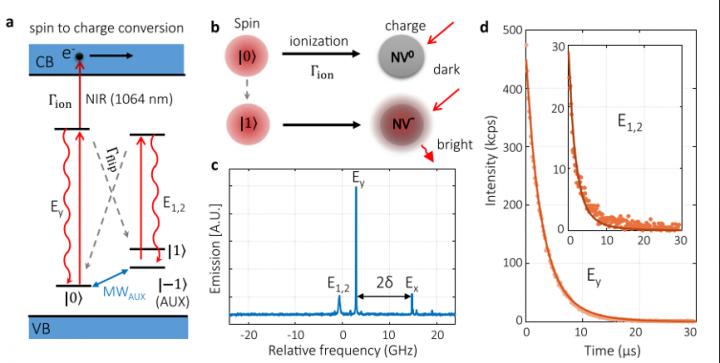
The team led by Professor DU Jiangfeng and Professor WANG Ya from the Chinese Academy of Sciences (CAS) Key Laboratory of Microscale Magnetic Resonance of the University of Science and Technology of China put forward an innovative spin-to-charge conversion method to achieve high-fidelity readout of qubits, stepping closer towards fault-tolerant quantum supercomputing.

Fault-tolerant quantum supercomputing requires the accumulated logic gate error and the spin readout fidelity to exceed the fault-tolerant threshold. DU's team has resolved the first requirement in the nitrogen-vacancy (NV) center system previously and this work targeted at the high-fidelity readout of qubits.

Qubit state, such as spin state, is fragile: a common readout approach may cause the flip between the 0 and 1 states for even a few photons resulting in a reading error. The readout fidelity of the traditional resonance fluorescence method is strictly limited by such property. Since the spin state is difficult to measure, researchers blazed a trail to replace it with an easy-to-readout and measurable property: the charge state.

They first compared the optical readout lifetime of the charge state and spin state, finding that the charge state is more stable than the spin state by five orders of magnitude. Experiment results showed that the average non-demolition charge readout fidelity reached 99.96%. a) Energy levels used to achieve SCC. b) A schematic diagram of SCC readout. c) The excitation spectrum of the nitrogen-vacancy (NV) center used here at cryogenic temperature of 8?K. d) Spin-flip process induces the photoluminescence (PL) decay.  CREDIT ZHANG Qi et al.

Then the team adopted near-infrared (NIR) light (1064 nm) to induce the ionization of the excited spin state, transforming the spin state 0 and 1 to the "electrically neutral" and "negatively charged" charge states respectively. This process converted the spin readout to the charge readout.

The results indicated that the error of the traditional resonance fluorescence method reached 20.1%, while the error of this new method can be suppressed to 4.6%.

The article was published in an academic journal.

This new method is compatible with traditional methods, provisioning a spin readout fidelity exceeding the fault-tolerant threshold in real applications. Thanks to the less damage of NIR light to biological tissues and other samples, this method will also effectively improve the detection efficiency of quantum sensors.