CyrusOne deploys second net-positive water data center

CyrusOne is collaborating with Bonneville Environmental Foundation and Trout Unlimited to promote water conservation and sustainability

CyrusOne has announced its second net-positive water data center at the Company’s Carrollton, TX location. The Carrollton data center is the single largest CyrusOne data center in the United States and is located in a high-water stress region as designated by the World Resources Institute. 

“Data center operators across the world are becoming more aware of the significant water usage at these facilities,” said Kyle Myers, Senior Director of Environmental Health, Safety and Sustainability at CyrusOne. “This is a great way to celebrate World Water Day on March 22 and a milestone moment for CyrusOne to further our goals on our path to a sustainable future.” 

Over the past year, water efficiency projects completed at the Carrollton location have reduced onsite water consumption by 67%. By leveraging our zero water-consumption cooling technology, CyrusOne will save millions of gallons of water annually in a drought-prone region. 

The collaboration with the Bonneville Environmental Foundation (BEF) and Trout Unlimited will restore to regional watersheds 20% more water than CyrusOne consumed at the site in 2020. BEF was CyrusOne’s partner in the Company’s first net-positive water facility in Chandler, Arizona, and they are pleased to work together again on the Carrollton project. Trout Unlimited partners with agencies, farmers, and water managers to flexibly manage, store, and deliver water during critical times of the years to increase flows in waterways and facilitate groundwater recharge. By leasing water, exchanging water at critical times, and shifting the timing of water delivery, project partners have been able to increase habitat for fish and provide important economic and community benefits for residents in the region. 

“Addressing water scarcity will require us to not only reduce consumptive water use but also restore water to nature,” said Val Fishman, Chief Development Officer at BEF. “We’re excited to have CyrusOne on board as a leader and partner helping to keep water in rivers during times of water stress. Through Water Restoration Credits, CyrusOne is supporting innovative projects on the Upper Rio Grande region that help farmers, agencies, and water managers restore water flows.” 

This project exemplifies CyrusOne’s commitment to minimize impacts to the local environment and communities in which we operate and also deliver benefits when possible. The Carrollton project is the next step toward our effort to become net water positive in high water stress regions across the company’s global data center portfolio. This is in addition to the announcement earlier this year that the facility will begin incorporating renewable energy in 2021, in support of its Zero Carbon by 2040 target. 

Japanese researchers use diamond color centers for nonlinear photonics

Researchers at the University of Tsukuba use color center defects in diamonds to demonstrate second-order nonlinear optical effects, which may allow for extremely fast all-optical communication and computation devices.

Researchers from the Department of Applied Physics at the University of Tsukuba in Japan have demonstrated second-order nonlinear optical effects in diamonds by taking advantage of internal color center defects that break the inversion symmetry of the diamond crystals. This research may lead to faster internet communications, all-optical supercomputers, and even open a route to next-generation quantum sensing technologies. Figure 1. The nonlinear emission spectrum from diamond crystal with NV centers (NV diamond) excited with IR laser (1350 nm). Both SHG and THG are simultaneously generated at 675 nm and 450 nm, respectively. An inset photograph was taken during the nonlinear emission (SHG and THG) from the NV diamond.

Current fiber optical technology uses light pulses to transfer broad-bandwidth data that let you check your email, watch videos, and everything else on the Internet. The main drawback is that light pulses hardly interact with each other, so the information must be converted into electrical signals to allow your computer to handle it. An “all-optical” system with light-based logic processing would be much faster and more efficient. This would require new, easy-to-fabricate nonlinear optical materials that can mediate the combination or splitting of photons.

Now, a team of researchers at the University of Tsukuba have shown that synthetic diamonds can exhibit a second-order nonlinear response. Previously, scientists thought that the inversion-symmetric nature of diamond crystal lattice could only support weaker, odd-order nonlinear optical effects, which depend on the electric field amplitude raised to the power of three, five, and so on. But the team showed diamonds can support second-order nonlinear optical effects when color centers—so-called nitrogen-vacancy (NV) centers—are introduced. In these cases, two adjacent carbon atoms in the diamond’s rigid lattice are replaced with a nitrogen atom and a vacancy. This breaks the inversion symmetry and permits even-order nonlinear processes to occur, which include more useful outcomes that scale as the electric field squared. “Our work allows us to produce powerful second-order nonlinear optical effects, such as second-harmonic generation and electro-optic effect, in bulk diamonds,” senior author Professor Muneaki Hase says.

The team used chemical vapor-deposited single-crystal diamonds (from Element Six), with extra nitrogen ions implanted to encourage the formation of NV centers. The emission spectrum they observed when the diamonds were excited with 1350-nm light showed clear second-and third-order harmonic peaks (Figure 1). These observations represent the merging of two or three photons, respectively, into a single photon of higher energy. “In addition to new photonic devices, second-order nonlinear optical effect by NV centers in diamonds might be used as the basis of quantum sensing of electromagnetic fields,” first author Dr. Aizitiaili Abulikemu says. Because diamonds are already used in industrial applications, they have the advantage of being relatively easily applicable to optical uses. The work has been published in ACS Photonics as “Second-harmonic generation in bulk diamond based on inversion symmetry breaking by color centers.” (DOI: 10.1021/acsphotonics.0c01806).

Japanese researchers devise a new approach to show how ghost-like neutrinos helped shape the Universe

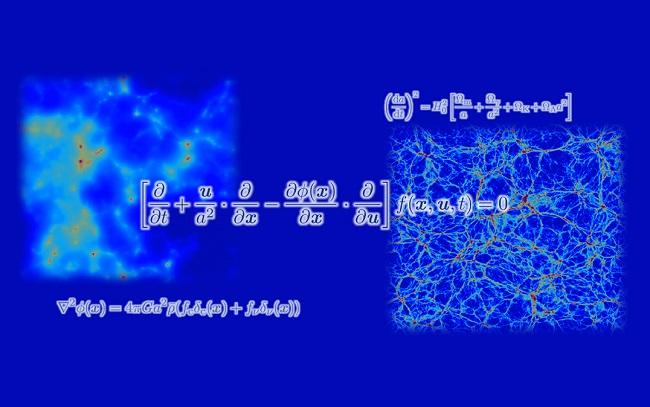
Supercomputer simulations have struggled to capture the impact of elusive particles called neutrinos on the formation and growth of the large-scale structure of the Universe. But now, a research team from Japan has developed a method that overcomes this hurdle.

In a study published this month in The Astrophysical Journal, researchers led by the University of Tsukuba present simulations that accurately depict the role of neutrinos in the evolution of the Universe.

Why are these simulations important? One key reason is that they can set constraints on a currently unknown quantity: the neutrino mass. If this quantity is set to a particular value in the simulations and the simulation results differ from observations, that value can be ruled out. However, the constraints can be trusted only if the simulations are accurate, which was not guaranteed in previous work. The team behind this latest research aimed to address this limitation.

“Earlier simulations used certain approximations that might not be valid,” says lead author of the study Lecturer Kohji Yoshikawa. “In our work, we avoided these approximations by employing a technique that accurately represents the velocity distribution function of the neutrinos and follows its time evolution.” {module INSIDE STORY} Researchers led by the University of Tsukuba devise a new approach to show how ghost-like neutrinos helped shape the Universe

To do this, the research team directly solved a system of equations known as the Vlasov–Poisson equations, which describe how particles move in the Universe. They then carried out simulations for different values of the neutrino mass and systemically examined the effects of neutrinos on the large-scale structure of the Universe.

The simulation results demonstrate, for example, that neutrinos suppress the clustering of dark matter—the ‘missing’ mass in the Universe—and in turn galaxies. They also show that neutrino-rich regions are strongly correlated with massive galaxy clusters and that the effective temperature of the neutrinos varies substantially depending on the neutrino mass.

“Overall, our findings suggest that neutrinos considerably affect the large-scale structure formation and that our simulations provide an accurate account for the important effect of neutrinos,” explains Lecturer Yoshikawa. “It is also reassuring that our new results are consistent with those from entirely different simulation approaches.”

This work represents a milestone in simulating the Universe and paves the way for further exploration of how neutrinos influence the formation and growth of the large-scale structure. For instance, the new simulation approach could be used to study the dynamics of neutrinos and unconventional types of dark matter. Ultimately, it might lead to a determination of the neutrino mass.