UCF researchers distinguish features that could make someone a virus super-spreader

Sneezes from people who have congested noses and a full set of teeth travel about 60% farther than from people who don't, according to a new study

New research from the University of Central Florida has identified physiological features that could make people super-spreaders of viruses such as COVID-19.

In a study appearing this month in the journal Physics of Fluids, researchers in UCF's Department of Mechanical and Aerospace Engineering used supercomputer-generated models to numerically simulate sneezes in different types of people and determine associations between people's physiological features and how far their sneeze droplets travel and linger in the air.

They found that people's features, like a stopped-up nose or a full set of teeth, could increase their potential to spread viruses by affecting how far droplets travel when they sneeze.

According to the U.S. Centers for Disease Control and Prevention, the main way people are infected by the virus that causes COVID-19 is through exposure to respiratory droplets, such as from sneezes and coughs that are carrying the infectious virus.

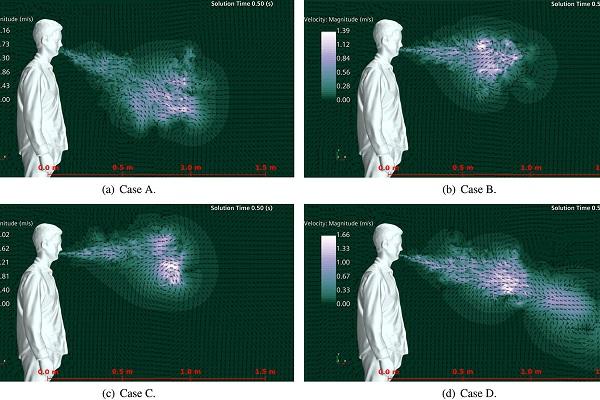
Knowing more about factors affecting how far these droplets travel can inform efforts to control their spread, says Michael Kinzel, an assistant professor with UCF's Department of Mechanical Engineering and study co-author. Sneeze velocity for four different nose and mouth types is shown. A is open nasal passage with teeth, B is open nasal passage without teeth, C is blocked nasal passage without teeth, and D is blocked nasal passage with teeth. {module INSIDE STORY} 
"This is the first study that aims to understand the underlying 'why' of how far sneezes travel," Kinzel says. "We show that the human body has influencers, such as a complex duct system associated with the nasal flow that actually disrupts the jet from your mouth and prevents it from dispersing droplets far distances."

For instance, when people have a clear nose, such as blowing it into a tissue, the speed and distance sneeze droplets travel decrease, according to the study.

This is because a clear nose provides a path in addition to the mouth for the sneeze to exit. But when people's noses are congested, the area that the sneeze can exit is restricted, thus causing sneeze droplets expelled from the mouth to increase in velocity.

Similarly, teeth also restrict the sneeze's exit area and cause droplets to increase in velocity.

"Teeth create a narrowing effect in the jet that makes it stronger and more turbulent," Kinzel says. "They actually appear to drive transmission. So, if you see someone without teeth, you can actually expect a weaker jet from the sneeze from them."

To perform the study, the researchers used 3D modeling and numerical simulations to recreate four mouth and nose types: a person with teeth and a clear nose; a person with no teeth and a clear nose; a person with no teeth and a congested nose; and a person with teeth and a congested nose.

When they simulated sneezes in the different models, they found that the spray distance of droplets expelled when a person has a congested nose and a full set of teeth is about 60 percent greater than when they do not.

The results indicate that when someone keeps their nose clear, such as by blowing it into a tissue, that they could be reducing the distance their germs travel.

The researchers also simulated three types of saliva: thin, medium, and thick.

They found that thinner saliva resulted in sneezes comprised of smaller droplets, which created a spray and stayed in the air longer than medium and thick saliva.

For instance, three seconds after a sneeze, when thick saliva was reaching the ground and thus diminishing its threat, the thinner saliva was still floating in the air as a potential disease transmitter.

The work ties back to the researchers' project to create a COVID-19 cough drop that would give people thicker saliva to reduce the distance droplets from a sneeze or cough would travel, and thus decrease disease-transmission likelihood.

The findings yield novel insight into the variability of exposure distance and indicate how physiological factors affect transmissibility rates, says Kareem Ahmed, an associate professor in UCF's Department of Mechanical and Aerospace Engineering and study co-author.

"The results show exposure levels are highly dependent on the fluid dynamics that can vary depending on several human features," Ahmed says. "Such features may be underlying factors driving super spreading events in the COVID-19 pandemic."

The researchers say they hope to move the work toward clinical studies next to compare their simulation findings with those from real people from varied backgrounds.

Study co-authors were Douglas Fontes, a postdoctoral researcher with the Florida Space Institute and the study's lead author, and Jonathan Reyes, a postdoctoral researcher in UCF's Department of Mechanical and Aerospace Engineering.

Fontes says to advance the findings of the study, the research team wants to investigate the interactions between gas flow, mucus film, and tissue structures within the upper respiratory tract during respiratory events.

"Numerical models and experimental techniques should work side by side to provide accurate predictions of the primary breakup inside the upper respiratory tract during those events," he says.

"This research potentially will provide information for more accurate safety measures and solutions to reduce pathogen transmission, giving better conditions to deal with the usual diseases or with pandemics in the future," he says.
Tokyo University of Science advances spintronics by controlling the magnetization direction of magnetite at room temperature

Over the last few decades, conventional electronics has been rapidly reaching its technical limits in computing and information technology, calling for innovative devices that go beyond the mere manipulation of electron current. In this regard, spintronics, the study of devices that exploit the "spin" of electrons to perform functions, is one of the hottest areas in applied physics. But, measuring, altering, and, in general, working with this fundamental quantum property is no mean feat. CAPTION Creating high-density spintronic memory devices with large capacity and even neuromorphic devices that mimic biological neural systems.

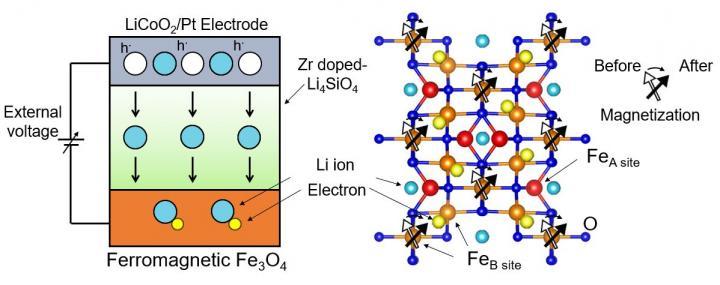
Current spintronic devices--for example, magnetic tunnel junctions--suffer from limitations such as high-power consumption, low operating temperatures, and severe constraints in material selection. To this end, a team of scientists at Tokyo University of Science and the National Institute for Materials Science (NIMS), Japan, has recently published a study in ACS Nano, in which they present a surprisingly simple yet efficient strategy to manipulate the magnetization angle in magnetite (Fe3O4), a typical ferromagnetic material. The team fabricated an all-solid reduction-oxidation ("redox") transistor containing a thin film of Fe3O4 on magnesium oxide and a lithium silicate electrolyte doped with zirconium (Fig. 1). The insertion of lithium ions in the solid electrolyte made it possible to achieve rotation of the magnetization angle at room temperature and significantly change the electron carrier density. Associate Professor Tohru Higuchi from Tokyo University of Science, one of the authors of this published paper, says "By applying a voltage to insert lithium ions in a solid electrolyte into a ferromagnet, we have developed a spintronic device that can rotate the magnetization with lower power consumption than that in magnetization rotation by spin current injection. This magnetization rotation is caused by the change of spin-orbit coupling due to electron injection into a ferromagnet." CAPTION Figure 1. After applying an external voltage, lithium ions flow through the reduction-oxidation transistor and reach the bottom magnetite film, altering its charge carrier concentration and modifying the orientation of Fe spins.  CREDIT Tohru Higuchi, Tokyo University of Science{module INSIDE STORY}

Unlike previous attempts that relied on using strong external magnetic fields or injecting spin-tailored currents, the new approach leverages a reversible electrochemical reaction. After applying an external voltage, lithium ions migrate from the top lithium cobalt oxide electrode and through the electrolyte before reaching the magnetic Fe3O4 layer. These ions then insert themselves into the magnetite structure, forming LixFe3O4 and causing a measurable rotation in its magnetization angle owing to an alteration in charge carriers.

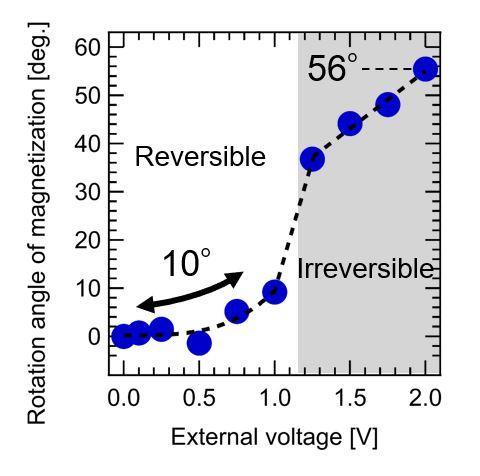
This effect allowed scientists to reversibly change the magnetization angle by approximately 10°. Although a much greater rotation of 56° was achieved by upping the external voltage further, they found that the magnetization angle could not be switched back entirely (Fig. 2). "We determined that this irreversible magnetization angle rotation was caused by a change in the crystalline structure of magnetite due to an excess of lithium ions," explains Higuchi, "If we could suppress such irreversible structural changes, we could achieve a considerably larger magnetization rotation." CAPTION Figure 2. The change in magnetization angle become noticeable under external voltages higher than 0.7 V, yielding a reversible change of about 10°. At voltages higher than 1.2 V, the rotation is more pronounced but becomes irreversible due to permanent structural changes in the magnetite phase.  CREDIT Tohru Higuchi, Tokyo University of Science {module INSIDE STORY}

The novel device developed by scientists represents a big step in the control of magnetization for the development of spintronic devices. Moreover, the structure of the device is relatively simple and easy to fabricate. Dr. Takashi Tsuchiya, Principal Researcher at NIMS, the corresponding author of the study says, "By controlling the magnetization direction at room temperature due to the insertion of lithium ions into Fe3O4, we have made it possible to operate with much lower power consumption than the magnetization rotation by spin current injection. The developed element operates with a simple structure."

Although more work remains to be done to take full advantage of this new device, the imminent rise of spintronics will certainly unlock many novel and powerful applications. "In the future, we will try to achieve a rotation of 180° in the magnetization angle," says Dr Kazuya Terabe, Principal Investigator at the International Center for Materials Nanoarchitectonics at NIMS and a co-author of the study, "This would let us create high-density spintronic memory devices with large capacity and even neuromorphic devices that mimic biological neural systems." Some other applications of spintronics are in the highly coveted field of quantum supercomputing.

Only time will tell what this frontier technology has in line for us!

Missouri S&T researchers use federated learning to improve data security in smart devices

Companies that make internet-connected household devices need user data to improve their products. But customers want assurances that their private information is secure. So how can companies secure private data and improve future products? The answer is machine learning, according to researchers at Missouri University of Science and Technology. 

Missouri S&T researchers want to ensure that the Internet of Things (IoT)-collected data is accurate and usable, while still protecting the items from malicious attacks or invasions of privacy. IoT is physical objects with sensors and software that are connected to the internet. Researchers say that improving a machine-learning technique called federated learning could allow companies to develop new ways to collect anonymous, but accurate, data from users. 

Federated learning trains algorithms with access to multiple individual devices that hold local data. Federated learning doesn't exchange data with the items, which means there is no central dataset or server where all the information is stored. With the lack of shared data in federated learning, concerns such as privacy, security, and access rights could become a non-issue. 

“Federated learning is a game-changer for IoT because it enables machine learning without needing the learner to directly access customer data,” says Dr. Sajal Das, the Daniel C. St. Clair Chair of computer science at S&T. “IoT provides a fertile ground for applying federated learning to private devices that are rich in data.”   {module INSIDE STORY} Image caption: A smart phone is used to operate the lighting and windows within a Missouri S&T Solar Village home. Photo by Sam O’Keefe, Missouri S&T.

Das warns that IoT devices are vulnerable to dynamic environments and attacks from outside sources with erroneous data. Therefore, he says collecting data in a federated manner is crucial.

Das and his co-investigator Dr. Tony Luo, an associate professor of computer science at S&T, are designing new federated learning algorithms with funding from the National Science Foundation and are putting data safety and accuracy above all else in their work. 

“By collecting data from numerous IoT devices without compromising privacy or network capabilities, our methods will allow for growth in the way these devices work and measure data,” says Das. “Our new algorithms will combat erroneous data by designing novel incentive mechanisms to motivate and encourage users who contribute accurate data.” 

Das and Luo hope that users will be willing to contribute data to machine learning while having confidence that the data is not identifiable. That way, the data can be used to push the boundaries of complexity and performance for IoT items. 

Das says that the research has the potential to produce tremendous benefits to personalized industries such as health care. 

“In smart health care, wearable IoT devices can help measure an individual’s health conditions such as vital records, physical activities and food intake,” says Das. “For example, without directly accessing a patient’s sensitive and private information, our novel federated learning approach can investigate how diseases like diabetes are influenced by lifestyle and demography and whether there is a correlation with other health conditions like hypertension.”

Das says that with enough advances in the secure and accurate collection of IoT data, new devices could serve more and better purposes while easing the minds of those who are reluctant to accept smart technology into their homes.