German scientists use hydrodynamical simulations to determine black-hole formation in neutron star collisions

A new study lead by GSI scientists in Germany and international colleagues investigates black-hole formation in neutron star mergers. Supercomputer simulations show that the properties of dense nuclear matter play a crucial role, which directly links the astrophysical merger event to heavy-ion collision experiments at GSI and FAIR. These properties will be studied more precisely at the future FAIR facility. The results have now been published in Physical Review Letters. With the award of the 2020 Nobel Prize in Physics for the theoretical description of black holes and for the discovery of a supermassive object at the center of our galaxy the topic currently also receives a lot of attention.

But under which conditions does a black hole actually form? This is the central question of a study lead by the GSI Helmholtzzentrum für Schwerionenforschung in Darmstadt, Germany within an international collaboration. Using supercomputer simulations, the scientists focus on a particular process to form black holes namely the merging of two neutron stars (simulation movie). CAPTION Artistic representation: In a merger of neutron stars extreme temperatures and densities occur.  CREDIT Dana Berry, SkyWorks Digital, Inc.{module INSIDE STORY}
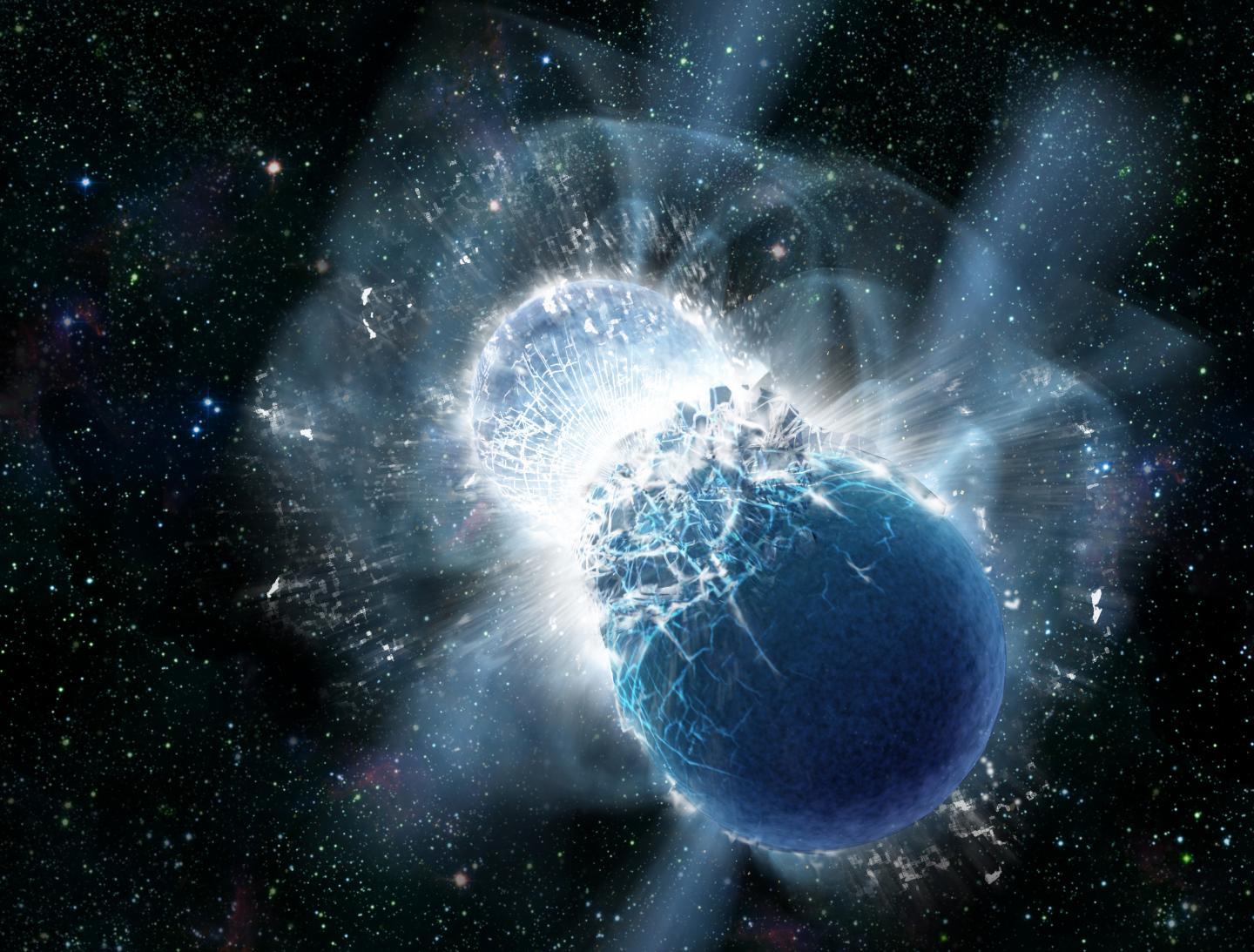
Neutron stars consist of highly compressed dense matter. The mass of one and a half solar masses is squeezed to the size of just a few kilometers. This corresponds to similar or even higher densities than in the inner of atomic nuclei. If two neutron stars merge, the matter is additionally compressed during the collision. This brings the merger remnant on the brink to collapse into a black hole. Black holes are the most compact objects in the universe, even light cannot escape, so these objects cannot be observed directly.

"The critical parameter is the total mass of the neutron stars. If it exceeds a certain threshold the collapse to a black hole is inevitable" summarizes Dr. Andreas Bauswein from the GSI theory department. However, the exact threshold mass depends on the properties of highly dense nuclear matter. In detail, these properties of high-density matter are still not completely understood, which is why research labs like GSI collide atomic nuclei - like a neutron star merger but on a much smaller scale. In fact, the heavy-ion collisions lead to very similar conditions as mergers of neutron stars. Based on theoretical developments and physical heavy-ion experiments, it is possible to compute certain models of neutron star matter, so-call equations of state.

Employing numerous of these equations of state, the new study calculated the threshold mass for black-hole formation. If neutron star matter or nuclear matter, respectively, is easily compressible - if the equation of state is "soft" - already the merger a relatively light neutron stars lead to the formation of a black hole. If the nuclear matter is "stiffer" and less compressible, the remnant is stabilized against the so-called gravitational collapse and a massive rotating neutron star remnant forms from the collision. Hence, the threshold mass for collapse itself informs about the properties of high-density matter. The new study revealed furthermore that the threshold to collapse may even clarify whether during the collision nucleon dissolves into their constituents, the quarks.

"We are very excited about these results because we expect that future observations can reveal the threshold mass" adds Professor Nikolaos Stergioulas of the department of physics of Aristotle University Thessaloniki in Greece. Just a few years ago a neutron star merger was observed for the first time by measuring gravitational waves from the collision. Telescopes also found the "electromagnetic counterpart" and detected light from the merger event. If a black hole is directly formed during the collision, the optical emission of the merger is pretty dim. Thus, the observational data indicates if a black hole was created. At the same time, the gravitational-wave signal carries information about the total mass of the system. The more massive the stars the stronger is the gravitational-wave signal, which thus allows determining the threshold mass.

While gravitational-wave detectors and telescopes wait for the next neutron star mergers, the course is being set in Darmstadt for knowledge that is even more detailed. The new accelerator facility FAIR, currently under construction at GSI, will create conditions, which are even more similar to those in neutron star mergers. Finally, only the combination of astronomical observations, computer simulations and heavy-ion experiments can settle the questions about the fundamental building blocks of matter and their properties, and, by this, they will also clarify how the collapse to a black hole occurs.
WPI awarded more than $900,000 to develop computational models for human cell division

Project funded by National Institutes of Health combines mathematics and biology to identify cellular forces to target cancer

Two researchers at Worcester Polytechnic Institute (WPI) have been awarded $917,999 by the National Institutes of Health to develop computational models for the study of a critical piece of cellular machinery that often goes awry in cancer.

The three-year study will use mathematical techniques and biological findings to assess how cellular forces influence the geometry of the mitotic spindle, a part of the cell’s machinery that is responsible for separating genetic material during cell division.

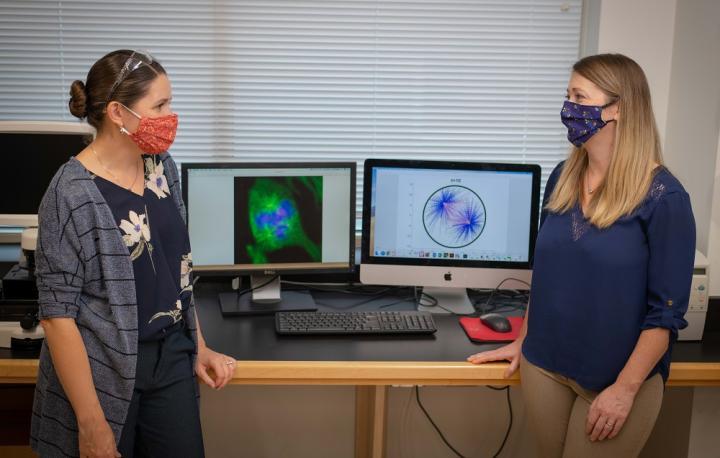
“There is too much going on during cell division to tease out and examine all the possible forces at work through laboratory experiments,” said Sarah Olson, WPI associate professor of mathematical sciences and the principal investigator (PI) of the project. “But by combining experiments with modeling, you can explore factors that lead to defective spindle structure in cells.” WPI professors Amity Manning (left) and Sarah Olson have teamed up to conduct cancer research.{module INSIDE STORY}

The study will build on previous work done by Olson and co-PI Amity Manning, assistant professor of biology and biotechnology, to build computational models to illuminate the forces in human epithelial cells during division. Both Olson and Manning are affiliated with WPI’s Bioinformatics and Computational Biology program.

Computational models use math and supercomputer simulations to adjust numerous variables in a complex system and observe outcomes. Cell division is a complex process in which a parent cell makes a copy of its chromosomes, which contain genetic instructions, and then splits into two new daughter cells.

A healthy cell undergoing division contains two centrosomes that anchor opposite ends of a molecular spindle. As the cell divides, one copy of all chromosomes is pulled toward each anchor point or spindle pole. Both cells that result from the division inherit an identical complement of chromosomes.

Cancer cells, however, often contain more than two centrosomes. The extra centrosomes must cluster together to form a functional spindle with two spindle poles so that a cancer cell can divide into two new cancer cells. If the extra centrosomes do not cluster together, a cancer cell with extra centrosomes divides into more than two new cells, each of which inherits too little genetic material to survive. This suggests that interventions that limit centrosome clustering could promote the death of cancer cells.

Researchers can watch cell division under microscopes, manipulate genes and proteins involved in the process, and monitor the consequences when defects occur, but there are limits to how much can be accomplished in laboratory experiments, Manning said.

“There is a lot of redundancy and overlapping functions in cell division,” Manning said. “We want to understand how centrosome clustering is regulated and how that influences basic cell biology. With modeling, we can simplify complex functions and test scenarios to better understand what’s happening.”

During the project, the researchers will develop new computational models and elucidate the relationship between initial centrosome positions in a cell and cell division. They also will identify how forces, such as the motor protein dynein, impact the movement of centrosomes in a dividing cell with extra centrosomes. Laboratory experiments will inform new computational models, Olson and Manning said, and the models will spur additional laboratory experiments.

“This is truly a collaborative project with a balance of math and biology,” Manning said. “We can brainstorm and think about modeling questions, biological questions, and how we can apply our expertise to this problem.”

Russian physicist develops software to measure black holes stability

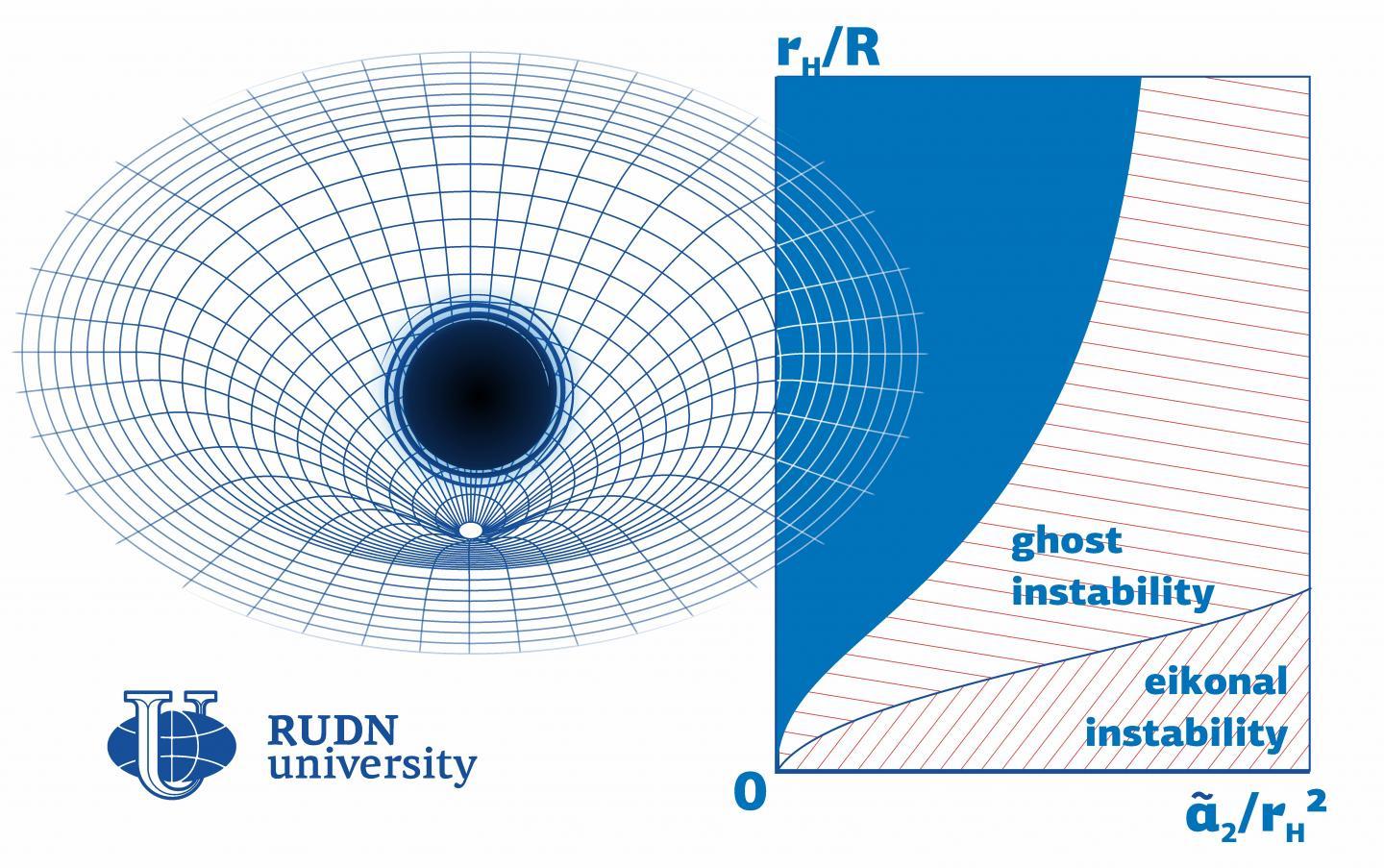
Even if a black hole can be described with a mathematical model, it doesn't mean it exists in reality. Some theoretical models are unstable: though they can be used to run mathematical calculations, from the point of view of physics they make no sense. A physicist from RUDN University developed an approach to finding such instability regions. The work was published in the Physics of the Dark Universe journal.

The existence of black holes was first predicted by Einstein's general theory of relativity. These objects have so strong gravitational pull that nothing, not even light, can escape them. Dense and massive, black holes deform space-time (a physical construct with three spatial and one temporal dimension). Many mathematical models used to describe black holes include corrections to account for such space-time curvatures. The main condition of existence for every black hole model is its stability in cases of minor spatial or temporal changes. Mathematically unstable black holes make no physical sense, as the objects they describe cannot exist in reality. A physicist from RUDN University suggested a method to identify black hole instability parameters in 4D space-time. Even if a black hole can be described with a mathematical model, it doesn't mean it exists in reality. Some theoretical models are unstable: though they can be used to run mathematical calculations, from the point of view of physics they make no sense. A physicist from RUDN University developed an approach to finding such instability regions.{module INSIDE STORY}

"For a model to be considered feasible, a black hole described by it has to remain stable in case of minor space-time fluctuations. One of the most promising approaches to developing alternative gravity theories includes adding corrections to Einstein's equation, including the fourth-order Gauss-Bonnet correction and the Lovelock correction that provides a higher level of generalization," said Roman Konoplya, a researcher at the Educational and Research Institute of Gravitation and Cosmology, RUDN University.

The physicist studied stability in the Einstein-Gauss-Bonnet theory in which a black hole is described by Einstein's equation with a fourth additional component. Previously, he had focused on a different mathematical description of a black hole, the so-called Lovelock theory, that describes a black hole as a sum of an infinite number of components. The instability region turned out to be closely associated with the values of the so-called coupling constants: numerical coefficients by which the corrections to Einstein's equation are multiplied.

According to the physicist, the Einstein-Gauss-Bonnet model does not provide for the existence of small black holes, because if coupling constants are relatively big compared to other parameters (such as the radius of a black hole), the model almost always turns out to be unstable. The stability region is much bigger if the coupling constant has a negative value. Based on these calculations, he and his team developed a program to calculate black hole stability based on any of its parameters.

"Our approach helps test black hole models for stability. We made the code publicly available so that any of our colleagues could use it to calculate instability regions for models with an unspecified set of parameters," added Roman Konoplya.