

SUPERCOMPUTING NEWS SUPERCOMPUTING NEWS
    • MEDIA KIT
    • MOST READ
    • RSS FEED
    • ACADEMIA
    • AEROSPACE
    • APPLICATIONS
    • ASTRONOMY
    • AUTOMOTIVE
    • BIG DATA
    • BIOLOGY
    • CHEMISTRY
    • CLIENTS
    • CLOUD
    • DEFENSE
    • DEVELOPER TOOLS
    • EARTH SCIENCES
    • ECONOMICS
    • ENGINEERING
    • ENTERTAINMENT
    • GAMING
    • GOVERNMENT
    • HEALTH
    • OIL & GAS
    • INDUSTRY
    • INTERCONNECTS
    • MANUFACTURING
    • MIDDLEWARE
    • MOVIES
    • NETWORKS
    • PHYSICS
    • PROCESSORS
    • RETAIL
    • SCIENCE
    • STORAGE
    • SYSTEMS
    • VISUALIZATION
    • AcyMailing subscription form

    • ADD YOUR VIDEOS
    • MANAGE VIDEOS
    • CONVERSATION INBOX
    • SOCIAL ADVERTISER
    • SOCIAL NETWORK VIDEOS
    • SURVEYS
    • GROUPS
    • PAGES
    • MARKETPLACE LISTINGS
    • APPLICATIONS BROWSER
    • PRIVACY CONFIRM REQUEST
    • PRIVACY CREATE REQUEST
    • LEADERBOARD
    • POINTS LISTING
      • BADGES
    • TRADE SHOWS
Sign In
Tyler O'Neal, Staff Editor INDUSTRY April 11, 2022, 4:00 pm

UMass Amherst ensemble model evolves as the most accurate for predicting COVID-19 deaths

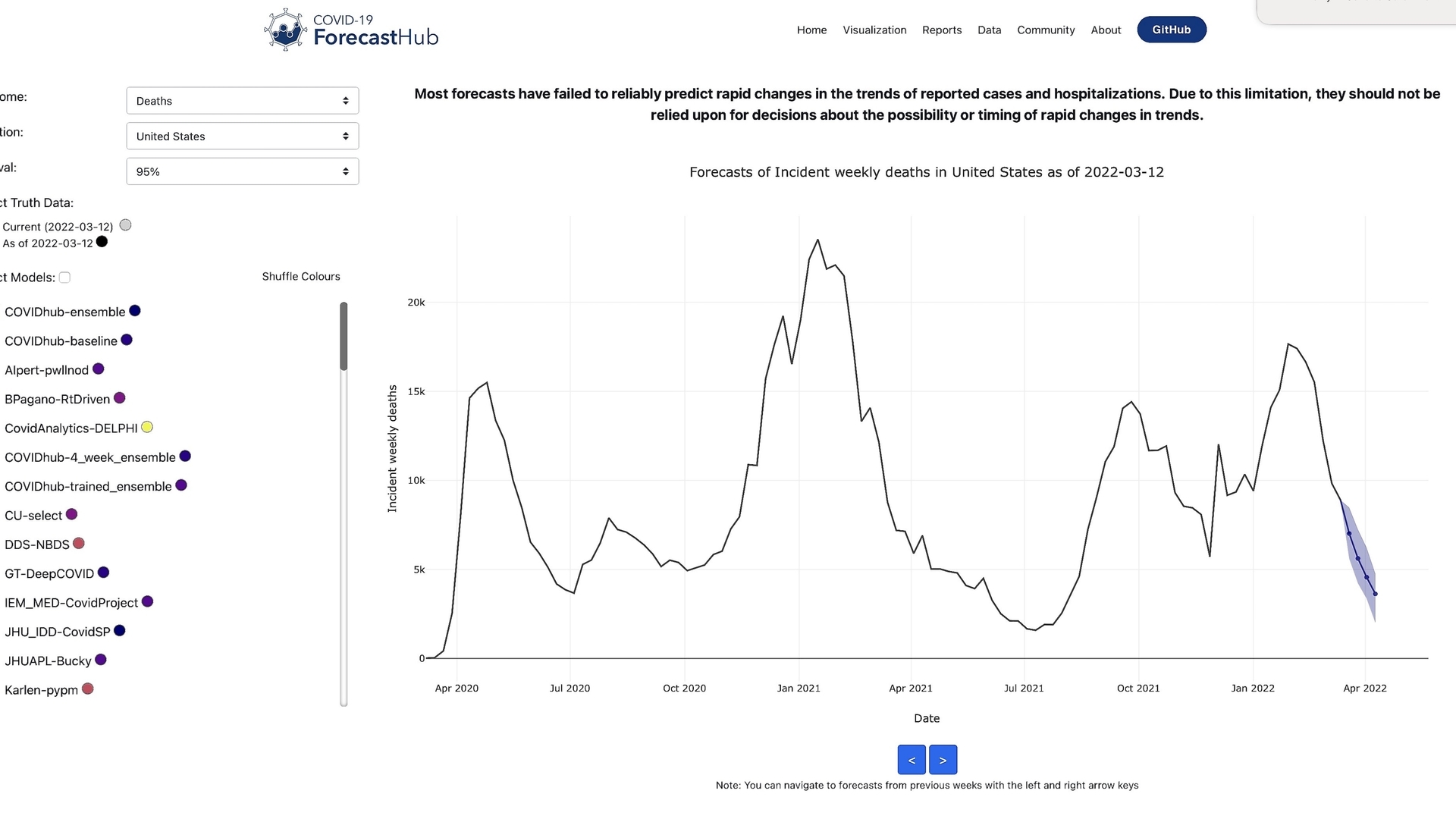
The University of Massachusetts Amherst-based U.S. COVID-19 Forecast Hub, a collaborative research consortium, has generated the most consistently accurate predictions of pandemic deaths at the state and national levels. Every week since early April 2020, this international effort has produced a multi-model ensemble forecast of short-term COVID-19 trends in the U.S.

The COVID-19 pandemic has highlighted the vital role that collaboration and coordination among public health agencies, academic teams, and industry partners can play in developing modern modeling capabilities to support local, state, and federal responses to infectious disease outbreaks. Forecast Hub screenshot 1 428bf
“Anticipating outbreak change is critical for optimal resource allocation and response,” says lead author Estee Cramer, a UMass Amherst Ph.D. epidemiology candidate in the School of Public Health and Health Sciences. “These forecasting models provide specific, quantitative and evaluable predictions that inform short-term decisions, such as healthcare staffing needs, school closures and allocation of medical supplies.”

An unprecedented global cooperative effort, the Forecast Hub represents the largest infectious disease prediction project ever conducted. The ensemble research includes just under 300 authors affiliated with 85 groups, including U.S. government agencies such as the Centers for Disease Control and Prevention (CDC); universities in the U.S., Canada, China, England, France, and Germany; and the scientific industry partners in the U.S. and India. The authors also include independent data analysts with no affiliation, such as Youyang Gu, who took the internet by storm with his early successful modeling efforts of the pandemic.

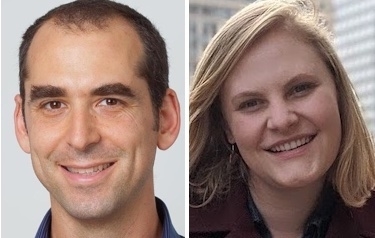
The Forecast Hub is directed by Nicholas Reich and Evan Ray, faculty in the UMass School of Public Health and Health Sciences. “It has been an incredible experience to collaborate directly with so many talented and motivated groups to build this ensemble forecast,” says Reich, a biostatistician and the senior author of the paper. “In addition to the operational aspect of the Hub, where the forecasts have been used by CDC every week for the last two years, this paper shows how we can use these data, collected in real-time across the entire pandemic, to better understand which modeling approaches worked and which did not, and why. It’s going to take many years to unpack all of the lessons of the last few years. In some ways, this is just the beginning.” UMass Amherst professor Nicholas Reich,  ​Ph.D. candidate Estee Cramer
In April 2020, the CDC partnered with the Reich Lab to create the COVID-19 Forecast Hub and fund it. At this time, the Hub began collecting, disseminating, and synthesizing specific predictions from different academic, industry, and independent research groups. The effort grew rapidly, and in its first two years, the U.S. Forecast Hub collected over half a billion rows of forecast data from nearly 100 research groups. The CDC uses the Hub’s weekly forecast in official public communications about the pandemic. 

The paper compared the accuracy of short-term forecasts of U.S.-based COVID-19 deaths during the first year and a half of the pandemic. The 27 individual models that submitted forecasts consistently during that period showed high variation in accuracy across time, locations and forecast horizons. The ensemble model that combined individual forecasts was more consistently accurate than those individual forecasts.

“This project demonstrates the importance of diversity in modeling approaches and modeling assumptions,” Cramer says. “Including a variety of models in the ensemble contributes to its robustness and ability to overcome individual model biases. This is a really important consideration for public health agencies when using forecasts to inform policies during an outbreak of any size.”

The Forecast Hub ensemble was the only model that ranked in the top half of all models for more than 85% of the forecasts it made, that had better overall accuracy than the baseline forecast in every location, and had better overall four-week-ahead accuracy than the baseline forecast in every week.

All the forecasts, including those of the ensemble model, made less consistent and less accurate forecasts during the four waves of the pandemic that occurred during the study period: the summer 2020 wave in the South and Southwest, the late fall 2020 rise in deaths in the upper Midwest, the spring 2021 Alpha variant wave in Michigan and the nationwide Delta variant wave in the summer of 2021. “Models in general systematically underpredicted the mortality curve as trends were rising and overpredicted as trends were falling,” the paper states.

Forecasts became less accurate as models made longer-term predictions. Probabilistic error at a 20-week horizon was three to five times larger than when predicting a one-week horizon. This resulted from underestimating the possibility of future increases in cases, the paper concludes. “Because many of us interact with weather forecasts almost every day on our phones, we know not to trust the daily precipitation forecasts much past a two-week horizon,” Reich says. “But we don’t have the same intuition yet as a society about infectious disease forecasts. This work shows that the accuracy of forecasts for deaths is pretty good for the next four weeks, but at horizons of six weeks or more, the accuracy is typically substantially worse.”

The open-source infrastructure built by the U.S. COVID-19 Forecast Hub team has also been used around the world, including by hubs run by the European Centers for Disease Control and Prevention, German academic researchers, and other U.S. researchers looking at longer-term modeling of different “what if” scenarios.
French researchers explore whether Europe could become self-sufficient in soybeans

Tyler O'Neal, Staff Editor INDUSTRY April 11, 2022, 7:00 am

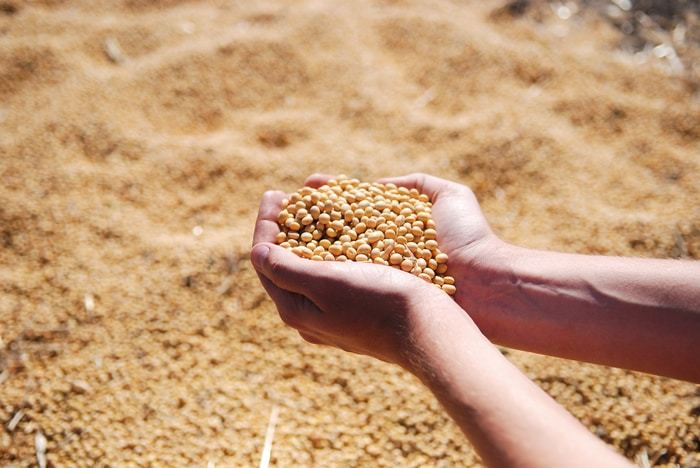
Currently, Europe imports nearly 90% of the soybeans it consumes, mostly from the United States and Brazil, mainly for animal feed. Although the area under soybean cultivation has quadrupled on the continent in 12 years, from 1.2 Mha in 2004 to 5 Mha in 2016, it represented only 1.7% of the total European cultivated area in 2016. Photo of soybeans in hand  CREDIT Pixabay

Yet local soybean cultivation has many economic and environmental advantages. Like other legumes, it fixes nitrogen in the soil thanks to symbiotic bacteria living in its roots, which is beneficial for the following crop and reduces the use of nitrogen fertilizers and their environmental impact. Moreover, the reduction of imports would reduce the cost and pollution associated with them. That is why researchers from AgroParisTech and INRAE set out to explore whether the European continent could become self-sufficient in soybeans and whether climate change would be a help, or on the contrary, a hindrance, to this crop in Europe over the next few decades.

To do so, they developed a modeling approach based on the joint use of global agronomic and climatic databases and machine learning algorithms. Thanks to this, they were able to make continent-wide soybean yield projections directly from the available data, according to different crop area scenarios, and based on forecasts of present and future climate conditions.

Self-sufficiency is achievable with 11% of European cropland devoted to soy

The results show that the European agricultural area suitable for soybean cultivation is much higher than the area currently harvested. Projections indicate an average yield of 2 tonnes per hectare under current climatic conditions, even without irrigation or fertilizer, and it would increase with future climatic conditions by +0.4 to +0.6 tonnes per hectare in 2050 and 2090. Projections also show a shift of the most productive areas from the south of the European continent to the north and east due to climate change.

With a constant need for soybeans, the results suggest that soybean self-sufficiency of 50 to 100% is achievable in Europe, under current and future climates, if 4 to 11% of the cultivated land was devoted to soybeans. This would require an increase in crop area by a factor of 2 to 3, or 5 to 6, for a 50% or 100% self-sufficiency rate respectively. Assuming that fertilizers are not used on soybeans, this increase would cut back the use of nitrogen fertilizers by 4 to 17% on the European continent.

German prof generates insights into the dynamic ultrastructure of the heart

Tyler O'Neal, Staff Editor INDUSTRY April 8, 2022, 11:00 am

What happens below the cellular level when the heart contracts and relaxes has long been unexplored. Thanks to new ultra-high-resolution electron microscopy techniques, scientists can now watch the heart beating almost at a molecular level. Researchers at the Medical Faculty of the University of Freiburg have produced insights at the nanometre scale is of great importance for the development of new therapies, for example for heart attacks or cardiac arrhythmias.

"With the high-resolution microscopy techniques developed by us and others worldwide, we gain fascinating insights into the dynamic ultrastructure of the heart," says the study's lead author Dr. Eva Rog-Zielinska. She heads the 4D Imaging Section at the Institute of Experimental Cardiovascular Medicine (IEKM) of the University Heart Centre at the University Medical Centre Freiburg. "We can use this insight to analyze the three-dimensional structure of heart cells with unprecedented precision. Our images are made up of cubes – so-called voxels – with an edge length of one nanometre or less. For illustration: one nanometre is the distance a fingernail grows in one second," Rog-Zielinska explains.

Watching the heartbeat in super slow motion

A challenge is to link ultra-high resolution mapping of the heart to a moving target. "Thanks to recent advances in imaging, we now have a much better understanding of how muscle and connective tissue cells behave in the beating heart," says co-author Prof Peter Kohl, Director of the IEKM, who is also the spokesperson of the German Collaborative Research Centre 1425 dedicated to exploring cardiac scarring.

Electron microscopy itself, but crucially also newly developed methods for the preparation and post-processing of corresponding samples, play a central role in the generation of molecular insight. "It is particularly exciting that we can record muscle cells like individual frames in a film – thanks to millisecond-precise high-pressure freezing. This allows us to watch the heart‘s molecular structures beating in super slow motion, as it were," says Kohl.

Experiments, simulations, and artificial intelligence intertwine

The microscopic images are evaluated at IEKM with the help of artificial intelligence, assisted by supercomputer simulations to depict heart function and pathological changes as realistically as possible. "Newly gained insight allows us to gain a completely new understanding of cardiac activity and, based on this, to develop new therapeutic concepts. We are looking forward to a very exciting time in heart research," says Kohl.

  1. ConocoPhillips deploys Schlumberger's supercomputing in the cloud to achieve vast increases in innovation
  2. Zyter qualifies dashboard for 5G private networks; production-ready apps include autonomous mobile robots, LiDAR-based analytics, AI-based cameras

Page 24 of 39

  • 19
  • 20
  • 21
  • 22
  • 23
  • 24
  • 25
  • 26
  • 27
  • 28
POPULAR RIGHT NOW
  • Supercomputers replace ‘bathtub’ flood maps with physics-based digital twins of Britain’s coastline
    Supercomputers replace ‘bathtub’ flood maps with physics-based digital twins of Britain’s coastline
  • Supercomputers push neural quantum simulation beyond previous limits
    Supercomputers push neural quantum simulation beyond previous limits
  • Intel’s AI supercomputing revival: Q2 financial surge signals new era for CPU-powered HPC infrastructure
    Intel’s AI supercomputing revival: Q2 financial surge signals new era for CPU-powered HPC infrastructure
  • AWS supercomputing investment reaches historic scale as Amazon’s AI strategy powers record financial results
    AWS supercomputing investment reaches historic scale as Amazon’s AI strategy powers record financial results
  • AI infrastructure financing fears shake semiconductor sector
    AI infrastructure financing fears shake semiconductor sector
  • Catching the wave of the future: Supercomputers unlock the hidden dynamics of Venus
    Catching the wave of the future: Supercomputers unlock the hidden dynamics of Venus
  • NCAR supercomputers run planet scale climate experiments impossible in the real world
    NCAR supercomputers run planet scale climate experiments impossible in the real world
  • AI hunts the cosmos: Machine learning helps astronomers discover the first ‘Wandering’ supermassive black hole caught destroying a star
    AI hunts the cosmos: Machine learning helps astronomers discover the first ‘Wandering’ supermassive black hole caught destroying a star
  • Supercomputing for the masses: Meta's vision of a personal superintelligence for everyone
    Supercomputing for the masses: Meta's vision of a personal superintelligence for everyone
  • NVIDIA helps turn AI compute into a new asset class as Wall Street mobilizes $500 billion
    NVIDIA helps turn AI compute into a new asset class as Wall Street mobilizes $500 billion
THIS YEAR'S MOST READ
  • Wall Street wants to trade supercomputing power like oil
    Wall Street wants to trade supercomputing power like oil
  • Beamforming the future: BeammWave's 6G push signals the rise of orbital-terrestrial wireless networks
    Joakim Axmon
    Joakim Axmon
  • Cosmic ambition at scale: UK’s supercomputer unlocks a 2.5 petabytes universe
    Cosmic ambition at scale: UK’s supercomputer unlocks a 2.5 petabytes universe
  • Hidden order, revealed at scale: Supercomputing, electron ptychography uncover the inner workings of relaxor ferroelectrics
    Hidden order, revealed at scale: Supercomputing, electron ptychography uncover the inner workings of relaxor ferroelectrics
  • Intel's Q1 results signal supercomputing surge driving Xeon momentum
    Intel's Q1 results signal supercomputing surge driving Xeon momentum
  • When stars fall apart: Supercomputing reveals the hidden physics of black holes
    When stars fall apart: Supercomputing reveals the hidden physics of black holes
  • MIT develops computational framework to probe dark matter via gravitational waves
    MIT develops computational framework to probe dark matter via gravitational waves
  • Explainable AI moves into the watershed: FAMU-FSU engineers build predictive framework for real-time E. coli forecasting
    FAMU-FSU College of Engineering Assistant Professor Nasrin Alamdari. (Scott Holstein/FAMU-FSU College of Engineering)
    FAMU-FSU College of Engineering Assistant Professor Nasrin Alamdari. (Scott Holstein/FAMU-FSU College of Engineering)
  • Multi-layer simulations reveal the hidden supply chain of solar prominences
    Multi-layer simulations reveal the hidden supply chain of solar prominences
  • Japanese scientists decode dolphin speed with supercomputing: Turbulence, vortices, and the hidden physics of propulsion
    Japanese scientists decode dolphin speed with supercomputing: Turbulence, vortices, and the hidden physics of propulsion
  • FRONTPAGE
  • LATEST
  • POPULAR
  • REGISTER
  • SOCIAL
  • VIDEO
  • SUBSCRIPTION
  • RSS
  • GUIDELINES
  • PRIVACY
  • TOS
  • ABOUT
  • +1 (816) 799-4488
  • editorial@supercomputingonline.com
© 2001 - 2026 SuperComputingOnline.com, LLC. All rights reserved. This material may not be published, broadcast, rewritten or redistributed without permission.
Sign In
  • FRONT PAGE
  • LATEST
    • MEDIA KIT
    • MOST READ
    • RSS FEED
    • ACADEMIA
    • AEROSPACE
    • APPLICATIONS
    • ASTRONOMY
    • AUTOMOTIVE
    • BIG DATA
    • BIOLOGY
    • CHEMISTRY
    • CLIENTS
    • CLOUD
    • DEFENSE
    • DEVELOPER TOOLS
    • EARTH SCIENCES
    • ECONOMICS
    • ENGINEERING
    • ENTERTAINMENT
    • HEALTH
    • INDUSTRY
    • INTERCONNECTS
    • GAMING
    • GOVERNMENT
    • MANUFACTURING
    • MIDDLEWARE
    • MOVIES
    • NETWORKS
    • OIL & GAS
    • PHYSICS
    • PROCESSORS
    • RETAIL
    • SCIENCE
    • STORAGE
    • SYSTEMS
    • VISUALIZATION
  • VIDEOS
    • ADD YOUR VIDEOS
    • MANAGE VIDEOS
  • COMMUNITY
    • TRADE SHOWS
    • SOCIAL NETWORK VIDEOS
    • SURVEYS
    • APPLICATIONS BROWSER
    • CONVERSATION INBOX
    • SOCIAL ADVERTISER
    • GROUPS
    • MARKETPLACE LISTINGS
    • PAGES
    • LEADERBOARD
    • POINTS LISTING
      • BADGES
    • PRIVACY CONFIRM REQUEST
    • PRIVACY CREATE REQUEST

Hey there! We noticed you’re using an ad blocker.