

SUPERCOMPUTING NEWS SUPERCOMPUTING NEWS
    • MEDIA KIT
    • MOST READ
    • RSS FEED
    • ACADEMIA
    • AEROSPACE
    • APPLICATIONS
    • ASTRONOMY
    • AUTOMOTIVE
    • BIG DATA
    • BIOLOGY
    • CHEMISTRY
    • CLIENTS
    • CLOUD
    • DEFENSE
    • DEVELOPER TOOLS
    • EARTH SCIENCES
    • ECONOMICS
    • ENGINEERING
    • ENTERTAINMENT
    • GAMING
    • GOVERNMENT
    • HEALTH
    • OIL & GAS
    • INDUSTRY
    • INTERCONNECTS
    • MANUFACTURING
    • MIDDLEWARE
    • MOVIES
    • NETWORKS
    • PHYSICS
    • PROCESSORS
    • RETAIL
    • SCIENCE
    • STORAGE
    • SYSTEMS
    • VISUALIZATION
    • AcyMailing subscription form

    • ADD YOUR VIDEOS
    • MANAGE VIDEOS
    • CONVERSATION INBOX
    • SOCIAL ADVERTISER
    • SOCIAL NETWORK VIDEOS
    • SURVEYS
    • GROUPS
    • PAGES
    • MARKETPLACE LISTINGS
    • APPLICATIONS BROWSER
    • PRIVACY CONFIRM REQUEST
    • PRIVACY CREATE REQUEST
    • LEADERBOARD
    • POINTS LISTING
      • BADGES
    • TRADE SHOWS
Sign In
Tyler O'Neal, Staff Editor INDUSTRY November 29, 2021, 12:00 pm

A novel quantum supercomputer design

An animation of the photonic quantum supercomputer was proposed by the researchers.On the left is the storage ring, which holds several counter-propagating photons.On the right is the scattering unit, which is used to manipulate the photonic qubits.The spheres at the top, called “Bloch spheres,” depict the mathematical state of the atom and one of the photons.Because the atom and the photon ar...
...

Read more https://www.supercomputingonline.com/categories-media/how-to-style/a-novel-quantum-supercomputer-design

KIST researcher demos quantum sensor exceeding the measurement limit of conventional sensor

Tyler O'Neal, Staff Editor INDUSTRY November 29, 2021, 10:00 am

Quantum "entangled" state where photons exist in multiple places simultaneously. Quantum effect-based sensor with enhanced precision level surpassing the limit of conventional mechanisms

Precise data measurement and securing images and videos using highly sensitive sensors are crucial in the era of the Fourth Industrial Revolution. To this end, multiple parameters that change in real-time such as the location of an object, temperature, and time should be estimated with high precision, and quantum effects (superposition and entanglement) can help enhance the measurement precision or estimate the parameters that were not measurable with conventional sensors. The research on such quantum sensors along with quantum supercomputers and communication studies are the major application areas of quantum information technology, in which there is fierce competition between the U.S. and China over technological hegemony. A simplified scheme of preparing 4-mode 2002 state using the Hong-Ou-Mandel interference effect
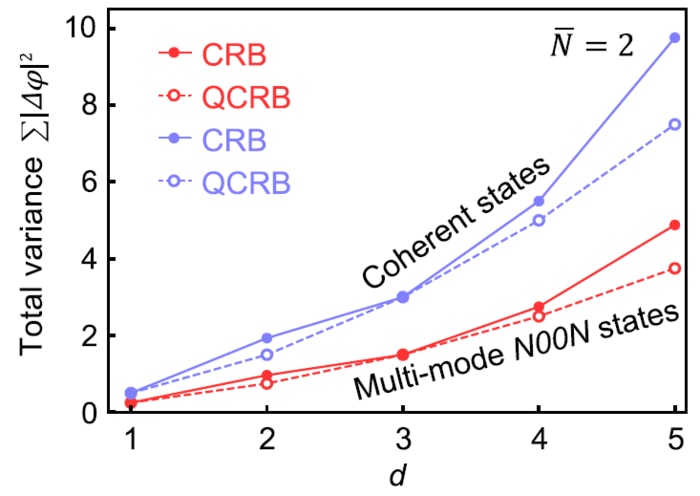
A research team led by Dr. Hyang-Tag Lim from the Center for Quantum Information, Korea Institute of Science and Technology (KIST) demonstrated quantum sensors that can estimate multiple parameters changing in real-time with high precision beyond the standard limits.

The KIST research team demonstrated "multi-mode N00N states" where multiple parameters changing in real-time can be precisely estimated. The "multi-mode N00N state" was known to show the highest precision in theory, but its demonstration has been highly challenging.

The research team succeeded in demonstrating quantum-enhanced multiple-phase estimation by generating multi-mode N00N states, a quantum entanglement state with photon number N = 2 and mode number m = 4 that is applied to an interferometer so that its multiple phase difference can be simultaneously measured with high precision beyond the standard quantum limit. Dr. Hyang-Tag Lim from the Center for Quantum Information, KIST

Dr. Hyang-Tag Lim from the KIST who led this research stated, "Multi-mode N00N states, the key technology of this achievement, will contribute to the further development of quantum sensing as a foundation technique for quantum imaging and sensor networks." He added, "I hope it will also be used in a high-performance quantum microscope and bio-imaging sensors.“
Swedish-built neuromorphic supercomputing attempts to imitate the brain’s neural networks

Tyler O'Neal, Staff Editor INDUSTRY November 29, 2021, 8:00 am

Researchers have long strived to develop computers to work as energy efficiently as our brains. A study, led by researchers at the University of Gothenburg in Sweden's second-largest city, Gothenburg, has succeeded for the first time in combining a memory function with a calculation function in the same component. The discovery opens the way for more efficient technologies.

In recent years, supercomputers have been able to tackle advanced cognitive tasks, like language and image recognition or displaying superhuman chess skills, thanks in large part to artificial intelligence (AI). At the same time, the human brain is still unmatched in its ability to perform tasks effectively and energy efficiently.

“Finding new ways of performing calculations that resemble the brain’s energy-efficient processes has been a major goal of research for decades. Cognitive tasks, like image and voice recognition, require significant computing power, and mobile applications, in particular, like mobile phones, drones, and satellites, require energy-efficient solutions,” says Johan Åkerman, professor of applied spintronics at the University of Gothenburg.

Important breakthrough

Working with a research team at Tohoku University, Åkerman led a study that has now taken a step forward in achieving this goal. In the study, the researchers have succeeded for the first time in linking the two tools for advanced calculations: oscillator networks and memristors.

Åkerman describes oscillators as oscillating circuits that can perform calculations and that are comparable to human nerve cells. Memristors are programable resistors that can also perform calculations and that have integrated memory. This makes them comparable to memory cells. Integrating the two is a major advancement by the researchers.

“This is an important breakthrough because we show that it is possible to combine a memory function with a calculating function in the same component. These components work more like the brain’s energy-efficient neural networks, allowing them to become important building blocks in future, more brain-like computers.”

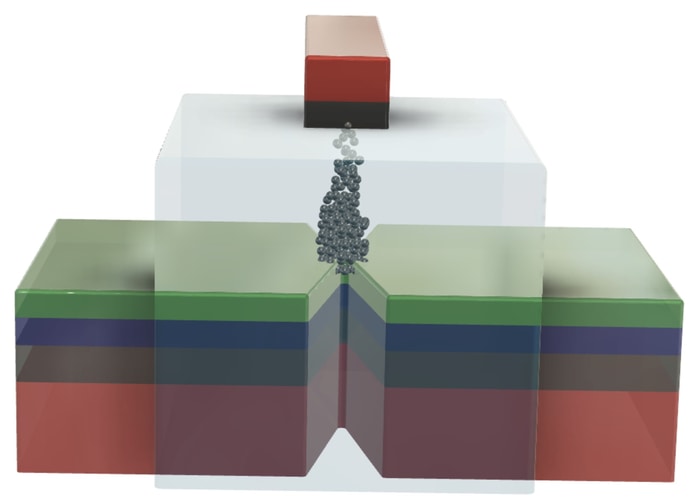
Enables energy-efficient technologies The three coloured layers at the bottom illustrate an oscillator, which can perform different types of calculations when interacting with other oscillators in a network or a chain. Above this is seen a semi-transparent insulating layer with a red and black top contact. This top contact can be used to control how the ions (the dark grey balls) in the insulator position themselves and this enables control of the insulator’s resistance. This is a memristor and it gives the oscillator memory. Now that these two functions have been integrated for the first time in the same component, each oscillator, which can be compared with a neuron, can have its own local memory independent of the others.  CREDIT Mohammad Zahedinejad

According to Johan Åkerman, the discovery will enable faster, easier to use, and less energy-consuming technologies in many areas. He feels that it is a huge advantage that the research team has successfully produced the components in a small footprint: hundreds of components fit into an area equivalent to a single bacterium. This can be of particular importance in smaller applications like mobile phones.
“More energy-efficient calculations could lead to new functionality in mobile phones. An example is digital assistants like Siri or Google.

Today, all processing is done by servers since the calculations require too much energy for the small size of a phone. If the calculations could instead be performed locally, on the actual phone, they could be done faster and easier without a need to connect to servers.”
He notes self-driving cars and drones as other examples of where more energy-efficient calculations could drive developments.
“The more energy-efficiently that cognitive calculations can be performed, the more applications become possible. That’s why our study really has the potential to advance the field.”

  1. Japanese researchers study the effect of temperature on the structure of magnesium carbonate, helping improve the trapping of CO2 inside minerals
  2. Osaka Metropolitan University improves quantum algorithm performance

Page 30 of 39

  • 25
  • 26
  • 27
  • 28
  • 29
  • 30
  • 31
  • 32
  • 33
  • 34
POPULAR RIGHT NOW
  • Supercomputers replace ‘bathtub’ flood maps with physics-based digital twins of Britain’s coastline
    Supercomputers replace ‘bathtub’ flood maps with physics-based digital twins of Britain’s coastline
  • Supercomputers push neural quantum simulation beyond previous limits
    Supercomputers push neural quantum simulation beyond previous limits
  • Intel’s AI supercomputing revival: Q2 financial surge signals new era for CPU-powered HPC infrastructure
    Intel’s AI supercomputing revival: Q2 financial surge signals new era for CPU-powered HPC infrastructure
  • AI infrastructure financing fears shake semiconductor sector
    AI infrastructure financing fears shake semiconductor sector
  • AWS supercomputing investment reaches historic scale as Amazon’s AI strategy powers record financial results
    AWS supercomputing investment reaches historic scale as Amazon’s AI strategy powers record financial results
  • Catching the wave of the future: Supercomputers unlock the hidden dynamics of Venus
    Catching the wave of the future: Supercomputers unlock the hidden dynamics of Venus
  • NCAR supercomputers run planet scale climate experiments impossible in the real world
    NCAR supercomputers run planet scale climate experiments impossible in the real world
  • AI hunts the cosmos: Machine learning helps astronomers discover the first ‘Wandering’ supermassive black hole caught destroying a star
    AI hunts the cosmos: Machine learning helps astronomers discover the first ‘Wandering’ supermassive black hole caught destroying a star
  • Supercomputing for the masses: Meta's vision of a personal superintelligence for everyone
    Supercomputing for the masses: Meta's vision of a personal superintelligence for everyone
  • NVIDIA helps turn AI compute into a new asset class as Wall Street mobilizes $500 billion
    NVIDIA helps turn AI compute into a new asset class as Wall Street mobilizes $500 billion
THIS YEAR'S MOST READ
  • Wall Street wants to trade supercomputing power like oil
    Wall Street wants to trade supercomputing power like oil
  • Beamforming the future: BeammWave's 6G push signals the rise of orbital-terrestrial wireless networks
    Joakim Axmon
    Joakim Axmon
  • Cosmic ambition at scale: UK’s supercomputer unlocks a 2.5 petabytes universe
    Cosmic ambition at scale: UK’s supercomputer unlocks a 2.5 petabytes universe
  • Hidden order, revealed at scale: Supercomputing, electron ptychography uncover the inner workings of relaxor ferroelectrics
    Hidden order, revealed at scale: Supercomputing, electron ptychography uncover the inner workings of relaxor ferroelectrics
  • Intel's Q1 results signal supercomputing surge driving Xeon momentum
    Intel's Q1 results signal supercomputing surge driving Xeon momentum
  • When stars fall apart: Supercomputing reveals the hidden physics of black holes
    When stars fall apart: Supercomputing reveals the hidden physics of black holes
  • MIT develops computational framework to probe dark matter via gravitational waves
    MIT develops computational framework to probe dark matter via gravitational waves
  • Explainable AI moves into the watershed: FAMU-FSU engineers build predictive framework for real-time E. coli forecasting
    FAMU-FSU College of Engineering Assistant Professor Nasrin Alamdari. (Scott Holstein/FAMU-FSU College of Engineering)
    FAMU-FSU College of Engineering Assistant Professor Nasrin Alamdari. (Scott Holstein/FAMU-FSU College of Engineering)
  • Multi-layer simulations reveal the hidden supply chain of solar prominences
    Multi-layer simulations reveal the hidden supply chain of solar prominences
  • Japanese scientists decode dolphin speed with supercomputing: Turbulence, vortices, and the hidden physics of propulsion
    Japanese scientists decode dolphin speed with supercomputing: Turbulence, vortices, and the hidden physics of propulsion
  • FRONTPAGE
  • LATEST
  • POPULAR
  • REGISTER
  • SOCIAL
  • VIDEO
  • SUBSCRIPTION
  • RSS
  • GUIDELINES
  • PRIVACY
  • TOS
  • ABOUT
  • +1 (816) 799-4488
  • editorial@supercomputingonline.com
© 2001 - 2026 SuperComputingOnline.com, LLC. All rights reserved. This material may not be published, broadcast, rewritten or redistributed without permission.
Sign In
  • FRONT PAGE
  • LATEST
    • MEDIA KIT
    • MOST READ
    • RSS FEED
    • ACADEMIA
    • AEROSPACE
    • APPLICATIONS
    • ASTRONOMY
    • AUTOMOTIVE
    • BIG DATA
    • BIOLOGY
    • CHEMISTRY
    • CLIENTS
    • CLOUD
    • DEFENSE
    • DEVELOPER TOOLS
    • EARTH SCIENCES
    • ECONOMICS
    • ENGINEERING
    • ENTERTAINMENT
    • HEALTH
    • INDUSTRY
    • INTERCONNECTS
    • GAMING
    • GOVERNMENT
    • MANUFACTURING
    • MIDDLEWARE
    • MOVIES
    • NETWORKS
    • OIL & GAS
    • PHYSICS
    • PROCESSORS
    • RETAIL
    • SCIENCE
    • STORAGE
    • SYSTEMS
    • VISUALIZATION
  • VIDEOS
    • ADD YOUR VIDEOS
    • MANAGE VIDEOS
  • COMMUNITY
    • TRADE SHOWS
    • SOCIAL NETWORK VIDEOS
    • SURVEYS
    • APPLICATIONS BROWSER
    • CONVERSATION INBOX
    • SOCIAL ADVERTISER
    • GROUPS
    • MARKETPLACE LISTINGS
    • PAGES
    • LEADERBOARD
    • POINTS LISTING
      • BADGES
    • PRIVACY CONFIRM REQUEST
    • PRIVACY CREATE REQUEST

Hey there! We noticed you’re using an ad blocker.