

University of Bern astrophysicist proposes a new way of analyzing the phase curve of exoplanets

The Bernese theoretical astrophysicist Kevin Heng has achieved a rare feat: On paper, he has derived novel solutions to an old mathematical problem needed to calculate light reflections from planets and moons. Now, data can be interpreted simply to understand planetary atmospheres, for example. The new formulae will likely be incorporated into future textbooks.

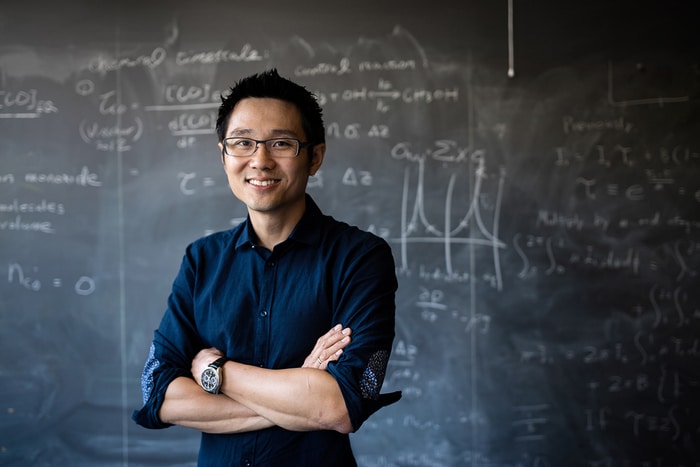
For millennia, humanity has observed the changing phases of the Moon. The rise and fall of sunlight reflected off the Moon, as it presents its different faces to us, is known as a "phase curve". Measuring phase curves of the Moon and Solar System planets is an ancient branch of astronomy that goes back at least a century. The shapes of these phase curves encode information on the surfaces and atmospheres of these celestial bodies. In modern times, astronomers have measured the phase curves of exoplanets using space telescopes such as Hubble, Spitzer, TESS, and CHEOPS. These observations are compared with theoretical predictions. To do so, one needs a way of calculating these phase curves. It involves seeking a solution to a difficult mathematical problem concerning the physics of radiation. Prof. Dr. Kevin Heng, Center for Space and Habitability (CSH), University of Bern © Alessandro Della Bella
Approaches for the calculation of phase curves have existed since the 18th century. The oldest of these solutions goes back to the Swiss mathematician, physicist, and astronomer, Johann Heinrich Lambert, who lived in the 18th century. "Lambert's law of reflection" is attributed to him. The problem of calculating reflected light from Solar System planets was posed by the American astronomer Henry Norris Russell in an influential 1916 paper. Another well-known 1981 solution is attributed to the American lunar scientist Bruce Hapke, who built on the classic work of the Indian-American Nobel laureate Subrahmanyan Chandrasekhar in 1960. Hapke pioneered the study of the Moon using mathematical solutions of phase curves. The Soviet physicist Viktor Sobolev also made important contributions to the study of reflected light from celestial bodies in his influential 1975 textbook. Inspired by the work of these scientists, theoretical astrophysicist Kevin Heng of the Center for Space and Habitability CSH at the University of Bern in Switzerland has discovered an entire family of new mathematical solutions for calculating phase curves. The paper, authored by Kevin Heng in collaboration with Brett Morris from the National Center of Competence in Research NCCR PlanetS – which the University of Bern manages together with the University of Geneva – and Daniel Kitzmann from the CSH, has just been published in Nature Astronomy.

Generally applicable solutions

"I was fortunate that this rich body of work had already been done by these great scientists. Hapke had discovered a simpler way to write down the classic solution of Chandrasekhar, who famously solved the radiative transfer equation for isotropic scattering. Sobolev had realized that one can study the problem in at least two mathematical coordinate systems." Sara Seager brought the problem to Heng’s attention by her summary of it in her 2010 textbook.

By combining these insights, Heng was able to write down mathematical solutions for the strength of reflection (the albedo) and the shape of the phase curve, both completely on paper and without resorting to a computer. "The ground-breaking aspect of these solutions is that they are valid for any law of reflection, which means they can be used in very general ways. The defining moment came for me when I compared these pen-and-paper calculations to what other researchers had done using computer calculations. I was blown away by how well they matched," said Heng.

Successful analysis of the phase curve of Jupiter

“What excites me is not just the discovery of new theory, but also its major implications for interpreting data”, says Heng. For example, the Cassini spacecraft measured phase curves of Jupiter in the early 2000s, but an in-depth analysis of the data had not previously been done, probably because the calculations were too computationally expensive. With this new family of solutions, Heng was able to analyze the Cassini phase curves and infer that the atmosphere of Jupiter is filled with clouds made up of large, irregular particles of different sizes. This parallel study has just been published by the Astrophysical Journal Letters, in collaboration with Cassini data expert and planetary scientist Liming Li of Houston University in Texas, U.S.A.

New possibilities for the analysis of data from space telescopes

"The ability to write down mathematical solutions for phase curves of reflected light on paper means that one can use them to analyze data in seconds," said Heng. It opens up new ways of interpreting data that were previously infeasible. Heng is collaborating with Pierre Auclair-Desrotour (formerly CSH, currently at Paris Observatory) to further generalize these mathematical solutions. "Pierre Auclair-Desrotour is a more talented applied mathematician than I am, and we promise exciting results in the near future," said Heng.

In the Nature Astronomy paper, Heng and his co-authors demonstrated a novel way of analyzing the phase curve of the exoplanet Kepler-7b from the Kepler space telescope. Brett Morris led the data analysis part of the paper. "Brett Morris leads the data analysis for the CHEOPS mission in my research group, and his modern data science approach was critical for successfully applying the mathematical solutions to real data," explained Heng. They are currently collaborating with scientists from the American-led TESS space telescope to analyze TESS phase curve data. Heng envisions that these new solutions will lead to novel ways of analyzing phase curve data from the upcoming, 10-billion-dollar James Webb Space Telescope, which is due to launch later in 2021. "What excites me most of all is that these mathematical solutions will remain valid long after I am gone, and will probably make their way into standard textbooks," said Heng.
Technical University of Denmark scientists show ultra-coherent Fano laser based on a bound state in the continuum

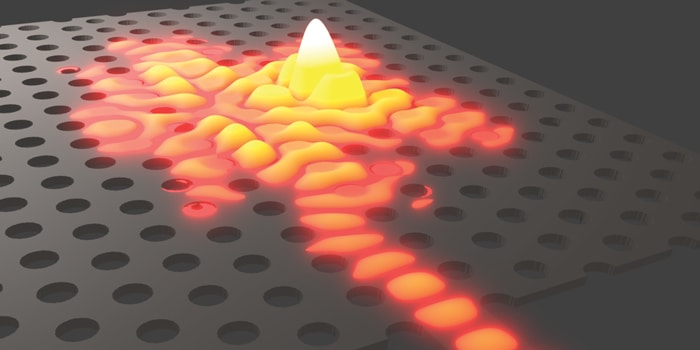
Scientists from the Technical University of Denmark in the town Kongens Lyngby, 12 kilometers north of central Copenhagen, Denmark (DTU), have shown that a Fano laser, a new type of microscopic laser, has fundamental advantages compared to other types of lasers. The discovery can be important for many future applications, such as integrated photonics, interfacing of electronics and photonics, and optical sensors.

An increasing fraction of the global energy consumption is used for information technology, and photonics operating at very high data rates with ultra-low energy per bit has been identified as a key technology to enable sustainable growth of capacity demands.

However, existing laser designs cannot just be scaled down to reach the goals for next-generation integrated devices, and fundamental discoveries in the field of nanophotonics are therefore needed. 

Supported by a Villum Center of Excellence, NATEC, a newly established DNRF Center of Excellence, NanoPhoton, and an ERC Advanced Grant, scientists from DTU are exploring the physics and applications of a new class of photonic devices using a phenomenon known as Fano interference. This physical effect offers an opportunity for realizing ultrafast and low-noise nanolasers (called Fano lasers), optical transistors, and quantum devices working at the level of a single photon.

Now, the DTU scientists have shown that the coherence of a Fano laser can be significantly improved compared to existing microscopic lasers. The result has been published in Nature Photonics.

“The coherence of a laser is a measure of the purity of the color of the light generated by the laser. A higher coherence is essential to numerous applications, such as on-chip communications, programmable photonic integrated circuits, sensing, quantum technology, and neuromorphic computing. For example, coherent optical communication systems transmit and detect information using the phase of light pulses, leading to a tremendous information capacity” says Jesper Mørk, Professor at DTU Fotonik and Center Leader of NATEC and NanoPhoton.

Jesper Mørk further explains: “The Fano laser, with a size of a few microns (one micron is one-thousandth of a millimeter), operates in an unusual optical state, a so-called bound-state-in the-continuum, induced by the Fano resonance. The existence of such a state was first identified by some of the early pioneers of quantum mechanics but evaded experimental observation for many years. In the paper, we show that the characteristics of such a bound-state-in-the-continuum can be harnessed to improve the coherence of the laser.”

“The observation is somewhat surprising,” adds lead author and senior researcher at DTU Fotonik, Yi Yu, “since a bound-state-in-the-continuum is much less robust than the states commonly used in lasers. We show in our paper, experimentally as well as theoretically, that the peculiarities of this new state can be used to advantage.”

Yi Yu continues: “To achieve the goal we have developed, in collaboration with Professor Kresten Yvind’s group at DTU Fotonik, an advanced nanotechnology platform, called Buried Heterostructure Technology. This technology allows realizing small, nanometer-sized regions of active material, where the light generation takes place, while the remaining laser structure is passive. It is the physics of Fano resonance combined with this technology that eventually enables the suppression of quantum noise, leading to the highest measured coherence for microscopic lasers.”

This new finding may lead to the use of Fano lasers in integrated electronic-photonic circuits, in particular in new generations of high-speed supercomputers. In today’s computers, electrical signals are used for logic operations as well as for transmitting data between different parts of the computer. However, due to ohmic losses, a lot of energy is wasted in the transmission. The primary role of the Fano laser will be to convert the electrical data to light signals, which then are transmitted within the computer almost without loss – just as it is done in optical fibers on the internet today. The long-term perspective is to get much faster computer chips with minimal energy consumption.

Award-winning research in Edinburgh, UK shows the potential of deep learning in managing power networks

Power networks worldwide are faced with increasing challenges. The fast rollout of distributed renewable generation (such as rooftop solar panels or community wind turbines) can lead to considerable unpredictability. The previously used "fit-and-forget" mode of operating power networks is no longer adequate, and more active management is required. Moreover, new types of demand (such as from the rollout EV charging) can also be source of unpredictability, especially if concentrated in particular areas of the distribution grid.

Network operators are required to keep power and voltage within safe operating limits at all connection points in the network, as out of bounds fluctuations can damage expensive equipment and connected devices. Hence, having good estimates of which area of the network could be at risk and require interventions (such as strengthening the network, or extra storage to smoothen fluctuations) is increasingly a key requirement.

Privacy-sensitive machine learning

Smart meter data analysis holds great promise for identifying “at risk” areas in distribution networks. Yet, using smart meter data can present significant practical constraints. In many countries and regions, the rollout of smart meters does not provide full coverage, as installation is voluntary and many customers may reject installing a smart meter at their home. Moreover, even places where there is a successful smart meter roll-out, privacy restrictions must be taken into account and, in practice, regulators considerably constrain what private data from smart meters network operators have access to.

Newly published research from the Smart Systems Group at Heriot-Watt University in Edinburgh, UK https://www.sciencedirect.com/science/article/pii/S2666546821000550, in collaboration with Scottish Power Energy Energy Networks addresses these key challenges. Based on real data and case studies from distribution networks in Scotland, researchers have shown that deep learning neural networks can provide accurate estimates of voltage distributions in all areas of the network, even if high-granularity smart meter data is available from only a few locations, not from every consumer meter.

Dr. Maizura Mokhtar, the Data Scientist who led the work, explains: "While modern smart meters can collect high-granularity data from every household, in practice, there are computational constraints with collecting so much data, as well as privacy concerns. Our work shows that, to produce high accuracy voltage predictions across the whole network, only data from a few Key Identified Locations is needed. Furthermore, it can do so by using only current voltage data to output accurate voltage predictions. Crucially, our method does NOT require input of privacy-sensitive power data, which could be conceivably be used to infer what individual customer activity in their home."

Dr. Valentin Robu, Associate Professor and Academic PI of the project, said: "This work was part of the NCEWS (Network Constraints Early Warning System project), a collaboration between Heriot-Watt and Scottish Power Energy Networks, part funded by InnovateUK, the United Kingdom’s applied research and innovation agency. The project's results greatly exceeded our expectations, and it illustrates how advanced AI techniques (in this case deep learning neural networks) can address important practical challenges emerging in modern energy systems. We were very much honoured to win the IET and E&T 2019 Innovation of the Year Award https://ieeexplore.ieee.org/stamp/stamp.jsp?arnumber=9450443 for the work in this project (one of UK’s top yearly awards for innovation), as well as, now a top publication in the Energy and AI journal."

Professor David Flynn, the Head of the Smart Systems Group at Heriot-Watt added: "The NCEWS project showcases very well how an academia-industry collaboration can bring new thinking and expertise to the activity of UK power network operators. Artificial Intelligence and data analytics are increasingly central to addressing challenges that UK DNOs face, and will likely play a key role in decarbonising our energy systems."