

Stanford scientists solve mystery of icy plumes that may foretell deadly supercell storms

Supercell storm discovery using supercomputer simulations

When a cloudy plume of ice and water vapor billows up above the top of a severe thunderstorm, there’s a good chance a violent tornado, high winds or hailstones bigger than golf balls will soon pelt the Earth below.

A new Stanford University-led study, published Sept. 10 in Science, reveals the physical mechanism for these plumes, which from above most of the world’s most damaging tornadoes.

Previous research has shown they’re easy to spot in satellite imagery, often 30 minutes or more before severe weather reaches the ground. “The question is, why is this plume associated with the worst conditions, and how does it exist in the first place? That’s the gap that we are starting to fill,” said atmospheric scientist Morgan O’Neill, lead author of the new study. A 3D rendering of the simulation experiment that produces the AACP in the the sheltered side or lee of the overshooting top. (Image credit: Leigh Off, David Semeraro)
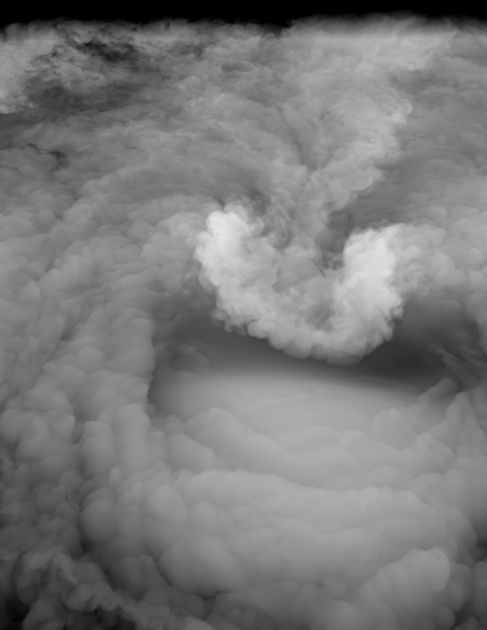
The research comes just over a week after supercell thunderstorms and tornadoes spun up among the remnants of Hurricane Ida as they barreled into the U.S. Northeast, compounding devastation wrought across the region by record-breaking rainfall and flash floods.

Understanding how and why plumes take shape above powerful thunderstorms could help forecasters recognize similar impending dangers and issue more accurate warnings without relying on Doppler radar systems, which can be knocked out by wind and hail – and have blind spots even on good days. In many parts of the world, Doppler radar coverage is nonexistent.

“If there’s going to be a terrible hurricane, we can see it from space. We can’t see tornadoes because they’re hidden below thunderstorm tops. We need to understand the tops better,” said O’Neill, who is an assistant professor of Earth system science at Stanford’s School of Earth, Energy & Environmental Sciences (Stanford Earth).

Supercell storms and exploding turbulence

The thunderstorms that spawn most tornadoes are known as supercells, a rare breed of a storm with a rotating updraft that can hurtle skyward at speeds faster than 150 miles an hour, with enough power to punch through the usual lid on Earth’s troposphere, the lowest layer of our atmosphere.

In weaker thunderstorms, rising currents of moist air tend to flatten and spread out upon reaching this lid, called the tropopause, forming an anvil-shaped cloud. A supercell thunderstorm’s intense updraft presses the tropopause upward into the next layer of the atmosphere, creating what scientists call an overshooting top. “It’s like a fountain pushing up against the next layer of our atmosphere,” O’Neill said.

As winds in the upper atmosphere race over and around the protruding storm top, they sometimes kick up streams of water vapor and ice, which shoot into the stratosphere to form the tell-tale plume, technically called an Above-Anvil Cirrus Plume or AACP.

The rising air of the overshooting top soon speeds back toward the troposphere, like a ball that accelerates downward after cresting aloft. At the same time, the air is flowing over the dome in the stratosphere and then racing down the sheltered side.

Using supercomputer simulations of idealized supercell thunderstorms, O’Neill and colleagues discovered that this excites a downslope windstorm at the tropopause, where wind speeds exceed 240 miles per hour. “Dry air descending from the stratosphere and moist air rising from the troposphere join in this very narrow, crazy-fast jet. The jet becomes unstable and the whole thing mixes and explodes in turbulence,” O’Neill said. “These speeds at the storm top have never been observed or hypothesized before.”

Hydraulic jump

Scientists have long recognized that overshooting storm tops of moist air rising into the upper atmosphere can act like solid obstacles that block or redirect airflow. And it’s been proposed that waves of moist air flowing over these tops can break and loft water into the stratosphere. But no research to date has explained how all the pieces fit together.

The new modeling suggests the explosion of turbulence in the atmosphere that accompanies plumed storms unfolds through a phenomenon called a hydraulic jump. The same mechanism is at play when rushing winds tumble over mountains and generate turbulence on the downslope side, or when water speeding smoothly down a dam’s spillway abruptly bursts into froth upon joining slower-moving water below.

Leonardo DaVinci observed the phenomenon in flowing water as early as the 1500s, and ancient Romans may have sought to limit hydraulic jumps in aqueduct designs. But until now atmospheric scientists have only seen the dynamic induced by solid topography. The new modeling suggests a hydraulic jump can also be triggered by fluid obstacles in the atmosphere made almost entirely of air and which are changing shape every second, mile above the Earth’s surface.

The simulations suggest the onset of the jump coincides with a surprisingly rapid injection of water vapor into the stratosphere, upwards of 7000 kilograms per second. That’s two to four times higher than previous estimates. Once it reaches the overworld, water may stay there for days or weeks, potentially influencing the amount and quality of sunlight that reaches Earth via the destruction of ozone in the stratosphere and warming the planet’s surface. “In our simulations that exhibit plumes, water reaches deep into the stratosphere, where it possibly could have more of a long-term climate impact,” said co-author Leigh Orf, an atmospheric scientist at the University of Wisconsin-Madison.

According to O’Neill, high-altitude NASA research aircraft have only recently gained the ability to observe the three-dimensional winds at the tops of thunderstorms, and have not yet observed AACP production at close range. “We have the technology now to go verify our modeling results to see if they’re realistic,” O’Neill said. “That’s really a sweet spot in science.”
Stanford's discovery in phase-change memory enables in-memory supercomputing

Scientists have spent decades searching for faster, more energy-efficient memory technologies for everything from large data centers to mobile sensors and other flexible electronics. Among the most promising data storage technologies is phase-change memory, which is thousands of times faster than conventional hard drives but uses a lot of electricity.

Now, Stanford University engineers have overcome a key obstacle that has limited the widespread adoption of phase-change memory. The results are published in a Sept. 10 study in Science.

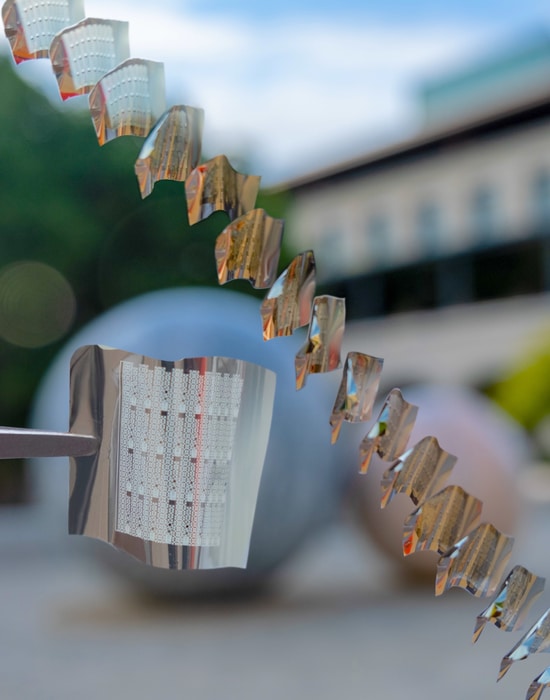
“People have long expected phase-change memory to replace much of the memory in our phones and laptops,” said Eric Pop, a professor of electrical engineering and senior author of the study. “One reason it hasn’t been adopted is that it requires more power to operate than competing memory technologies. In our study, we’ve shown that phase-change memory can be both fast and energy-efficient.” A flexible phase-change memory substrate held by tweezers (left) with a diagonal sequence showing substrates in the process of being bent.  CREDIT Crystal Nattoo

Electrical resistance

Unlike conventional memory chips built with transistors and other hardware, a typical phase-change memory device consists of a compound of three chemical elements – germanium, antimony, and tellurium (GST) – sandwiched between two metal electrodes.

Conventional devices, like flash drives, store data by switching the flow of electrons on and off, a process symbolized by 1’s and 0’s. In phase-change memory, the 1’s and 0’s represent measurements of electrical resistance in the GST material – how much it resists the flow of electricity.

“A typical phase-change memory device can store two states of resistance: a high-resistance state 0, and a low-resistance state 1,” said doctoral candidate Asir Intisar Khan, co-lead author of the study. “We can switch from 1 to 0 and back again in nanoseconds using heat from electrical pulses generated by the electrodes.”

Heating to about 300 degrees Fahrenheit (150 degrees Celsius) turns the GST compound into a crystalline state with low electrical resistance. At about 1,100 F (600 C), the crystalline atoms become disordered, turning a portion of the compound to an amorphous state with much higher resistance. The large difference in resistance between the amorphous and crystalline states is used to program memory and store data.

“This large resistance change is reversible and can be induced by switching the electrical pulses on and off,” said Khan.

“You can come back years later and read the memory just by reading the resistance of each bit,” Pop said. “Also, once the memory is set it doesn’t use any power, similar to a flash drive.”

‘Secret sauce’

But switching between states typically requires a lot of power, which could reduce battery life in mobile electronics.

To address this challenge, the Stanford team set out to design a phase-change memory cell that operates with low power and can be embedded on flexible plastic substrates commonly used in bendable smartphones, wearable body sensors and other battery-operated mobile electronics.

“These devices require low cost and low energy consumption for the system to work efficiently,” said co-lead author Alwin Daus, a postdoctoral scholar. “But many flexible substrates lose their shape or even melt at around 390 F (200 C) and above.”

In the study, Daus and his colleagues discovered that a plastic substrate with low thermal conductivity can help reduce current flow in the memory cell, allowing it to operate efficiently.

“Our new device lowered the programming current density by a factor of 10 on a flexible substrate and by a factor of 100 on rigid silicon,” Pop said. “Three ingredients went into our secret sauce: a superlattice consisting of nanosized layers of the memory material, a pore cell – a nanosized hole into which we stuffed the superlattice layers – and a thermally insulating flexible substrate. Together, they significantly improved energy efficiency.”

Ultrafast, flexible computing

The ability to install fast, energy-efficient memory on mobile and flexible devices could enable a wide range of new technologies, such as real-time sensors for smart homes and biomedical monitors. 

“Sensors have high constraints on battery lifetime, and collecting raw data to send to the cloud is very energy inefficient,” Daus said. “If you can process the data locally, which requires memory, it would be very helpful for implementing the Internet of Things.”

Phase-change memory could also usher in a new generation of ultrafast computing.

“Today’s computers have separate chips for computing and memory,” Khan said. “They compute data in one place and store it in another. The data have to travel back and forth, which is highly energy inefficient.”

Phase-change memory could enable in-memory computing, which bridges the gap between computing and memory. In-memory computing would require a phase-change device with multiple resistance states, each capable of storing memory.

“Typical phase-change memory has two resistant states, high and low,” Khan said. “We programmed four stable resistance states, not just two, an important first step towards flexible in-memory computing.”

Phase-change memory could also be used in large data centers, where data storage accounts for about 15 percent of electricity consumption.

“The big appeal of phase-change memory is speed, but energy-efficiency in electronics also matters,” Pop said. “It’s not just an afterthought. Anything we can do to make lower-power electronics and extend battery life will have a tremendous impact.”

ESO captures best images yet of peculiar dog-bone asteroid

Using the European Southern Observatory’s Very Large Telescope (ESO’s VLT), a team of astronomers has obtained the sharpest and most detailed images yet of the asteroid Kleopatra. The observations have allowed the team to constrain the 3D shape and mass of this peculiar asteroid, which resembles a dog bone, to a higher accuracy than ever before. Their research provides clues as to how this asteroid and the two moons that orbit it formed.

“Kleopatra is truly a unique body in our Solar System,” says Franck Marchis, an astronomer at the SETI Institute in Mountain View, USA, and at the Laboratoire d'Astrophysique de Marseille, France, who led a study on the asteroid — which has moons and an unusual shape — published today in Astronomy & Astrophysics. “Science makes a lot of progress thanks to the study of weird outliers. I think Kleopatra is one of those and understanding this complex, multiple asteroid systems can help us learn more about our Solar System.”

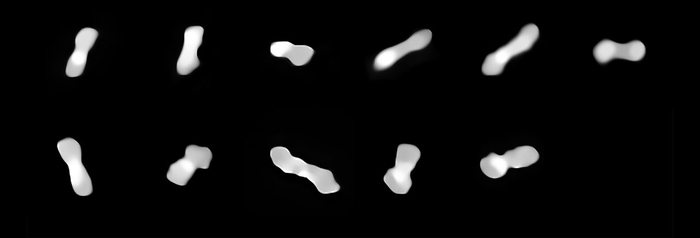
Kleopatra orbits the Sun in the Asteroid Belt between Mars and Jupiter. Astronomers have called it a “dog-bone asteroid” ever since radar observations around 20 years ago revealed it has two lobes connected by a thick “neck”. In 2008, Marchis and his colleagues discovered that Kleopatra is orbited by two moons, named AlexHelios and CleoSelene, after the Egyptian queen’s children. These eleven images are of the asteroid Kleopatra, viewed at different angles as it rotates. The images were taken at different times between 2017 and 2019 with the Spectro-Polarimetric High-contrast Exoplanet REsearch (SPHERE) instrument on ESO’s VLT. Kleopatra orbits the Sun in the Asteroid Belt between Mars and Jupiter. Astronomers have called it a “dog-bone asteroid” ever since radar observations around 20 years ago revealed it has two lobes connected by a thick “neck”.  CREDIT ESO/Vernazza, Marchis et al./MISTRAL algorithm (ONERA/CNRS)

To find out more about Kleopatra, Marchis and his team used snapshots of the asteroid taken at different times between 2017 and 2019 with the Spectro-Polarimetric High-contrast Exoplanet REsearch (SPHERE - https://www.eso.org/public/teles-instr/paranal-observatory/vlt/vlt-instr/sphere/) instrument on ESO’s VLT (https://www.eso.org/public/teles-instr/paranal-observatory/vlt/). As the asteroid was rotating, they were able to view it from different angles and to create the most accurate supercomputer models of its shape to date. They constrained the asteroid’s dog-bone shape and its volume, finding one of the lobes to be larger than the other, and determined the length of the asteroid to be about 270 kilometers or about half the length of the English Channel.

In a second study, also published in Astronomy & Astrophysics and led by Miroslav Brož of Charles University in Prague, Czech Republic, the team reported how they used the SPHERE (https://www.eso.org/public/teles-instr/paranal-observatory/vlt/vlt-instr/sphere/) observations to find the correct orbits of Kleopatra’s two moons. Previous studies had estimated the orbits, but the new observations with ESO’s VLT (https://www.eso.org/public/teles-instr/paranal-observatory/vlt/) showed that the moons were not where the older data predicted them to be.

“This had to be resolved,” says Brož. “Because if the moons’ orbits were wrong, everything was wrong, including the mass of Kleopatra.” Thanks to the new observations and sophisticated modeling, the team managed to precisely describe how Kleopatra’s gravity influences the moons’ movements and to determine the complex orbits of AlexHelios and CleoSelene. This allowed them to calculate the asteroid’s mass, finding it to be 35% lower than previous estimates.

Combining the new estimates for volume and mass, astronomers were able to calculate a new value for the density of the asteroid, which, at less than half the density of iron, turned out to be lower than previously thought. The low density of Kleopatra, which is believed to have a metallic composition, suggests that it has a porous structure and could be little more than a “pile of rubble.” This means it likely formed when material reaccumulated following a giant impact.

Kleopatra’s rubble-pile structure and the way it rotates also give indications as to how its two moons could have formed. The asteroid rotates almost at a critical speed, the speed above which it would start to fall apart, and even small impacts may lift pebbles off its surface. Marchis and his team believe that those pebbles could subsequently have formed AlexHelios and CleoSelene, meaning that Kleopatra has truly birthed its own moons.

The new images of Kleopatra and the insights they provide are only possible thanks to one of the advanced adaptive optics (https://www.eso.org/public/teles-instr/technology/adaptive_optics/) systems in use on ESO’s VLT (https://www.eso.org/public/teles-instr/paranal-observatory/vlt/), which is located in the Atacama Desert in Chile. Adaptive optics help to correct for distortions caused by the Earth’s atmosphere which cause objects to appear blurred — the same effect that causes stars viewed from Earth to twinkle. Thanks to such corrections, SPHERE (https://www.eso.org/public/teles-instr/paranal-observatory/vlt/vlt-instr/sphere/) was able to image Kleopatra — located 200 million kilometers away from Earth at its closest — even though its apparent size on the sky is equivalent to that of a golf ball about 40 kilometers away.

ESO’s upcoming Extremely Large Telescope (ELT - https://elt.eso.org/ ), with its advanced adaptive optics systems, will be ideal for imaging distant asteroids such as Kleopatra. “I can’t wait to point the ELT at Kleopatra, to see if there are more moons and refine their orbits to detect small changes,” adds Marchis.