BioSimulytics (www.biosimulytics.ai), a University College Dublin (UCD) spin-out company, has secured €595k in initial seed funding from a number of strategic angel investors and Enterprise Ireland.
The NovaUCD-headquartered company has developed a novel software solution, using artificial intelligence, to digitize key steps in how new drug molecules are designed and developed to transform the success rates of new drug development.
BioSimulytics has developed a novel software solution, using a powerful combination of AI, machine learning, computational chemistry, quantum physics, and high-performance computing (HPC), to drive smarter, faster, and more cost-effective R&D processes in the design and development of new drugs. The company’s software enables the pharma industry to advance potential molecules to approved medicines quicker and with a much greater probability of success. 
BioSimulytics, which has already secured its first commercial contract with a major pharma company in Europe, and signed evaluation agreements with several others for industrial evaluation, will use the funding to support the growth of its product development team and client base and plans to complete a Series A funding round within the next 18-24 months.
In the pharma industry, it can take between US$2-3 billion and over a decade to bring new drug molecules, which are manufactured in their solid-state crystal structure, to market with only a very limited (~1%) chance of success.
One of the complicating factors in the drug development process is polymorphism, the ability of a compound to exist in more than one stable crystalline structure. Drug molecules are complex compounds that can have hundreds of stable structures, and a polymorph may change to more thermodynamically stable form hours, weeks and even years later depending on conditions.
Different drug polymorphs can have different properties such as solubility, toxicity, and efficacy. It is therefore vital for pharma companies to fully understand the polymorphic landscape of their drug molecules, required also for regulatory compliance and patent protection, and to have absolute certainty about identifying and reproducing the most stable crystal structure of any new drug before bringing it to market for patient use.
Experimental techniques which are the current state-of-the-art for identifying the most stable polymorph of a new drug molecule, are slow and arduous manual processes, which can take 6 months or more to complete and with potentially uncertain results.
BioSimulytics’ unique software solution only requires the basic 2D structure of a molecule to accurately predict the full polymorphic landscape of that molecule and to rank the most stable crystal structures of the molecule, within a matter of weeks. This provides pharma companies with far greater accuracy and certainty in the development process of new drugs, avoiding potentially very costly mistakes such as those cases in recent decades where polymorph problems have forced the pharma companies involved to pull their drugs from the market resulting in multi-million US dollar losses.
BioSimulytics was founded in 2019 by Professor Niall English, Dr. Christian Burnham, and Peter Doyle as a spin-out from the UCD School of Chemical and Bioprocess Engineering following the completion of Enterprise Ireland Commercialisation Funding.
Speaking from NovaUCD Peter Doyle, CEO, BioSimulytics said, “We are delighted to have secured this seed funding which will help us to expand our team here in Ireland and grow our client base in the EU and US markets.”
He added, “The successful development of COVID-19 vaccines over the last 18-months demonstrates the powerful role that new digital AI and HPC-based technologies play in dramatically transforming the pharma value chain. BioSimulytics’ goal is to be a key player in this rapidly expanding global market within the next few years.”
He concluded, “As a follow-on to this seed round we plan to complete a multi-million euro Series A funding round within the next 18 to 24 months following the full industrial validation of our technology.”
Alan Hobbs, Manager, High Potential Start-Ups (Life Sciences and Industrial) at Enterprise Ireland said, “BioSimulytics is a great example of a world-class High Potential Start-Up driving innovative solutions to support the design and development of new drugs and we are delighted to support the company and to be part of this investment round.”
“We wish Peter and all the team every success with this exciting new phase of development for the company and look forward to continuing to work with them to achieve their ambitious plans for the future.”
BioSimulytics was the overall winner of the 2019 UCD VentureLaunch Accelerator Programme run by NovaUCD. In addition, the company was a finalist in 2020 The Institution of Chemical Engineers (IChemE) Global Awards, widely considered as the world’s most prestigious chemical engineering awards.
The familiar star at the center of our solar system has had billions of years to mature and ultimately provide life-giving energy to us here on Earth. But a very long time ago, our sun was just a growing baby star. What did the sun look like when it was so young? That’s long been a mystery that, if solved, could teach us about the formation of our solar system—so-named because sol is the Latin word for sun—and other stellar systems made up of planets and cosmic objects orbiting stars.
“We’ve detected thousands of planets in other stellar systems in our galaxy, but where did all of these planets come from? Where did Earth come from? That’s what really drives me,” says Catherine Espaillat, lead author on the paper and a Boston University College of Arts & Sciences associate professor of astronomy.
A new research paper published in Nature by Espaillat and collaborators finally provides new clues as to what forces were at play when our sun was in its infancy, detecting, for the first time, a uniquely shaped spot on a baby star that reveals new information about how young stars grow. 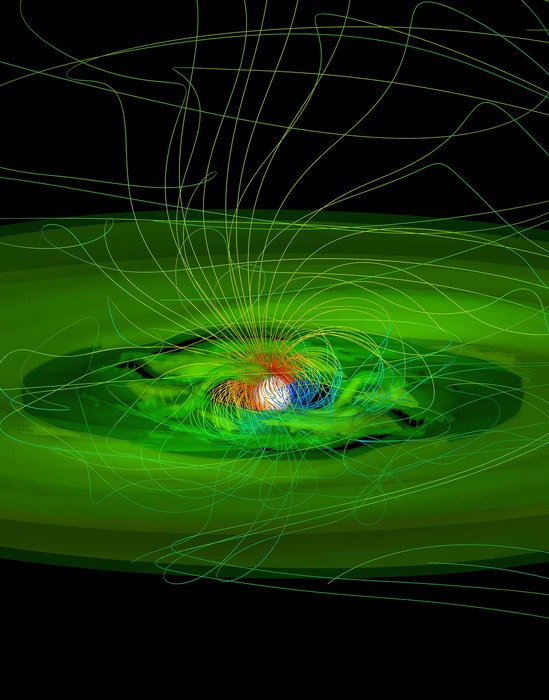
When a baby star is forming, Espaillat explains, it eats up dust and gas particles swirling around it in what’s called a protoplanetary disk. The particles slam into the surface of the star in a process called accretion.
“This is the same process the sun went through,” Espaillat says.
Protoplanetary disks are found within magnetized molecular clouds, which throughout the universe are known by astronomers to be breeding grounds for the formation of new stars. It’s been theorized that the protoplanetary disks and the stars are connected by a magnetic field, and the particles follow the field onto the star. As particles collide into the surface of the growing star, hot spots—which are extremely hot and dense—form at the focal points of the accretion process.
Looking at a young star about 450 million light-years away from Earth, Espaillat and her team’s observations confirm, for the first time, the accuracy of astronomers’ accretion models developed to predict the formation of hot spots. Those supercomputer models have until now relied on algorithms that calculate how the structure of magnetic fields direct particles from protoplanetary disks to crash into specific points on the surface of growing stars. Now, observable data backs those calculations.
The BU team, including graduate student John Wendeborn, and postdoctoral researcher Thanawuth Thanathibodee, closely studied a young star called GM Aur, located in the Taurus-Auriga molecular cloud of the Milky Way. It’s currently impossible to photograph the surface of such a faraway star, Espaillat says, but other types of images are possible given that different parts of a star’s surface emit light in different wavelengths. The team spent a month taking daily snapshots of light wavelengths emitting from GM Aur’s surface, compiling datasets of X-ray, ultraviolet (UV), infrared, and visual light. To peek at GM Aur, they relied on the “eyes” of NASA’s Hubble Space Telescope, Transiting Exoplanet Survey Satellite (TESS), Swift Observatory, and the Las Cumbres Observatory global telescope network.
This particular star, GM Aur, makes a full rotation in about one week, and in that time the brightness levels are expected to peak and wane as the brighter hot spot turns away from Earth and then back around to face our planet again. But when the team first lined up their data side by side, they were stumped by what they saw.
“We saw that there was an offset [in the data] by a day,” Espaillat says. Instead of all light wavelengths peaking at the same time, UV light was at its brightest about a day before all the other wavelengths reached their peak. At first, they thought they may have gathered inaccurate data.
“We went over the data so many times, double-checked the timing, and realized this was not an error,” she says. They discovered that the hot spot itself is not totally uniform, and it has an area within it that is even hotter than the rest of it.
“The hot spot is not a perfect circle…it’s more like a bow with one part of the bow that is hotter and denser than the rest,” Espaillat says. The unique shape explains the misalignment in the light wavelength data. This is a phenomenon in a hot spot never previously detected.
“This [study] teaches us that the hot spots are footprints on the stellar surface created by the magnetic field,” Espaillat says. At one time, the sun also had hot spots—different from sunspots, which are areas of our sun that are cooler than the rest of its surface—concentrated in the areas where it was eating up particles from a surrounding protoplanetary disk of gas and dust.
Eventually, protoplanetary disks fade away, leaving behind stars, planets, and other cosmic objects that make up a stellar system, Espaillat says. There is still evidence of the protoplanetary disk that fueled our solar system, she says, found in the existence of our asteroid belt and all the planets. Espaillat says that studying young stars that share similar properties with our sun is key to understanding the birth of our own planet.