

Scientists synthesized a yellow fever drug suggested by artificial intelligence

Yellow fever is a deadly disease in overpopulated tropical regions of Africa and South America. Infected people have a temperature increase to 39-41oC, chills, severe headache, nausea, and vomiting. The patient’s face becomes dull, the eyelids swell and the skin turns yellow due to liver damage (hence the name of the disease). Before the yellow fever vaccine was developed, the infection claimed thousands of lives for example in 1871, 8 percent of the population of Buenos Aires died in the epidemic. In mosquito-infested areas, where the vaccination is not readily available to the majority of the population, outbreaks of infection still occur. The yellow fever virus, as well as its related flaviviruses causing Zika and Dengue fever, is treated only by symptomatic treatment, as there are no specific drugs. An international team of scientists used artificial intelligence to select from a vast array of molecules that might be suitable for this purpose. Scientists from the Research Centre of Biotechnology of the Russian Academy of Sciences developed the technology and purchased or synthesized five of the most promising compounds and investigated their activity. The research was conducted in cooperation with Collaborations Pharmaceuticals, Inc. a private company specializing in innovative therapeutics for multiple rare and infectious diseases (based in the USA), São Carlos Institute of Physics, University of São Paulo (Brazil) along with support from the NIH, NIAID (USA). Using machine learning techniques, scientists selected the most promising virtual chemical structures from thousands of molecules, and then obtained or synthesized them before testing in vitro (in a test tube) five promising molecules that would become contenders for a future drug. All five compounds were active, but one showed the most promising activity.  CREDIT Gawriljuk et al. / J. Chem. Inf. Model., 2021
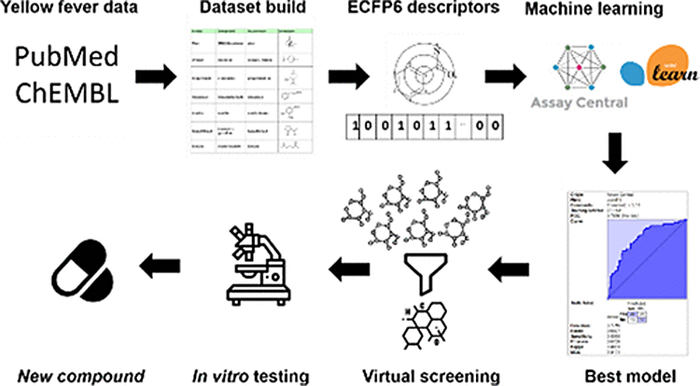
“Our team used a predictive computer model in combination with several machine learning methods. For model training, we relied on in vitro screening data and information available in existing databases to select identify the ideal molecule features for desired activity. With the help of these computational models we predicted their bioactivity before testing them in vitro using NIAID resources”, — explains Vadim Makarov, the co-author, Dr.Sci. (Pharmacy), the head of the Laboratory for Biomedicinal Chemistry of Research Centre of Biotechnology RAS.

Typically, only one of the 5,000 molecules that survived experimental testing is given a chance to reach the pharmacy counter. Others are too toxic, hard to produce, disintegrate in the body, or show too little activity in the real body compared to the test tube. Selection is even more rigorous before the experiments. Even if you focus on the hundreds of thousands of molecules that are known to science that are used or used to treat something else, testing them all not the same on animals and humans, but even in vitro would be almost infinite. To make the first stages of experiments cheaper and faster, scientists use supercomputer simulations and try to convert some of the initial tests into virtual ones. In the next stage, they are also assisted by high-throughput screening, during which “the robot dispenser” automatically dispenses tiny amounts of active substances into the microplates that contain cells infected with viruses. The researcher then evaluates which compounds kill the virus.

The authors of the paper created supercomputer models that can self-learn, comparing chemical compounds according to certain structural rules. Machine learning requires as much basic information from molecules wit or without activity as possible. For this purpose, scientists took information from public databases on small medicinal molecules and studied scientific publications on yellow fever virus research on cells. The models helped propose five of the most promising molecules that would fight the virus in human cells. Scientists have then tested these molecules and found the optimal concentration at which they should work. For the most efficient substance, the half-maximal effective concentration was 3.2 uM (equal to one mole of active substance per liter).

“The molecule we choose relates to the derivatives of pyrazosulphonamide. Its activity with the yellow fever virus is so great that we can talk about a potential drug. The structure of this molecule provides ample opportunity for further modification, which could greatly expand the list of potentially affordable yellow fever drugs. If the tests are successful, we will receive an entirely new group of drugs to fight this dangerous disease”, — says Vadim Makarov.

Korean university builds a programmable DNA-based chip that solves complex math problems

The term ‘DNA’ immediately calls to mind the double-stranded helix that contains all our genetic information. But the individual units of its two strands are pairs of molecules bonded with each other in a selective, complementary fashion. Turns out, one can take advantage of this pairing property to perform complex mathematical calculations, and this forms the basis of DNA computing.

Since DNA has only two strands, performing even a simple calculation requires multiple chemical reactions using different sets of DNA. In most existing research, the DNA for each reaction are added manually, one by one, into a single reaction tube, which makes the process very cumbersome. Microfluidic chips, which consist of narrow channels etched onto material like plastic, offer a way to automate the process. But despite their promise, the use of microfluidic chips for DNA computing remains underexplored. DNA computing, such as the calculations performed by the novel DNA-based microchip, has the potential to execute complex mathematical functions more easily than conventional electronic computers can.  CREDIT Gerd Altmann from Pixabay

In a recent article—made available online in ACS Nano on 7 July 2021 and published in Volume 15 Issue 7 of the journal on 27 July 2021—a team of scientists from Incheon National University (INU), Korea, present a programmable DNA-based microfluidic chip that can be controlled by a personal computer to perform DNA calculations. “Our hope is that DNA-based CPUs will replace electronic CPUs in the future because they consume less power, which will help with global warming. DNA-based CPUs also provide a platform for complex calculations like deep learning solutions and mathematical modelling,” says Dr. Youngjun Song from INU, who led the study.

Dr. Song and team used 3D printing to fabricate their microfluidic chip, which can execute Boolean logic, one of the fundamental logics of computer programming. Boolean logic is a type of true-or-false logic that compares inputs and returns a value of ‘true’ or ‘false’ depending on the type of operation, or ‘logic gate,’ used. The logic gate in this experiment consisted of a single-stranded DNA template. Different single-stranded DNA were then used as inputs. If part of an input DNA had a complementary Watson-Crick sequence to the template DNA, it paired to form double-stranded DNA. The output was considered true or false based on the size of the final DNA.

What makes the designed chip extraordinary is a motor-operated valve system that can be operated using a PC or smartphone. The chip and software set-up together form a microfluidic processing unit (MPU). Thanks to the valve system, the MPU could perform a series of reactions to execute a combination of logic operations in a rapid and convenient manner.

This unique valve system of the programmable DNA-based MPU paves the way for more complex cascades of reactions that can code for extended functions. “Future research will focus on a total DNA computing solution with DNA algorithms and DNA storage systems,” says Dr. Song.

With such a convincing proof of concept, it’s not hard to imagine DNA-based computers becoming everyday objects quite soon!

Better weather forecasting through satellite isotope data assimilation

As the global climate continues to change and extreme weather events increasingly threaten regions all over the world, accurate weather forecasting is becoming more important than ever.

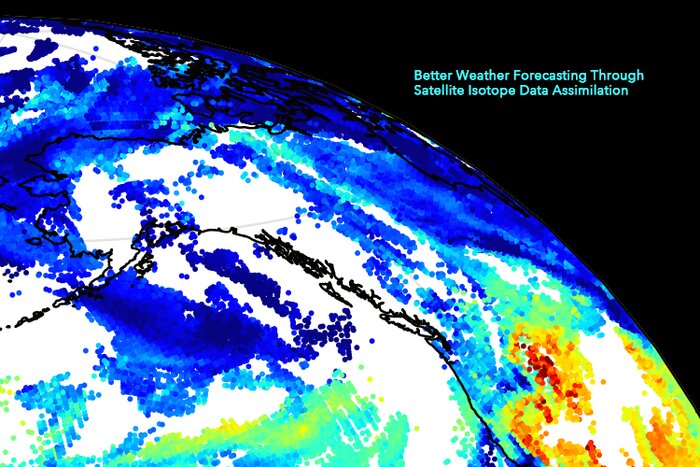
In a new study published in Scientific Reports, a research team led by Institute of Industrial Science, The University of Tokyo reports that weather forecast accuracy can be improved by several percentage points if satellite observations of water vapor isotope compositions are incorporated into a general circulation model. Researchers from The University of Tokyo assimilated satellite observations of water vapor isotopes into a weather forecasting model and found that forecast accuracy was improved by several percentage points  CREDIT Institute of Industrial Science, the University of Tokyo

Different isotopes of hydrogen and oxygen make individual water molecules heavier or lighter, and weather processes like evaporation and precipitation influence the distributions of these isotopes. These isotopes have potential to reveal the weather system, but have generally been neglected in meteorological models because of the relative scarcity of isotope data compared with conventional weather measurements like temperature and wind speed. However, advances in satellite technology have made it possible to fill this gap and improve forecasting ability.

For this study, the researchers used water vapor isotope data from the Infrared Atmospheric Sounding Interferometer (IASI), a satellite-based spectrometer that observes water vapor data in the mid-troposphere between 60°S to 60°N twice a day. Measurements from an altitude of 4.5 km were used because this altitude was where the isotope measurements were most reliable.

“A local ensemble transform Kalman filter was used to assimilate the IASI data into the forecasting model” study first author Masataka Tada explains. “Almost 230,000 data points measured during April 2013 were used in the assimilation experiments. We used the Isotope-incorporated Global Spectral Model (IsoGSM) as the forecasting model.”

Experiments were conducted to determine how incorporating these isotope data affected the modeling of other weather variables at both the global and local scales. The global experiment showed improved model skill, especially in the mid-latitudes and in the Northern Hemisphere. Most weather variables showed improved modeling, especially air temperature and specific humidity.

To test the model in a local setting, the researchers investigated a low-pressure event over Japan that occurred in April, 2013. With the water vapor isotope data included, the model was better able to simulate the overall pressure pattern of this event.

According to study senior and corresponding author Kei Yoshimura, “Ours is the first study to assimilate real satellite observations of water vapor isotopes with a general circulation model and examine the effects on the modeling of both global and local dynamics. With the improvements we observed, and with the increasing availability of satellite isotope measurements, we expect further improvements to weather forecasting in the future based on isotope data.”