NASA builds a new online tool showing rising sea levels anywhere in the world in the decades to come

NASA’s Sea Level Change Team has created a sea-level projection tool that makes extensive data on the future sea-level rise from the Intergovernmental Panel on Climate Change (IPCC) easily accessible to the public – and to everyone with a stake in planning for the changes to come.

Pull up the tool’s layers of maps, click anywhere on the global ocean and coastlines, and pick any decade between 2020 and 2150: The tool, hosted on NASA’s Sea Level Portal, will deliver a detailed report for the location based on the projections in the IPCC’s Sixth Assessment Report, released on Aug. 9, which addresses the most updated physical understanding of the climate system and climate change.

The IPCC has provided global-scale assessments of Earth’s climate every five to seven years since 1988, focusing on changes in temperature, ice cover, greenhouse gas emissions, and sea level across the planet. Their sea-level projections are informed by data gathered by satellites and instruments on the ground, as well as analyses and supercomputer simulations. A new visualization tool will make data on future sea level rise from the Intergovernmental Panel on Climate Change more easily accessible to people around the world.
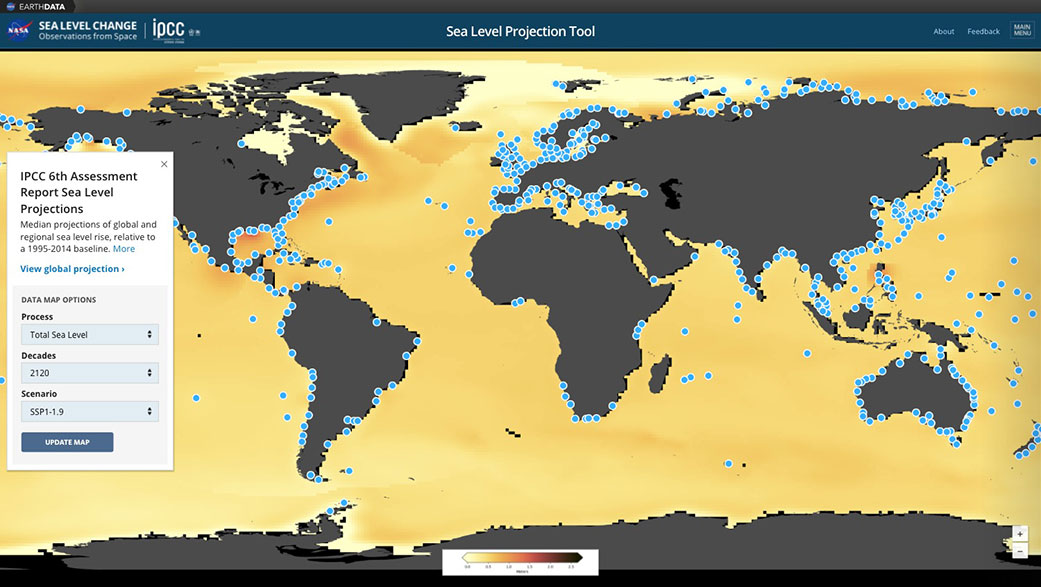
But for the first time, anyone will be able to see a visualization of how sea levels will change on a local level using the new online tool, a granularity that is difficult to capture in the IPCC report itself.

“What’s new here is a tool that we are providing to the community, to distribute the latest climate knowledge produced by the IPCC and NASA scientists in an accessible and user-friendly way while maintaining scientific integrity,” said Nadya Vinogradova Shiffer, program scientist, and manager at NASA, who directs NASA’s Sea Level Change science team.

“As the first data-delivery partnership between the IPCC and a federal agency, NASA’s new sea-level projection tool will help pave the way for future activities that facilitate knowledge sharing, open science, and easy access to the state-of-the-art climate science. This information is critical to increasing climate resilience of nations with large coastal populations, infrastructure, and economies that will be impacted by sea-level rise,” said Vinogradova Shiffer.

Along with providing snapshots of rising sea levels in the decades to come, the tool enables users to focus on the effects of different processes that drive sea-level rise. Those processes include the melting of ice sheets and glaciers and the extent to which ocean waters shift their circulation patterns or expand as they warm, which can affect the height of the ocean.

“As communities across the country prepare for the impacts of sea-level rise, access to good, clear data is key to helping save lives and livelihoods,” said NASA Administrator Bill Nelson. “NASA’s new sea-level projection tool will arm the American people and decision-makers with the information needed to make critical decisions about economic and public policy, to protect our communities from the potentially devastating effects of sea-level rise.”

The tool can display possible future sea levels under several greenhouse-gas-emission and socioeconomic scenarios, including a low-emissions future, a “business as usual” trajectory with emissions on their current track, and an “accelerated emissions” scenario. A low-emission future, for example, would occur if humanity reduces its greenhouse gas emissions, lessening the effects of climate-driven sea level change. The other end of the emission spectrum yields projections with the most rapid rise in sea level, information that could be useful for coastal planning that takes less likely but potentially more destructive possibilities into account.

“The goal is to deliver the projection data in the IPCC report in a usable form while also providing easy visualization of the future scenarios,” said Ben Hamlington, a research scientist at NASA’s Jet Propulsion Laboratory in Southern California, who leads the agency’s Sea Level Change science team.

The sea level projection tool should help people at all levels of government in countries around the world to forecast future scenarios and to develop coastal resources accordingly. “Making sea level science accessible is our primary goal,” said Carmen Boening, a NASA oceanographer who also heads the agency’s Sea Level Portal, which hosts the projection tool.

EI team uses machine learning models to gain insights into what makes plants, humans tick

The inner 24-hour cycles - or circadian rhythms - are key to maintaining human, plant, and animal health, which could provide valuable insight into how broken clocks impact health.  Dr Laura-Jayne Gardiner and Prof Anthony Hall inspecting a wheat trial at the Earlham Institute.  CREDIT Earlham Institute (EI)

Circadian rhythms, such as the sleep-wake cycle, are innate to most living organisms and critical to life on Earth. The word circadian originates from the Latin phrase ‘circa diem’ which means ‘around a day’. 

Biologically, the circadian clock temporally orchestrates physiology, biochemistry, and metabolism across the 24-hour day-night cycle. This is why being out of kilter can affect our fitness levels, our health, or our ability to survive. For example, experiencing jet lag is a chronobiological problem - our body clocks are out of sync because the normal external cues such as light or temperature have changed. 

The circadian clock isn’t unique to humans. In plants, an accurate clock helps to regulate flowering and is crucial to synchronizing metabolism and physiology with the rising and setting sun. Understanding circadian rhythms can help to improve plant growth and yields, not to mention revealing new avenues for tackling human diseases. 

Beyond plants

For this latest research, the team applied ML to predict complex temporal circadian gene expression patterns in the model plant Arabidopsis thaliana. Taking newly generated datasets, published temporal datasets, and Arabidopsis genomes, the team of scientists trained ML models to make predictions about circadian gene regulation and expression patterns. 

Featured in the journal PNAS, the work demonstrates the power of AI and ML-based approaches to enable more cost-effective analysis and deeper insight into the function of the circadian clock and its regulation. These approaches are redefining how scientists use public data and generate testable hypotheses to understand gene expression control in plants and humans.  

Lead author Dr. Laura-Jayne Gardiner from IBM Research Europe (formerly at the Earlham Institute where the research was carried out), said: “Essentially, our inner rhythm is driven by a circadian clock, which is a biochemical oscillator synchronized with solar time or the position of the sun in the sky. In most living things, including animals, plants, fungi, and even cyanobacteria, internally synchronized circadian clocks make it possible for an organism to anticipate daily environmental changes corresponding with the day-night cycle and adjust its biology and behavior accordingly.”

Detecting circadian rhythms 

Prof Anthony Hall, Group Leader at the Earlham Institute, said: “Genes involved in the circadian clock typically show an oscillation between off-on state rhythmic patterns throughout a 24-hour period. This pattern is called circadian rhythmicity. 

“Detecting circadian rhythmicity with existing methods is challenging as it requires using sequencing technologies to generate long, high-resolution, time-series transcriptome datasets to measure gene expression throughout the day. Not only is this expensive, it is also time-consuming for laboratory scientists. Consequently, our knowledge to date of how genes are controlled and regulated in a circadian clock is limited.”

The development of AI and ML-based technology was initially applied to the model plant Arabidopsis, progressing to testing other complex or temporal gene expression patterns as well as other species across Arabidopsis ecotypes. Furthermore, the team has adapted the ML approach for wheat to show that the methods used to allow accurate analysis of key food crops.

Arabidopsis thaliana is a popular scientific model organism used by plant biology and genetics. The first plant to have its genome sequenced, it has been used to understand the molecular biology and genetics of many plant traits, including circadian regulation. 

“Our ML models classify circadian expression patterns using iteratively lower numbers of transcriptomic timepoints, which is an improvement in accuracy compared to the existing state-of-the-art models,” explained Prof Hall. 

“We developed an ML model which generates a proxy gene set to predict the circadian time (phase) from a single transcriptomic sampling time point in the day. There are thousands of public transcriptomic datasets and by comparing this predicted time with the experimental time, we can identify specific genes or conditions that alter the clock function. Therefore increasing our understanding of the mechanism and function of the clock.” 

“We re-defined the field by developing ML models to distinguish circadian transcripts that don’t use transcriptomic timepoint information, but instead DNA sequence features generated from public genomic resources. Therefore, allowing us to predict the circadian regulation of genes simply by analyzing the genome DNA sequence.”

The researchers based their study on the theory that a major mechanism of gene expression control, be it circadian or other mechanisms, is through transcription factors (and other factors) that bind to a regulatory DNA sequence. 

Transcription factors are vital molecules that can control gene expression - directing when, where and to what degree genes are expressed. They bind to specific sequences of DNA and control the transcription of DNA into mRNA.

Explainable AI

Dr. Gardiner adds: “Our ML models and their application in crops, where circadian rhythms are critical to maintaining healthy growth and development, could lead to increased yields as agricultural scientists and farmers begin to use the model to understand the inner rhythms of the plants they grow and harvest.

“However, the technology we developed goes beyond the scope of plants. We are now looking at different species to investigate the circadian clock and its link to disease in humans, for example, where the dysregulation of the circadian clock has been associated with a range of diseases from depression to cancer.”

Dr. Gardiner is clear about the value of ML and AI in gaining deeper insights into circadian regulation: “What makes our models more informative is our usage of explainable AI algorithms,” she explains. “We wanted to use the interpretation of our ML models to illuminate what’s inside the black box so that we can better understand the predictions they make. 

“We used local model explanations that are transcript specific to rank DNA sequence features, which provide a detailed profile of the potential circadian regulatory mechanisms for each transcript. Using the local explanation derived from ranked DNA sequence features allows us to distinguish the temporal phase of transcript expression and, in doing so, reveal hidden sub-classes within the circadian class. E.g., whether a transcript is likely to show its peak expression in the morning, afternoon, evening, or night.”

Rice built models show small stars share similar dynamics to our sun, the key to planet habitability

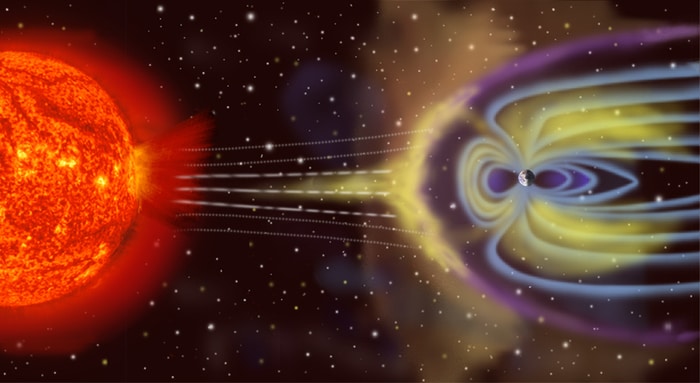
Stars scattered throughout the cosmos look different, but they may be more alike than once thought, according to Rice University researchers. Rice University scientists have shown that "cool" stars like the sun share dynamic surface behaviors that influence their energetic and magnetic environments. Stellar magnetic activity is key to whether a given star can host planets that support life.  CREDIT NASA

New modeling work by Rice scientists shows that "cool" stars like the sun share the dynamic surface behaviors that influence their energetic and magnetic environments. This stellar magnetic activity is key to whether a given star hosts planets that could support life.

The work by Rice postdoctoral researcher Alison Farrish and astrophysicists David Alexander and Christopher Johns-Krull appear in a published study in The Astrophysical JournalThe research links the rotation of cool stars with the behavior of their surface magnetic flux, which in turn drives the star's coronal X-ray luminosity, in a way that could help predict how magnetic activity affects any exoplanets in their systems.

The study follows another led by Farrish and Alexander that showed a star's space "weather" may make planets in their "Goldilocks zone" uninhabitable.

"All stars spin down over their lifetimes as they shed angular momentum, and they get less active as a result," Farrish said. "We think the sun in the past was more active and that might have affected the early atmospheric chemistry of Earth. So thinking about how the higher energy emissions from stars change over long timescales is pretty important to exoplanet studies." Alison Farrish is an astrophysicist and postdoctoral research associate with Rice University's Department of Physics and Astronomy.

"More broadly, we're taking models that were developed for the sun and seeing how well they adapt to stars," said Johns-Krull.

The researchers set out to model what far-flung stars are like based on the limited data available. The spin and flux of some stars have been determined, along with their classification -- types FGK, and M -- which gave information about their sizes and temperatures.

They compared the properties of the sun, a G-type star, through its Rossby number, a measure of stellar activity that combines its speed of rotation with its subsurface fluid flows that influence the distribution of magnetic flux on a star's surface, with what they knew of other cool stars. Their models suggest that each star's "space weather" works in much the same way, influencing conditions on their respective planets.

"The study suggests that stars -- at least cool stars -- are not too dissimilar from each other," Alexander said. "From our perspective, Alison's model can be applied without fear or favor when we look at exoplanets around M or F or K stars, as well, of course, as other G stars.

"It also suggests something much more interesting for established stellar physics, that the process by which a magnetic field is generated may be quite similar in all cool stars. That's a bit of a surprise," he said. This could include stars that, unlike the sun, are convective down to their cores.

"All stars like the sun fuse hydrogen and helium in their cores and that energy is first carried in the radiation of photons toward the surface," Johns-Krull said. "But it hits a zone about 60% to 70% of the way that's just too opaque, so it starts to undergo convection. Hot matter moves from below, the energy radiates away, and the cooler matter falls back down.

"But stars with less than a third of the mass of the sun don't have a radiative zone; they're convective everywhere," he said. "A lot of ideas about how stars generate a magnetic field rely on there being a boundary between the radiative and the convection zones, so you would expect stars that don't have that boundary to behave differently. This paper shows that in many ways, they behave just like the sun, once you adjust for their own peculiarities."

Farrish, who recently earned her doctorate at Rice and begins a postdoctoral research assignment at NASA's Goddard Space Flight Center soon, noted the model applies only to unsaturated stars.

"The most magnetically active stars are the ones we call 'saturated,'" Farrish said. "At a certain point, an increase in magnetic activity stops showing the associated increase in high energy X-ray emission. The reason that dumping more magnetism onto the star's surface doesn't give you more emission is still a mystery.

"Conversely, the sun is in the unsaturated regime, where we do see a correlation between magnetic activity and energetic emission," she said. "That happens at a more moderate activity level, and those stars are of interest because they might provide more hospitable environments for planets."

"The bottom line is the observations, which span four spectral types including both fully and partially convective stars, can be reasonably well represented by a model generated from the sun," Alexander said. "It also reinforces the idea that even though a star that is 30 times more active than the sun may not be a G-class star, it's still captured by the analysis that Alison has done".

"We do have to be clear that we're not simulating any specific star or system," he said. "We are saying that statistically, the magnetic behavior of a typical M star with a typical Rossby number behaves in a similar fashion to that of the sun which allows us to assess its potential impact on its planets."

A critical wild card is a star's activity cycle, which can't be incorporated into the models without years of observation. (The sun's cycle is 11 years, evidenced by sunspot activity when its magnetic field lines are most distorted.)

Johns-Krull said the model will still be useful in many ways. "One of my areas of interest is studying very young stars, many of which are, like low-mass stars, fully convective," he said. "Many of these have disc material around them and are still forming planets. How they interact is mediated, we think, by the stellar magnetic field.

"So, Alison's modeling work can be used to learn about the large-scale structure of very magnetically active stars, and that can then allow us to test some ideas about how these young stars and their disks interact."

Minjing Li, a visiting undergraduate from the University of Science and Technology of China, is a co-author of the paper. Alexander is a professor of physics and astronomy and director of the Rice Space Institute. Johns-Krull is a professor of physics and astronomy.