

The human brain holds the secret to our unique personalities. But did you know that it can also form the basis of highly efficient computing devices? Researchers from Nagoya University, Japan, recently showed how to do this, through graphene-diamond junctions that mimic some of the human brain’s functions. 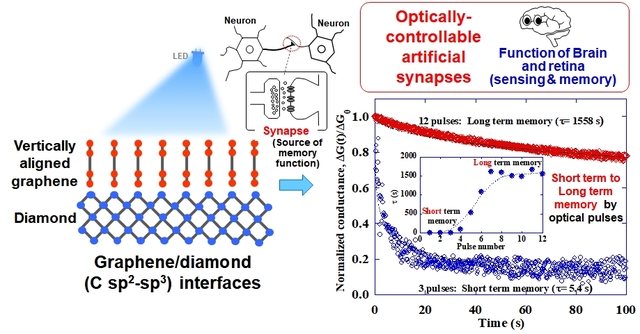
But, why would scientists try to emulate the human brain? Today, existing computer architectures are subjected to complex data, limiting their processing speed. The human brain, on the other hand, can process highly complex data, such as images, with high efficiency. Scientists have, therefore, tried to build “neuromorphic” architectures that mimic the neural network in the brain.
A phenomenon essential for memory and learning is “synaptic plasticity,” the ability of synapses (neuronal links) to adapt in response to an increased or decreased activity. Scientists have tried to recreate a similar effect using transistors and “memristors” (electronic memory devices whose resistance can be stored). Recently developed light-controlled memristors, or “photomemristors,” can both detect light and provide non-volatile memory, similar to human visual perception and memory. These excellent properties have opened the door to a whole new world of materials that can act as artificial optoelectronic synapses!
This motivated the research team from Nagoya University to design graphene-diamond junctions that can mimic the characteristics of biological synapses and key memory functions, opening doors for next-generation image-sensing memory devices. In their recent study published in Carbon, the researchers, led by Dr. Kenji Ueda, demonstrated optoelectronically controlled synaptic functions using junctions between vertically aligned graphene (VG) and diamond. The fabricated junctions mimic biological synaptic functions, such as the production of “excitatory postsynaptic current” (EPSC)—the charge induced by neurotransmitters at the synaptic membrane—when stimulated with optical pulses and exhibit other basic brain functions such as the transition from short-term memory (STM) to long-term memory (LTM).
Dr. Ueda explains, “Our brains are well-equipped to sieve through the information available and store what’s important. We tried something similar with our VG-diamond arrays, which emulate the human brain when exposed to optical stimuli.” He adds, “This study was triggered due to a discovery in 2016 when we found a large optically induced conductivity change in graphene-diamond junctions.” Apart from EPSC, STM, and LTM, the junctions also show paired-pulse facilitation of 300%—an increase in postsynaptic current when closely preceded by a prior synapse.
The VG-diamond arrays underwent redox reactions induced by fluorescent light and blue LEDs under a bias voltage. The researchers attributed this to the presence of differently hybridized carbons of graphene and diamond at the junction interface, which led to the migration of ions in response to the light and turn, allowed the junctions to perform photo-sensing and photo-controllable functions similar to those performed by the brain and retina. In addition, the VG-diamond arrays surpassed the performance of conventional rare-metal-based photosensitive materials in terms of photosensitivity and structural simplicity.
Dr. Ueda says, “Our study provides a better understanding of the working mechanism behind the artificial optoelectronic synaptic behaviors, paving the way for optically controllable brain-mimicking computers better information-processing capabilities than existing computers.”
The future of next-generation supercomputing may not be too far away.
Via advanced analyses, scientists shed light on the mechanism of a deadly problem plaguing combustion chambers in rocket engines 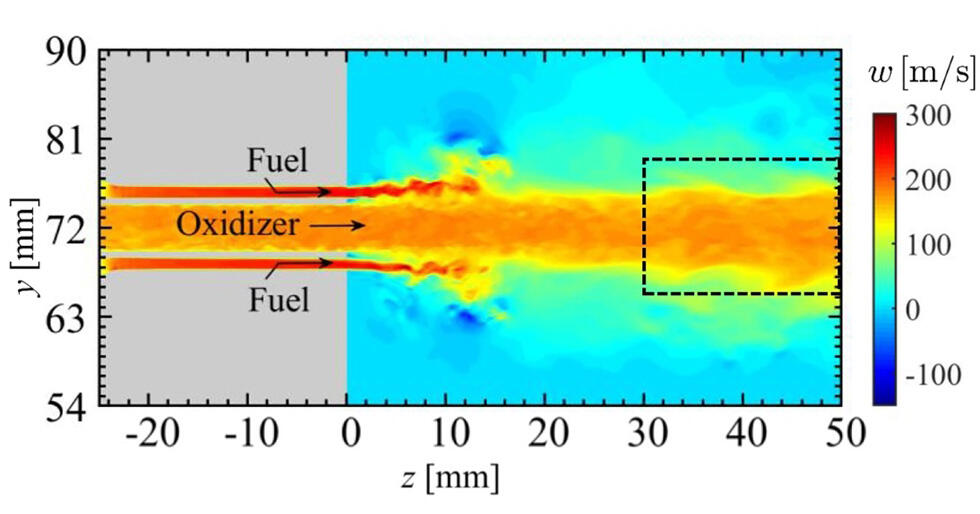
A vital piece of gas engines, combustors―the chambers in which the combustion powering the engine occurs―have the problem of breaking down due to fatal high-frequency oscillations during the combustion process. Now, through advanced time-series analyses based on complex systems, researchers from Tokyo University of Science and Japan Aerospace Exploration Agency have found what causes them, opening up novel paths to solving the problem.
Rocket engines contain confined combustion systems, which are, essentially, combustion chambers. In these chambers, nonlinear interactions among turbulent fuel and oxidizer flow, sound waves, and heat produced from chemical reactions cause an unstable phenomenon called 'combustion oscillations.' The force of these oscillations on the body of the combustion chamber―the mechanical stress on the chamber― is high enough to threaten the catastrophic failure of the engine. What causes these oscillations? The answer remains to be found.
Now, in a breakthrough, published in Physics of Fluids, a team including Prof. Hiroshi Gotoda, Ms. Satomi Shima, and Mr. Kosuke Nakamura from Tokyo University of Science (TUS), in collaboration with Dr. Shingo Matsuyama and Dr. Yuya Ohmichi from the Japan Aerospace Exploration Agency (JAXA), have used advanced time-series analyses based on complex systems to find out.
Explaining their work, Prof. Gotoda says, "Our main purpose was to reveal the physical mechanism behind the formation and sustenance of high-frequency combustion oscillations in a cylindrical combustor using sophisticated analytical methods inspired by symbolic dynamics and complex networks." These findings have also been covered by the American Society of Physics in their news section, and by the Institute of Physics on their news platform Physics World.
The combustor the scientists picked to simulate is one of the model rocket engines. They were able to pinpoint the moment of transition from the stable combustion state to combustion oscillations and visualize it. They found that significant periodic flow velocity fluctuations in fuel injectors affect the ignition process, resulting in changes to the heat release rate. The heat release rate fluctuations synchronize with the pressure fluctuations inside the combustor, and the whole cycle continues in a series of feedback loops that sustain combustion oscillations.
Additionally, by considering a spatial network of pressure and heat release rate fluctuations, the researchers found that clusters of acoustic power sources periodically form and collapse in the shear layer of the combustor near the injection pipe's rim, further helping drive the combustion oscillations.
These findings provide reasonable answers for why combustion oscillations occur, albeit specific to liquid rocket engines. Prof. Gotoda explains, "Combustion oscillations can cause fatal damage to combustors in rocket engines, aero engines, and gas turbines for power generation. Therefore, understanding the formation mechanism of combustion oscillations is an important research subject. Our results will greatly contribute to our understanding of the mechanism of combustion oscillations generated in liquid rocket engines."
Indeed, these findings are significant and can be expected to open doors to novel routes of exploration to prevent combustion oscillations in critical engines.