KAIST researchers make a brain-inspired scalable neuromorphic hardware

Korea Advanced Institute of Science and Technology (KAIST) researchers fabricated brain-inspired highly scalable neuromorphic hardware by co-integrating single transistor neurons and synapses. Using standard silicon complementary metal-oxide-semiconductor (CMOS) technology, neuromorphic hardware is expected to reduce chip costs and simplify fabrication procedures.

The research team led by Yang-Kyu Choi and Sung-Yool Choi produced neurons and synapses based on a single transistor for highly scalable neuromorphic hardware and showed the ability to recognize text and face images. This research was featured in Science Advances on August 4. Single transistor neurons and synapses fabricated using a standard silicon CMOS process. They are co-integrated on the same 8-inch wafer.
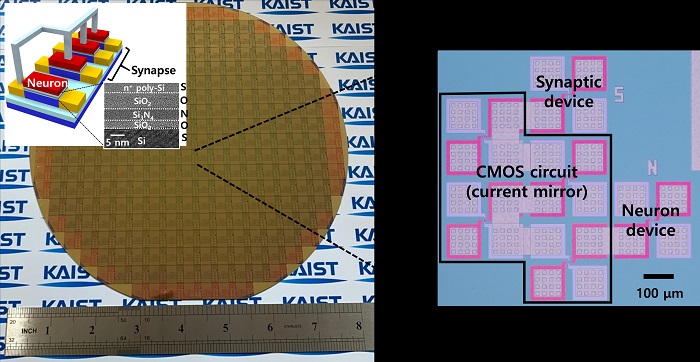
Neuromorphic hardware has attracted a great deal of attention because of its artificial intelligence functions but consuming ultra-low-power of fewer than 20 watts by mimicking the human brain. To make neuromorphic hardware work, a neuron that generates a spike when integrating a certain signal, and a synapse remembering the connection between two neurons is necessary, just like the biological brain. However, since neurons and synapses constructed on digital or analog circuits occupy a large space, there is a limit in terms of hardware efficiency and costs. Since the human brain consists of about 1011 neurons and 1014 synapses, it is necessary to improve the hardware cost in order to apply it to mobile and IoT devices.

To solve the problem, the research team mimicked the behavior of biological neurons and synapses with a single transistor and co-integrated them onto an 8-inch wafer. The manufactured neuromorphic transistors have the same structure as the transistors for memory and logic that are currently mass-produced. In addition, the neuromorphic transistors proved for the first time that they can be implemented with a ‘Janus structure’ that functions as both neuron and synapse, just like coins have heads and tails.

Professor Yang-Kyu Choi said that this work can dramatically reduce the hardware cost by replacing the neurons and synapses that were based on complex digital and analog circuits with a single transistor. "We have demonstrated that neurons and synapses can be implemented using a single transistor," said Joon-Kyu Han, the first author. "By co-integrating single transistor neurons and synapses on the same wafer using a standard CMOS process, the hardware cost of the neuromorphic hardware has been improved, which will accelerate the commercialization of neuromorphic hardware,” Han added. This research was supported by the National Research Foundation (NRF) and IC Design Education Center (IDEC).
UW prof builds a model that proposes blobs like in a lava lamp of sediment float up through deep earth

A University of Wyoming professor has used computer modeling to propose that sand and mud subducted off the coast of California around 75 million years ago returned to the Earth’s crust by rising through the mantle as enormous diapirs, like blobs in a lava lamp.

These blobs are now found at the surface of the Earth, far inland from the coast, in places including the Mojave Desert and western Arizona.

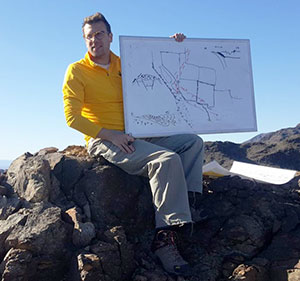
“These rocks aren’t the prettiest to look at, but they went on an extraordinary journey and have an incredible story to tell,” says Jay Chapman, an assistant professor in UW’s Department of Geology and Geophysics who focuses on tectonics. UW Assistant Professor Jay Chapman teaches a winter-term field course in southern Arizona, during which students were able to investigate the Orocopia Schist in person. Chapman is the author of a new paper that suggests the rock originated as sand and mud subducted off the coast of California around 75 million years ago, then returned to the Earth’s crust by rising up through the mantle as enormous diapirs. (UW Photo)

Chapman is the author of a new paper, titled “Diapiric relamination of the Orocopia Schist (southwestern U.S.) during low-angle subduction,” which was published in the August issue of the journal Geology. 

“The rocks started their lives as sediment eroded from the Sierra Nevada Mountains and carried by rivers and streams down to the ocean, where they ended up deposited in a subduction trench, similar to the modern-day Marianas trench,” Chapman says. “Then, they were carried about 20 miles deep into the Earth by a subducting oceanic plate, where the sediments were metamorphosed into a rock called schist. That in and of itself is pretty amazing, but the truly special thing about these rocks is that they didn’t stay subducted, but somehow made their way back up to the surface, where you can go stand on them today.”

How the subducted sediments returned to the surface of the Earth and the distribution of the sediments in the subsurface are some of the questions Chapman is trying to answer with his research.

“The prevailing theory is that the sediments were smeared against and plastered to the base of the North American tectonic plate, forming a sheet-like layer,” Chapman says. “However, the density of these sediments is much lower than rocks in the mantle or lower crust and, over millions of years, computer modeling predicts that the sediments will flow and buoyantly ascend, like hot wax in a lava lamp.”

The research has implications for understanding subduction zone processes and the distribution of natural resources. Numerical modeling of sediment subducted beneath North American crust suggests that the sediment may buoyantly rise up through the mantle, like a lava lamp blob, and become attached to the base of the crust.

“Geoscientists around the world are working to understand what gives the continental crust its unique composition, and subduction and reincorporation of sediment are a popular hypothesis,” Chapman says. “In addition, many researchers are now wondering whether fluids and elements released from the subducted sediments may have contributed to the concentration of economically important minerals and metals.”

Emirates' Technology Innovation Institute appoints distinguished technologist Dr. Ray O. Johnson as CEO

Dr. Johnson will shape the Institute’s strategic direction Dr Ray O. Johnson, Chief Executive Officer, Technology Innovation Institute

Technology Innovation Institute (TII), the applied research pillar of the Advanced Technology Research Council (ATRC), the overarching advanced technology body in Abu Dhabi responsible for driving research and development for transformative technology outcomes, today announced the appointment of veteran technologist and entrepreneur Dr. Ray O. Johnson as Chief Executive Officer. Dr. Johnson will work on shaping the strategic direction of the Institute and lead the execution of its growth strategies to achieve operational excellence.

Prior to joining TII, Dr. Johnson was an Operating Partner at Bessemer Venture Partners, a top-tier American venture capital company that has been part of 130 IPOs in the last 50 years, and before that, he was the Corporate Senior Vice President for Engineering, Technology, and Operations and Chief Technology Officer of the Lockheed Martin Corporation.

Dr. Johnson brings to his role over four decades of experience in global technology leadership, making strategic investments in disruptive technologies, and developing business strategies that resulted in several new billion-dollar lines of business. He also holds outstanding networking capabilities; he has met with leaders at the highest echelons of government, industry, and academia. He is frequently sought after as a speaker at global forums on business, strategy, innovation, and education.

Speaking on the new appointment, His Excellency Faisal Al Bannai, Secretary-General of ATRC, said: “We welcome Dr. Ray Johnson as the first CEO of Technology Innovation Institute. His appointment is a much anticipated one – we were keen that the person entrusted with this role should not merely be an excellent research and technology specialist, but equally, a consummate professional and industry stakeholder that is capable of ensuring the most positive outcomes for the breakthrough projects TII is currently engaged in across its seven initial dedicated research centers.

“We are confident Dr. Johnson will be able to build game-changing synergies for TII as he leads it towards realizing its wider goals of growing its talented global team of 375+ researchers, scientists, and engineers, and ensuring the objectives of the current workstreams are met. He will also leverage his vast network to further expand our visibility and reach across markets.”

For his part, Dr. Ray O. Johnson said: “I am very excited about this new role in a region that I admire for its dedication to advanced research and development for the betterment of the UAE. Since TII’s inception in November 2020, I have followed its many announcements and achievements with great interest. As it moves into a new phase of growth, I look forward to working with the talented teams of researchers across its centers to drive competitive results and facilitate breakthrough solutions that transition to the market.”