

University of British Columbia physicist develops new software to capture the most detailed radio image of the Andromeda galaxy

The disk of a galaxy is identified as a region where new stars are born Radio image of Andromeda galaxy at 6.6 GHz (inset), captured using the Sardinia Radio Telescope in Italy.  CREDIT S. Fatigoni et al (2021)
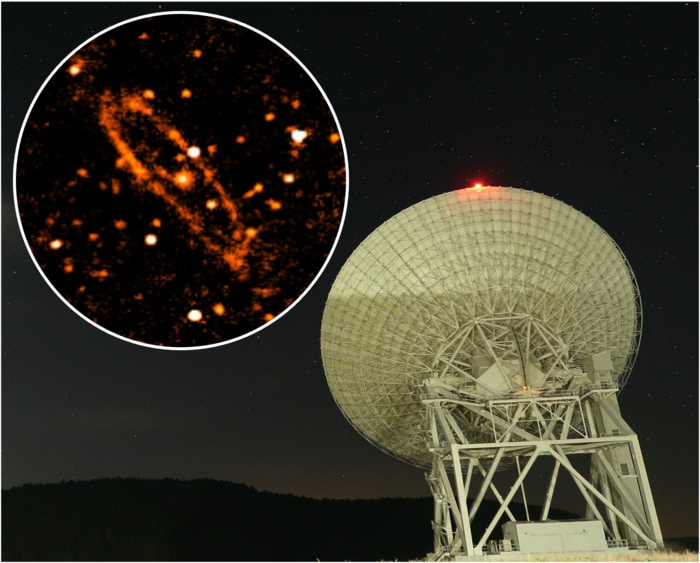
Scientists have published a new, detailed radio image of the Andromeda galaxy – the Milky Way’s sister galaxy – which will allow them to identify and study the regions of Andromeda where new stars are born.

The study – which is the first to create a radio image of Andromeda at the microwave frequency of 6.6 GHz – was led by University of British Columbia physicist Sofia Fatigoni, with colleagues at the Sapienza University of Rome and the Italian National Institute of Astrophysics. It was published online in Astronomy and Astrophysics.

“This image will allow us to study the structure of Andromeda and its content in more detail than has ever been possible,” said Fatigoni, a Ph.D. student in the department of physics and astronomy at UBC. “Understanding the nature of physical processes that take place inside Andromeda allows us to understand what happens in our own galaxy more clearly – as if we were looking at ourselves from the outside.”

Prior to this study, no maps capturing such a large region of the sky around the Andromeda Galaxy had ever been made in the microwave band frequencies between one GHz to 22 GHz. In this range, the galaxy’s emission is very faint, making it hard to see its structure. However, it is only in this frequency range that particular features are visible, so having a map at this particular frequency is crucial to understanding which physical processes are happening inside Andromeda.

In order to observe Andromeda at this frequency, the researchers required a single-dish radio telescope with a large effective area. For the study, the scientists turned to the Sardinia Radio Telescope, a 64-meter fully steerable telescope capable of operating at high radio frequencies.

It took 66 hours of observation with the Sardinia Radio Telescope and consistent data analysis for the researchers to map the galaxy with high sensitivity. They were then able to estimate the rate of star formation within Andromeda, and produce a detailed map that highlighted the disk of the galaxy as the region where new stars are born.

“By combining this new image with those previously acquired, we have made significant steps forward in clarifying the nature of Andromeda’s microwave emissions and allowing us to distinguish physical processes that occur in different regions of the galaxy,” said Dr. Elia Battistelli, a professor in the department of physics at Sapienza and coordinator of the study.

“In particular, we were able to determine the fraction of emissions due to thermal processes related to the early stations of new star formation, and the fraction of radio signals attributable to non-thermal mechanisms due to cosmic rays that spiral in the magnetic field present in the interstellar medium,” Fatigoni said.

For the study, the team developed and implemented software that allowed – among other things – to test new algorithms to identify never-before-examined lower emission sources in the field of view around Andromeda at a frequency of 6.6 GHz. From the resulting map, researchers were able to identify a catalog of about 100 point sources, including stars, galaxies and other objects in the background of Andromeda.

Intel data center chips sales decrease by 9 percent in Q2

Intel has reported second-quarter 2021 total revenues of $19.6 billion, flat from Q2 2020. The Santa Clara, California-based company's sales were supported by record Q2 revenue achieved by the personal computers and Mobileye businesses. In Q2, PC platform volumes were up 33 percent YoY. 

Despite this, the data center group (DCG) had diminishing sales of $6.5 billion, down by 9% from $7.1 billion last year. Its operating income has dived 37% to $1.9 billion (30% margin) from $3.1 billion (44% margin) a year ago. DCG adjacencies including Optane, AI accelerator, ethernet, 5G, and silicon photonics products have plunged by 20%. 

“There’s never been a more exciting time to be in the semiconductor industry. The digitization of everything continues to accelerate, creating a vast growth opportunity for us and our customers across core and emerging business areas. With our scale and a renewed focus on both innovation and execution, we are uniquely positioned to capitalize on this opportunity, which I believe is merely the beginning of what will be a decade of sustained growth across the industry,” said Pat Gelsinger, Intel CEO. “Our second-quarter results show that our momentum is building, our execution is improving, and customers continue to choose us for leadership products.”

New astrophysical supercomputing enables scientists on the hunt for ‘hierarchical’ black holes by accurately interpreting gravitational wave signals

Black holes, detected by their gravitational wave signal as they collide with other black holes, could be the product of much earlier parent collisions. Such an event has only been hinted at so far, but scientists at the University of Birmingham in the UK, and Northwestern University in the US, believe we are getting close to tracking down the first of these so-called ‘hierarchical’ black holes.

In a review paper, Dr. Davide Gerosa, of the University of Birmingham, and Dr. Maya Fishbach of Northwestern University suggest that recent theoretical findings and astrophysical modeling, and recorded gravitational wave data will enable scientists to accurately interpret gravitational wave signals from these events.

Since the first gravitational wave was detected by the LIGO and Virgo detectors in September 2015, scientists have produced increasingly nuanced and sophisticated interpretations of these signals.

There is now fervent activity to prove the existence of so-called ‘hierarchical mergers’ although the detection of GW190521 in 2019 – the most massive black hole merger yet detected – is thought to be the most promising candidate so far.

“We believe that most of the gravitational waves so far detected are the result of first-generation black holes colliding,” says Dr. Gerosa. “But we think there’s a good chance that others will contain the remnants of previous mergers. These events will have distinctive gravitational wave signatures suggesting higher masses, and an unusual spin caused by the parent collision.”

Understanding the characteristics of the environment in which such objects might be produced will also help narrow the search. This must be an environment with a large number of black holes, and one that is sufficiently dense to retain the black holes after they have merged, so they can go on and merge again.

These could be, for example, nuclear star clusters, or accretion disks – containing a flow of gas, plasma, and other particles – surrounding the compact regions at the center of galaxies.

“The LIGO and Virgo collaboration has already discovered more than 50 gravitational wave events,” says Dr. Fishbach. “This will expand to thousands over the next few years, giving us so many more opportunities to discover and confirm unusual objects like hierarchical black holes in the universe.”