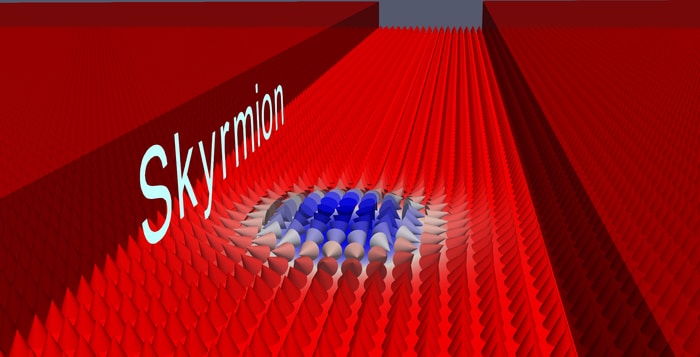
Shinshu University demos an effective strategy for protecting skyrmion-based spintronics

Magnetic skyrmions are potential information carriers in future spintronic devices, and an effective method to confine and protect them in magnetic materials has been realized by scientists in Japan A magnetic skyrmion confined in a designed channel within a ferromagnetic film, where the skyrmion is protected from being touching the film edge.

A magnetic skyrmion is a versatile topological object that can be used to carry information in future spintronic information processing devices. As potential non-volatile information carriers, excellent endurance and robust retention are desired properties of skyrmions in spintronic devices. However, previous studies have suggested that skyrmions can be easily destroyed at device edges during high-speed operations due to the so-called skyrmion Hall effect. For these reasons, a focus of current skyrmion research is to find effective ways to protect skyrmions from being destroyed by touching device edges. Typical solutions include the elimination of the skyrmion Hall effect in antiferromagnetic and synthetic antiferromagnetic systems.

In a study published in Nano Letters, the group led by Prof. Xiaoxi Liu from the Department of Electrical and Computer Engineering, Shinshu University, Japan, and their collaborators demonstrate in experiments that skyrmions can be effectively confined in channels and protected from being destroyed at device edges in more commonly used ferromagnetic systems. The confinement of skyrmions in designed channels is fundamental for any practical applications based on the accumulation and transport of skyrmions. The authors find that the position of skyrmions in ferromagnetic materials can be controlled by engineered energy barriers and wells. Therefore, they experimentally fabricated a magnetic multilayer film with many energy barriers and wells formed by patterns with modified magnetic properties, where they find that skyrmions can be attracted or repelled by the boundaries of patterns. By fabricating square and stripe patterns with modified magnetic properties in a large ferromagnetic film, the authors show the possibility of building reliable channels for confinement, accumulation, and potential transport of skyrmions as information carriers.

In addition, this method reported in this research also offers the possibility for future study of the skyrmions interacting with one-dimensional and two-dimensional substrates, which are important dynamic problems that have been investigated theoretically in past decades.

“Our research demonstrated that a robust topological protection of skyrmions can be achieved by a simple but effective approach, which has practical application importance,” explains experimentalist Prof. Xiaoxi Liu of Shinshu University, who led this research study.

Senior JSPS researcher Dr. Xichao Zhang says, “The research results suggest that we can use patterns of modified magnetic properties to control the static and dynamic behaviors of skyrmions." He then adds, “In our future work, we will investigate the current-induced dynamics of skyrmions in designed channels, which will be another important step toward skyrmion-based spintronic devices.”

Prof. Markram builds AI that reveals how glucose helps the SARS-CoV-2 virus

A group in the Blue Brain assembled an AI tool that could read hundreds of thousands of scientific papers, extract the knowledge and assemble the answer - A machine-generated view of the role of blood glucose levels in the severity of COVID-19 was published today by Frontiers in Public Health, Clinical Diabetes.

In response to the COVID-19 pandemic, the COVID-19 Open Research Dataset (CORD-19) of over 400,000 scholarly articles was made open access, including over 150,000 with full-text papers related to COVID-19, SARS-CoV-2, and other coronaviruses. The CORD-19 dataset is the most extensive coronavirus literature collection available for data mining to date and the coalition behind it has challenged AI experts to apply their skills in natural language processing and other machine learning techniques to generate new insights that may help in the ongoing fight against COVID-19.

“Since early 2020, Blue Brain has been proactively contributing to the fight against COVID-19,” explains Prof. Henry Markram, Founder, and Director of the Blue Brain Project. “With this call to action, we realized we could use our Machine Learning technologies and Data and Knowledge Engineering expertise to develop text and data mining tools required to try and help the medical community. Blue Brain set out to answer one of the most puzzling aspects of this pandemic – why some people get very sick, while others are completely unaffected”.

Building and using the text and data mining tools

Accordingly, Blue Brain built and trained machine-learning models to mine these papers and extract structured information from text sources. A simple analysis by this text mining toolbox ‘Blue Brain Search’ of the CORD-19v47 dataset revealed papers that all pointed to glucose metabolism as the most frequently mentioned biological variable.

Using Blue Graph, a unifying Python framework that analyses extracted text concepts to construct knowledge graphs, the group constructed specific knowledge graphs to focus on all the findings that considered glucose in the context of respiratory diseases, coronaviruses, and COVID-19. This allowed for the exploration of the potential role of glucose across many levels, from the most superficial symptomatic associations to the deepest biochemical mechanisms implicated in the disease.

From the facts and findings of thousands of papers mined, multiple lines of evidence emerged that elevated blood glucose levels were either caused by abnormal glucose metabolism or induced during hospitalization, drug treatments, or by IV administration. This approach correlated extremely well with COVID-19 severity across the population and revealed how elevated glucose helps virtually every step of the viral infection, from its onset in the lungs, through to severe complications such as Acute Respiratory Distress Syndrome, multi-organ failure, and thrombotic events.

“Subsequently, in the paper, we discuss the potential consequences of this hypothesis and propose areas for further investigation into diagnostics, treatments, and interventions that may help to reduce the severity of COVID-19 and help manage the public health impact of the pandemic,” discloses Blue Brain’s Molecular Biologist Dr. Emmanuelle Logette.

The potential of open access scientific papers    

“Scientists immediately went to work when the pandemic started and within a year published over a hundred thousand papers. But, can anyone read so many papers? Can anyone see and understand all the patterns across all this research?” asks Prof. Henry Markram. “Fortunately, the coalition behind the CORD-19 dataset convinced all subscription publishers to bring these papers over the subscription paywall and make them openly accessible so that they can be mined with modern machine learning and knowledge engineering technologies”

“With access to the CORD-19 dataset, Blue Brain quickly assembled an AI tool and targeted it to try and find out why some get sick and others not. Is it enough to just say that older people are more vulnerable? We must find out why. Why do some apparently healthy people die from COVID-19? Why do so many people die in the ICU? To answer these questions, we directed our AI to trace every step of the viral infection from the moment the virus enters the lungs until the time when the virus breaks out of the cells in the lungs and spreads throughout the body to infect the organs,” explains Prof. Markram. “We also built the virus at an atomistic level and developed a computational model of the infection so we could try to test what was coming out of the literature. I think we did find the most likely reason why some people get sicker than others,” he concludes.

An example of this is the team using Blue Brain BioExplorer to visually show the main impacts of high glucose in airway surface liquid on the primary step of infections in the lung and explaining the increased susceptibility to respiratory viruses in at-risk patients.

Blue Brain BioExplorer was built to reconstruct, visualize, explore and describe in detail the structure and function of the coronavirus for this study, and is an open-source software to use to answer key scientific questions.

“Pioneering Simulation Neuroscience to better understand the brain has numerous collateral benefits,” states Prof. Markram. “This study shows how Blue Brain’s supercomputing technologies and unique team of multi-disciplinary experts can quickly be redirected to help in a global health crisis.”

A major step forward for science and understanding the brain    

“The COVID-19 study also shows why we believe that computational tools are so important to help us understand the brain,” explains Prof. Markram. “The problem is even bigger. There are several million scientific papers that one would need to read and understand to work out what we know about the brain. Does anyone know what we know? But, machines can read so many papers. This is the reason that the Blue Brain has developed some of the most advanced knowledge engineering, mathematical, and machine learning accelerator technologies. Actually, this solves only a part of the challenge. With an AI tool that can read all these papers, we would still only know only a small fraction of what the brain contains and how it works. But building model brains using design principles helps us to try and complete the picture.” he concludes.

Is it right to only open science during a pandemic?

Prof. Markram also expressed his frustration with the all too common practice of locking up scientific knowledge by subscription publishers. “When the CORD-19 literature dataset was made available to us, we at Blue Brain were able to point our technology at COVID-19 and propose an answer to an important question in the battle against this deadly virus.  Therefore, is it right to only make science papers (that are publicly funded) open to the public during a pandemic when the same kind of techniques can be used to help address so many other diseases, accelerate science, and help save the planet from climate change?”


A new mathematical model unveils the possible role of drug-eluting stents in artery re-closure in the dynamics of blood flow

For patients with symptomatic coronary artery disease, the best course of action often involves implanting a drug-eluting stent into the artery where a plaque buildup is blocking blood flow to the heart. The metallic stent props the artery open while releasing a drug that helps to suppress restenosis — the re-closure of the artery due to excess tissue growth around the stent. However, the body’s response to tissue inflammation and arterial injury around the stent’s edges can still sometimes cause restenosis.

In a paper publishing on Thursday in the SIAM Journal on Applied Mathematics, Sunčica Čanić, Yifan Wang (both of the University of California, Berkeley), and Martina Bukač (University of Notre Dame) develop mathematical models that represent a drug-eluting stent in an artery and investigate how the stent affects arterial tissue permeability and blood flow. “I believe that our work may help clinical workers understand certain pathologies of stent-related restenosis and eventually improve patient outcomes,” Wang said.

To accomplish this objective, the authors used several novel elements that are not present in previous stent models. “For the first time in our study, drug-eluting stents were computationally evaluated based on their performance in moving arteries modeled as poroelastic materials, with arterial wall permeability depending on the deformation of the arterial wall,” Čanić said. Poroelastic materials are solids with many pores through which fluids can flow, like sponges or the biological tissues that make up artery walls. The degree to which fluids can permeate the tissue wall depends on changes in the volume of the pores.

“We showed that the presence of a stent affects the deformation of the arterial tissue at the stent location, which changes the permeability properties of the tissue,” Čanić said. “This, in turn, influences how an anti-inflammatory drug that coats the stent penetrates the tissue and prevents inflammation.”

The researchers were inspired to follow this line of questioning by their partnership with David Paniagua of Baylor College of Medicine and Michael E. DeBakey Veterans Affairs Medical Center in Houston, Texas. Paniagua, who performs procedures with drug-eluting stents daily, suggested that the authors investigate stent performance and how the coating drugs elute into the tissue. “I believe that modeling drug-eluting stents help us better understand their behavior and aids in the clinical decision-making process by providing clinicians with more information,” Bukač said. 

One remaining challenge in the field of drug-eluting stent design is the “edge effect,” in which restenosis may occur at a higher rate near the outer borders of stents. After a stent is implanted, the interior of the artery near its edges continues to decrease in size for some patients, which constricts blood flow. 

Čanić, Wang, and Bukač utilized two sets of mathematical models to investigate exactly what causes the edge effect. The first is a fluid-structure interaction model, which represents the flow of blood through arteries and the arterial wall tissue’s response to the periodic changes in blood flow that occur as the heartbeats. The second model is a system of advection-reaction-diffusion equations, which represent how the anti-inflammatory drug in the stent coating undergoes chemical reactions, diffuses into the arterial wall tissue, and moves within the interior of the stented artery. 

“These two sets of models are coupled,” Čanić said. “The fluid-structure interaction model ‘informs’ the advection-reaction-diffusion model about the blood and blood plasma velocity that carries the drug, and enables the elution of the drug into the tissue.” The authors defined this coupling on a moving domain to represent the interaction between the flood of blood and the stented artery. Their model could represent five different geometries of metallic stent platforms, as well as two different kinds of coating drugs. 

The researchers began by examining how stent implantation altered the permeability of arterial wall tissue, which in turn affects how well the drug can elute into the tissue. The models showed that tissue pores expanded between the struts that make up the stent, resulting in increased permeability. But near the stent’s edges, the permeability was low since its rigidity prevents the adjacent tissue from expanding freely. This is problematic. “Lower permeability near the edges of the stent may compromise drug elution in that neighborhood,” Čanić said.

Čanić, Wang, and Bukač next investigated how the different elasticities of the normal artery and the stented artery influenced the dynamics of blood flow. They found that “recirculation zones” form near the stent’s edges, where blood circulates in one area instead of flowing down the artery as normal. This phenomenon seems to be caused by the mismatch in elastic properties at the boundaries between the stented and non-stented regions.

The recirculation zones in combination with the low permeability is a dangerous mix — both contribute to the edge effect, leading to excess tissue growth around the stent that could eventually cause restenosis and re-block the artery. The researchers are now working to design a stent that could avoid this problem by investigating whether the addition of a coated “stent-graft skirt” near-certain stents’ edges may help counter the edge effect and reduce the rate of restenosis. They are collaborating with Paniagua to design the skirt and plan to perform laboratory experiments with the new design.

The work from this study could potentially find applications to help real patients. “This approach could be used in patient-specific situations, like with arterial models that are obtained using medical imaging,” Bukač said. And the authors’ mathematical modeling approach may also have more far-reaching clinical applications. “I believe that our proposed model can also be adopted and applied to a more general field, such as studying tumor cell growth in tissue,” Wang said. In the future, the results from this work may move even beyond creating more effective stents for patients with coronary artery disease.