

SUPERCOMPUTING NEWS SUPERCOMPUTING NEWS
    • MEDIA KIT
    • MOST READ
    • RSS FEED
    • ACADEMIA
    • AEROSPACE
    • APPLICATIONS
    • ASTRONOMY
    • AUTOMOTIVE
    • BIG DATA
    • BIOLOGY
    • CHEMISTRY
    • CLIENTS
    • CLOUD
    • DEFENSE
    • DEVELOPER TOOLS
    • EARTH SCIENCES
    • ECONOMICS
    • ENGINEERING
    • ENTERTAINMENT
    • GAMING
    • GOVERNMENT
    • HEALTH
    • OIL & GAS
    • INDUSTRY
    • INTERCONNECTS
    • MANUFACTURING
    • MIDDLEWARE
    • MOVIES
    • NETWORKS
    • PHYSICS
    • PROCESSORS
    • RETAIL
    • SCIENCE
    • STORAGE
    • SYSTEMS
    • VISUALIZATION
    • AcyMailing subscription form

    • ADD YOUR VIDEOS
    • MANAGE VIDEOS
    • CONVERSATION INBOX
    • SOCIAL ADVERTISER
    • SOCIAL NETWORK VIDEOS
    • SURVEYS
    • GROUPS
    • PAGES
    • MARKETPLACE LISTINGS
    • APPLICATIONS BROWSER
    • PRIVACY CONFIRM REQUEST
    • PRIVACY CREATE REQUEST
    • LEADERBOARD
    • POINTS LISTING
      • BADGES
    • TRADE SHOWS
Sign In
Tyler O'Neal, Staff Editor MIDDLEWARE August 9, 2021, 8:00 am

British AI tech firm Kortical configures ML algorithms faster than Google’s Vertex, helping companies with first mover advantage

A British AI tech start-up Kortical has improved 10x their success rate of generating positive outcomes across their organizations vs the industry average.

Companies use ML and AI to help predict demand for their products and services, for pricing and an array of business decisions yet only 9% of these tech implementations are ROI positive. Kortical’s platform is able to quickly absorb the data sets of any company and creates algorithms that offer strategic and commercial insights for them. Saving them time and investment in large-scale tech investment, the platform has delivered 92% ROI positive outcomes for the business.
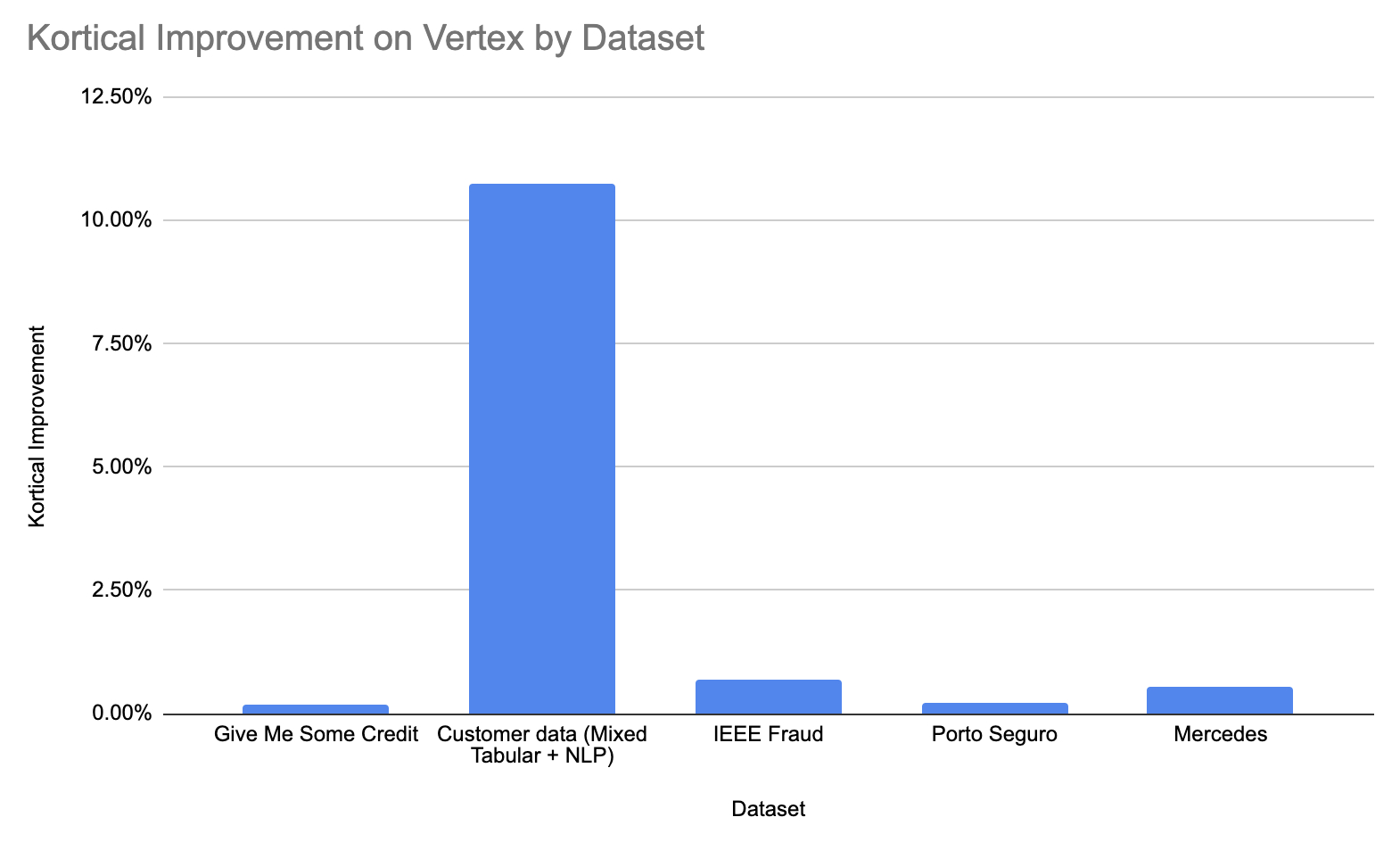
David vs Goliath: Kortical tops Google on all data sets

Last month, Google released its latest offering Vertex AI and Kortical is already outperforming them and has been since they first went head to head in 2019 at the Schroder’s Datathon. Kortical tested both platforms using well-known public datasets from Kaggle and another from a real-life client. Data was funneled through both and overall Kortical averaged 2.47% better across all datasets and 10.75% better on the real-life customer data. This difference in performance would mean the project that resulted in a £500k saving on Kortical would have not been viable on Vertex due to subhuman performance and would be another failed project statistic. Furthermore, Kortical was also 7 times faster to create the results vs Google’s Vertex AI.

Andy Gray, CEO, and co-founder at Kortical commented: “At the moment businesses are still in the early days of the machine learning gold rush, where you can crest a hill and stumble upon a nugget. Better ML accelerators are like better metal detectors helping you find those nuggets faster.”

Kortical is working with a wide range of customers across industries, from saving 54% on the blood supply chain waste for the NHS to enabling faster and more impactful ML project delivery for Capita, to “significant operational efficiencies” through back-office automation of tax processes at Deloitte and hyper-personalized marketing with Hyundai. As well as working with smaller start-ups.

“Initially it was really only the big players that were the early adopters, where they had the luxury to experiment with new technology and those experiments have turned into significant business so increasingly we’re seeing smaller businesses that recognize the strategic advantage and huge potential of ML to really distance themselves from their competitors,” added Andy Gray.

Kortical came into existence because the original founders Andy and Alex were trying to create an AI product but as they engaged different customers, they found that the data was always a little different and they needed to keep building new models but that the process was slow, error-prone and repetitive. Kortical is the culmination of 7 years of trying to take the pain out of creating enterprise-ready AI and ML solutions, quickly and easily but with enough control that expert users can still create exactly what they want.

Looking ahead Andy Gray said: “It’s great to see that the conversation has shifted from do I need a machine learning accelerator platform, to which platform should I use? I’m incredibly proud of what we’ve accomplished and excited to deliver on our plan to see what the future holds.”

Kortical helps companies that have data sets and a business problem they want to solve. Kortical works with tabular, NLP, and time-series data and can take you right through to live ML web applications or self-learning API-based services. Some of the most popular use cases are back-office automation, demand prediction, and hyper-personalized marketing.

All the major pundits are expecting the machine learning platform market to boom. Andy Gray concluded, “Over the past 12 months businesses have focussed on continuity and their remote work set up but this year we’re seeing signs of growth getting back to 300% year on year and will be looking to raise an investment round by the end of the year as we scale our business.”
Huawei is aiming to survive as sales drop 30 percent in H1

Tyler O'Neal, Staff Editor MIDDLEWARE August 6, 2021, 7:00 pm

Huawei has generated 320.4 billion yuan ($49.6 billion) in revenue in the first half of 2021. It's a significant decline from the 454 billion yuan that the Shenzhen, China-headquartered company recorded in the first half of 2020. 

Huawei said its profit margin grew 0.6% to 9.8%.

Its overall performance was in line with the forecast.

  • Carrier business revenue: CNY136.9 billion
  • Enterprise business revenue: CNY42.9 billion
  • Consumer business revenue: CNY135.7 billion

"We've set our strategic goals for the next five years," said Eric Xu, Huawei's Rotating Chairman. "Our aim is to survive and to do so sustainably. We'll do this by creating practical value for our customers and partners. Despite a decline in revenue from our consumer business caused by external factors, we are confident that our carrier and enterprise businesses will continue to grow steadily."

Xu continued, "These have been challenging times, and all of our employees have been pushing forward with extraordinary determination and strength. I want to thank every single member of the Huawei team for their incredible effort. Going forward, we continue to believe deeply in the power of digital technology to provide fresh solutions to the problems the world is facing right now. We will keep on innovating to help build a low-carbon, intelligent world."

Researchers from Japan discover that machine learning can predict the subcellular locations of proteins

Tyler O'Neal, Staff Editor MIDDLEWARE August 6, 2021, 6:00 pm

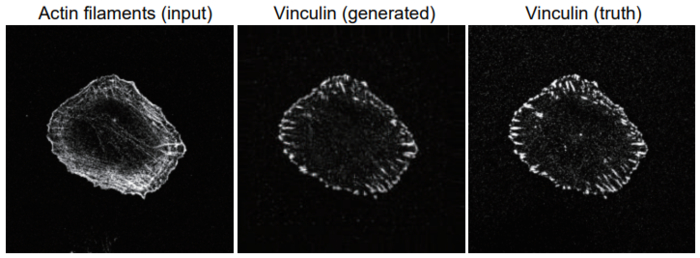
Facial recognition software can be used to spot a face in a crowd; but what if it could also predict where someone else was in the same crowd? While this may sound like science fiction, researchers from Japan have now shown that artificial intelligence can accomplish something very similar on a cellular level. An example of a generated image of focal adhesion protein (vinculin) (center), which anchors actin filaments, from an image of actin filaments (left). The true vinculin image is also shown (right).  CREDIT Shiro Suetsugu

In a study published in Frontiers in Cell and Developmental Biology, researchers from Nara Institute of Science and Technology (NAIST) have revealed that a machine learning program can accurately predict the location of proteins related to actin, an important part of the cellular skeleton, based on the location of actin itself.

Actin plays a key role in providing shape and structure to cells, and during cell, movement helps form lamellipodia, which are fan-shaped structures that cells use to "walk" forwards. Lamellipodia also contains a host of other proteins that bind to actin to help maintain the fan-like structure and keep the cells moving.

"While artificial intelligence has been used previously to predict the direction of cell migration based on a sequence of images, so far it has not been used to predict protein localization," says the lead author of the study, Shiro Suetsugu. This idea came in during the discussion with Yoshinobu Sato at the Data Science Center in NAIST. "We, therefore, sought to design a machine learning algorithm that can determine where proteins will appear in the cell-based on their relationship with other proteins."

To do this, the researchers trained an artificial intelligence system to predict where actin-associated proteins would be in the cell by showing pictures of cells in which the proteins were labeled with fluorescent markers to show where they were located. Then, they gave the program pictures in which only actin was labeled and asked it to tell them where the associated proteins were.

"When we compared the predicted images to the actual images, there was a considerable degree of similarity," states Suetsugu. "Our program accurately predicted the localization of three actin-associated proteins within lamellipodia; and, in the case of one of these proteins, in other structures within the cell."

On the other hand, when the researchers asked the program to predict where tubulin, which is not directly related to actin, would be in the cell, the program did not perform nearly as well.

"Our findings suggest that machine learning can be used to accurately predict the location of functionally related proteins and describe the physical relationships between them," says Suetsugu.

Given that lamellipodia are not always easy for non-experts to spot, the program developed in this study could be used to quickly and accurately identify these structures from cell images in the future. In addition, this approach could potentially be used as a sort of artificial cell staining method to avoid the limitations of current cell-staining methods.

  1. University of Minnesota CEMS professors invent a more efficient tech for making metals in components
  2. Stony Brook University scientists use new method to predict precipitation changes

Page 7 of 19

  • 2
  • 3
  • 4
  • 5
  • 6
  • 7
  • 8
  • 9
  • 10
  • 11
POPULAR RIGHT NOW
  • IBM's Historic stock collapse raises questions for the future of enterprise supercomputing
    IBM's Historic stock collapse raises questions for the future of enterprise supercomputing
  • Could a novel dark matter theory simultaneously resolve multiple cosmic enigmas? Supercomputer simulations provide a compelling, albeit currently unverified, potential solution
    Could a novel dark matter theory simultaneously resolve multiple cosmic enigmas? Supercomputer simulations provide a compelling, albeit currently unverified, potential solution
  • Melting icebergs may be reshaping Earth’s greatest ocean current
    Melting icebergs may be reshaping Earth’s greatest ocean current
  • Supercomputers replace ‘bathtub’ flood maps with physics-based digital twins of Britain’s coastline
    Supercomputers replace ‘bathtub’ flood maps with physics-based digital twins of Britain’s coastline
  • Supercomputers push neural quantum simulation beyond previous limits
    Supercomputers push neural quantum simulation beyond previous limits
  • Intel’s AI supercomputing revival: Q2 financial surge signals new era for CPU-powered HPC infrastructure
    Intel’s AI supercomputing revival: Q2 financial surge signals new era for CPU-powered HPC infrastructure
  • AI infrastructure financing fears shake semiconductor sector
    AI infrastructure financing fears shake semiconductor sector
  • AWS supercomputing investment reaches historic scale as Amazon’s AI strategy powers record financial results
    AWS supercomputing investment reaches historic scale as Amazon’s AI strategy powers record financial results
  • Catching the wave of the future: Supercomputers unlock the hidden dynamics of Venus
    Catching the wave of the future: Supercomputers unlock the hidden dynamics of Venus
  • NCAR supercomputers run planet scale climate experiments impossible in the real world
    NCAR supercomputers run planet scale climate experiments impossible in the real world
THIS YEAR'S MOST READ
  • Wall Street wants to trade supercomputing power like oil
    Wall Street wants to trade supercomputing power like oil
  • Beamforming the future: BeammWave's 6G push signals the rise of orbital-terrestrial wireless networks
    Joakim Axmon
    Joakim Axmon
  • Cosmic ambition at scale: UK’s supercomputer unlocks a 2.5 petabytes universe
    Cosmic ambition at scale: UK’s supercomputer unlocks a 2.5 petabytes universe
  • Hidden order, revealed at scale: Supercomputing, electron ptychography uncover the inner workings of relaxor ferroelectrics
    Hidden order, revealed at scale: Supercomputing, electron ptychography uncover the inner workings of relaxor ferroelectrics
  • Intel's Q1 results signal supercomputing surge driving Xeon momentum
    Intel's Q1 results signal supercomputing surge driving Xeon momentum
  • When stars fall apart: Supercomputing reveals the hidden physics of black holes
    When stars fall apart: Supercomputing reveals the hidden physics of black holes
  • MIT develops computational framework to probe dark matter via gravitational waves
    MIT develops computational framework to probe dark matter via gravitational waves
  • Explainable AI moves into the watershed: FAMU-FSU engineers build predictive framework for real-time E. coli forecasting
    FAMU-FSU College of Engineering Assistant Professor Nasrin Alamdari. (Scott Holstein/FAMU-FSU College of Engineering)
    FAMU-FSU College of Engineering Assistant Professor Nasrin Alamdari. (Scott Holstein/FAMU-FSU College of Engineering)
  • Multi-layer simulations reveal the hidden supply chain of solar prominences
    Multi-layer simulations reveal the hidden supply chain of solar prominences
  • Japanese scientists decode dolphin speed with supercomputing: Turbulence, vortices, and the hidden physics of propulsion
    Japanese scientists decode dolphin speed with supercomputing: Turbulence, vortices, and the hidden physics of propulsion
  • FRONTPAGE
  • LATEST
  • POPULAR
  • REGISTER
  • SOCIAL
  • VIDEO
  • SUBSCRIPTION
  • RSS
  • GUIDELINES
  • PRIVACY
  • TOS
  • ABOUT
  • +1 (816) 799-4488
  • editorial@supercomputingonline.com
© 2001 - 2026 SuperComputingOnline.com, LLC. All rights reserved. This material may not be published, broadcast, rewritten or redistributed without permission.
Sign In
  • FRONT PAGE
  • LATEST
    • MEDIA KIT
    • MOST READ
    • RSS FEED
    • ACADEMIA
    • AEROSPACE
    • APPLICATIONS
    • ASTRONOMY
    • AUTOMOTIVE
    • BIG DATA
    • BIOLOGY
    • CHEMISTRY
    • CLIENTS
    • CLOUD
    • DEFENSE
    • DEVELOPER TOOLS
    • EARTH SCIENCES
    • ECONOMICS
    • ENGINEERING
    • ENTERTAINMENT
    • HEALTH
    • INDUSTRY
    • INTERCONNECTS
    • GAMING
    • GOVERNMENT
    • MANUFACTURING
    • MIDDLEWARE
    • MOVIES
    • NETWORKS
    • OIL & GAS
    • PHYSICS
    • PROCESSORS
    • RETAIL
    • SCIENCE
    • STORAGE
    • SYSTEMS
    • VISUALIZATION
  • VIDEOS
    • ADD YOUR VIDEOS
    • MANAGE VIDEOS
  • COMMUNITY
    • TRADE SHOWS
    • SOCIAL NETWORK VIDEOS
    • SURVEYS
    • APPLICATIONS BROWSER
    • CONVERSATION INBOX
    • SOCIAL ADVERTISER
    • GROUPS
    • MARKETPLACE LISTINGS
    • PAGES
    • LEADERBOARD
    • POINTS LISTING
      • BADGES
    • PRIVACY CONFIRM REQUEST
    • PRIVACY CREATE REQUEST

Hey there! We noticed you’re using an ad blocker.