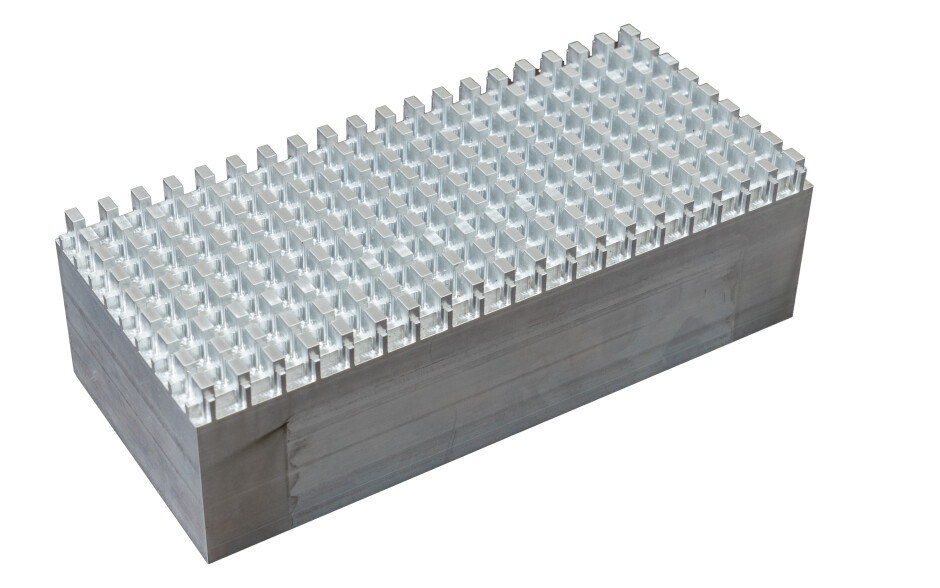
A rendering of the new synthetic metamaterial with 4D capabilities designed by scientists at the University of Missouri. It includes the ability to control energy waves on the surface of a solid material.

Mizzou prof Huang creates a novel approach to control energy waves in 4D

Mizzou professor Guoliang Huang is revolutionizing the way we think about elastic surface waves. His groundbreaking research has led to the development of a smart patterning technique for topological pumping of elastic surface waves, which could have far-reaching implications for a wide range of industries. By combining his expertise in mathematics, physics, and engineering, Huang is pushing the boundaries of what is possible and inspiring a new generation of scientists and engineers. Guoliang Huang
The University of Missouri scientists engineered a synthetic metamaterial to direct mechanical waves along a specific path, which adds an innovative layer of control to 4D reality, otherwise known as the synthetic dimension.

ward and back. But, in recent years scientists like Guoliang Huang, the Huber and Helen Croft Chair in Engineering at MU, have explored a “fourth dimension” (4D), or synthetic dimension, as an extension of our current physical reality.

Now, Huang and a team of scientists in the Structured Materials and Dynamics Lab at the MU College of Engineering have successfully created a new synthetic metamaterial with 4D capabilities, including the ability to control energy waves on the surface of a solid material. These waves, called mechanical surface waves, are fundamental to how vibrations travel along the surface of solid materials.

While the team’s discovery, at this stage, is simply a building block for other scientists to take and adapt as needed, the material also has the potential to be scaled up for larger applications related to civil engineering, micro-electromechanical systems (MEMS) and national defense uses.

“Conventional materials are limited to only three dimensions with an X, Y, and Z axis,” Huang said. “But now we are building materials in the synthetic dimension, or 4D, which allows us to manipulate the energy wave path to go exactly where we want it to go as it travels from one corner of a material to another.”

This breakthrough discovery, called topological pumping, could one day lead to advancements in quantum mechanics and quantum computing by allowing for the development of higher-dimension quantum-mechanical effects. 

“Most of the energy — 90% — from an earthquake happens along the surface of the Earth,” Huang said. “Therefore, by covering a pillow-like structure in this material and placing it on the Earth’s surface underneath a building, it could potentially help keep the structure from collapsing during an earthquake.”

The work builds on previous research by Huang and colleagues which demonstrates how a passive metamaterial could control the path of sound waves as they travel from one corner of a material to another. 

Mizzou professor Guoliang Huang has created a revolutionary new method for topological pumping of elastic surface waves. His innovative approach has the potential to revolutionize the way we think about wave manipulation and could lead to a host of new applications in the fields of engineering, physics, and materials science. Huang's research is a testament to the power of creativity and dedication, and his work serves as an inspiration to scientists and engineers everywhere.

The study is supported by grants from the Air Force Office of Scientific Research and the Army Research Office.

Is there any evidence that correlated insulator collapse due to quantum avalanche via in-gap ladder states is a reliable phenomenon?

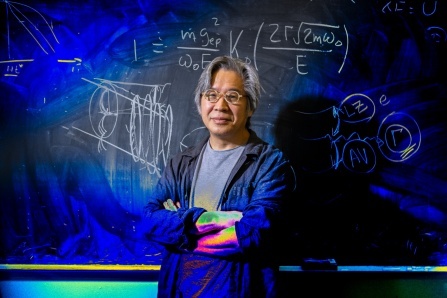
The phenomenon of correlated insulator collapse due to quantum avalanche via in-gap ladder states is a relatively unexplored area of research. While recent studies have suggested that this phenomenon could be a viable mechanism for controlling the electrical properties of materials, the underlying physics of this process remains largely unknown. In this article, we will explore this phenomenon's potential and discuss its potential applications' implications. We will also discuss the current state of knowledge regarding the underlying physics of this process and the challenges that need to be overcome to make it a viable technology. UB physics professor Jong Han is the lead author on a new study that helps solve a longstanding physics mystery on how insulators transition into metals via an electric field, a process known as resistive switching. Credit: Douglas Levere, University at Buffalo

Looking only at their subatomic particles, most materials can be placed into two categories.

Metals — like copper and iron — have free-flowing electrons that allow them to conduct electricity, while insulators — like glass and rubber — keep their electrons tightly bound and therefore do not conduct electricity.

Insulators can turn into metals when hit with an intense electric field, offering tantalizing possibilities for developing supercomputing, but the physics behind this phenomenon called resistive switching is not well understood.

Questions, like how large an electric field is needed, are fiercely debated by scientists, like University at Buffalo condensed matter theorist Jong Han. 

“I have been obsessed with that,” he says.

Han, Ph.D., professor of physics at the College of Arts and Sciences, is the lead author of a study that takes a new approach to answer a long-standing mystery about insulator-to-metal transitions.

Electrons move through quantum paths

Han says the difference between metals and insulators lies in quantum mechanical principles, which dictate that electrons are quantum particles and their energy levels come in bands that have forbidden gaps.

Since the 1930s, the Landau-Zener formula has served as a blueprint for determining the size of the electric field needed to push an insulator’s electrons from its lower bands to its upper bands. But experiments in the decades since have shown materials require a much smaller electric field — approximately 1,000 times smaller — than the Landau-Zener formula estimated.

“So, there is a huge discrepancy, and we need to have a better theory,” Han says.

To solve this, Han considered a different question: What happens when electrons already in the upper band of an insulator are pushed?

Han ran a supercomputer simulation of resistive switching that accounted for the presence of electrons in the upper band. It showed that a relatively small electric field could trigger a collapse of the gap between the lower and upper bands, creating a quantum path for the electrons to go up and down between the bands. 

To make an analogy, Han says, “Imagine some electrons are moving on a second floor. When the floor is tilted by an electric field, electrons not only begin to move but previously forbidden quantum transitions open up and the very stability of the floor abruptly falls apart, making the electrons on different floors flow up and down.

“Then, the question is no longer how the electrons on the bottom floor jump up, but the stability of higher floors under an electric field.”

This idea helps solve some of the discrepancies in the Landau-Zener formula, Han says. It also provides some clarity to the debate over insulator-to-metal transitions caused by electrons themselves or those caused by extreme heat. Han’s simulation suggests the quantum avalanche is not triggered by heat. However, the full insulator-to-metal transition doesn’t happen until the separate temperatures of the electrons and phonons — quantum vibrations of the crystal's atoms — equilibrate. This shows that the mechanisms for electronic and thermal switching are not exclusive, Han says but can arise simultaneously.

“So, we have found a way to understand some corner of this whole resistive switching phenomenon,” Han says. “But I think it's a good starting point.”

Research could improve microelectronics

The study was co-authored by Jonathan Bird, Ph.D., professor and chair of electrical engineering in UB’s School of Engineering and Applied Sciences, who provided experimental context. His team has been studying the electrical properties of emergent nanomaterials that exhibit novel states at low temperatures, which can teach researchers a lot about the complex physics that govern electrical behavior. 

“While our studies are focused on resolving fundamental questions about the physics of new materials, the electrical phenomena that we reveal in these materials could ultimately provide the basis of new microelectronic technologies, such as compact memories for use in data-intensive applications like artificial intelligence,” Bird says.

The research could also be crucial for areas like neuromorphic supercomputing, which tries to emulate the electrical stimulation of the human nervous system. “Our focus, however, is primarily on understanding the fundamental phenomenology,” Bird says.

Other authors include UB physics Ph.D. student Xi Chen; Ishiaka Mansaray, who received a Ph.D. in physics and is now a postdoc at the National Institute of Standards and Technology; and Michael Randle, who received a Ph.D. in electrical engineering and is now a postdoc at the Riken research institute in Japan. Other authors include international researchers representing École Normale Supérieure, French National Centre for Scientific Research (CNRS) in Paris; Pohang University of Science and Technology; and the Center for Theoretical Physics of Complex Systems, Institute for Basic Science.

Since publishing the paper, Han has devised an analytic theory that matches the supercomputer’s calculation well. Still, there’s more for him to investigate, like the exact conditions needed for a quantum avalanche to happen. 

“Somebody, an experimentalist, is going to ask me, ‘Why didn’t I see that before?’” Han says. “Some might have seen it, some might not have. We have a lot of work ahead of us to sort it out."

This study concludes that correlated insulator collapse due to quantum avalanche via in-gap ladder states is a viable mechanism for the emergence of novel quantum states of matter. However, further research is needed to fully understand the implications of this mechanism and its potential applications.

Tanaka uses supercomputer to perform simulations of collisions between cosmic dust aggregates

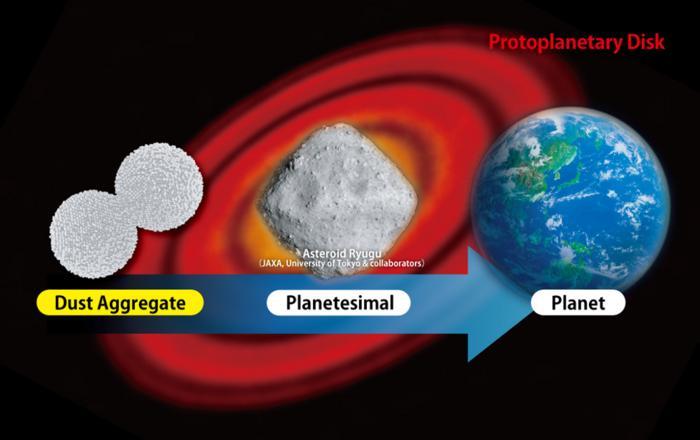
Tohoku prof Tanaka, a renowned astrophysicist, has made a remarkable breakthrough in the field of astrophysics. By using a powerful supercomputer, Tanaka has successfully conducted simulations of collisions between cosmic dust aggregates, offering a unique insight into the formation of stars and planets. This breakthrough promises to revolutionize our understanding of the universe and could potentially lead to further discoveries in the field of astrophysics. Micrometer-scale dust particles from protoplanetary disks, or sites around stars with particles and hydrogen and/or other gasses, aggregate to form planetesimals, or kilometer-scale building blocks of planets. Planetesimals, in turn, merge due to mutual gravity.

Microparticle dust aggregates, which are thought to play a role in the formation of new planets, are less likely to stick together after a collision when the aggregates are larger.

Current evidence suggests that microparticles of cosmic dust collide and stick together to form larger dust aggregates that may eventually combine and develop into planets. Numerical models that accurately characterize the conditions required for colliding microparticle aggregates to stick together, rather than bounce apart, are therefore paramount to understanding the evolution of planets. Recent modeling suggests that dust aggregates are less likely to stick together after a collision as the size of the aggregates increases.

A team of astrophysicists performed numerical simulations of dust aggregate collisions, with equal-mass aggregates varying between 10,000 and 140,000 microns (one to 14 cm) in size, using soft-sphere discrete element methods. The discrete modeling system accounted for each particle within the aggregate rather than treating the aggregate as a single entity, and soft-sphere simulation assumed the rigidity of each particle of the aggregate but allowed for deformations that may occur during the collision. Their modeling indicated that increasing the radius of microparticle dust aggregates decreased the sticking probability or likelihood that two aggregates would stick together and form a larger aggregate after the collision.

"The formation process of kilometer-sized bodies, planetesimals, from cosmic dust, which is the initial stage of planet formation, has been one of the biggest problems in the theory of planet formation," said Hidekazu Tanaka, one of the writers of the study and professor at the Astronomical Institute in the Graduate School of Science at Tohoku University in Sendai, Japan. "The present study showed that the dust clumps that are the material for planets stop growing when they grow to a certain size, as large clumps are difficult to adhere to each other. Our results made the problem of planetesimal formation even more difficult. The adhesive growth of dust clumps is a key process in the planet-formation process."

The simulations suggest that collisional bouncing between large microparticle aggregates would decrease the formation of planetesimals or the building blocks of planets. Kilometer-scale planetesimals form planets through collisional merging via mutual gravity.
Earlier modeling simulations and laboratory experiments characterizing the threshold for the sticking/bouncing barrier of dust aggregate collisions often produced conflicting results, which the research team and others hypothesized was due to varying sizes of aggregates. The results of the current study support this hypothesis.

It is currently unclear why the size of aggregates affects the sticking probability during a collision. Future studies aimed at dissecting the packing structure of aggregates over time may help scientists understand how aggregates can approach the scale of planetesimals. Studies of the contact sites between aggregates, where most energy is dissipated, after a collision may also unveil how larger aggregates eventually stick together.

Additionally, the simulations performed by the research team suggest that the sticking probability of particle aggregates may also be affected by the size of the individual particles that make up the aggregate and not just the radius of the entire aggregate.

The team acknowledges that the simulations they have performed in this study are far from comprehensive. Simulations that include aggregates that can be prepared by realistic procedures and that address acceleration will be performed, and laboratory experiments that will fine-tune the model are also planned.

Beyond these simulations, the team has its sights set on larger aggregates, which may fundamentally change current theories of planet development. "We will use a supercomputer to perform large-scale numerical simulations of collisions between even larger dust clumps in order to investigate how difficult it is for large dust clumps to attach to each other. This will help to settle the question of whether the formation of planetesimals is possible through the adhesion of dust clumps or not," said Tanaka.

The results of Tanaka's research are an exciting step forward in understanding the complex dynamics of cosmic dust collisions. With the help of a supercomputer, Tanaka has been able to simulate these collisions with unprecedented accuracy, providing valuable insight into the behavior of these particles. This research has the potential to revolutionize our understanding of the universe and could lead to new discoveries in the field of astrophysics.