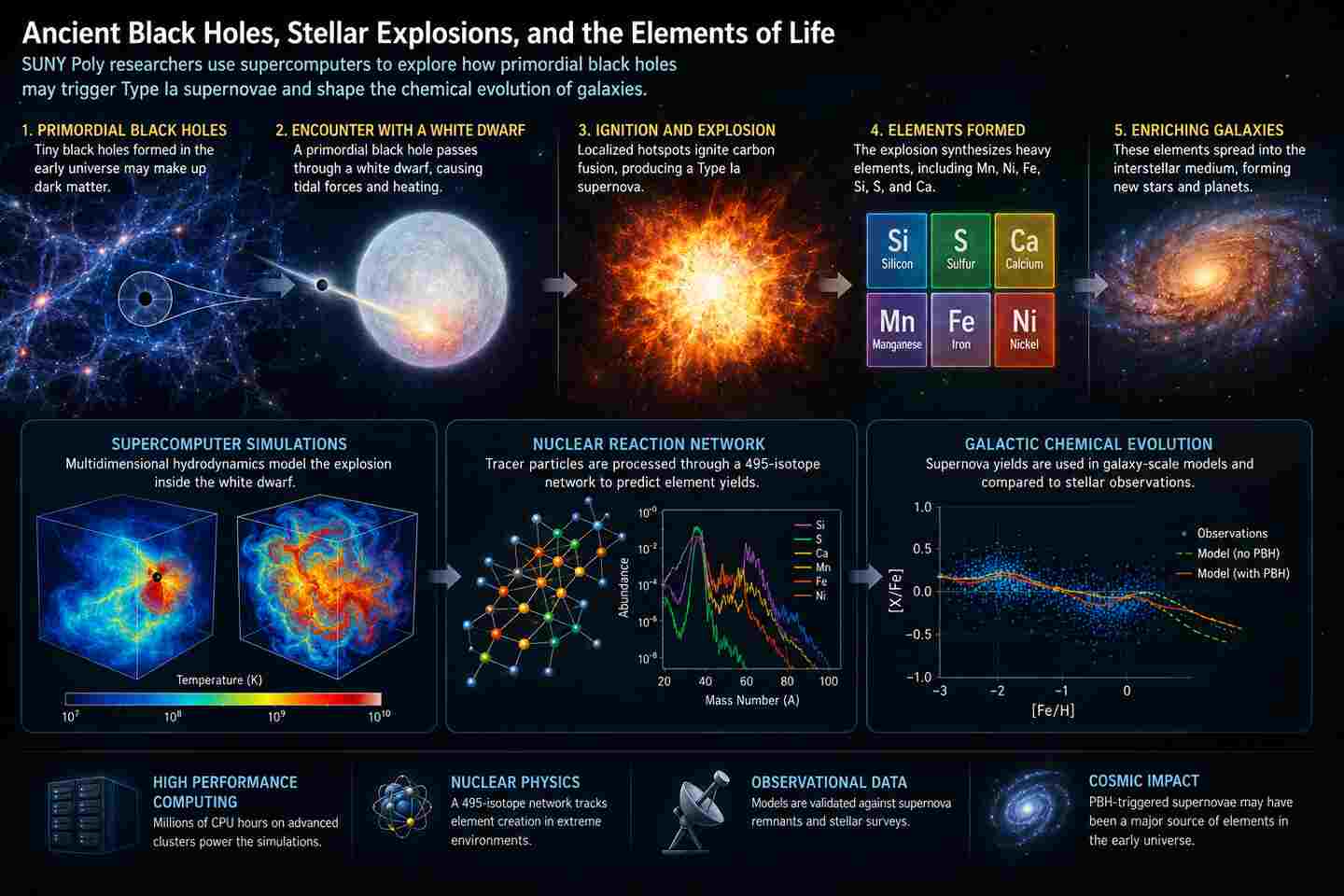
SUNY Poly researchers combine hydrodynamics simulations, nuclear reaction networks, and galactic chemical evolution models to investigate whether primordial black holes helped shape the chemical history of the universe.
The most powerful scientific discoveries often begin with an improbable question: could the universe's most significant stellar explosions be triggered not by companion stars, but by ancient black holes born moments after the Big Bang?
Researchers at SUNY Polytechnic Institute are using advanced computational astrophysics to investigate this provocative possibility. Their latest study examines whether primordial black holes (PBHs), hypothetical relics from the dawn of time, might trigger Type Ia supernovae, thereby offering a new explanation for the diversity of observed stellar explosions and the complex chemical evolution of galaxies.
This work represents a remarkable convergence of supercomputing, cosmology, nuclear physics, and observational astronomy, tracing a chain of events that links the birth of the universe to the elemental composition of stars observed today.
From dark matter candidate to cosmic trigger
Primordial black holes occupy a unique place in modern astrophysics. Unlike black holes formed from collapsing stars, PBHs may have formed directly from density fluctuations shortly after the Big Bang. In particular, asteroid-mass primordial black holes remain viable dark matter candidates because they inhabit a region of parameter space that has proven difficult to constrain through conventional observations. The SUNY Poly team investigated what happens when one of these ancient objects encounters a white dwarf, a compact stellar remnant containing roughly the mass of the Sun, compressed into a volume similar to that of Earth.
Their simulations show that as a primordial black hole passes through a white dwarf, tidal forces and accretion heating can create localized hotspots. Under the extreme densities inside the star, those hotspots can ignite runaway carbon fusion, transforming a quiet white dwarf into a Type Ia supernova. Testing such a scenario requires computational capabilities far beyond traditional theoretical modeling.
Supercomputers recreate stellar catastrophes
To explore these events, the researchers employed multidimensional compressible hydrodynamics simulations capable of modeling thermonuclear explosions in extraordinary detail. The simulations tracked the evolution of turbulent burning fronts, detonation transitions, and shock propagation throughout exploding white dwarfs. The computational workflow did not end there. After the hydrodynamic calculations, the team used tracer-particle techniques to follow the thermodynamic histories of material inside the explosion. Those histories were then processed through a 495-isotope nuclear reaction network spanning elements from hydrogen to technetium, enabling researchers to calculate precisely which isotopes and elements were synthesized during the explosion.
Such calculations are among the most demanding workloads in computational astrophysics because they require coupling fluid dynamics, nuclear reactions, gravity, and thermodynamics across enormous ranges of scale. The resulting model suite produced explosions spanning a broad range of luminosities and nickel-56 yields, from approximately 0.2 to 1.1 solar masses of radioactive nickel, matching much of the diversity observed in real Type Ia supernovae.
Matching real supernovae
A scientific hypothesis becomes powerful when it confronts observations. The team compared its simulations with well-known supernova remnants, including Tycho, Kepler, and 3C 397, as well as nearby Type Ia supernovae, including SN 2011fe, SN 2012cg, SN 2013aa, and SN 2014J. By examining isotope ratios including manganese, nickel, and iron, researchers found that several observed supernovae could be explained by PBH-triggered explosion models.
Particularly striking was the ability of some PBH-triggered models to reproduce observed nickel and manganese abundances in remnants such as Kepler and 3C 397. Meanwhile, isotope ratios measured from late-time supernova light curves showed consistency with several modeled PBH-triggered explosions involving white dwarfs between roughly 1.0 and 1.1 solar masses. The implication is profound: some supernovae that astronomers have already observed may carry signatures of interactions with primordial black holes.
Simulating the chemical history of a galaxy
The study's most ambitious computational achievement came after the explosions themselves. The researchers incorporated their supernova yields into a Galactic Chemical Evolution model that tracks how generations of stars enrich a galaxy with heavy elements over billions of years. The simulations followed the production and distribution of silicon, sulfur, calcium, manganese, nickel, and other elements throughout cosmic history.
By comparing the results against stellar abundance measurements from large astronomical surveys, the team evaluated whether the universe's observed elemental composition is consistent with a contribution from PBH-triggered supernovae. The answer appears to be yes. Across multiple parameter studies, the best-fitting models consistently favored a small but non-zero population of PBH-triggered Type Ia supernovae. Models that completely excluded the PBH channel did not provide the best agreement with observed chemical abundance trends.
A different universe in its youth
Perhaps the most intriguing conclusion concerns the early universe. The simulations suggest that primordial black hole-triggered supernovae may have been considerably more important during the universe's first epochs than they are today. Because white dwarfs could be ignited directly by PBHs without waiting for long-lived binary-star interactions, these explosions may have occurred earlier and more frequently in young galaxies rich in dark matter.
The researchers found evidence that the PBH channel could have been one of the dominant Type Ia supernova mechanisms during the universe's formative stages before conventional binary-star pathways became prevalent. If confirmed, this would mean that some of the iron, nickel, manganese, and other heavy elements present in galaxies today may trace their origins not only to stars, but to interactions with relic black holes formed near the beginning of time itself.
Supercomputing as a time machine
What makes this research especially compelling for the high-performance computing community is the extraordinary range of scales involved. The simulations connect physical processes occurring inside white dwarfs a few thousand kilometers across, with the chemical evolution of entire galaxies over billions of years. They bridge nuclear reactions lasting fractions of a second with cosmological questions concerning dark matter and the birth of structure in the universe. Such connections are only possible because modern supercomputing allows scientists to transform speculative ideas into testable models.
In this case, the computer becomes more than a calculator. It becomes a time machine, linking the universe's first moments to the elemental fingerprints found in stars today. For the supercomputing community, the message is clear: the next breakthrough in understanding dark matter may emerge not from a particle detector buried underground, but from the convergence of exascale simulation, observational astronomy, and computational astrophysics. And if SUNY Poly's results continue to withstand observational scrutiny, they may reveal that some of the universe's brightest explosions were ignited by some of its oldest objects.