Wouldn’t finding life on other worlds be easier if we knew exactly where to look? Researchers have limited opportunities to collect samples on Mars or elsewhere or access remote sensing instruments when hunting for life beyond Earth. An interdisciplinary study led by SETI Institute Senior Research Scientist Kim Warren-Rhodes mapped the sparse life hidden away in salt domes, rocks, and crystals at Salar de Pajonales at the boundary of the Chilean Atacama Desert and Altiplano. Warren-Rhodes then worked with co-investigators Michael Phillips (Johns Hopkins Applied Physics Lab) and Freddie Kalaitzis (University of Oxford) to train a machine learning model to recognize the patterns and rules associated with their distributions so it could learn to predict and find those same distributions in data on which it was not trained. In this case, by combining statistical ecology with AI/ML, the scientists could locate and detect biosignatures up to 87.5% of the time (versus ≤10% by random search) and decrease the area needed for search by up to 97%. 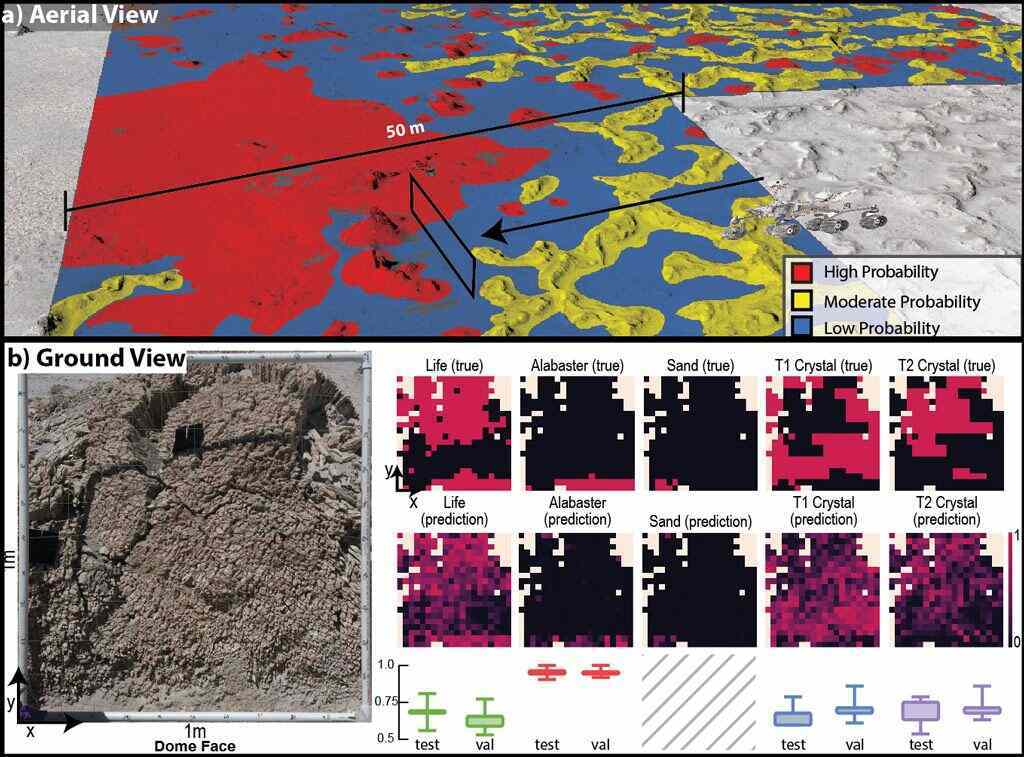
“Our framework allows us to combine the power of statistical ecology with machine learning to discover and predict the patterns and rules by which nature survives and distributes itself in the harshest landscapes on Earth.,” said Rhodes. “We hope other astrobiology teams adapt our approach to mapping other habitable environments and biosignatures. With these models, we can design tailor-made roadmaps and algorithms to guide rovers to places with the highest probability of harboring past or present life—no matter how hidden or rare.”
Ultimately, similar algorithms and machine learning models for many different types of habitable environments and biosignatures could be automated onboard planetary robots to efficiently guide mission planners to areas at any scale with the highest probability of containing life.
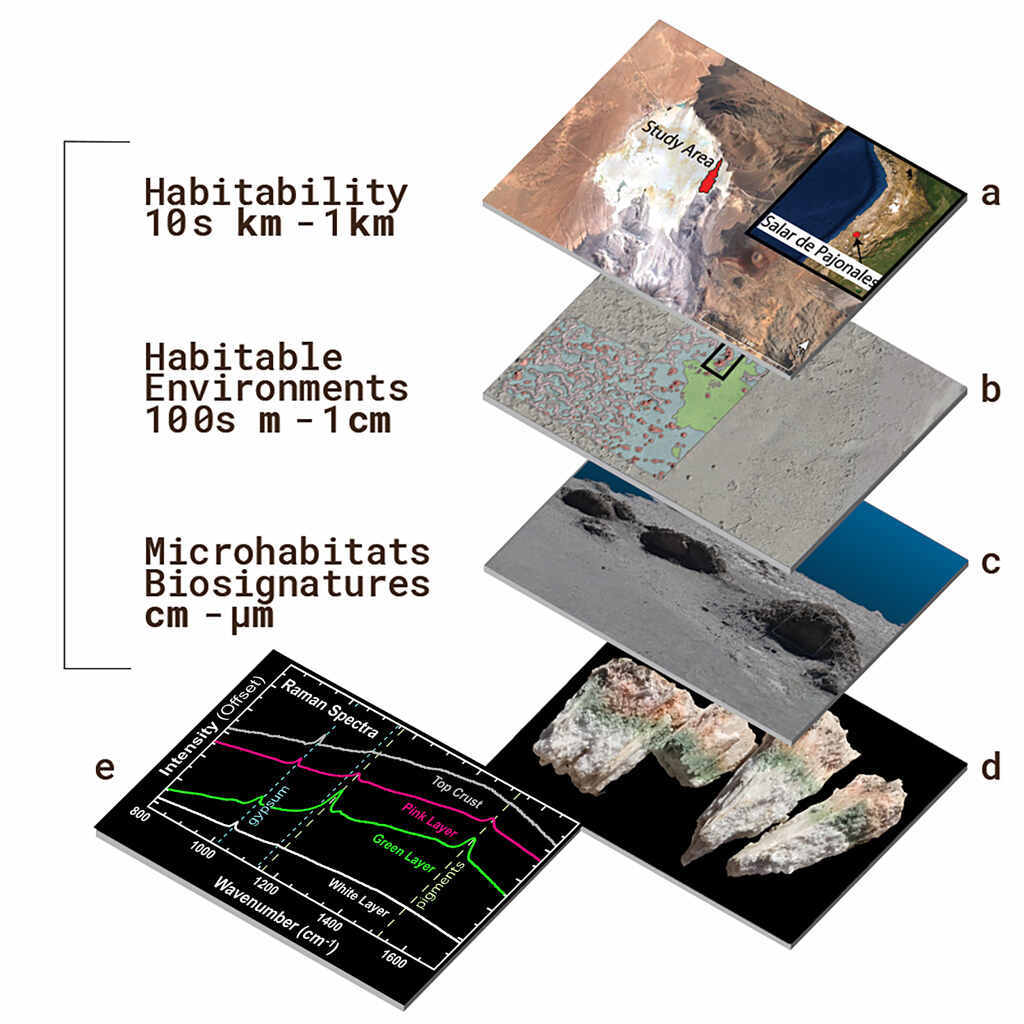
Rhodes and the SETI Institute NASA Astrobiology Institute (NAI) team used the Salar de Pajonales, as a Mars analog. Pajonales is a high altitude (3,541 m), high U/V, hyperarid, dry salt lakebed, considered inhospitable to many life forms but still habitable.
During the NAI project’s field campaigns, the team collected over 7,765 images and 1,154 samples and tested instruments to detect photosynthetic microbes living within the salt domes, rocks, and alabaster crystals. These microbes exude pigments that represent one possible biosignature on NASA’s Ladder of Life Detection.
At Pajonales, drone flight imagery connected simulated orbital (HiRISE) data to ground sampling and 3D topographical mapping to extract spatial patterns. The study’s findings confirm (statistically) that microbial life at the Pajonales terrestrial analog site is not distributed randomly but concentrated in patchy biological hotspots strongly linked to water availability at km to cm scales.
Next, the team trained convolutional neural networks (CNNs) to recognize and predict macro-scale geologic features at Pajonales—some of which, like the patterned ground or polygonal networks, are also found on Mars—and micro-scale substrates (or ‘micro-habitats’) most likely to contain biosignatures.
Like the Perseverance team on Mars, the researchers tested how to effectively integrate a UAV/drone with ground-based rovers, drills, and instruments (e.g., VISIR on ‘MastCam-Z’ and Raman on ‘SuperCam’ on the Mars 2020 Perseverance rover).
The team’s next research objective at Pajonales is to test the CNNs' ability to predict the location and distribution of ancient stromatolite fossils and halite microbiomes with the same machine learning programs to learn whether similar rules and models apply to other similar yet slightly different natural systems. From there, entirely new ecosystems, such as hot springs, permafrost soils, and rocks in the Dry Valleys, will be explored and mapped. As more evidence accrues, hypotheses about the convergence of life’s means of surviving in extreme environments will be iteratively tested, and biosignature probability blueprints for Earth’s key analog ecosystems and biomes will be inventoried.
“While the high rate of biosignature detection is a central result of this study, no less important is that it successfully integrated datasets at vastly different resolutions from orbit to the ground, and finally tied regional orbital data with microbial habitats,” said Nathalie A. Cabrol, the PI of the SETI Institute NAI team. “With it, our team demonstrated a pathway that enables the transition from the scales and resolutions required to characterize habitability to those that can help us find life. In that strategy, drones were essential, but so was the implementation of microbial ecology field investigations that require extended periods (up to weeks) of in situ (and in place) mapping in small areas, a strategy that was critical to characterize local environmental patterns favorable to life niches.”
This study led by the SETI Institute’s NAI team has paved the way for machine learning to assist scientists in the search for biosignatures in the universe. Their paper “Orbit-to-Ground Framework to Decode and Predict Biosignature Patterns in Terrestrial Analogues” is the culmination of five years of the NASA-funded NAI project, and a cooperative astrobiology research effort with over 50 team members from 17 institutions. In addition to Johns Hopkins Applied Physics Lab and the University of Oxford, the Universidad Católica del Norte, Antofagasta, Chile supported this research.
The SETI NAI team project entitled “Changing Planetary Environments and the Fingerprints of Life” was funded by the NASA Astrobiology Program (Mary Voytek, Director) under grant No. NNA15BB01A.