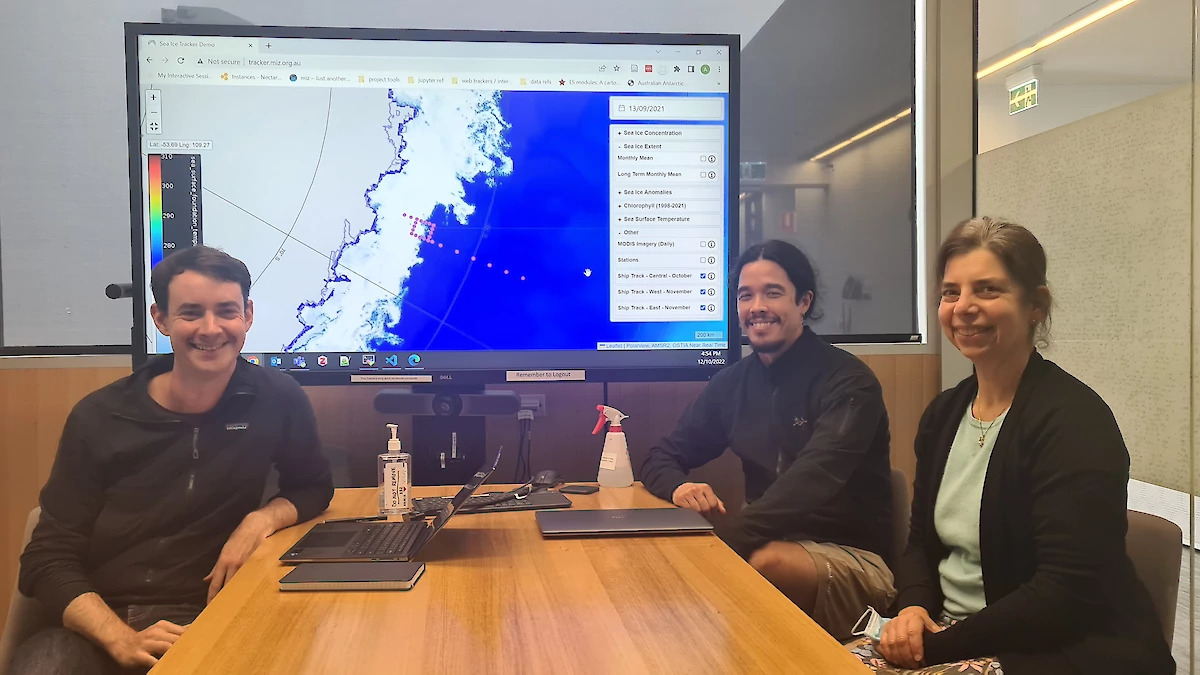
Nilas, the Southern Ocean Mapping Platform developers, Anton Steketee (left), Sean Chua and Dr Petra Heil. Photo: Wendy Pyper

Australian Antarctic scientists deploy Nilas online for sea-ice zone data sets

A new interactive Antarctic map promises to assist voyage planning and enhance climate research in the sea-ice zone, by bringing together Southern Ocean data from the past four decades.

Developed by Australian Antarctic Division sea-ice scientists Dr. Petra Heil, Sean Chua, and Anton Steketee, ‘Nilas’ presents near-real-time and historical data on sea ice, chlorophyll (a proxy for phytoplankton production), and sea-surface temperature around Antarctica. 

Nilas is a thin, elastic crust of sea ice, that easily bends on waves and swells, and under pressure.

Dr. Heil said the historical ice and ocean data and the ability to superimpose past or proposed ship trajectories or animal or instrument tracks over the data, made it a powerful planning, analysis, and research tool.

The tool includes sea-ice data dating back to 1980, chlorophyll data from 1998, and sea surface temperature from 1981.

“We have used this tool to plan a marine-science voyage, and are currently using it to pinpoint deployment locations for autonomous instruments to study ice-edge processes, such as wave-induced ice breakup,” Dr. Heil said.

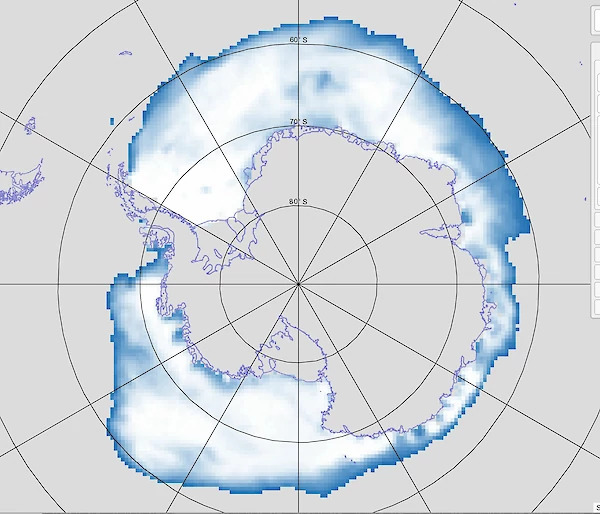
A Nilas screen shot of the monthly sea-ice concentration around Antarctica for November 2022. White areas are 100% sea-ice concentration (coverage). (Photo: Nilas) 

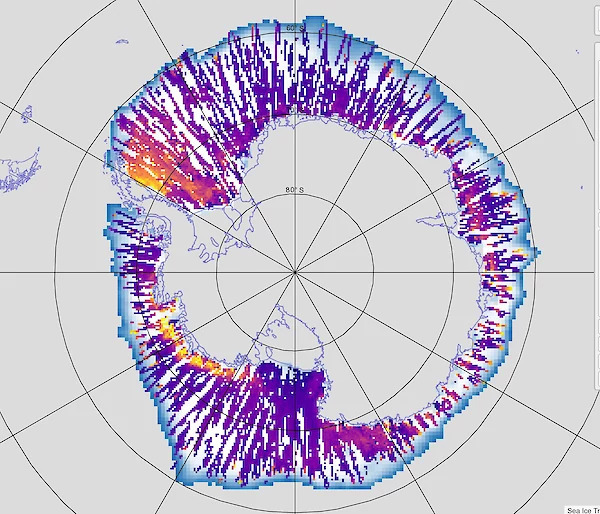
This graphic shows the sea-ice concentration for July 2022 overlaid with the sea-ice freeboard (ice height above the ocean surface). It allows users to identify zones of thicker versus thinner sea ice and to assess these against the areal sea-ice coverage. This information assists, for example, selection of deployment sites for instruments or planning navigation in an unfamiliar ice-covered ocean. (Photo: Nilas)

“The tool allows us to look back at the sea-ice concentration and extent over the past few years to gain an understanding of the likely sea-ice conditions in the month of our voyage. We can then identify the most suitable location to take samples and deploy instruments.

“The tool also allows us to look at ice conditions in locations where we may have limited or no experience in navigating the ice area and make decisions about the best time of year to visit to achieve our objective.”

Mr. Chua said the ability to look at different ice and ocean variables at the same time could spark new research ideas, or enable scientists to explore links between different Earth system components.

“If you’re an atmospheric scientist sampling air from a vessel and you see a signal that does not make sense, you could look back at the ice or chlorophyll conditions at the time and location of your signal and check for any correlation,” he said.

“Phytoplankton may have released sulfate aerosols into the air, affecting the atmospheric properties, for example. So having all these data in one interface enables connections between scientific disciplines.”

To build the mapping platform the team used existing data sets generated from satellite observations. Data sets came from a range of sources, including the National Snow and Ice Data Center, Unversität Bremen, the Met Office, and the Ocean Colour Climate Change Initiative.

Data sets include daily and monthly sea-ice concentration (amount of sea-ice cover), sea-ice freeboard (height above the ocean surface), chlorophyll concentration, and sea-surface temperature. They also include in-house derived parameters.

“In consultation with Antarctic scientists, we chose source data and products that would be the most useful for looking at the long-term climate record,” Mr. Steketee said.

“We standardized that data added some functionality, and presented it on a platform that doesn’t need any technical expertise to use.

“This tool does not require any software or downloads to run, it can be configured to run without an internet connection, and it displays multiple variables at different time scales.”

Dr. Heil said the availability of different sea-ice variables within one application was also important in teasing out sea-ice conditions. For example, an area of interest could show 100% sea-ice concentration. However, including the sea-ice freeboard variable (height of sea ice above the water level), could identify areas of thicker or thinner ice within.

“An area of interest may be 100% covered in ice, and only the freeboard data will show whether it is freshly frozen over and very thin, or if it’s thick, multi-year ice that one would not want to venture into,” she said.

The development team said the mapping platform could also be used by students to conceptualize climate variability or to provide climate modelers with an accessible, visual means of comparing model outputs with actual observations.

“There are many ways to look at sea ice in Antarctica, but our tool brings together a diverse set of observations to explore Earth system characteristics and processes that are relevant to the Australian Antarctic Division and the Australian Southern Ocean science community,” Mr. Chua said.

“While people can view many of these variables in isolation, the power of our mapping tool is in the combination of variables and the ability to overlay them within an accessible interface.”

The tool is available at nilas.org. The Australian Antarctic Data Centre houses the software and data in the Australian Antarctic Data Centre.

Tokyo Tech demos multi-policy-based annealer for solving real-world combinatorial optimization problems

A fully-connected annealer extendable to a multi-chip system and featuring a multi-policy mechanism has been designed by Tokyo Tech researchers to solve a broad class of combinatorial optimization (CO) problems relevant to real-world scenarios quickly and efficiently. Named Amorphica, the annealer has the ability to fine-tune parameters according to a specific target CO problem and has potential applications in logistics, finance, machine learning, and so on.

The modern world has grown accustomed to the efficient delivery of goods right at our doorsteps. But did you know that realizing such efficiency requires solving a mathematical problem, namely what is the best possible route between all the destinations? Known as the “traveling salesman problem,” this belongs to a class of mathematical problems known as “combinatorial optimization” (CO) problems.

As the number of destinations increases, the number of possible routes grows exponentially, and a brute force method based on an exhaustive search for the best route becomes impractical. Instead, an approach called “annealing computation” is adopted to find the best route quickly without an exhaustive search. Yet, a numerical study done by Tokyo Tech researchers has shown that while there exist many annealing computation methods, there is no one method suitable for solving a broad class of CO problems. Therefore, there is a need for an annealing mechanism that features multiple annealing methods (a multi-policy mechanism) to target a variety of such problems.

Fortunately, the same team of researchers, led by Assistant Professor Kazushi Kawamura and Professor Masato Motomura from the Tokyo Institute of Technology (Tokyo Tech), have reported a new annealer that features such a multi-policy approach or “metamorphic annealing.” Their findings are published in the Proceeding of ISSCC2023 and will be presented in the upcoming 2023 International Solid-State Circuits Conference.

“In the annealing computation, a CO problem is represented as an energy function in terms of (pseudo) spin vectors. We start from an initially randomized spin vector configuration and then update it stochastically to find the minimum energy states by reducing its (pseudo) temperature. This closely mirrors the annealing process of metals where hot metals are cooled down in a controlled manner,” explains Dr. Kawamura. “Our annealer named Amorphica features multiple annealing methods, including a new one proposed by our team. This provides it the ability to adopt the annealing method to the specific CO problem at hand.”

The team designed Amorphica to address the limitations of previous annealers, namely that their applicability is limited to only a few CO problems. This is first because these annealers are local-connection ones, meaning they can only deal with spin models having local inter-spin coupling. Another reason is that they do not have flexibility in terms of annealing methods and parameter control. These issues were solved in Amorphica by employing a full-connection spin model and incorporating finely controllable annealing methods and parameters. In addition, the team introduced a new annealing policy called “ratio-controlled parallel annealing” to improve the convergence speed and stability of existing annealing methods.

Additionally, Amorphica can be extended to a multi-chip, full-connection system with reduced inter-chip data transfer. On testing Amorphica against a GPU, the researchers found that it was up to 58 times faster while using only (1/500) power consumption, meaning it achieves around 30k times more energy efficiency.

“With a full-connection annealer like Amorphica, we can now deal with arbitrary topologies and densities of inter-spin couplings, even when they are irregular. This, in turn, would allow us to solve real-world CO problems such as those related to logistics, finance, and machine learning,” concludes Prof. Motomura.

Sea level rise contributions from the Antarctic and Greenland ice sheets, and maps of projected 2150 CE Antarctic ice sheet surface elevation following different greenhouse gas emission scenarios (SSP1-1.9, strong emission cuts; SSP2-4.5, medium emission cuts; SSP5-8.5, weak emission cuts). / Figure credit by Jun-Young Park

Prof Lee's supercomputing reveals an acceleration of global sea level rise imminent past 1.8℃ planetary warming

A study by an international team of scientists shows that an irreversible loss of the West Antarctic and Greenland ice sheets, and a corresponding rapid acceleration of sea level rise, may be imminent if global temperature change cannot be stabilized below 1.8°C, relative to the preindustrial levels.

Coastal populations worldwide are already bracing for rising seas. However, planning for counter-measures to prevent inundation and other damages has been extremely difficult since the latest climate model projections presented in the 6th assessment report of the Intergovernmental Panel on Climate Change (IPCC) do not agree on how quickly the major ice sheets will respond to global warming.

Melting ice sheets are potentially the most significant contributor to sea level change, and historically the hardest to predict because the physics governing their behavior is notoriously complex. “Moreover, computer models that simulate the dynamics of the ice sheets in Greenland and Antarctica often do not account for the fact that ice sheet melting will affect ocean processes, which, in turn, can feed back onto the ice sheet and the atmosphere,” says Jun Young Park, a Ph.D. student at the IBS Center for Climate Physics and Pusan National University, Busan, South Korea and first author of the study.

Using a new supercomputer model, which captures the coupling between ice sheets, icebergs, ocean, and atmosphere for the first time, climate researchers found that an ice sheet/sea level run-away effect can be prevented only if the world reaches net zero carbon emissions before 2060.

“If we miss this emission goal, the ice sheets will disintegrate and melt at an accelerated pace, according to our calculations. If we don’t take any action, retreating ice sheets will continue to increase sea level by at least 100 cm within the next 130 years. This would be on top of other contributions, such as the thermal expansion of ocean water” says Prof. Axel Timmermann, co-author of the study and Director of the IBS Center for Climate Physics.

Ice sheets respond to atmospheric and oceanic warming in delayed and often unpredictable ways. Previously, scientists have highlighted the importance of subsurface ocean melting as a critical process, which can trigger runaway effects in the major marine-based ice sheets in Antarctica. “However, according to our supercomputer simulations, the effectiveness of these processes may have been overestimated in recent studies,” says Prof. June Yi Lee from the IBS Center for Climate Physics and Pusan National University and co-author of the study. “We see that sea ice and atmospheric circulation changes around Antarctica also play a crucial role in controlling the amount of ice sheet melting with repercussions for global sea level projections,” she adds.

The study highlights the need to develop more complex earth system models, which capture the different climate components and their interactions. Furthermore, new observational programs are needed to constrain the representation of physical processes in earth system models, particularly from highly active regions, such as Pine Island glaciers in Antarctica.

“One of the key challenges in simulating ice sheets is that even small-scale processes can play a crucial role in the large-scale response of an ice sheet and for the corresponding sea-level projections. Not only do we have to include the coupling of all components, as we did in our current study, but we also need to simulate the dynamics at the highest possible spatial resolution using some of the fastest supercomputers,” summarizes Axel Timmermann.