


As the evolution of standard microchips is coming to an end, scientists are looking for a revolution. The big challenges are to design chips that are more energy efficient and to design devices that combine memory and logic (memristors). Materials scientists from the University of Groningen, the Netherlands, described in two papers how complex oxides can be used to create very energy-efficient magneto-electric spin-orbit (MESO) devices and memristive devices with reduced dimensions.
The development of classic silicon-based computers is approaching its limits. To achieve further miniaturization and to reduce energy consumption, different types of materials and architectures are required. Tamalika Banerjee, Professor of Spintronics of Functional Materials at the Zernike Institute for Advanced Materials, University of Groningen, is looking at a range of quantum materials to create these new devices. "Our approach is to study these materials and their interfaces, but always with an eye on applications, such as memory or the combination of memory and logic." 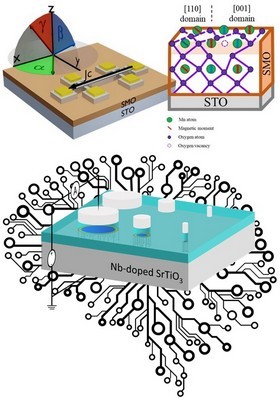
More efficient
The Banerjee group previously demonstrated how doped strontium titanate can be used to create memristors, which combine memory and logic. They have recently published two papers on devices "beyond CMOS," the complementary metal oxide semiconductors which are the building blocks of present-day computer chips.
One candidate to replace CMOS is the magneto-electric spin-orbit (MESO) device, which could be 10 to 30 times more efficient. Several materials have been investigated for their suitability in creating such a device. Job van Rijn, a Ph.D. student in the Banerjee group, is the first author of a paper in Physical Review B published in December 2022, describing how strontium manganate (SrMnO3 or SMO for short) might be a good candidate for MESO devices. ‘It is a multiferroic material that couples spintronics and charge-based effects,’ explains van Rijn. Spintronics is based on the spin (the magnetic moment) of electrons.
Banerjee: "The magnetic and charge orderings are coupled in this material, so we can switch magnetism with an electric field and polarization with a magnetic field." And, importantly, these effects are present at temperatures close to room temperature. Van Rijn is investigating the strong coupling between the two effects. "We know that ferromagnetism and ferroelectricity are tuneable by straining a thin SMO film. This straining was done by growing the films on different substrates."
Strain
Van Rijn studies how strain induces ferroelectricity in the material and how it impacts the magnetic order. He analyzed the domains in the strained films and noticed that magnetic interactions are greatly dependent on the crystal structure and, in particular, on oxygen vacancies, which modify the preferred direction of the magnetic order. ‘Spin transport experiments lead us to the conclusion that the magnetic domains play an active role in the devices that are made of this material. Therefore, this study is the first step in establishing the potential use of strontium manganate for novel computing architectures.’
On 14 February, the Banerjee group published a second paper on devices ‘beyond CMOS’, in the journal Advanced Electronic Materials. Ph.D. student Anouk Goossens is the first author of this paper on the miniaturization of memristors based on niobium-doped strontium titanate (SrTiO3 or STO). ‘The number of devices per unit surface area is important,’ says Goossens. "But some memristor types are difficult to downscale." 
Goossens previously showed that it was possible to create ‘logic-in-memory’ devices using STO. Her latest paper shows that it is possible to downscale these devices. A common problem with memristors is that their performance is negatively impacted by miniaturization. Surprisingly, making smaller memristors from STO increases the difference between the high and the low resistance ratio. ‘We studied the material using scanning transmission electron microscopy and noticed the presence of a large number of oxygen vacancies at the interface between the substrate and the device’s electrode’, says Goossens. "After we applied an electric voltage, we noticed oxygen vacancy movement, which is a key factor in controlling the resistance states."
New design
The conclusion is that the enhanced performance results from edge effects, which can be bad for normal memory. But in STO, the increased electric field at the edges supports the function of the memristor. "In our case, the edge is the device," concludes Goossens. ‘In addition, the exact properties depend on the amount of niobium doping, so the material is tuneable for different purposes."
In conclusion, both papers published by the group show the way toward novel supercomputing architectures. Indeed, the STO memristors have inspired colleagues of Goossens and Banerjee at the University of Groningen Bernoulli Institute for Mathematics, Computer Science and Artificial Intelligence and CogniGron (Groningen Cognitive Systems and Materials Center), who have already come up with a new design for memory architecture.
"This is exactly what we are working for," says Banerjee. We want to understand the physics of materials and how our devices work and then develop applications.’ Goosens: ‘We envision several applications and the one we are looking at is a random number generator that works without an algorithm and is therefore impossible to predict."

![Composite of (a) 300-hPa geopotential height anomalies [shading, shading interval (SI) = 10 gpm] and (b) 2-m air temperature anomalies (shading, SI = 0.5°C) during the extreme heat summers over Western North America (WNA) in ERA5 data set. (c, d) are the same as (a, b), but for the MME from 15 CMIP6 models. The blue rectangles represent the region over WNA (40°–60°N, 128°–110°W). The anomalies are relative to 1981–2010.](/images/ezgif.com-webp-to-jpg_f5ba0.jpg "Composite of (a) 300-hPa geopotential height anomalies [shading, shading interval (SI) = 10 gpm] and (b) 2-m air temperature anomalies (shading, SI = 0.5°C) during the extreme heat summers over Western North America (WNA) in ERA5 data set. (c, d) are the same as (a, b), but for the MME from 15 CMIP6 models. The blue rectangles represent the region over WNA (40°–60°N, 128°–110°W). The anomalies are relative to 1981–2010.")
![Spatial-temporal evolutions of the 2021 Western North America (WNA) heatwave in the observation. (a) Temporal variations of the spatial extent (shading, SI = 100 × 103 km2) of land areas over WNA that experience record-breaking temperature anomalies at different time scales. The purple dot indicates the date and time scale with the maximum record-breaking areas (i.e., June 29 at the 5-day time scale). (b) 2-m air temperature anomalies (shading, unit: °C; relative to 1981–2010) at the 5-day time scale centered on 29 June 2021. Contour lines [contour interval (CI) = 1 SD] indicate the normalized 2-m temperature, defined as the anomalies divided by the corresponding standard deviation among all summer days in 1981–2010. The black points highlight the record-breaking grids. The blue rectangle represents the region over WNA (40°–60°N, 128°–110°W), and the purple lines represent the Canadian and U.S. states' boundaries. (c) The daily evolution of the area-mean 2-m temperature anomalies (orange line) over WNA at the 5-day time scale in the June-August of 2021. The pink shading indicates the historical maximum temperature anomalies at the 5-day time scale on each summer day from 1950 to 2020. The black dot represents the temperature anomaly on 29 June 2021.](/images/ezgif.com-webp-to-jpg_1_e10d9.jpg "Spatial-temporal evolutions of the 2021 Western North America (WNA) heatwave in the observation. (a) Temporal variations of the spatial extent (shading, SI = 100 × 103 km2) of land areas over WNA that experience record-breaking temperature anomalies at different time scales. The purple dot indicates the date and time scale with the maximum record-breaking areas (i.e., June 29 at the 5-day time scale). (b) 2-m air temperature anomalies (shading, unit: °C; relative to 1981–2010) at the 5-day time scale centered on 29 June 2021. Contour lines [contour interval (CI) = 1 SD] indicate the normalized 2-m temperature, defined as the anomalies divided by the corresponding standard deviation among all summer days in 1981–2010. The black points highlight the record-breaking grids. The blue rectangle represents the region over WNA (40°–60°N, 128°–110°W), and the purple lines represent the Canadian and U.S. states' boundaries. (c) The daily evolution of the area-mean 2-m temperature anomalies (orange line) over WNA at the 5-day time scale in the June-August of 2021. The pink shading indicates the historical maximum temperature anomalies at the 5-day time scale on each summer day from 1950 to 2020. The black dot represents the temperature anomaly on 29 June 2021.")