

SUPERCOMPUTING NEWS SUPERCOMPUTING NEWS
    • MEDIA KIT
    • MOST READ
    • RSS FEED
    • ACADEMIA
    • AEROSPACE
    • APPLICATIONS
    • ASTRONOMY
    • AUTOMOTIVE
    • BIG DATA
    • BIOLOGY
    • CHEMISTRY
    • CLIENTS
    • CLOUD
    • DEFENSE
    • DEVELOPER TOOLS
    • EARTH SCIENCES
    • ECONOMICS
    • ENGINEERING
    • ENTERTAINMENT
    • GAMING
    • GOVERNMENT
    • HEALTH
    • OIL & GAS
    • INDUSTRY
    • INTERCONNECTS
    • MANUFACTURING
    • MIDDLEWARE
    • MOVIES
    • NETWORKS
    • PHYSICS
    • PROCESSORS
    • RETAIL
    • SCIENCE
    • STORAGE
    • SYSTEMS
    • VISUALIZATION
    • AcyMailing subscription form

    • ADD YOUR VIDEOS
    • MANAGE VIDEOS
    • CONVERSATION INBOX
    • SOCIAL ADVERTISER
    • SOCIAL NETWORK VIDEOS
    • SURVEYS
    • GROUPS
    • PAGES
    • MARKETPLACE LISTINGS
    • APPLICATIONS BROWSER
    • PRIVACY CONFIRM REQUEST
    • PRIVACY CREATE REQUEST
    • LEADERBOARD
    • POINTS LISTING
      • BADGES
    • TRADE SHOWS
Sign In
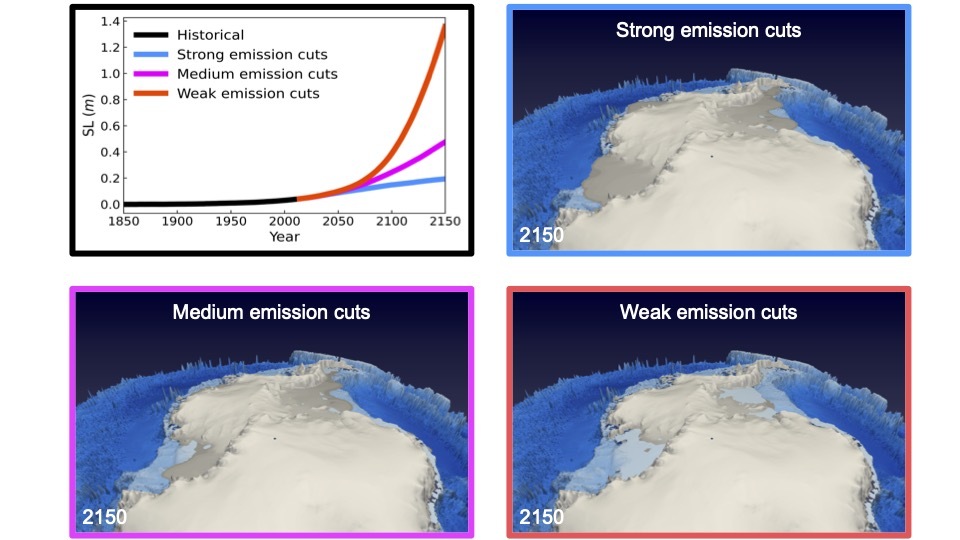
Sea level rise contributions from the Antarctic and Greenland ice sheets, and maps of projected 2150 CE Antarctic ice sheet surface elevation following different greenhouse gas emission scenarios (SSP1-1.9, strong emission cuts; SSP2-4.5, medium emission cuts; SSP5-8.5, weak emission cuts). / Figure credit by Jun-Young Park
Tyler O'Neal, Staff Editor ACADEMIA February 17, 2023, 2:20 pm

Prof Lee's supercomputing reveals an acceleration of global sea level rise imminent past 1.8℃ planetary warming

A study by an international team of scientists shows that an irreversible loss of the West Antarctic and Greenland ice sheets, and a corresponding rapid acceleration of sea level rise, may be imminent if global temperature change cannot be stabilized below 1.8°C, relative to the preindustrial levels.

Coastal populations worldwide are already bracing for rising seas. However, planning for counter-measures to prevent inundation and other damages has been extremely difficult since the latest climate model projections presented in the 6th assessment report of the Intergovernmental Panel on Climate Change (IPCC) do not agree on how quickly the major ice sheets will respond to global warming.

Melting ice sheets are potentially the most significant contributor to sea level change, and historically the hardest to predict because the physics governing their behavior is notoriously complex. “Moreover, computer models that simulate the dynamics of the ice sheets in Greenland and Antarctica often do not account for the fact that ice sheet melting will affect ocean processes, which, in turn, can feed back onto the ice sheet and the atmosphere,” says Jun Young Park, a Ph.D. student at the IBS Center for Climate Physics and Pusan National University, Busan, South Korea and first author of the study.

Using a new supercomputer model, which captures the coupling between ice sheets, icebergs, ocean, and atmosphere for the first time, climate researchers found that an ice sheet/sea level run-away effect can be prevented only if the world reaches net zero carbon emissions before 2060.

“If we miss this emission goal, the ice sheets will disintegrate and melt at an accelerated pace, according to our calculations. If we don’t take any action, retreating ice sheets will continue to increase sea level by at least 100 cm within the next 130 years. This would be on top of other contributions, such as the thermal expansion of ocean water” says Prof. Axel Timmermann, co-author of the study and Director of the IBS Center for Climate Physics.

Ice sheets respond to atmospheric and oceanic warming in delayed and often unpredictable ways. Previously, scientists have highlighted the importance of subsurface ocean melting as a critical process, which can trigger runaway effects in the major marine-based ice sheets in Antarctica. “However, according to our supercomputer simulations, the effectiveness of these processes may have been overestimated in recent studies,” says Prof. June Yi Lee from the IBS Center for Climate Physics and Pusan National University and co-author of the study. “We see that sea ice and atmospheric circulation changes around Antarctica also play a crucial role in controlling the amount of ice sheet melting with repercussions for global sea level projections,” she adds.

The study highlights the need to develop more complex earth system models, which capture the different climate components and their interactions. Furthermore, new observational programs are needed to constrain the representation of physical processes in earth system models, particularly from highly active regions, such as Pine Island glaciers in Antarctica.

“One of the key challenges in simulating ice sheets is that even small-scale processes can play a crucial role in the large-scale response of an ice sheet and for the corresponding sea-level projections. Not only do we have to include the coupling of all components, as we did in our current study, but we also need to simulate the dynamics at the highest possible spatial resolution using some of the fastest supercomputers,” summarizes Axel Timmermann.

 

AI model sheds light on cognition, brain disorders

Tyler O'Neal, Staff Editor ACADEMIA February 17, 2023, 5:00 am

Researchers from the National Institutes of Health (NIH) used computational modeling to uncover mutations in the human genome that likely influenced the evolution of human cognition. This groundbreaking research in human genomics could lead to a better understanding of human health and the discovery of novel treatments for complex brain disorders. The study was published in Science Advances.

Human cognition is a defining feature of human evolution, setting us apart from other primates. Despite over 100 million mutations since the human-chimp split, only a small fraction is significant. To navigate this vast landscape of genomic changes, researchers from the National Library of Medicine (NLM) and the National Cancer Institute (NCI) created an artificial intelligence (AI) model of gene regulation in the human brain. The model identified thousands of mutations likely impacting neocortical development and facilitating the acquisition of mathematical abilities through altered brain gene regulation mechanisms.

When the human genome was sequenced in 2001, researchers learned that only 2% of the sequence of our genome is used for coding genes that, in turn, translate into proteins. This is the sequence information that is being used by every single cell. The function of the other 98% of our DNA—often referred to as “noncoding DNA"— remains relatively unknown. It is believed that 95% of disease associations hide within these noncoding parts of our genome.

The research group of Ivan Ovcharenko, Ph.D., senior investigator in the Computational Biology Branch of NLM’s Intramural Research Program teamed up with the research group of Sridhar Hannenhalli, Ph.D., senior investigator in NCI’s Center for Cancer Research to create an AI model that measures the effect of noncoding genome mutations on human brain function and development. This led to the identification of a group of noncoding mutations disrupting brain regulatory pathways and potentially causing various complex brain disorders, including autism.

“There are treasure islands within the sea of noncoding DNA in the human genome that are critically important for regulating human genes,” said Dr. Ovcharenko. “Mutations in these regions are largely benign, but there is a class of mutations which detrimentally impact the function of regulatory regions in the brain and affect cellular activity there. By being able to address the impact of individual mutations, we are advancing towards understanding the mechanism of complex diseases and disorders and paving the way for the development of novel therapeutic approaches.”

According to the study authors, this fundamental work in human genomics is likely to have a long-ranging impact on human health and advance the research on the complex nature of the human brain.

A perovskite crystalline stone isolated on white background. Perovskites, like the one shown here, show great potential as light-absorbing material for solar harvesting. (Getty Images photo)

Optics professor Guo demos how to harness the power of metals to enhance the efficiency of perovskites

Tyler O'Neal, Staff Editor ACADEMIA February 16, 2023, 3:00 pm

Silicon, the standard semiconducting material used in a host of applications—computer central processing units (CPUs), semiconductor chips, detectors, and solar cells—is an abundant, naturally occurring material. However, it is expensive to mine and purify.

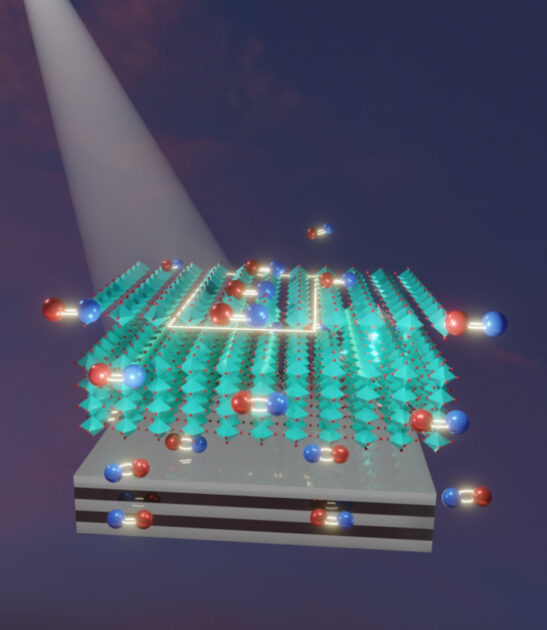
Perovskites—a family of materials nicknamed for their crystalline structure—have shown extraordinary promise in recent years as a far less expensive, equally efficient replacement for silicon in solar cells and detectors. Now, a study led by Chunlei Guo, a professor of optics at the University of Rochester, suggests perovskites may become far more efficient. This illustration from the Guo Lab shows the interaction between a perovskite material (cyan) and a substrate of metal-dielectric material. The red and blue pairings are electron-hole pairs. Mirror images reflected from the substrate reduce the ability of excited electrons in the perovskite to recombine with their atomic cores, increasing the efficiency of the perovskite to harvest solar light. (Illustration by Chloe Zhang)

Researchers typically synthesize perovskites in a wet lab, and then apply the material as a film on a glass substrate and explore various applications

Guo instead proposes a novel, physics-based approach. By using a substrate of either a layer of metal or alternating layers of metal and dielectric material—rather than glass—he and his coauthors found they could increase the perovskite’s light conversion efficiency by 250 percent.

“No one else has come to this observation in perovskites,” Guo says. “All of a sudden, we can put a metal platform under a perovskite, utterly changing the interaction of the electrons within the perovskite. Thus, we use a physical method to engineer that interaction.”

The novel perovskite-metal combination creates a lot of surprising physics

Metals are probably the simplest materials in nature, but they can be made to acquire complex functions. The Guo Lab has extensive experience in this direction. The lab has pioneered a range of technologies transforming simple metals to pitch black, super hydrophilic (water-attracting), or superhydrophobic (water-repellent). The enhanced metals have been used for solar energy absorption and water purification in their recent studies.

In this new paper, instead of presenting a way to enhance the metal itself, the Guo Lab demonstrates how to use the metal to enhance the efficiency of perovskites.

“A piece of metal can do just as much work as complex chemical engineering in a wet lab,” says Guo, adding that the new research may be particularly useful for future solar energy harvesting.”

In a solar cell, photons from sunlight need to interact with and excite electrons, causing the electrons to leave their atomic cores and generate an electrical current, Guo explains. Ideally, the solar cell would use materials that are weak to pull the excited electrons back to the atomic cores and stop the electrical current.

Guo’s lab demonstrated that such recombination could be substantially prevented by combining a perovskite material with either a layer of metal or a metamaterial substrate consisting of alternating layers of silver, a noble metal, and aluminum oxide, a dielectric.

The result was a significant reduction of electron recombination through “a lot of surprising physics,” Guo says. In effect, the metal layer serves as a mirror, which creates reversed images of electron-hole pairs, weakening the ability of the electrons to recombine with the holes.

The lab was able to use a simple detector to observe the resulting 250 percent increase in the efficiency of light conversion.

Several challenges must be resolved before perovskites become practical for applications, especially their tendency to degrade relatively quickly. Currently, researchers are racing to find new, more stable perovskite materials.

“As new perovskites emerge, we can then use our physics-based method to further enhance their performance,” Guo says.

Coauthors include Kwang Jin Lee, Ran Wei, Jihua Zhang, and Mohamed Elkabbash, all current and former members of the Guo Lab, and Ye Wang, Wenchi Kong, Sandeep Kumar Chamoli, Tao Huang, and Weili Yu, all of the Changchun Institute of Optics, Fine Mechanics, and Physics in China.

The Bill and Melinda Gates Foundation, the Army Research Office, and the National Science Foundation supported this research.


  1. Verkko software assembles complete genome sequences more affordable
  2. MIT engineers discover a new way to control atomic nuclei as qubits

Page 48 of 123

  • 43
  • 44
  • 45
  • 46
  • 47
  • 48
  • 49
  • 50
  • 51
  • 52
POPULAR RIGHT NOW
  • Supercomputers uncover a new class of cosmic explosions hidden in plain sight
    Supercomputers uncover a new class of cosmic explosions hidden in plain sight
  • AI supercharges the hunt for stronger magnets: Iowa State researchers launch a new era of intelligent materials discovery
    AI supercharges the hunt for stronger magnets: Iowa State researchers launch a new era of intelligent materials discovery
  • IBM's Historic stock collapse raises questions for the future of enterprise supercomputing
    IBM's Historic stock collapse raises questions for the future of enterprise supercomputing
  • Could a novel dark matter theory simultaneously resolve multiple cosmic enigmas? Supercomputer simulations provide a compelling, albeit currently unverified, potential solution
    Could a novel dark matter theory simultaneously resolve multiple cosmic enigmas? Supercomputer simulations provide a compelling, albeit currently unverified, potential solution
  • Melting icebergs may be reshaping Earth’s greatest ocean current
    Melting icebergs may be reshaping Earth’s greatest ocean current
  • Supercomputers replace ‘bathtub’ flood maps with physics-based digital twins of Britain’s coastline
    Supercomputers replace ‘bathtub’ flood maps with physics-based digital twins of Britain’s coastline
  • Supercomputers push neural quantum simulation beyond previous limits
    Supercomputers push neural quantum simulation beyond previous limits
  • Intel’s AI supercomputing revival: Q2 financial surge signals new era for CPU-powered HPC infrastructure
    Intel’s AI supercomputing revival: Q2 financial surge signals new era for CPU-powered HPC infrastructure
  • AI infrastructure financing fears shake semiconductor sector
    AI infrastructure financing fears shake semiconductor sector
  • AWS supercomputing investment reaches historic scale as Amazon’s AI strategy powers record financial results
    AWS supercomputing investment reaches historic scale as Amazon’s AI strategy powers record financial results
THIS YEAR'S MOST READ
  • Wall Street wants to trade supercomputing power like oil
    Wall Street wants to trade supercomputing power like oil
  • Cosmic ambition at scale: UK’s supercomputer unlocks a 2.5 petabytes universe
    Cosmic ambition at scale: UK’s supercomputer unlocks a 2.5 petabytes universe
  • Hidden order, revealed at scale: Supercomputing, electron ptychography uncover the inner workings of relaxor ferroelectrics
    Hidden order, revealed at scale: Supercomputing, electron ptychography uncover the inner workings of relaxor ferroelectrics
  • Beamforming the future: BeammWave's 6G push signals the rise of orbital-terrestrial wireless networks
    Joakim Axmon
    Joakim Axmon
  • Intel's Q1 results signal supercomputing surge driving Xeon momentum
    Intel's Q1 results signal supercomputing surge driving Xeon momentum
  • When stars fall apart: Supercomputing reveals the hidden physics of black holes
    When stars fall apart: Supercomputing reveals the hidden physics of black holes
  • Multi-layer simulations reveal the hidden supply chain of solar prominences
    Multi-layer simulations reveal the hidden supply chain of solar prominences
  • Japanese scientists decode dolphin speed with supercomputing: Turbulence, vortices, and the hidden physics of propulsion
    Japanese scientists decode dolphin speed with supercomputing: Turbulence, vortices, and the hidden physics of propulsion
  • Cosmic feedback at scale: Supercomputing reveals how quasars regulate the early Universe
    Cosmic feedback at scale: Supercomputing reveals how quasars regulate the early Universe
  • Modeling life at the microscopic scale: A computational breakthrough in oxygen transport
    Modeling life at the microscopic scale: A computational breakthrough in oxygen transport
MOST READ OF ALL-TIME
  • Largest Computational Biology Simulation Mimics The Ribosome
    Details
    112108
    The amino acid (green) slithers into the chemical reaction center, moving through an evolutionarily ancient corridor of the ribosome (purple). The amino acid is delivered to the reaction core by the transfer RNA molecule (yellow).
    The amino acid (green) slithers into the chemical reaction center, moving through an evolutionarily ancient corridor of the ribosome (purple). The amino acid is delivered to the reaction core by the transfer RNA molecule (yellow).
  • Silicon 'neurons' may add a new dimension to chips
    Details
    80995
    Silicon 'neurons' may add a new dimension to chips
  • Linux Networx Accelerators Expected to Drive up to 4x Price/Performance
    Details
    75539
  • Complex Concepts That Really Add Up
    Details
    73640
    Complex Concepts That Really Add Up
  • Blue Sky Studios Donates Animation SuperComputer to Wesleyan
    Details
    68141
    Each rack holds 52 Angstrom Microsystem-brand “blades,” with a memory footprint of 12 or 24 gigabytes each. (Photos by Olivia Bartlett Drake)
    Each rack holds 52 Angstrom Microsystem-brand “blades,” with a memory footprint of 12 or 24 gigabytes each. (Photos by Olivia Bartlett Drake)
  • Humanities, HPC connect at NERSC
    Details
    57948
  • TeraGrid ’09 'Call for Participation'
    Details
    54952
  • Turbulence responsible for black holes' balancing act
    Details
    52314
  • Cray Wins $52 Million SuperComputer Contract
    Details
    50141
  • SDSC Researchers Accurately Predict Protein Docking
    Details
    46083
  • FRONTPAGE
  • LATEST
  • POPULAR
  • REGISTER
  • SOCIAL
  • VIDEO
  • SUBSCRIPTION
  • RSS
  • GUIDELINES
  • PRIVACY
  • TOS
  • ABOUT
  • +1 (816) 799-4488
  • editorial@supercomputingonline.com
© 2001 - 2026 SuperComputingOnline.com, LLC. All rights reserved. This material may not be published, broadcast, rewritten or redistributed without permission.
Sign In
  • FRONT PAGE
  • LATEST
    • MEDIA KIT
    • MOST READ
    • RSS FEED
    • ACADEMIA
    • AEROSPACE
    • APPLICATIONS
    • ASTRONOMY
    • AUTOMOTIVE
    • BIG DATA
    • BIOLOGY
    • CHEMISTRY
    • CLIENTS
    • CLOUD
    • DEFENSE
    • DEVELOPER TOOLS
    • EARTH SCIENCES
    • ECONOMICS
    • ENGINEERING
    • ENTERTAINMENT
    • HEALTH
    • INDUSTRY
    • INTERCONNECTS
    • GAMING
    • GOVERNMENT
    • MANUFACTURING
    • MIDDLEWARE
    • MOVIES
    • NETWORKS
    • OIL & GAS
    • PHYSICS
    • PROCESSORS
    • RETAIL
    • SCIENCE
    • STORAGE
    • SYSTEMS
    • VISUALIZATION
  • VIDEOS
    • ADD YOUR VIDEOS
    • MANAGE VIDEOS
  • COMMUNITY
    • TRADE SHOWS
    • SOCIAL NETWORK VIDEOS
    • SURVEYS
    • APPLICATIONS BROWSER
    • CONVERSATION INBOX
    • SOCIAL ADVERTISER
    • GROUPS
    • MARKETPLACE LISTINGS
    • PAGES
    • LEADERBOARD
    • POINTS LISTING
      • BADGES
    • PRIVACY CONFIRM REQUEST
    • PRIVACY CREATE REQUEST

Hey there! We noticed you’re using an ad blocker.