TAU opens a new window of observation on the Moon for the detection of radio waves

Researchers at Tel Aviv University (TAU) have predicted that a lunar-based detection of radio waves could help advance the study of "dark matter" in the universe. This would be the first time such a detection is made from the moon and could lead to groundbreaking results. The signals from these radio waves have the potential to test the standard cosmological model and determine the composition of the universe, as well as the mass of neutrino particles. Furthermore, these findings could offer valuable insights into the mysterious dark matter.

The study was conducted by Professor Rennan Barkana and Dr. Rajesh Mondal, a postdoctoral fellow at TAU. By detecting radio waves from hydrogen gas in the early universe, scientists can study the cosmic "dark ages" that existed before the formation of stars. However, Earth's atmosphere blocks these specific radio waves, which is why they must be observed from space.

The moon has a stable environment free from atmospheric or radio interference, making it an ideal location for studying radio waves from the cosmic dark ages. Space agencies across the US, Europe, China, and India are exploring scientific goals for lunar development, and recent research highlights the potential for uncovering discoveries by combining current knowledge with radio observations.

NASA's James Webb space telescope has discovered distant galaxies whose light reaches us from the cosmic dawn, approximately 300 million years after the Big Bang. This latest research delves even further back in time to study the cosmic dark ages, a period only 50 million years after the Big Bang. By simulating the density and temperature of hydrogen gas at various points in time, the researchers were able to determine the intensity of radio waves and how they can be analyzed for desired results.

The researchers believe that these findings will greatly contribute to our understanding of cosmic history and test the standard model of cosmology using a single lunar antenna. By accurately determining the composition of the universe (specifically the levels of hydrogen and helium) with an array of radio antennas, we can gain crucial insights into the building blocks of ordinary matter that formed stars, and planets, and ultimately led to our existence.

Precisely determining the amount of helium is crucial in understanding the ancient period just a minute after the Big Bang when helium was formed in what could be considered a massive nuclear reactor. With a larger array of lunar antennas, it will also allow for the measurement of cosmic neutrinos' weight. These minuscule particles are released during various nuclear reactions, and their weight is an important yet unknown factor in advancing physics beyond the standard model.

According to Professor Barkana, new observational discoveries often result from opening a new window. With lunar observations, we may uncover new properties of dark matter, the enigmatic substance that makes up most of our universe's mass, but we still know very little about it. The cosmic dark ages promise to shed light on previously unknown aspects of our universe.

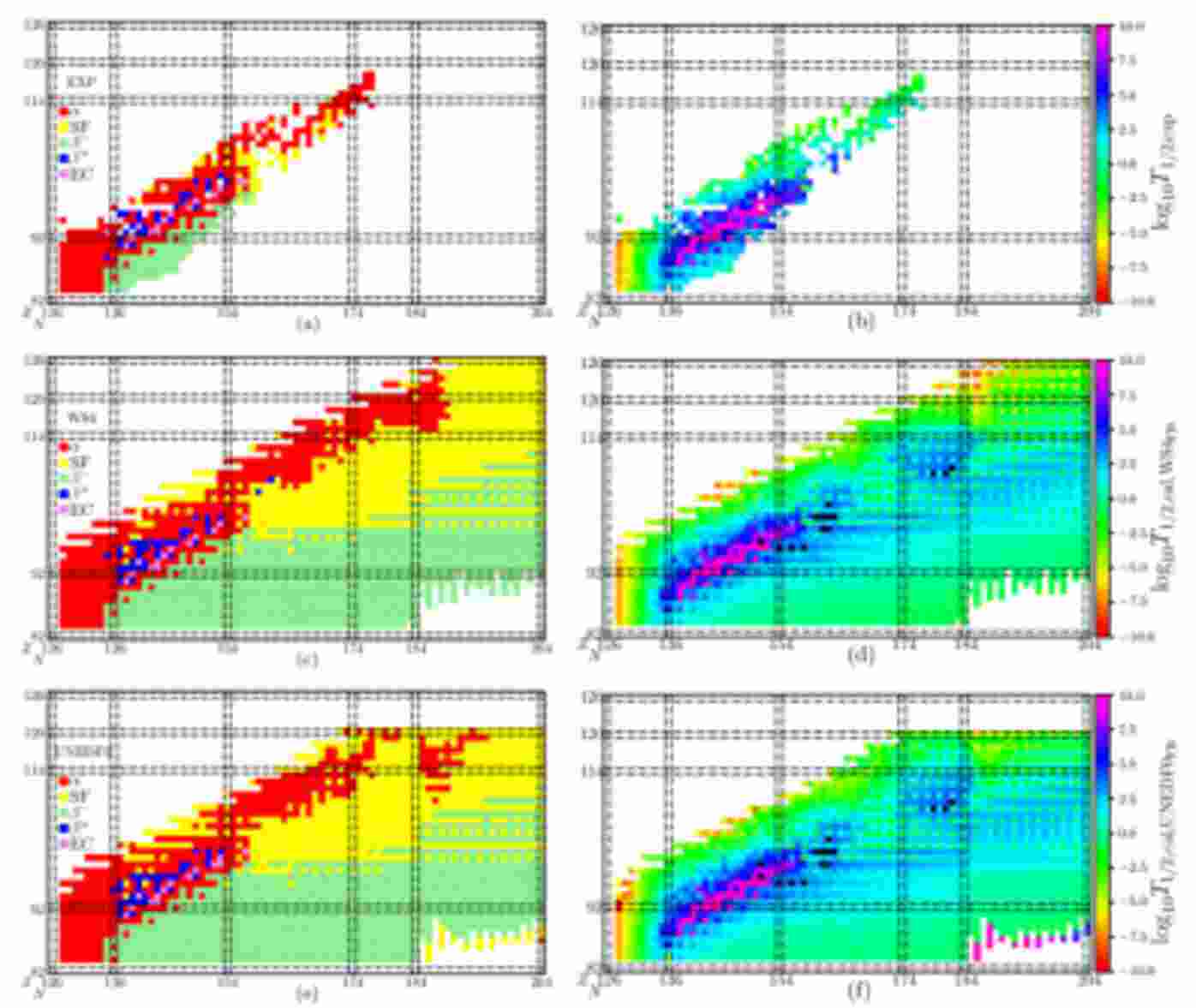
The left panels show the dominant decay modes, while the right panels show the minimum partial half-lives, for α decay, β− decay, β+ decay, EC, and SF. Experimental data can be found in NUBASE2020, while the predicted results from RF can be found in panels c-f. WS4 and UNEDF0 are the sources of predicted energies. The decay energy is replaced with FB to learn SF. The nuclides with a predicted partial half-life longer than 10^4 seconds are marked with a star.

Chinese researchers build AI models that predict decay modes, half-lives of superheavy nuclei with unprecedented accuracy

A team of researchers from Sun Yat-sen University in China has made a groundbreaking discovery regarding the decay patterns of superheavy nuclei. Using a random forest machine learning algorithm, the team gained new insights into the half-lives and decay modes of elements beyond oganesson (element 118).

The team focused on studying nuclei with a high number of protons (Z) and neutrons (N). They employed a combination of semi-empirical formulas and advanced machine learning techniques to calculate partial half-lives for various decay modes such as alpha decay, beta-minus decay, beta-plus decay, electron capture, and spontaneous fission (SF). The random forest algorithm played a crucial role in improving the precision of these calculations by considering multiple nuclear properties and decay energies.

The study's findings are revolutionary, as they shed light on the prevalence of alpha decay in regions with a neutron shortage, and beta-minus decay in areas with a neutron excess. The algorithm's accuracy was remarkable, having correctly predicted the dominant decay mode in 96.9% of the studied nuclei. The researchers also discovered a previously unknown long-lived island of spontaneous fission situated southwest of element 298 Fl (flerovium), providing insight into the complex balance between the fission barrier and Coulomb repulsion in superheavy elements.

This research is a significant step forward in understanding superheavy nuclei and the ways they decay. This understanding is essential for exploring new elements and discovering the "island of stability" in the realm of superheavy atomic masses. The study emphasizes the importance of precise measurements of nuclear mass and decay energy in making accurate predictions. The team has proposed multiple isotopes for future exploration, which will play a crucial role in advancing nuclear research, particularly in modern facilities such as CAFE2 and SHANS2 in Lanzhou, China.

The use of the random forest algorithm has revolutionized nuclear physics and provided a deeper understanding of superheavy nucleus decay. This breakthrough sets the stage for future discoveries in this exciting field.

Guangzhou deploys new chinese-built supercomputer

A state-of-the-art supercomputing system, called Tianhe Xingyi, was recently launched in Guangzhou, Guangdong Province, China. This system is a major domestic achievement and will help meet the growing needs for high-performance computing, large-scale AI training, and big data analysis, as reported by the National Supercomputer Center in Guangzhou. Tianhe Xingyi, like a shining dragon soaring through the clouds, represents a new era of technological advancement and innovation in Guangzhou. Its power and capabilities, both domestic and cutting-edge, make it a symbol of progress and potential for the future.

The system was introduced at a conference focused on innovation and applications of supercomputing, where over 400 representatives from scientific and technological institutions gathered to discuss integrating supercomputing with AI, big data, and biochemical research.

The supercomputing center stated that the system is designed for application-focused tasks and uses advanced domestic computing architecture. It features high-performance multicore processors, fast interconnection networks, and large-scale storage capabilities. According to Lu Yutong, director of the supercomputing center at Sun Yat-sen University, the new system surpasses the Tianhe II in areas such as CPU computing, network speed, storage capacity, and application services. Tianhe II, which was launched in 2013 and is located at the Guangzhou-headquartered supercomputing center, has served over 300,000 users from across China.

Lu also mentioned that the new system will significantly support cutting-edge scientific and technological advancements, strategic engineering projects, and industrial development efforts. Additionally, it will strengthen Guangzhou's capabilities for core scientific innovation.

According to the director, over the last few years, the supercomputing center has expanded to 15 different locations throughout the Guangdong-Hong Kong-Macao Greater Bay Area and allied supercomputing. They have launched a project to establish a supercomputing application network in the GBA to integrate computing power, and aggregate resources, and promote high-speed networking and supercomputing applications. This project involves collaboration between the Guangzhou-based supercomputing center and 14 other scientific and technological institutions in the GBA, including The Hong Kong University of Science and Technology's Fok Ying Tung Research Institute and the Macao Chinese Innovation and Technology Development Promotion Association. This network aims to create a national-level platform for scientific and technological innovation that aligns with the national computing network construction strategy, providing top-quality computing power, and networking services to contribute to the high-quality development of both Guangdong and the GBA.