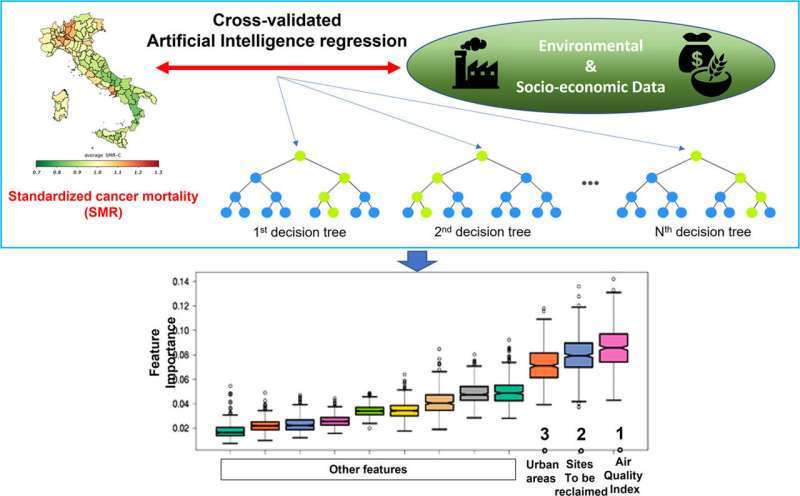
 Today, cancer represents the second leading cause of death in the world after cardiovascular diseases. In the last decades of cancer research, lifestyle - especially physical inactivity, poor diet, obesity, alcoholism, and smoking - and random or genetic factors have been identified as major causes of the development of tumors. Nevertheless, there is a growing understanding of how environmental pollution is among the main factors inducing cancer proliferation.
To further investigate this issue, a group of scholars from the University of Bologna, the University of Bari, and the CNR (National Research Council) used advanced artificial intelligence methods to analyze the relationship between cancer mortality, socio-economic factors, and environmental pollution sources in Italy on a regional and provincial level.
"Contrary to what has been believed so far, our analysis showed that the distribution of cancer mortality among Italian citizens is neither random nor spatially well-defined," explains Roberto Cazzolla Gatti, professor at the Department of Biological, Geological, and Environmental Sciences at the University of Bologna. "Instead, cancer mortality exceeds the national average, especially where environmental pollution is higher, even if in these areas living habits are generally healthier."
Researchers took into consideration 35 environmental sources of pollution such as industries, pesticides, incinerators, and motor vehicle traffic. Among these, they found that air quality is the most important factor in terms of its association with the average cancer mortality rate. This is followed by the presence of sites to be reclaimed, urban areas, motor vehicle density, and pesticides. Moreover, other specific sources of environmental pollution are relevant for specific types of tumors. For instance, cultivated areas are associated with tumors of the gastrointestinal system, roads and steelworks proximity to bladder tumors, and industrial activities in urban areas with prostate tumors and lymphomas.
The Italian province with the highest cancer mortality rate in the decade 2009-2018 was Lodi. It was followed by those of Naples, Bergamo, Pavia, Sondrio, and Cremona. The highest-ranked province in central Italy is Viterbo (11th position), followed by Rome (18th). In southern Italy, in addition to the province of Naples in second place, only Caserta (8th) is in the top 10 for cancer mortality. Anyone can check the ten-year mortality rate in its municipality by visiting the open-access dataset published by the authors of the study.
"Of course, these results do not question the fact that a healthier lifestyle helps to reduce the risk of cancer, just as they don’t question the efforts to get to the genetic basis that may favor the onset of cancer," adds Cazzolla Gatti. "Our results, however, give us good reason to believe that living in a highly polluted area can cancel out the benefits that come with a healthy lifestyle and induce the development of cancers with a higher frequency."
Every year in Italy, there are 400,000 new cases of malignant tumors, with an annual average of about three deaths per thousand people according to the Italian cancer registries. On both national and regional levels, the analysis carried out by the scholars showed the relevance of the environment on the onset of tumors even if compared to other socio-economic factors and lifestyles. Moreover, it was possible to determine on a provincial level what potential sources of pollution could cause an excess of cancer mortality compared to the national average, thus also providing a focus on environmental factors that are mostly associated with specific types of cancer.
"From a global health perspective, following the approach known as One Health, it is now evident that the quality of life of our species is closely dependent on that of the environment in which we live and of the entire planet," explains Cazzolla Gatti. "It is, therefore, necessary to give the highest priority not only to research for cancer cures but also to the reduction and prevention of environmental contamination. These are essential actions in the difficult fight against cancer onset. We need to know how to cure our planet to be able to avoid getting sick.”
According to the study, Italian regions with a relatively high cancer mortality rate have a relatively high degree of pollution, despite registering a relatively low frequency of the usual cancer risk factors such as being overweight, smoking, having a low income, high meat consumption, and low fruit and vegetable consumption. Furthermore, on a provincial level, for both malignant and benign tumors in general and for 16 out of 23 specific types of cancer, significant spatial associations were found with certain sources of pollution and explained more than half of the association between environment and cancer. This confirmed that, in most cases, being exposed to a contaminated environment has a significant impact on cancer mortality in Italy.
"Data show good, albeit preliminary, evidence that a better lifestyle and greater attention to socio-economic and health issues can only partially reduce the risk of dying from cancer if the quality of the environment is overlooked," explains Cazzolla Gatti. “This could explain why we have observed that people living in northern Italian regions - particularly in those located in the Po Valley, between the Lombardy and Veneto regions, which are highly industrialized areas - and exposed to very high levels of environmental pollution show a significant excess of cancer mortality compared to those who live in the central-southern regions (except for some other highly polluted areas, such as the so-called Terra Dei Fuochi (Land of Fires) in the Campania region), even though they enjoy better health, have higher incomes, consume more food of plant origin than animal one, and have easier access to health care.”
The entire ten-year database (2009-2018) on cancer mortality rates developed by researchers from ISTAT (Italian National Institute of Statistics) registers has been published with open access. In the database, 23 cancer macro-categories in Italy on a municipal, provincial, and regional level are considered. "We want to make a complete, up-to-date and ready-to-use data source on cancer mortality in Italy easily accessible to be consulted by interested bodies and local and national authorities, and to provide researchers useful data to carry out further studies," Cazzolla Gatti concludes.


 In search of more accurate dementia diagnoses