

Southwest Research Institute will advance hypersonics research in collaboration with The University of Texas at San Antonio (UTSA) under a three-year, $1.5 million grant through the University Consortium of Applied Hypersonics. As a subcontractor to UTSA, SwRI will design experiments to push the envelope on what is capable with hypersonic system designs and provide methods to better model complex system behavior during separation events.
Hypersonic speeds are faster than five times the speed of sound or greater than Mach 5. When something is flying that fast, the air around a flying object will chemically decompose. Some points behind the shockwave created by the vehicle are hotter than the surface of the Sun. This strange chemical environment causes whatever is traveling through it to heat up, and even melt and chemically react with the air.
SwRI engineers, led by Nicholas Mueschke, program manager of SwRI’s Computational Mechanics Section, are studying hypersonic separation events when two or more things intentionally come apart.
Separation events are commonplace in many aerospace applications. For example, rocket boosters are ejected during space launches, including some that now return to the launch pad after separation. Military aircraft require safe separation of payloads carried underwing or within storage bays. Some rocket nose cones are designed to protect launch packages, such as satellites, which split open and separate from the vehicle in flight.
“Flying at hypersonic speeds within the atmosphere makes the aerodynamics and loads experienced by separating structures more difficult to predict and harder to safely design around because the time scales of these events are squeezed into milliseconds,” Mueschke said.
As next-generation hypersonic technology progresses, the ability to support separating components must also advance. A booster that separates from a vehicle, for example, allows for extended range and novel flight corridors. The challenge is designing components that can separate easily, avoid damaging or upsetting the primary vehicle, but also withstand the extreme aerodynamics and thermal environment associated with traveling at hypersonic speeds. 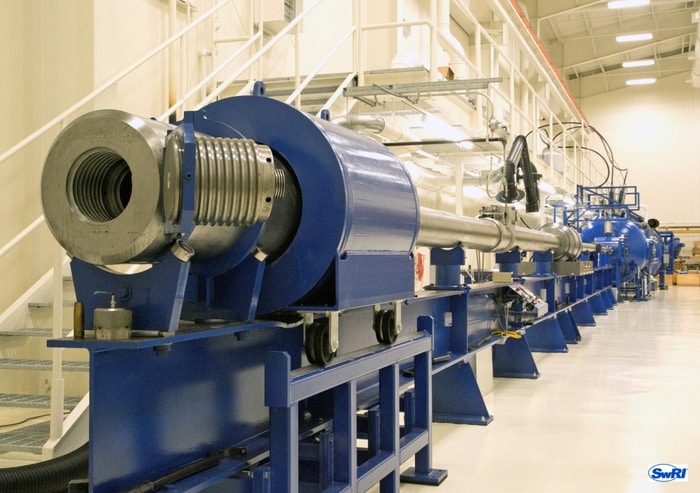
SwRI is designing novel experiments to evaluate hypersonic system designs while also providing methods to better model complex system behavior during separation events. To accomplish this, the team is designing tests that can be conducted in the Institute’s two-stage light-gas gun, which simulates hypersonic flight conditions and allows researchers to image objects in hypersonic flight.
“The goal is to generate aerodynamic and kinematic data that will anchor high-fidelity simulation models,” Mueschke said. “We will also leverage some of our advanced simulation capabilities to both design these experiments and evaluate how simulation models can improve future vehicle designs. Ultimately, this work is part of the broader effort to leverage hypersonic technology to deliver operational capability and options to combatant commanders that otherwise don’t exist today.”
Mueschke and his colleagues began work under the new contract in October.
“It’s encouraging to see academia, government, and industry collaborating on multiyear efforts to advance hypersonics research,” Mueschke said. “I hope this effort will open new doors to operational capabilities we haven’t seen before.”
Leading atmospheric scientists are measuring emissions of the most dangerous greenhouse gases at COP26 and sharing them live online to highlight how rigorous measurement and detailed data reporting are essential in the fight against climate change. 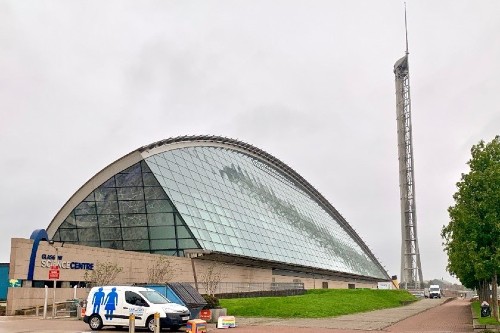
The initiative, by the University of Bristol, UK, and an international team of scientists deploy sophisticated instrumentation to measure the amount of carbon dioxide (CO2) and methane (CH4) – the main culprits in driving global warming – present in the air in Glasgow, where this year’s United Nations Climate Change Conference is being hosted.
The same technology is used in a wider Bristol-led project in partnership with the Met Office to gather this data from across the UK, called the Deriving Emissions linked to Climate Change (DECC) network. This globally unique system is used to check the accuracy of the UK government’s greenhouse gas emissions report to the United Nations.
Experts from the team are involved in events and presentations at the 13-day summit to demonstrate how timely measurements present a vital but little-used tool to accurately monitor and effectively tackle climate change.
Prof. Matt Rigby, Professor of Atmospheric Chemistry at the university’s Cabot Institute for the Environment, said: “The UK is world-leading in its evaluation of emissions of greenhouse gases, including the two which pose the biggest threat to our planet. The aim of this work is to demonstrate the huge potential of this technology, and urge other countries to follow, especially the industrial powerhouses of China, the US, and India.”
A feed of the Glasgow data in real-time is available on an online dashboard and the statistics are being carefully analyzed by the team to identify possible trends and issues.
Professor Rigby said: “Advanced measurement and tightly-scrutinized evaluation of emissions is imperative to detect any irregularities which may warrant further investigation and to enable countries, including the UK, to meet crucial targets to curb emissions and limit global warming. This approach can help ensure accurate, consistent, and reliable emissions reporting to build and evidence progress.”
Government reporting of Greenhouse Gases (GHGs) is based on “bottom-up” or inventory accountancy methods, which calculate the national total contribution to climate change by estimating emissions from individual gas leaks, cars, cows, etc., and adding up the total number of each contributor. Although comprehensive, they can be subject to substantial inaccuracies. These reports do not generally consider arguably key information: measurements that can indicate the actual amount of greenhouse gas in the atmosphere.
By contrast, the team measures real-time levels of GHGs in the atmosphere across the UK and uses supercomputer models based on meteorological data to produce “top-down” emissions estimates. The UK was the first country to use this measurement-based approach to evaluate its GHG emission reports to the UN and is currently one of only three countries, including Switzerland and Australia, to do so.
Professor Alistair Manning, an atmospheric modeling expert at the Met Office, added: “As the UK government routinely cross-check with their figures against our top-down emissions estimates, the credibility of the UK reporting is greatly enhanced. By raising awareness of these methods at COP26 we hope that other countries will be encouraged to follow the UK’s lead, in turn improving the accuracy of the global emissions reporting system, which needs to become more consistent and robust.”