

BYU researchers create algorithm that predicts when an adolescent will become suicidal with 91% accuracy

Study reveals which risk factors are most strongly associated with suicidal thoughts and behavior among teens

Researchers from Brigham Young University, Johns Hopkins, and Harvard have created an algorithm that can predict suicidal thoughts and behavior among adolescents with 91% accuracy.

The researchers outline their machine learning approach in an article published today in PLOS ONE, where they also detail risk factors that are leading predictors of suicidal ideation and behavior among adolescents: online harassment and bullying.

“Suicide is the second leading cause of death among adolescents in the U.S.,” said Michael Barnes, study co-author and Associate Dean of the BYU College of Life Sciences. “It’s critical we have a better understanding of the risk factors — and the protective factors — associated with this heartbreaking issue.”

The study results show researchers can predict with high accuracy which adolescents will exhibit suicidal thoughts (consider or planning) or suicidal behavior (attempting) based on experiences they face.

The team analyzed data from 179,384 junior high and high school students, along with those who participated in the Student Health and Risk Prevention survey from 2011-2017. The dataset includes responses to 300+ survey questions and 8000+ bits of demographic information, resulting in a total of 1.2 billion data points that were processed. Researchers then applied various algorithms to the data and found a machine-learning model that accurately predicted which adolescents went on to have suicidal thoughts and behaviors (STB) based on the data provided.

The data showed females were more likely to experience suicidal thoughts and behavior (17.7%) than males (10.8%), and that those adolescents without a father in the home were 72.6% more likely to have suicidal ideation than those that did.

Most importantly, the algorithm discovered which risk factors were the leading predictors of suicidal thoughts and behavior:

  • Being threatened or harassed through digital media
  • Being picked on or bullied by a student at school
  • Exposure/involvement in serious arguments and yelling at home

“This analysis finds the most important root causes of suicidal thoughts and behavior in adolescents and creates risk profiles that give us a clearer picture of adolescents that are at risk,” said study co-author Carl Hanson, professor of public health at BYU. “If you want to wrap your head around what you can do about it, these profiles are one good place to start.”

Researchers were not surprised to see some of the risk factors that rose to the top — bullying, and harassment — but were interested to see the heavy influence from family factors: three of the top ten predictive factors for STB were tied directly to family situations: 1) being in a family where there are serious arguments, 2) being in a family that argues about the same things over and over and 3) being in a family that yells and insults each other.

The team said the implications of the research are critical for prevention programming and policymaking. Specifically, they hope policymakers use the STB risk profile and its associate rankings to prepare services, resources, and assessments aimed at school, community, and family settings.

“Clearly the results speak to the need for prevention and schools may be the best place to start by helping to mitigate bullying and online harassment. The results also indicate a need to strengthen families,” Hanson said. “For communities, we need programming that can help support and strengthen the family.”
DESY built machine learning produces unprecedented insights into how biomolecules work

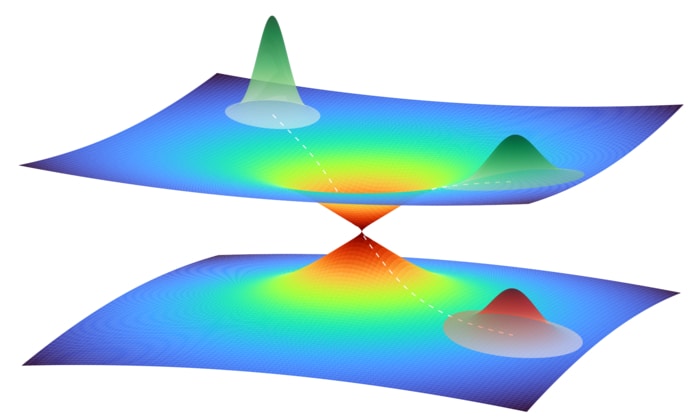
A new analytical technique can provide hitherto unattainable insights into the extremely rapid dynamics of biomolecules. The team of developers, led by Abbas Ourmazd from the University of Wisconsin–Milwaukee and Robin Santra from DESY in Germany, is presenting its clever combination of quantum physics and molecular biology. The scientists used the technique to track how the photoactive yellow protein (PYP) undergoes changes in its structure in less than a trillionth of a second after being excited by light. Illustration of a quantum wave packet in close vicinity of a conical intersection between two potential energy surfaces. The wave packet represents the collective motion of multiple atoms in the photoactive yellow protein. A part of the wave packet moves through the intersection from one potential energy surface to the other, while the another part remains on the top surface, leading to a superposition of quantum states.  CREDIT DESY, Niels Breckwoldt

“In order to precisely understand biochemical processes in nature, such as photosynthesis in certain bacteria, it is important to know the detailed sequence of events,” Santra explains their underlying motivation. “When light strikes photoactive proteins, their spatial structure is altered, and this structural change determines what role a protein takes on in nature.” Until now, however, it has been almost impossible to track the exact sequence in which structural changes occur. Only the initial and final states of a molecule before and after a reaction can be determined and interpreted in theoretical terms. “But we don’t know exactly how the energy and shape changes in between the two,” says Santra. “It’s like seeing that someone has folded their hands, but you can’t see them interlacing their fingers to do so.”

Whereas a hand is large enough and the movement is slow enough for us to follow it with our eyes, things are not that easy when looking at molecules. The energy state of a molecule can be determined with great precision using spectroscopy, and bright X-rays for example from an X-ray laser can be used to analyze the shape of a molecule. The extremely short wavelength of X-rays means that they can resolve very small spatial structures, such as the positions of the atoms within a molecule. However, the result is not an image like a photograph, but instead a characteristic interference pattern, which can be used to deduce the spatial structure that created it.

Bright and short X-ray flashes

Since the movements are extremely rapid at the molecular level, scientists have to use extremely short X-ray pulses to prevent the image from being blurred. It was only with the advent of X-ray lasers that it became possible to produce sufficiently bright and short X-ray pulses to capture these dynamics. However, since molecular dynamics takes place in the realm of quantum physics where the laws of physics deviate from our everyday experience, the measurements can only be interpreted with the help of a quantum-physical analysis.

A peculiar feature of photoactive proteins needs to be taken into consideration: the incident light excites their electron shell to enter a higher quantum state, and this causes an initial change in the shape of the molecule. This change in shape can in turn result in the excited and ground quantum states overlapping each other. In the resulting quantum jump, the excited state reverts to the ground state, whereby the shape of the molecule initially remains unchanged. The conical intersection between the quantum states, therefore, opens a pathway to a new spatial structure of the protein in the quantum mechanical ground state.

The team led by Santra and Ourmazd has now succeeded for the first time in unraveling the structural dynamics of a photoactive protein at such a conical intersection. They did so by drawing on machine learning because a full description of the dynamics would require every possible movement of all the particles involved to be considered. This quickly leads to unmanageable equations that cannot be solved.

6000 dimensions

“The photoactive yellow protein we studied consists of some 2000 atoms,” explains Santra, who is a Lead Scientist at DESY and a professor of physics at Universität Hamburg. “Since every atom is basically free to move in all three spatial dimensions, there are a total of 6000 options for movement. That leads to a quantum mechanical equation with 6000 dimensions – which even the most powerful computers today are unable to solve.”

However, supercomputer analyses based on machine learning were able to identify patterns in the collective movement of the atoms in the complex molecule. “It’s like when a hand moves: there, too, we don’t look at each atom individually, but at their collective movement,” explains Santra. Unlike a hand, where the possibilities for collective movement are obvious, these options are not as easy to identify in the atoms of a molecule. However, using this technique, the supercomputer was able to reduce the approximately 6000 dimensions to four. By demonstrating this new method, Santra’s team was also able to characterize a conical intersection of quantum states in a complex molecule made up of thousands of atoms for the first time.

The detailed calculation shows how this conical intersection forms in four-dimensional space and how the photoactive yellow protein drops through it back to its initial state after being excited by light. The scientists can now describe this process in steps of a few dozen femtoseconds (quadrillionths of a second) and thus advance the understanding of photoactive processes. “As a result, quantum physics is providing new insights into a biological system, and biology is providing new ideas for quantum mechanical methodology,” says Santra, who is also a member of the Hamburg Cluster of Excellence “CUI: Advanced Imaging of Matter”. “The two fields are cross-fertilizing each other in the process.”

Black & Veatch helps data centers increase efficiency, transition to high density

Black & Veatch and Future Facilities will work together to offer assessments, analysis, and modeling as the financial industry seeks to modernize data center infrastructure

As the digital revolution redefines the definition of infrastructure, data centers are increasingly transitioning to high-performance computing with higher rack density to meet the demand for high-speed, reliable supercomputing. Recognizing this, Black & Veatch and Future Facilities are working together to offer a suite of services including data center assessments, analysis, and upgrades to maximize the efficiency and longevity of existing data center infrastructure.

This collaboration with Future Facilities, a software company specializing in 3D digital twin technology using Computational Fluid Dynamics (CFD), allows Black & Veatch to offer its data center design, modernization, and sustainability expertise to financial institutions, enabling them to make informed, cost-effective decisions as they transition data centers from low- to high-density racks. High-density rack data centers allow for the ultra-speed, data-intensive computing necessary in today’s fast-moving economy.

“From commerce to communication, as the world continues to strengthen its reliance on digitization, it is imperative that any company utilizing data has the right tools in place to chart the best path forward to maximize the lifespan, efficiency, and capabilities of their data centers,” said Robert Schmidt, director of client innovation at Future Facilities. “Through our collaboration with Black & Veatch, we are happy to offer these tools to financial institutions, as they continue to develop their digital transformation strategies.”

Datacenter assessments provide insight into a building system’s performance, identifying potential risks and barriers to efficiency that may be related to aging facility equipment, single points of failure, IT equipment spacing, capacity, and more.

“Future Facilities’ digital twin technologies are optimal for assessing and providing strategies to institutions using data centers for information processing,” said Gary Cudmore, Black & Veatch’s global director of data centers. “With Future Facilities software, Black & Veatch is able to pair our expertise in data center design and assessment with sophisticated CFD analysis and modeling to deliver a comprehensive service to any company looking to optimize their data centers.”

Black & Veatch’s study, Data Center Solutions: Helping Financial Enterprises Maximize Performance, highlights an example of the challenges many existing data center operators face as the needs of their clients outpace facility capacity. Initially, the client considered migrating their IT assets to a colocation provider, as power availability seemed to limit a transition to high-density racks in their on-prem facility. Black & Veatch assessed the client’s data centers and found the potential to extend the existing assets for several more years, delaying the need for migrating to a colocation facility. This kept the company online, bought time for long-term digital planning, and staved off a multi-million-dollar upgrade. Future Facilities’ data center modeling software determined the best operating scenario for optimization of space and assets. Pairing these complimentary services of assessment and modeling will benefit any institution struggling with data center optimization or transition.