

NUST MISIS scientists develop fastest-ever quantum random number generator

An international research team has developed a fast and affordable quantum random number generator. The device created by scientists from NUST MISIS, Russian Quantum Center, University of Oxford, Goldsmiths, University of London, and Freie Universität Berlin produces randomness at a rate of 8.05 gigabits per second, which makes it the fastest random number generator of its kind. The study published in Physical Review X is a promising starting point for the development of commercial random number generators for cryptography and complex systems modeling. Alex Fedorov, head of the Russian Quantum Center research group and expert at the NUST MISIS Quantum Communications Theory Lab.  CREDIT Sergey Gnuskov/NUST MISIS{module INSIDE STORY}

KIST research team generates optical data transmission speed increase by a factor of at least 10,000

A pulsed-laser repetition rate of 57.8 GHz was achieved by inserting a resonator containing graphene. The limitations of the manufacturing process were overcome by directly synthesizing graphene onto standard copper (Cu) wires

Pulsed lasers repeatedly emit light for a short period of time as if blinking. They have the advantage of focusing more energy than a continuous wave laser, whose intensity is kept unchanged over time. If digital signals are loaded in a pulsed laser, each pulse can encode one bit of data. In this respect, the higher the repetition rate, the more the amount of data that can be transmitted. However, conventional optical-fiber-based pulsed lasers have typically had a limitation in increasing the number of pulses per second above the MHz level.

The Korea Institute of Science and Technology (KIST) announced that the research team led by Senior Researcher Dr. Yong-Won Song at the Center for Opto-Electronic Materials and Devices was able to generate laser pulses at a rate at least 10,000 times higher than the state of the art. This achievement was accomplished by inserting an additional *resonator containing graphene into a fiber-optic pulsed-laser oscillator that operates in the domain of femtoseconds (10-15 seconds). The data transmission and processing speeds are expected to increase significantly by applying this method to data communications. Abstract Illustration{module INSIDE STORY}
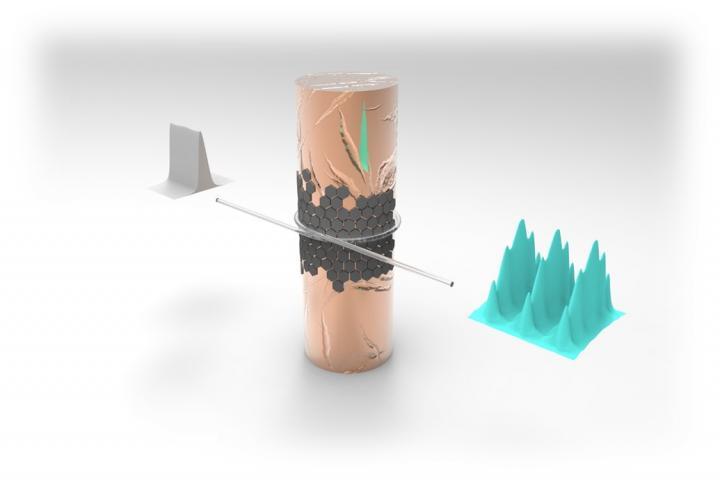
* Resonator: A device that generates waves or vibrations at a specific frequency by leveraging the resonance phenomenon.

The KIST research team noted that the characteristics of the wavelength and intensity of laser light that change over time are correlated (**Fourier transform). If a resonator is inserted into the laser oscillator, the wavelength of the pulsed laser is periodically filtered, thereby modifying the pattern of laser intensity change. Based on this background research, Principal Researcher Song synthesized graphene, which has the characteristics of absorbing and eliminating weak light and amplifying the intensity by passing only strong light into the resonator. This allows the laser intensity change to be accurately controlled at a high rate, and thus the repetition rate of pulses could be increased to a higher level.

**Fourier Transform: A mathematical technique that decomposes a signal into frequency components. In other words, if a function(signal) of time is Fourier-transformed, this function becomes a function of frequency.

Furthermore, graphene is typically synthesized onto the surface of a catalytic metal, and then the product is separated from the catalyst and transferred to the surface of a desired substrate. In this process, there has been typically the issue that graphene is damaged or impurities are introduced. The aforementioned KIST research team solved the problem of reduced efficiency occurring during the manufacturing process by forming graphene directly onto the surface of a copper wire, which is easily obtainable, and further covering the wire with an optical fiber for its use as a resonator.

As a result, it was possible to obtain a repetition rate of 57.8 GHz, thereby overcoming the limitations of pulsed lasers in terms of repetition rate, typically constrained to MHz. In addition, the characteristic of graphene such that heat is locally generated when the laser is absorbed, was exploited to tune the characteristics of the graphene resonator by applying an additional laser to the device.

Researcher Seong-Jae Lee at KIST said, "In the current scenario, in which the demand for data traffic is increasing exponentially, ultra-fast pulsed lasers operating at ultra-high speed and admitting tuning characteristics are expected to provide a new approach to adapt to this rapidly changing data-processing scenario." Principal Researcher Song, who has led this research, added: "We expect that the development of ultra-fast pulsed lasers based on resonators and graphene will bring our lead in technology development and related market within the field of nanomaterial-based optical information devices."

The results of this study were published in the latest issue of "ACS Nano" (IF: 14.588, the top 5.25% in JCR), an international journal in the field of nanotechnology.
Swiss scientists develop algorithm to mimic electrosensing in fish

While humans may struggle to navigate a murky, turbid underwater environment, weakly electric fish can do so with ease. These aquatic animals are specially adapted to traverse obscured waters without relying on vision; instead, they sense their environment via electric fields. Now, researchers are attempting to adapt these electrosensing techniques to improve underwater robotics.

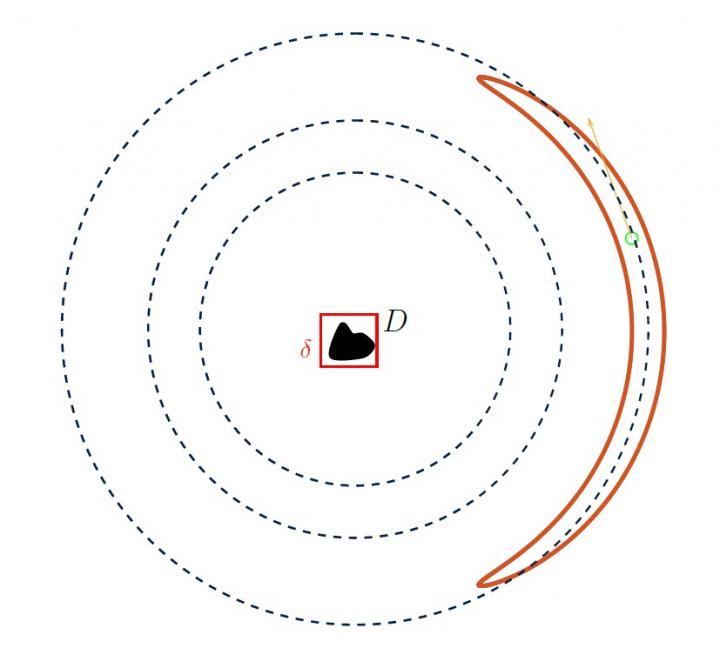
Scientists have spent years studying how weakly electric fish—including the knife fish and elephant nose fish—utilize electricity for navigation. These fish have specialized electric organs that discharge small voltages into the surrounding water, creating their own personal electric fields. Nearby objects cause slight disruptions to these fields, which the fish detect with sensitive organs on their skin called electroreceptors. As a fish swims around, it can sense an object from multiple viewpoints to learn more about its features — all without gaining any visual perspective. Fully understanding the mechanisms of this unique adaptation that allows fish to orient themselves and navigate in complete darkness could help underwater robots do the same. The simulated fish collects data about the target object (in the center) while swimming in multiple orbits at different length-scales (dotted lines).  CREDIT Figure courtesy of Lorenzo Baldassari and Andrea Scapin.

Lorenzo Baldassari and Andrea Scapin of the Swiss Federal Institute of Technology in Zürich were intrigued by the possibility of modeling the way in which weakly electric fish perceive their environments through electricity. In a paper publishing on Thursday in the SIAM Journal on Imaging Sciences, Baldassari and Scapin introduce an innovative algorithm for observing objects via electrosensing that is based on the real behavior of weakly electric fish. “These animals are an ideal subject for developing new bio-inspired imaging techniques,” Baldassari said.  {module INSIDE STORY}

Weakly electric fish’s impressive sensing capabilities inspired the duo to develop an algorithm that could emulate how the fish detect and locate a target based on the distribution of electrical current over their skin. They sought to create a mathematical simulation of a fish that would swim in circular paths around a target object and incorporate a recognition algorithm that could synthesize the electrosensed information to determine what object the fish was near. 

The algorithm needed to know the possible shapes of this object, so Baldassari and Scapin established a dictionary of seven standard shapes: a circle, ellipse, triangle, bent ellipse, curved triangle, gingerbread man, and drop. In their simulation, a fish swam around a randomly-selected object from the dictionary — this theoretical fish did not know beforehand what kind of object it would encounter, just like a real fish does not know about its environment before electrosensing it. The algorithm’s goal was then to use the data collected by the simulated fish to determine which dictionary element matched the target object. 

The most important mathematical quantity in this simulation was the length-scale, or the ratio between the target’s size and the distance between the fish and the target. As the length-scale increases—i.e., the fish moves closer to the target—the size of the electrical disturbance from the target also increases, providing a higher-resolution view of the object. Previous studies involving electrosensing algorithms only utilized measurements taken at one length-scale. To improve upon this technique, Baldassari and Scapin had their modeled fish take multiple circular orbits at different distances from the target, thereby obtaining measurements at several different length-scales. This multi-scale approach combines information that the theoretical fish gathers at different distances from the object to gain a more accurate understanding of its features. But the advantages of multi-scale did not come easily. “The most difficult aspect of this work was choosing a proper way for combining the information at multiple length-scales,” Scapin said. The authors attempted multiple methods before finally landing on a strategy for combining the information that did not have any major drawbacks.  

For the recognition algorithm that worked best, the first step was to measure and record the electric perturbation from the target that the fish detected upon each orbit. A matching procedure then compared this data to the dictionary of possible shapes, giving a numerical score to indicate the degree of similarity between the unknown target and the dictionary item that it most resembled. This score was saved for later combination. “The strong point of our recognition algorithm is that when performing the classifications orbit-by-orbit, previous comparisons are incorporated in the selection of the best matching shape,” Scapin said. “This leads to an enhancement in the recognition.” The team combined the numerical scores from different orbits to create a belief assignment that denoted which dictionary shape the algorithm determined was the best match for the target, and how confident it was in that determination.

To test their recognition algorithm, the authors simulated a fish with 1,024 electroreceptors evenly distributed on its body that made three circular orbits around an object, then recorded how often it was able to correctly identify the target. This new multi-scale approach had a higher rate of correct recognition than previous single-scale approaches; although fusing the results from different length-scales did not produce the best outcome every single time, it was the most effective approach overall. According to these results, future advancements in electrosensing algorithms will be most successful if they continue to incorporate multi-scale measurements.

Baldassari and Scapin’s new electrosensing algorithm has the potential to advance navigation in underwater robotics, though applying their procedure to real devices would require extending the algorithm to handle three dimensions. However, the potential rewards for such an effort are tantalizing. “Building autonomous robots with electrosensing technology may supply unexplored navigation, imaging, and classification capabilities, especially when sight is unreliable due to the turbidity of the surrounding waters or poor lighting conditions,” Baldassari said. Electrosensing robots could enable a deeper study of areas of the ocean that are inaccessible to human divers, advancing undersea exploration further than ever before.