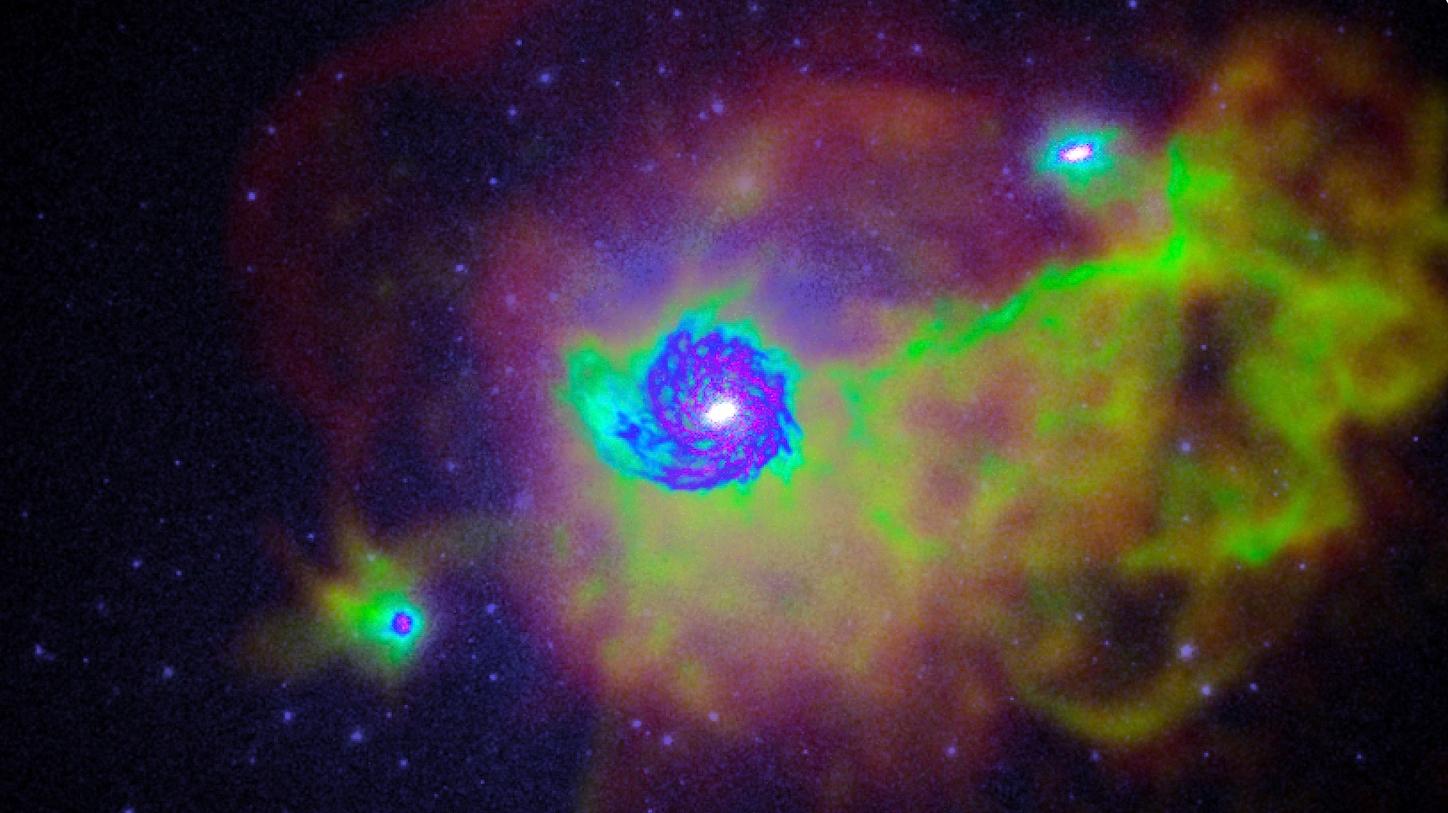
Swiss scientist shows how nearby galaxies form their stars

How stars form in galaxies remains a major open question in astrophysics. A new UZH study sheds new light on this topic with the help of a data-driven re-analysis of observational measurements. The star-formation activity of typical, nearby galaxies is found to scale proportionally with the amount of gas present in these galaxies. This points to the net gas supply from cosmic distances as the main driver of galactic star formation.

Stars are born in dense clouds of molecular hydrogen gas that permeates the interstellar space of most galaxies. While the physics of star formation is complex, recent years have seen substantial progress towards understanding how stars form in a galactic environment. What ultimately determines the level of star formation in galaxies, however, remains an open question.

In principle, two main factors influence the star formation activity: The amount of molecular gas that is present in galaxies and the timescale over which the gas reservoir is depleted by converting it into stars. While the gas mass of galaxies is regulated by competition between gas inflows, outflows, and consumption, the physics of the gas-to-star conversion is currently not well understood. Given its potentially critical role, many efforts have been undertaken to determine the gas depletion timescale observationally. However, these efforts resulted in conflicting findings partly because of the challenge in measuring gas masses reliably given current detection limits. Stars (white) form throughout the gas disk. (Illustration: Robert Feldmann){module INSIDE STORY}

Typical star formation is linked to the overall gas reservoir

The present study from the Institute for Computational Science of the University of Zurich uses a new statistical method based on Bayesian modeling to properly account for galaxies with undetected amounts of molecular or atomic hydrogen to minimize observational bias. This new analysis reveals that, in typical star-forming galaxies, molecular and atomic hydrogen is converted into stars over approximately constant timescales of 1 and 10 billion years, respectively. However, extremely active galaxies (“starbursts”) are found to have much shorter gas depletion timescales.

“These findings suggest that star formation is indeed directly linked to the overall gas reservoir and thus set by the rate at which gas enters or leaves a galaxy,” says Robert Feldmann, professor at the Center for Theoretical Astrophysics and Cosmology. In contrast, the dramatically higher star-formation activity of starbursts likely has a different physical origin, such as galaxy interactions or instabilities in galactic disks.

Far galaxies across cosmic history

This analysis is based on observational data of nearby galaxies. Observations with the Atacama Large Millimeter/Submillimeter Array, the Square Kilometer Array, and other observatories promise to probe the gas content of large numbers of galaxies across cosmic history. It will be paramount to continue the development of statistical and data science methods to accurately extract the physical content from these new observations and to fully uncover the mysteries of star formation in galaxies.

UH machine learning model boosts search for 'superhard' materials

The model predicts promising new materials

Superhard materials are in high demand in industry, from energy production to aerospace, but finding suitable new materials has largely been a matter of trial and error based on classical materials such as diamonds. Until now.

Researchers from the University of Houston and Manhattan College have reported a machine learning model that can accurately predict the hardness of new materials, allowing scientists to more readily find compounds suitable for use in a variety of applications. The work was reported in Advanced Materials.

Superhard materials - defined as those with a hardness value exceeding 40 gigapascals on the Vickers scale, meaning it would take more than 40 gigapascals of pressure to leave an indentation on the material's surface - are rare. Researchers have developed a machine learning model that can accurately predict the hardness of new materials, allowing scientists to more readily find compounds suitable for use in a variety of applications.{module INSIDE STORY}

"That makes identifying new materials challenging," said Jakoah Brgoch, associate professor of chemistry at UH and corresponding author for the paper. "That is why materials like synthetic diamond are still used even though they are challenging and expensive to make."

One of the complicating factors is that the hardness of a material may vary depending on the amount of pressure exerted, known as load dependence. That makes testing a material experimentally complex and using computational modeling today almost impossible.

The model reported by the researchers overcomes that by predicting the load-dependent Vickers hardness based solely on the chemical composition of the material. The researchers report finding more than 10 new and promising stable borocarbide phases; work is now underway to design and produce the materials so they can be tested in the lab.

Based on the model's reported accuracy, the odds are good. Researchers reported the accuracy at 97%.

First author Ziyan Zhang, a doctoral student at UH, said the database built to train the algorithm is based on data involving 560 different compounds, each yielding several data points. Finding the data required poring over hundreds of published academic papers to find data needed to build a representative dataset.

"All good machine learning projects start with a good dataset," said Brgoch, who is also a principal investigator with the Texas Center for Superconductivity at UH. "The true success is largely the development of this dataset."

In addition to Brgoch and Zhang, additional researchers on the project include Aria Mansouri Tehrani and Blake Day, both with UH, and Anton O. Oliynyk from Manhattan College.

Researchers traditionally have used machine learning to predict a single variable of hardness, Brgoch said, but that doesn't account for the complexities of the property like load dependence, which he said still aren't well understood. That makes machine learning a good tool, despite earlier limitations.

"A machine learning system doesn't need to understand the physics," he said. "It just analyzes the training data and makes new predictions based on statistics."

Machine learning does have limitations, though. "The idea of using machine learning isn't to say, 'Here is the next greatest material,' but to help guide our experimental search," Brgoch said. "It tells you where you should look."

Swiss machine learning models show DNA regions in our brain that contribute to make us human

With only 1% difference, the human and chimpanzee protein-coding genomes are remarkably similar. Understanding the biological features that make us human is part of a fascinating and intensely debated line of research. Researchers at the SIB Swiss Institute of Bioinformatics and the University of Lausanne have developed a new approach to pinpoint, for the first time, adaptive human-specific changes in the way genes are regulated in the brain. These results open new perspectives in the study of human evolution, developmental biology and neurosciences. The paper is published in Science Advances.

Gene expression, not gene sequence

To explain what sets human apart from their ape relatives, researchers have long hypothesized that it is not so much the DNA sequence, but rather the regulation of the genes (i.e. when, where and how strongly the gene is expressed), that plays the key role. However, precisely pinpointing the regulatory elements which act as 'gene dimmers' and are positively selected is a challenging task that has thus far defeated researchers (see box). With only 1% difference, the human and chimpanzee protein-coding genomes are remarkably similar. Understanding the biological features that make us human is part of a fascinating and intensely debated line of research. Researchers at SIB and the University of Lausanne have developed a new approach to pinpoint, for the first time, adaptive human-specific changes in the way genes are regulated in the brain. These results open new perspectives in the study of human evolution, developmental biology and neurosciences. The paper is published in Science Advances.  CREDIT Source: Image by Gerd Altmann from Pixabay https://pixabay.com/illustrations/artificial-intelligence-brain-think-4389372/{module INSIDE STORY}

Marc Robinson-Rechavi, Group Leader at SIB and study co-author says: "To be able to answer such tantalizing questions, one has to be able identify the parts in the genome that have been under so called 'positive' selection [see box]. The answer is of great interest in addressing evolutionary questions, but also, ultimately, could help biomedical research as it offers a mechanistic view of how genes function."

A high proportion of the regulatory elements in the human brain have been positively selected

Researchers at SIB and the University of Lausanne have developed a new method which has enabled them to identify a large set of gene regulatory regions in the brain, selected throughout human evolution. Jialin Liu, Postdoctoral researcher and lead author of the study explains: "We show for the first time that the human brain has experienced a particularly high level of positive selection, as compared to the stomach or heart for instance. This is exciting, because we now have a way to identify genomic regions that might have contributed to the evolution of our cognitive abilities!"

To reach their conclusions, the two researchers combined machine learning models with experimental data on how strongly proteins involved in gene regulation bind to their regulatory sequences in different tissues, and then performed evolutionary comparisons between human, chimpanzee and gorilla. "We now know which are the positively selected regions controlling gene expression in the human brain. And the more we learn about the genes they are controlling, the more complete our understanding of cognition and evolution, and the more scope there will be to act on that understanding," concludes Marc Robinson-Rechavi.

Box - Positive selection: a hint of the functional relevance of a mutation

Most random genetic mutations neither benefit nor harm an organism: they accumulate at a steady rate that reflects the amount of time that has passed since two living species had a common ancestor. In contrast, an acceleration in that rate in a particular part of the genome can reflect a positive selection for a mutation that helps an organism to survive and reproduce, which makes the mutation more likely to be passed on to future generations. Gene regulatory elements are often only a few nucleotides long, which makes estimating their acceleration rate particularly difficult from a statistical point of view.