Penn uses computational chemistry to show how sulfur clouds can form in Venus' atmosphere

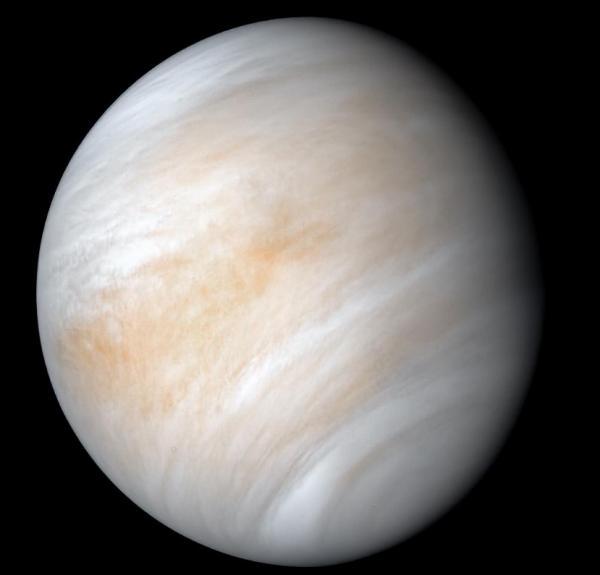
Scientists using sophisticated computational chemistry techniques have identified a new pathway for how sulfur particles can form in the atmosphere of Venus. These results may help to understand the long sought-after identity of the mysterious ultraviolet absorber on Venus. A reprocessed image of archived Mariner 10 data collected in 1974. This is a false color image created using orange and ultraviolet filters for the red and blue channels, respectively. The clouds are at about 60 kilometers altitude, and the image illustrates the presence of an unknown ultraviolet absorber in the atmosphere, a long unsolved mystery of Venus.

“We know that the atmosphere of Venus has abundant SO2 and sulfuric acid particles. We expect that ultraviolet destruction of SO2 produces sulfur particles. They are built up from atomic S (sulfur) to S2, then S4, and finally S8. But how is this process initiated, that is, how does S2 form?” said Planetary Science Institute Senior Scientist James Lyons. 

One possibility is to form S2 from two sulfur atoms, that is, a reaction of S and S. Molecules of S2 and S2 can then combine to form S4, and so on. Sulfur particles can form either by condensation of S8 or by condensation of S2, S4, and other allotropes – different physical forms in which an element can exist – which then rearrange to form condensed S8

“Sulfur particles, and the yellow sulfur we more commonly encounter, is made up of mostly S8, which has a ring structure. The ring structure makes S8 more stable against destruction by UV light than the other allotropes. To form S8, we can either start with two S atoms and make S2, or we can produce S2 by another pathway, which is what we’ve done in the paper,” said Lyons. 

“We found a new pathway for Sformation, the reaction of sulfur monoxide (SO) and disulfur monoxide (S2O), which is much faster than combining two S atoms to make S2,” Lyons said. 

“For the first time, we are using computational chemistry techniques to determine which reactions are most important, rather than waiting for laboratory measurements to be done or using highly inaccurate estimates of the rate of unstudied reactions. This is a new and very much needed approach for studying the atmosphere of Venus,” Lyons said. “People are reluctant to go in the lab to measure rate constants for molecules made up of S, chlorine (Cl), and oxygen (O) – these are difficult and sometimes dangerous compounds to work with. Computational methods are the best – and only – alternative. 

Computational methods were used to supercompute the rate constants and to determine the expected reaction products. These are state-of-the-art computational models (what we call ab initio models). These ab initio calculations were done by the authors from Spain and the University of Pennsylvania. 

“This research illustrates another pathway to S2 and sulfur particle formation. Sulfur chemistry is dominant in Venus' atmosphere, and very likely plays a key role in the formation of the enigmatic UV absorber. More generally, this work opens the doors to using molecular ab initio techniques to disentangle the complex chemistry of Venus,” Lyons said. 

Antonio Francés-Monerris of Departament de Química Física, Universitat de València, Spain is lead author on the paper. Coauthors include Javier Carmona-García and Daniel Roca-Sanjuán also of the Universitat de València, Alfonso Saiz-Lopez of the Institute of Physical Chemistry Rocasolano in Madrid, and Tarek Trabelsi and Joseph S. Francisco of the University of Pennsylvania.


Rice combines MD simulations, stochastic models to sharpen genetic base editors

The approach improves avoidance of ‘bystander’ edits in CRISPR-base editor treatments

Want to keep the riffraff out of the gene pool party? Sneak in and slam the gate before they arrive. 

That’s the central idea of a new strategy by Rice University scientists who seek to avoid gene-editing errors by fine-tuning specific CRISPR-base editing strategies in advance.

Rice chemical and biomolecular engineer Xue Sherry Gao and chemist Anatoly Kolomeisky and their labs' combined theory and experimentation for a comprehensive approach to building better base editors, molecular machines that target and fix faulty DNA at single-base resolution. A new strategy by Rice University scientists seeks to avoid gene-editing errors by fine-tuning specific CRISPR-base editing strategies in advance. Their theoretical framework is intended to eliminate trial and error in the design of a library of editors.  CREDIT Qian Wang/Rice University
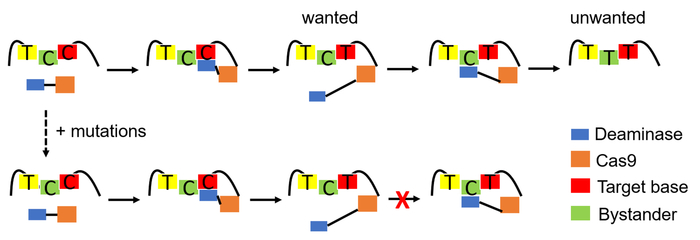
The study describes the molecular processes that base editors use to manipulate strands of DNA, cutting them where necessary and making way for replacement code. When it works, as it increasingly does to treat genetic diseases like sickle cell anemia and some cancers, the editor only edits the intended nucleotide

And when it doesn’t, that’s because bystander edits can cause undesired effects. 

The Rice strategy primarily seeks to eliminate wayward edits to bystanders, nucleotides adjacent to the base editor’s target. Gao’s lab previously introduced tools to improve the accuracy of CRISPR-based edits of cytosine mutations up to 6,000-fold.

For the new project, she engaged the Kolomeisky lab to help create a theoretical framework to eliminate trial and error in the design of a library of editors. These would better target mutations that cause disease while avoiding bystanders. In the process, the framework could help scientists better understand the chemical and physical processes that take place during base editing.

“Sherry and other experimental scientists already had results that worked,” Kolomeisky said, referring to the earlier paper, in which the lab used its editor to convert cytosines to thymines, correcting the DNA mutations while avoiding otherwise vulnerable cytosines upstream. “But despite these amazing developments, there’s been no microscopic understanding of what we have to do with these protein systems to improve editing.”

He said Qian Wang, a former postdoctoral researcher in Kolomeisky’s lab and now an assistant professor at the University of Science and Technology of China (USTC), Hefei, took on the challenge, using Gao’s cytosine experiment as a baseline. 

“We applied the model for that result and got some important parameters we then used to design what mutations and where are needed to get precise editing,” Kolomeisky said. “Ultimately, this symbiosis of theory and experiment allows us to work in a smart way.”

Their strategy combines molecular dynamics simulations and stochastic (aka random) models that pinpoint the binding energies between molecules required to achieve maximum editing selectivity. Experiments in Gao’s lab validated the results. 

Critically, the framework includes a way to characterize the binding affinity between deaminases -- enzymes that catalyze the removal of an amino group from a molecule -- and single-stranded DNA (ssDNA).

Ideally, they said, the deaminase stays on the ssDNA just long enough to complete the primary edit and releases before inadvertently editing a bystander site. 

“The important thing here is that one mutation doesn't work for different systems,” Kolomeisky said. “So, for every system, you have to do this procedure again, but at least it's clear what should be done.”

“The model has been very successful in reflecting what has already been done experimentally,” Gao said. “But since then, we’ve been able to turn down bystander effects in other base-editing systems. 

“Because the number of mutants could be in the thousands, it’s unrealistic for experimentalists alone to verify individual base editors,” she said. “Only this multidisciplinary approach will allow us to build a huge library of editors computationally, then narrow the numbers down to the most promising candidates for further experimental verifications. That’s what we’re working toward.”


UAF space physicists upend understanding of upper atmospheric wind

Space physicist Mark Conde had been seeing something curious in his atmospheric research data since the 1990s.

Three years ago, he realized the odd behavior of extreme upper-level wind was a real phenomenon and not a problem with instrumentation. He chose to hand the mystery to his research student, Rajan Itani, who is pursuing a doctorate in physics at the University of Alaska Fairbanks. 

Itani confirmed that the cross-polar jet, a well-known wind in the upper atmosphere, sometimes inexplicably stops or is deflected or reversed when it reaches the region above Alaska. The finding upends previous understanding of the wind's behavior and has implications for spacecraft orbits, space debris avoidance, ionospheric storm modeling, and our understanding of the transport of air in the thermosphere. That portion of the atmosphere is far less dense, almost to a vacuum, compared to air at the Earth’s surface. And that means the occasional stalling of the cross-polar jet won’t be noticed on the surface or affect life here. Photo by Daniel Walker Mark Conde

Itani’s paper on the topic, co-authored by Conde, was published in September by the Journal of Geophysical Research: Space Physics and included in the editor’s highlights in the American Geophysical Union magazine Eos. 

Itani’s research at the UAF Geophysical Institute, with assistance from Conde and, conducted mostly with data from UAF's Poker Flat Research Range, focused only on the Alaska region. But, likely, the cross-polar jet would also stall elsewhere on the globe at high latitudes as the wind emerges from the polar cap around midnight.

Conde and Itani were studying the upper thermosphere, the region of the atmosphere above 90 miles altitude. 

This cross-polar jet carries the thin air in this region over the North Pole from the Earth’s dayside to its nightside and delivers it toward the equator, where it dissipates. Sometimes, according to Itani’s research, the forces driving the wind aren’t strong enough to push it through the background atmosphere on the Earth’s night side.

“All of the computer models say that this wind spills out quite some distance toward the equator and then eventually slows and blends into the background flow, just like traffic merging onto a highway,” said Conde, who is a professor in the UAF Department of Physics. “There should be quite a strong flow extending far equatorward, but we find that it basically just hits a wall over Alaska on some occasions. It really should continue and spill out just like the models say.” Photo by Daniel Walker Rajan Itani

But what causes this stalling? That hasn’t been resolved yet. Itani’s paper does offer a correlation, however: A review of seven years of data shows a “strong influence” from solar activity. Thermospheric wind stalling is most likely to occur during solar minimum, the period of low disturbance on the sun’s surface.

Conde had seen the wind stalling in data at various times since the late 1990s when he began studying the impact of auroral displays on thermospheric winds above Alaska.

"Over the years as we've run multiple instruments and combined the data from those many instruments, I eventually just came to understand that what we were seeing was a real phenomenon,” he said.

Conde published a paper in 2018 that noted the thermospheric wind stalling; however, Itani’s paper expands on that work in more detail.

“Training the next generation of scientists is a major objective of the United States’ premier research institution, the National Science Foundation, which funded the work,” Conde said. “As a result, quite a bit of leading-edge research is done by graduate students. I am very pleased to see Rajan’s work in this area recognized by the American Geophysical Union.”

The mention in Eos was a career first for Itani. The magazine notes that fewer than 2% of papers receive such attention. 

“I am delighted that our paper has been featured as an editor's highlight in Eos,” Itani said. “It is a proud moment in my career in space physics, as it marks my first paper being promoted. I am thankful to my adviser, Dr. Mark Conde, for suggesting the research topic and for his endless support and encouragement.”