Hubble discovers spiraling stars, providing a window into the early universe

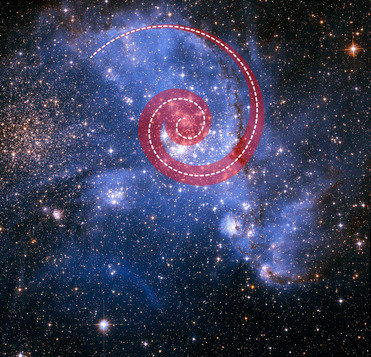
Nature likes spirals – from the whirlpool of a hurricane to pinwheel-shaped protoplanetary disks around newborn stars, to the vast realms of spiral galaxies across our universe. The massive star cluster NGC 346, located in the Small Magellanic Cloud, has long intrigued astronomers with its unusual shape. Now researchers using two separate methods have determined that this shape is partly due to stars and gas spiraling into the center of this cluster in a river-like motion. The red spiral superimposed on NGC 346 traces the movement of stars and gas toward the center. Scientists say this spiraling motion is the most efficient way to feed star formation from the outside toward the center of the cluster. Credits: Illustration: NASA, ESA, Andi James (STScI)

Now astronomers are bemused to find young stars that are spiraling into the center of a massive cluster of stars in the Small Magellanic Cloud, a satellite galaxy of the Milky Way.

The outer arm of the spiral in this huge, oddly shaped stellar nursery called NGC 346 may be feeding star formation in a river-like motion of gas and stars. This is an efficient way to fuel star birth, researchers say.

The Small Magellanic Cloud has a simpler chemical composition than the Milky Way, making it similar to the galaxies found in the younger universe when heavier elements were more scarce. Because of this, the stars in the Small Magellanic Cloud burn hotter and so run out of their fuel faster than in our Milky Way.

Though a proxy for the early universe, at 200,000 light-years away the Small Magellanic Cloud is also one of our closest galactic neighbors.

Learning how stars form in the Small Magellanic Cloud offers a new twist on how a firestorm of star birth may have occurred early in the universe's history when it was undergoing a "baby boom" about 2 to 3 billion years after the big bang (the universe is now 13.8 billion years old).

The new results find that the process of star formation there is similar to that in our own Milky Way.

Only 150 light-years in diameter, NGC 346 boasts the mass of 50,000 Suns. Its intriguing shape and rapid star formation rate have puzzled astronomers. It took the combined power of NASA's Hubble Space Telescope and the European Southern Observatory's Very Large Telescope (VLT) to unravel the behavior of this mysterious-looking stellar nesting ground.

"Stars are the machines that sculpt the universe. We would not have life without stars, and yet we don't fully understand how they form," explained study leader Elena Sabbi of the Space Telescope Science Institute in Baltimore. "We have several models that make predictions, and some of these predictions are contradictory. We want to determine what is regulating the process of star formation because these are the laws that we need to also understand what we see in the early universe."

Researchers determined the motion of the stars in NGC 346 in two different ways. Using Hubble, Sabbi and her team measured the changes in the stars' positions over 11 years. The stars in this region are moving at an average velocity of 2,000 miles per hour, which means that in 11 years they move 200 million miles. This is about 2 times the distance between the Sun and the Earth.

But this cluster is relatively far away, inside a neighboring galaxy. This means the amount of observed motion is very small and therefore difficult to measure. These extraordinarily precise observations were possible only because of Hubble's exquisite resolution and high sensitivity. Also, Hubble's three-decade-long history of observations provides a baseline for astronomers to follow minute celestial motions over time.

The second team, led by Peter Zeidler of AURA/STScI for the European Space Agency, used the ground-based VLT's Multi Unit Spectroscopic Explorer (MUSE) instrument to measure radial velocity, which determines whether an object is approaching or receding from an observer.

"What was really amazing is that we used two completely different methods with different facilities and basically came to the same conclusion, independent of each other," said Zeidler. "With Hubble, you can see the stars, but with MUSE we can also see the gas motion in the third dimension, and it confirms the theory that everything is spiraling inwards."

But why a spiral?

"A spiral is really the good, natural way to feed star formation from the outside toward the center of the cluster," explained Zeidler. "It's the most efficient way that stars and gas fueling more star formation can move towards the center."

Half of the Hubble data for this study of NGC 346 is archival. The first observations were taken 11 years ago. They were recently repeated to trace the motion of the stars over time. Given the telescope's longevity, the Hubble data archive now contains more than 32 years of astronomical data powering unprecedented, long-term studies. 

{media id=287,layout=solo}

"The Hubble archive is really a gold mine," said Sabbi. "There are so many interesting star-forming regions that Hubble has observed over the years. Given that Hubble is performing so well, we can actually repeat these observations. This can really advance our understanding of star formation."

Observations with NASA's James Webb Space Telescope should be able to resolve lower-mass stars in the cluster, giving a more holistic view of the region. Over Webb's lifespan, astronomers will be able to repeat this experiment and measure the motion of the low-mass stars. They could then compare the high-mass stars and the low-mass stars to finally learn the full extent of the dynamics of this nursery.

UM researchers reveal ocean cooling is an impossible solution to mitigate hurricanes

A new study found that even if we did have the infinite power to artificially cool enough of the oceans to weaken a hurricane, the benefits would be minimal. The study led by scientists at the University of Miami (UM) Rosenstiel School of Marine, Atmospheric and Earth Science showed that the energy alone that is needed to use intervention technology to weaken a hurricane before landfall makes it a highly inefficient solution to mitigate disasters. A satellite image from the National Oceanic and Atmospheric Administration captures an active hurricane season which included Hurricanes Katia and Irma and Tropical Storm Jose (from left to right) on September 8, 2017  CREDIT NOAA

“The main result from our study is that massive amounts of artificially cooled water would be needed for only a modest weakening in hurricane intensity before landfall,” said the study’s lead author James Hlywiak, a graduate of the UM Rosenstiel School. “Plus, weakening the intensity by marginal amounts doesn’t necessarily mean that the likelihood for inland damages and safety risks would decrease as well. While any amount of weakening before landfall is a good thing, for these reasons it makes more sense to direct focus toward adaptation strategies such as reinforcing infrastructure, improving the efficiency of evacuation procedures, and advancing the science around detection and prediction of impending storms.”

To scientifically answer questions about the effectiveness of artificially cooling the ocean to weaken hurricanes, the authors used a combination of air-sea interaction theories and a highly sophisticated supercomputer model of the atmosphere.

In their computer simulations, they cooled areas of the ocean up to 260,000 km2 in size - larger than the state of Oregon and equating to 21,000 cubic kilometers of water - by up to 2 degrees Celsius. Even with the largest area of cooling, the simulated hurricanes weakened by only 15 percent. The amount of energy extracted from the ocean to achieve this small reduction is equivalent to more than 100 times the amount consumed across the entire United States in 2019 alone.

“You might think that the main finding of our article, that it’s pointless to try to weaken hurricanes, should be obvious,” said David Nolan, a professor of atmospheric sciences at the UM Rosenstiel School and senior author of the study. “And yet, various ideas for hurricane modification appear often in popular media and are even submitted for patents every few years. We’re happy to be able to put something into the peer-reviewed literature that actually addresses this.”

The study was supported by a University of Miami Graduate Fellowship and National Science Foundation PREEVENTS grant (Award # 1663947).

Enhancing our physical understanding of climactic processes using improved climate models

More frequent extreme climate events have become a major global challenge. To mitigate the human and economic costs of these events, climatologists consistently create future climate predictions. These projections help policymakers develop actionable climate policies to avoid the most dangerous climate change effects. Because of the high data volume required for accurate forecasts, scientists rely on supercomputer-run climate models to make predictions and project changes in the climate system. However, an incomplete physical understanding of the Earth’s dynamic climatic processes remains a major limitation regarding climate model usability.

Chibuike Ibebuchi from the Institute of Physical Geography, University of Würzburg, conducted a recent study, which applied a synoptic climatological statistical modeling approach called “circulation typing with fuzzy rotated principal component analysis.” This new technique is designed to enhance the physical understanding of the mechanisms through which teleconnections, such as the sub-tropical Indian Ocean Dipole, impact seasonal rainfall variability in southern Africa, a region that is vulnerable to climate extremes. Circulation typing considers both space and time for rainfall anomalies.

Ibebuchi believes that climate modeling and projection improvements can advance with more research studies that aim toward gaining a better physical understanding of climate processes on the synoptic and global scales. Furthermore, research should analyze how the synoptic and large-scale climate processes interact with regional climates. Researchers can achieve this by enhancing techniques for effectively breaking down climate data sets through space and time to unravel the distinct (continuous) variability associated with the climate system.

More specifically, for these subsequent studies, Ibebuchi aims toward developing and optimizing existing statistical methods for decomposing or breaking down data sets to unravel physically meaningful climate forecasting signals. This includes diagnosing misrepresentations in climate modeling processes.