10,000 times faster calculations of many-body quantum dynamics possible

Physicists have developed an extremely fast simulation technique to predict the time evolution of interacting electrons

How an electron behaves in an atom, or how it moves in a solid, can be predicted precisely with the equations of quantum mechanics. These theoretical calculations agree fully with the results obtained from experiments. But complex quantum systems, which contain many electrons or elementary particles - such as molecules, solids or atomic nuclei - can currently not be described exactly, even with the most powerful computers available today. The underlying mathematical equations are too complex, and the computational requirements are too large. A team led by Professor Michael Bonitz from the Institute of Theoretical Physics and Astrophysics at Kiel University (CAU) has now succeeded in developing a simulation method, which enables quantum mechanical calculations up to around 10,000 times faster than previously possible. They have published their findings in the current issue of the renowned scientific journal Physical Review Letters.

Even with extremely powerful supercomputers, quantum simulations take too long CAPTION Computing time required for the new G1-G2 method (solid line) as a function of the process duration, compared to the traditional method (logarithmic scale).  CREDIT Niclas Schlünzen, AG Bonitz{module INSIDE STORY}

The new procedure of the Kiel researchers is based on one of the currently most powerful and versatile simulation techniques for quantum mechanical many-body systems. It uses the method of so-called nonequilibrium Green functions: this allows movements and complex interactions of electrons to be described with very high accuracy, even for an extended period. However, to date this method is very computer-intensive: in order to predict the development of the quantum system over a ten times longer period, a computer requires a thousand times more processing time.

With the mathematical trick of introducing an additional auxiliary variable, the physicists at the CAU have now succeeded in reformulating the primary equations of nonequilibrium Green functions such that the calculation time only increases linearly with the process duration. Thus, a ten times longer prediction period only requires ten times more computing time. In comparison with the previously-used methods, the physicists achieved an acceleration factor of approximately 10,000. This factor increases further for longer processes. Since the new approach combines two Green functions for the first time, it is called the "G1-G2 method".

Temporal development of material properties predictable for the first time

The new calculation model of the Kiel research team not only saves expensive computing time but also allows for simulations, which have previously been completely impossible. "We were surprised ourselves that this dramatic acceleration can also be demonstrated in practical applications," explained Bonitz. For example, it is now possible to predict how certain properties and effects in materials such as semiconductors develop over an extended period of time. Bonitz is convinced: "The new simulation method is applicable in numerous areas of quantum many-body theory, and will enable qualitatively new predictions, such as about the behavior of atoms, molecules, dense plasmas and solids after excitation by intense laser radiation."

Beyond the brim, Sombrero Galaxy's halo suggests turbulent past

Surprising new data from NASA's Hubble Space Telescope suggest the smooth, settled "brim" of the Sombrero galaxy's disk may be concealing a turbulent past. Hubble's sharpness and sensitivity resolve tens of thousands of individual stars in the Sombrero's vast, extended halo, the region beyond a galaxy's central portion, typically made of older stars. These latest observations of the Sombrero are turning conventional theory on its head, showing only a tiny fraction of older, metal-poor stars in the halo, plus an unexpected abundance of metal-rich stars typically found only in a galaxy's disk and the central bulge. Past major galaxy mergers are a possible explanation, though the stately Sombrero shows none of the messy evidence of a recent merger of massive galaxies.

"The Sombrero has always been a bit of a weird galaxy, which is what makes it so interesting," said Paul Goudfrooij of the Space Telescope Science Institute (STScI), Baltimore, Maryland. "Hubble's metallicity measurements (i.e., the abundance of heavy elements in the stars) are another indication that the Sombrero has a lot to teach us about galaxy assembly and evolution."

"Hubble's observations of the Sombrero's halo are turning our generally accepted understanding of galaxy makeup and metallicity on its head," added co-investigator Roger Cohen of STScI. CAPTION On the left is an image of the Sombrero galaxy (M104) that includes a portion of the much fainter halo far outside its bright disk and bulge. Hubble photographed two regions in the halo (one of which is shown by the white box). The images on the right zoom in to show the level of detail Hubble captured. The orange box, a small subset of Hubble's view, contains myriad halo stars. The stellar population increases in density closer to the galaxy's disk (bottom blue box). Each frame contains a bright globular cluster of stars, of which there are many in the galaxy's halo. The Sombrero's halo contained more metal-rich stars than expected, but even stranger was the near-absence of old, metal-poor stars typically found in the halos of massive galaxies. Many of the globular clusters, however, contain metal-poor stars. A possible explanation for the Sombrero's perplexing features is that it is the product of the merger of massive galaxies billions of years ago, even though the smooth appearance of the galaxy's disk and halo show no signs of such a huge disruption.  CREDIT NASA/Digitized Sky Survey/P. Goudfrooij (STScI)/The Hubble Heritage Team (STScI/AURA){module INSIDE STORY}

Long a favorite of astronomers and amateur skywatchers alike for its bright beauty and curious structure, the Sombrero galaxy (M104) now has a new chapter in its strange story -- an extended halo of metal-rich stars with barely a sign of the expected metal-poor stars that have been observed in the halos of other galaxies. Researchers, puzzling over the data from Hubble, turned to sophisticated supercomputer models to suggest explanations for the perplexing inversion of conventional galactic theory. Those results suggest the equally surprising possibility of major mergers in the galaxy's past, though the Sombrero's majestic structure bears no evidence of recent disruption. The unusual findings and possible explanations are published in the Astrophysical Journal.

"The absence of metal-poor stars was a big surprise," said Goudfrooij, "and the abundance of metal-rich stars only added to the mystery."

In a galaxy's halo astronomers expect to find earlier generations of stars with less heavy elements, called metals, as compared to the crowded stellar cities in the main disk of a galaxy. Elements are created through the stellar "lifecycle" process, and the longer a galaxy has had stars going through this cycle, the more element-rich the gas and the higher-metallicity the stars that form from that gas. These younger, high-metallicity stars are typically found in the main disk of the galaxy where the stellar population is denser -- or so goes the conventional wisdom.

Complicating the facts is the presence of many old, metal-poor globular clusters of stars. These older, metal-poor stars are expected to eventually move out of their clusters and become part of the general stellar halo, but that process seems to have been inefficient in the Sombrero galaxy. The team compared their results with recent supercomputer simulations to see what could be the origin of such unexpected metallicity measurements in the galaxy's halo.

The results also defied expectations, indicating that the unperturbed Sombrero had undergone major accretion, or merger, events billions of years ago. Unlike our Milky Way galaxy, which is thought to have swallowed up many small satellite galaxies in so-called "minor" accretions over billions of years, a major accretion is the merger of two or more similarly massive galaxies that are rich in later-generation, higher-metallicity stars.

The satellite galaxies only contained low-metallicity stars that were largely hydrogen and helium from the big bang. Heavier elements had to be cooked up in stellar interiors through nucleosynthesis and incorporated into later-generation stars. This process was rather ineffective in dwarf galaxies such as those around our Milky Way and more effective in larger, more evolved galaxies.

The results for the Sombrero are surprising because its smooth disk shows no signs of disruption. By comparison, numerous interacting galaxies, like the iconic Antennae galaxies, get their name from the distorted appearance of their spiral arms due to the tidal forces of their interaction. Mergers of similarly massive galaxies typically coalesce into large, smooth elliptical galaxies with extended halos -- a process that takes billions of years. But the Sombrero has never quite fit the traditional definition of either a spiral or an elliptical galaxy. It is somewhere in between -- a hybrid.

For this particular project, the team chose the Sombrero mainly for its unique morphology. They wanted to find out how much "hybrid" galaxies might have formed and assembled over time. Follow-up studies for halo metallicity distributions will be done with several galaxies at distances similar to that of the Sombrero.

The research team looks forward to future observatories continuing the investigation into the Sombrero's unexpected properties. The Wide-Field Infrared Survey Telescope (WFIRST), with a field of view 100 times that of Hubble, will be capable of capturing a continuous image of the galaxy's halo while picking up more stars in infrared light. The James Webb Space Telescope will also be valuable for its Hubble-like resolution and deeper infrared sensitivity.

###

German researchers simulate how our brain detects fine differences

How do we manage to find our way around our neighborhood even though the streets look so similar? Researchers at the University of Bonn, one of Germany's most important institutes of higher education, have gained new insights into a mechanism that very likely plays a major role in this ability. Especially interesting: It only seems to work well when our brain is oscillating in a special rhythm. The results have been published in the journal "eLife."

If you want to detect differences between the two photos, you can use software to subtract one image from the other. Identical areas become black, while the areas that have changed between the shots stand out.

Our brain also uses sophisticated methods of signal processing to highlight small discrepancies, for example between the memory of a street and the rows of houses we currently see in front of us.

An important role in this process seems to be played by a particular brain structure, the dentate gyrus. It is located in the hippocampus, a region that plays a significant part in memory processes in mammals. Without it, mice have great difficulty in detecting small changes.

A mechanism called "feedback inhibition" is probably central to this. In this process, neurons are inhibited more strongly the more active they or their neighbors were previously. This processing step in a sense amplifies the discrepancies between two stimulus patterns - they become more dissimilar. Even patterns that are very similar can be separated very precisely from each other.

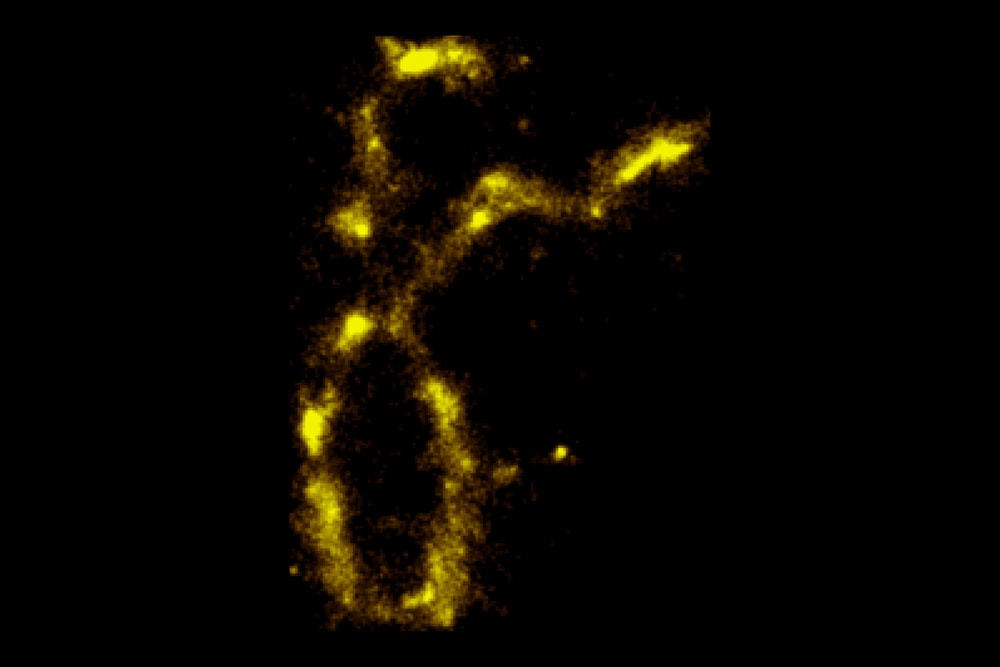
Supercomputer simulation of the dentate gyrus Dentate gyrus of the mouse (the arrow-shaped structure pointing to the right): Certain neurons (red) become active during feedback inhibition and play an important role in this process.  © Daniel Müller-Komorowska/Uni Bonn{module INSIDE STORY}

This is at least the assumption. "For the first time, we have now investigated at the cellular level just how plausible this theory actually is," explains Dr. Oliver Braganza from the Life & Brain Center at the University of Bonn.

To this end, the scientists stimulated certain cells in the dentate gyrus of mice and then determined to what extent other neurons were inhibited. Using numerous measurements, they were then able to determine where the inhibitory signals arrive, when the inhibition begins and how long it lasts.

"We then fed these data into a supercomputer simulation," says Braganza. "This allowed us to show whether this mechanism actually results in a better separation of similar stimulus patterns and, if so, under which conditions."

The analysis did indeed show that the feedback circuit of the dentate gyrus of mice can amplify differences in the stimulus pattern. Interestingly, this worked most effectively in the simulation if the brain oscillated back and forth between activity and inactivity in a particular rhythm.

It has long been known that nerve cells can be stimulated to fire more easily at some times than at others. These fluctuations in activity follow a regular rhythm. However, its frequency, i.e. the speed of the fluctuations, can change. For instance, during dreamless sleep, our brain oscillates at a slower pace than during the day.

It's the rhythm that matters

Recent research shows that the mouse brain displays so-called gamma oscillations during learning. "In our simulation, we can now see that pattern separation works particularly well at this frequency," says the head of the working group, Prof. Dr. Heinz Beck, who is also a researcher at the German Center for Neurodegenerative Diseases.

The reason: In the gamma rhythm, the timecourse of the inhibition seems to influence activity patterns particularly well. In other words: The inhibition triggered by a first pattern develops its full effect precisely when a second pattern is most active in the dentate gyrus.

There's another point that Braganza finds particularly interesting in this context: "Diseases such as Alzheimer's, schizophrenia or temporal lobe epilepsy are usually accompanied by a changed brain rhythm," he says. "Perhaps this explains the memory deficits that are so often seen in these three disorders."

In the next step, the scientists now want to investigate whether the prediction from the supercomputer model can be confirmed in the behavior of mice.