A new design of ultra-small silicon chip that manages terahertz waves leads to the next generation of communications

Researchers from Osaka University, Japan, and the University of Adelaide, Australia have worked together to produce the new multiplexer made from pure silicon for terahertz-range communications in the 300-GHz band.

"In order to control the great spectral bandwidth of terahertz waves, a multiplexer, which is used to split and join signals, is critical for dividing the information into manageable chunks that can be more easily processed and so can be transmitted faster from one device to another," said Associate Professor Withawat Withayachumnankul from the University of Adelaide's School of Electrical and Electronic Engineering.

"Up until now compact and practical multiplexers have not been developed for the terahertz range. The new terahertz multiplexers, which are economical to manufacture, will be extremely useful for ultra-broadband wireless communications.

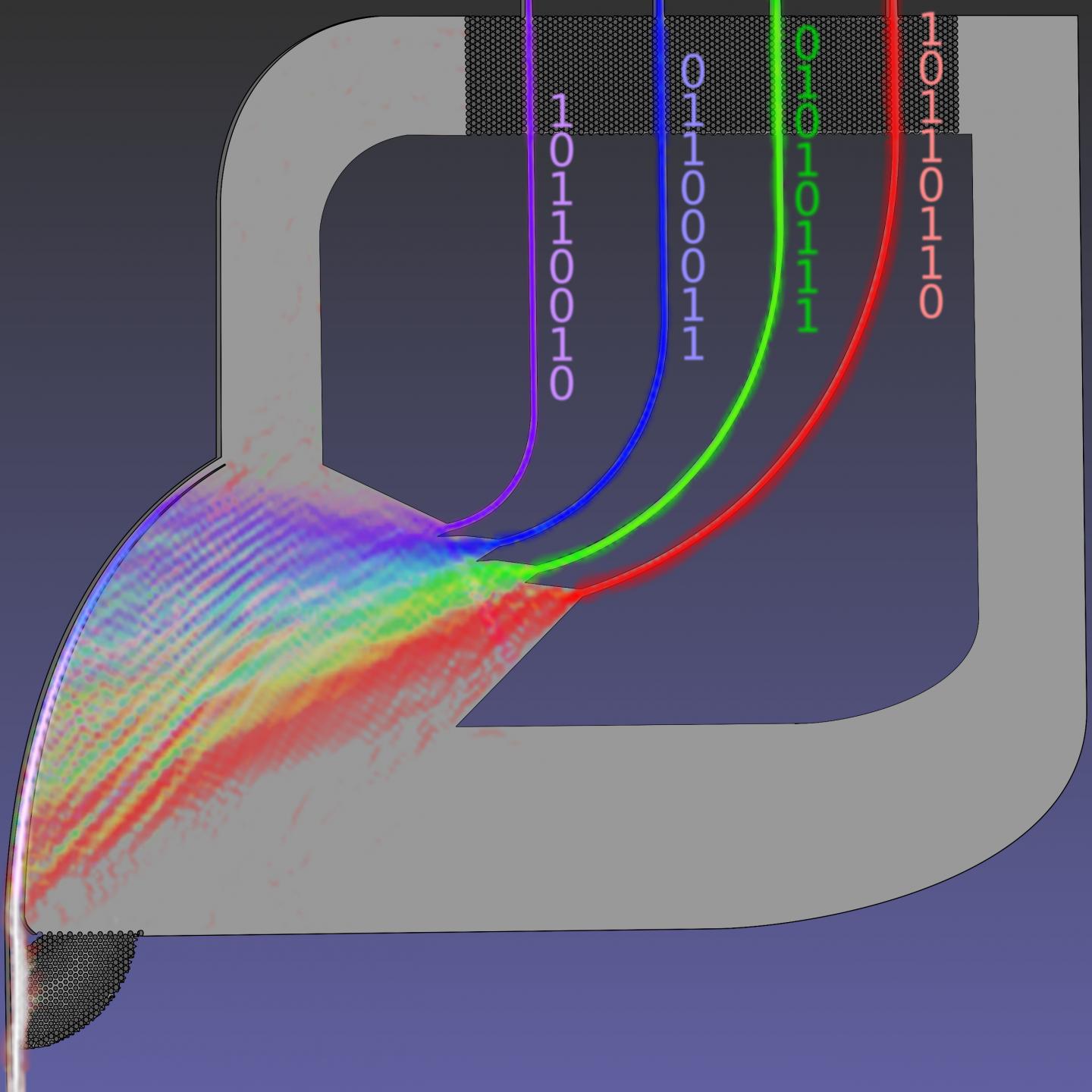
"The shape of the chips we have developed is the key to combining and splitting channels so that more data can be processed more rapidly. Simplicity is its beauty." Schematic of the integrated multiplexer, showing broadband terahertz wave being split into four different frequencies, where each is capable of carrying digital information.

People around the world are increasingly using mobile devices to access the internet and the number of connected devices is multiplying exponentially. Soon machines will be communicating with each other in the Internet of Things which will require even more powerful wireless networks able to transfer large volumes of data fast.

Terahertz waves are a portion of the electromagnetic spectrum that has a raw spectral bandwidth that is far broader than that of conventional wireless communications, which are based upon microwaves. The team has developed ultra-compact and efficient terahertz multiplexers, thanks to a novel optical tunneling process.

"A typical four-channel optical multiplexer might span more than 2000 wavelengths. This would be about two meters in length in the 300-GHz band," said Dr. Daniel Headland from Osaka University who is the lead author of the study.

"Our device is merely 25 wavelengths across, which offers dramatic size reduction by a factor of 6000."

The new multiplexer covers a spectral bandwidth that is over 30 times the total spectrum that is allocated in Japan for 4G/LTE, the fastest mobile technology currently available and 5G which is the next generation, combined. As bandwidth is related to data rate, ultra-high-speed digital transmission is possible with the new multiplexer.

"Our four-channel multiplexer can potentially support an aggregate data rate of 48 gigabits per second (Gbit/s), equivalent to that of uncompressed 8K ultrahigh definition video being streamed in real-time," said Associate Professor Masayuki Fujita, the team's leader from Osaka University.

"To make the entire system portable, we plan to integrate this multiplexer with resonant tunneling diodes to provide compact, multi-channel terahertz transceivers."

The modulation scheme employed in the team's study was quite basic; terahertz power was simply switched on and off to transmit binary data. More advanced techniques are available that can squeeze even higher data rates towards 1 Terabit/s into a given bandwidth allocation.

"The new multiplexer can be mass-produced, just like computer chips, but much simpler. So large-scale market penetration is possible," said Professor Tadao Nagatsuma from Osaka University.

"This would enable applications in 6G and beyond, as well as the Internet of Things, and low-probability-of-intercept communications between compact aircraft such as autonomous drones."

UCL investigators' simulations of black hole-neutron star collisions may help settle the debate over Universe's expansion

Studying the violent collisions of black holes and neutron stars may soon provide a new measurement of the Universe's expansion rate, helping to resolve a long-standing dispute, suggests a new supercomputer simulation study led by researchers at UCL (University College London).

Our two current best ways of estimating the Universe's rate of expansion - measuring the brightness and speed of pulsating and exploding stars, and looking at fluctuations in radiation from the early Universe - give very different answers, suggesting our theory of the Universe may be wrong.

A third type of measurement, looking at the explosions of light and ripples in the fabric of space caused by black hole-neutron star collisions, should help to resolve this disagreement and clarify whether our theory of the Universe needs rewriting.

The new study, published in Physical Review Letters, simulated 25,000 scenarios of black holes and neutron stars colliding, aiming to see how many would likely be detected by instruments on Earth in the mid-to-late-2020s.

The researchers found that, by 2030, instruments on Earth could sense ripples in space-time caused by up to 3,000 such collisions, and that for around 100 of these events, telescopes would also see accompanying explosions of light. 

They concluded that this would be enough data to provide a new, completely independent measurement of the Universe's rate of expansion, precise and reliable enough to confirm or deny the need for new physics.

Lead author Dr. Stephen Feeney (UCL Physics & Astronomy) said: "A neutron star is a dead star, created when a very large star explodes and then collapses, and it is incredibly dense - typically 10 miles across but with a mass up to twice that of our Sun. Its collision with a black hole is a cataclysmic event, causing ripples of space-time, known as gravitational waves, that we can now detect on Earth with observatories like LIGO and Virgo.

"We have not yet detected light from these collisions. But advances in the sensitivity of equipment detecting gravitational waves, together with new detectors in India and Japan, will lead to a huge leap forward in terms of how many of these types of events we can detect. It is incredibly exciting and should open up a new era for astrophysics."

To calculate the Universe's rate of expansion, known as the Hubble constant, astrophysicists need to know the distance of astronomical objects from Earth as well as the speed at which they are moving away. Analyzing gravitational waves tells us how far away a collision is, leaving only the speed to be determined.

To tell how fast the galaxy hosting a collision is moving away, we look at the "redshift" of light - that is, how the wavelength of light produced by a source has been stretched by its motion. Explosions of light that may accompany these collisions would help us pinpoint the galaxy where the collision happened, allowing researchers to combine measurements of distance and measurements of redshift in that galaxy.

Dr. Feeney said: "Computer models of these cataclysmic events are incomplete and this study should provide extra motivation to improve them. If our assumptions are correct, many of these collisions will not produce explosions that we can detect - the black hole will swallow the star without leaving a trace. But in some cases a smaller black hole may first rip apart a neutron star before swallowing it, potentially leaving matter outside the hole that emits electromagnetic radiation." 

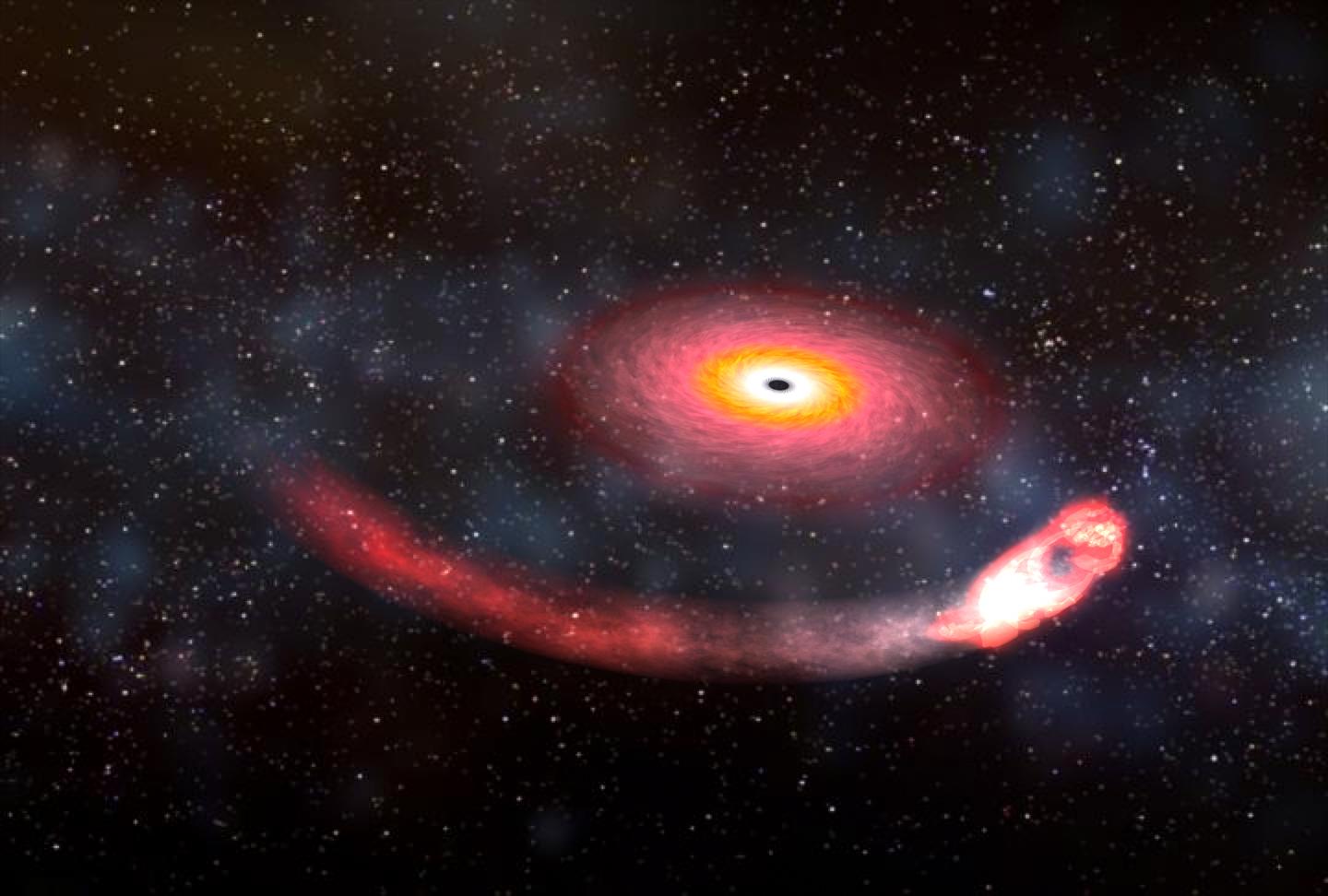
A still from a NASA animation of a black hole devouring a neutron star.  CREDIT Dana Berry/NASA

Co-author Professor Hiranya Peiris (UCL Physics & Astronomy and Stockholm University) said: "The disagreement over the Hubble constant is one of the biggest mysteries in cosmology. In addition to helping us unravel this puzzle, the spacetime ripples from these cataclysmic events open a new window on the universe. We can anticipate many exciting discoveries in the coming decade."

Gravitational waves are detected at two observatories in the United States (the LIGO Labs), one in Italy (Virgo), and one in Japan (KAGRA). A fifth observatory, LIGO-India, is now under construction.

Our two best current estimates of the Universe's expansion are 67 kilometers per second per megaparsec (3.26 million light-years) and 74 kilometers per second per megaparsec. The first is derived from analyzing the cosmic microwave background, the radiation left over from the Big Bang, while the second comes from comparing stars at different distances from Earth - specifically Cepheids, which have variable brightness, and exploding stars called type Ia supernovae.

Dr. Feeney explained: "As the microwave background measurement needs a complete theory of the Universe to be made but the stellar method does not, the disagreement offers tantalizing evidence of new physics beyond our current understanding. Before we can make such claims, however, we need confirmation of the disagreement from completely independent observations - we believe these can be provided through black hole-neutron star collisions."

UC Riverside researchers use a nanoscale synthetic antiferromagnet to toggle nonlinear spin dynamics for better technologies

Researchers at the University of California, Riverside, have used a nanoscale synthetic antiferromagnet to control the interaction between magnons -- research that could lead to faster and more energy-efficient computers.

In ferromagnets, electron spins point in the same direction. To make future computer technologies faster and more energy-efficient, spintronics research employs spin dynamics -- fluctuations of the electron spins -- to process information. Magnons, the quantum-mechanical units of spin fluctuations, interact with each other, leading to nonlinear features of the spin dynamics. Such nonlinearities play a central role in magnetic memory, spin torque oscillators, and many other spintronic applications. 

For example, in the emergent field of magnetic neuromorphic networks -- a technology that mimics the brain -- nonlinearities are essential for tuning the response of magnetic neurons. Also, in another frontier area of research, nonlinear spin dynamics may become instrumental. Graduate students Arezoo Etesamirad (seated) and Rodolfo Rodriguez (right) are seen here with their advisor, Igor Barsukov.

"We anticipate the concepts of quantum information and spintronics to consolidate in hybrid quantum systems," said Igor Barsukov, an assistant professor at the Department of Physics & Astronomy who led the study that appears in Applied Materials & Interfaces. "We will have to control nonlinear spin dynamics at the quantum level to achieve their functionality."

Barsukov explained that in nanomagnets, which serve as building blocks for many spintronic technologies, magnons show quantized energy levels. Interaction between the magnons follows certain symmetry rules. The research team learned to engineer the magnon interaction and identified two approaches to achieve nonlinearity: breaking the symmetry of the nanomagnet's spin configuration; and modifying the symmetry of the magnons. They chose the second approach.

"Modifying magnon symmetry is the more challenging but also more application-friendly approach," said Arezoo Etesamirad, the first author of the research paper and a graduate student in Barsukov's lab.

In their approach, the researchers subjected a nanomagnet to a magnetic field that showed nonuniformity at characteristic nanometer length scales. This nanoscale nonuniform magnetic field itself had to originate from another nanoscale object.

For a source of such a magnetic field, the researchers used a nanoscale synthetic antiferromagnet, or SAF, consisting of two ferromagnetic layers with antiparallel spin orientation. In its normal state, SAF generates nearly no stray field -- the magnetic field surrounding the SAF, which is very small. Once it undergoes the so-called spin-flop transition, the spins become canted and the SAF generates a stray field with nonuniformity at nanoscale, as needed. The researchers switched the SAF between the normal state and the spin-flop state in a controlled manner to toggle the symmetry-breaking field on and off.

"We were able to manipulate the magnon interaction coefficient by at least one order of magnitude," Etesamirad said. "This is a very promising result, which could be used to engineer coherent magnon coupling in quantum information systems, create distinct dissipative states in magnetic neuromorphic networks, and control large excitation regimes in spin-torque devices."