

UC Riverside researchers use a nanoscale synthetic antiferromagnet to toggle nonlinear spin dynamics for better technologies

Researchers at the University of California, Riverside, have used a nanoscale synthetic antiferromagnet to control the interaction between magnons -- research that could lead to faster and more energy-efficient computers.

In ferromagnets, electron spins point in the same direction. To make future computer technologies faster and more energy-efficient, spintronics research employs spin dynamics -- fluctuations of the electron spins -- to process information. Magnons, the quantum-mechanical units of spin fluctuations, interact with each other, leading to nonlinear features of the spin dynamics. Such nonlinearities play a central role in magnetic memory, spin torque oscillators, and many other spintronic applications. 

For example, in the emergent field of magnetic neuromorphic networks -- a technology that mimics the brain -- nonlinearities are essential for tuning the response of magnetic neurons. Also, in another frontier area of research, nonlinear spin dynamics may become instrumental. Graduate students Arezoo Etesamirad (seated) and Rodolfo Rodriguez (right) are seen here with their advisor, Igor Barsukov.
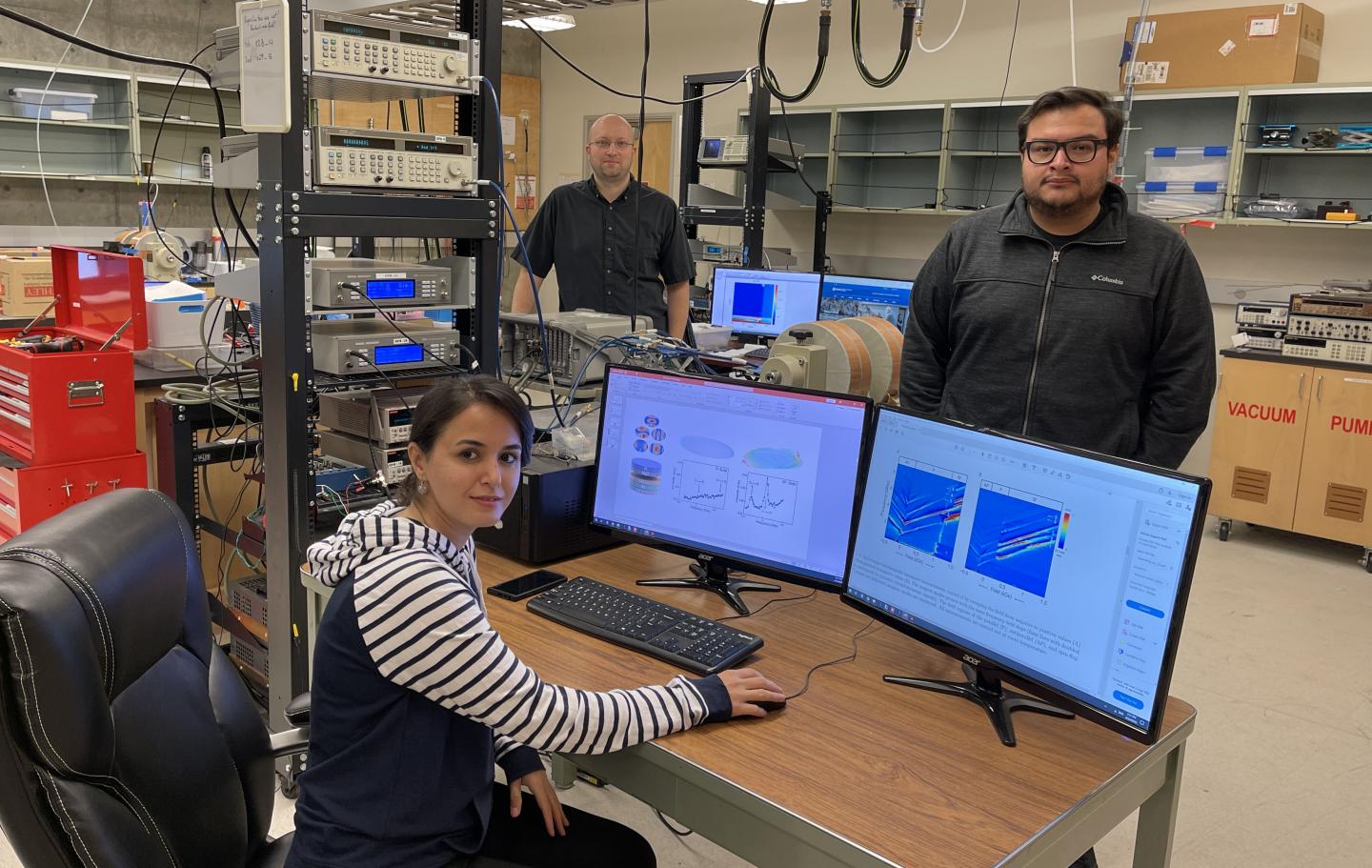
"We anticipate the concepts of quantum information and spintronics to consolidate in hybrid quantum systems," said Igor Barsukov, an assistant professor at the Department of Physics & Astronomy who led the study that appears in Applied Materials & Interfaces. "We will have to control nonlinear spin dynamics at the quantum level to achieve their functionality."

Barsukov explained that in nanomagnets, which serve as building blocks for many spintronic technologies, magnons show quantized energy levels. Interaction between the magnons follows certain symmetry rules. The research team learned to engineer the magnon interaction and identified two approaches to achieve nonlinearity: breaking the symmetry of the nanomagnet's spin configuration; and modifying the symmetry of the magnons. They chose the second approach.

"Modifying magnon symmetry is the more challenging but also more application-friendly approach," said Arezoo Etesamirad, the first author of the research paper and a graduate student in Barsukov's lab.

In their approach, the researchers subjected a nanomagnet to a magnetic field that showed nonuniformity at characteristic nanometer length scales. This nanoscale nonuniform magnetic field itself had to originate from another nanoscale object.

For a source of such a magnetic field, the researchers used a nanoscale synthetic antiferromagnet, or SAF, consisting of two ferromagnetic layers with antiparallel spin orientation. In its normal state, SAF generates nearly no stray field -- the magnetic field surrounding the SAF, which is very small. Once it undergoes the so-called spin-flop transition, the spins become canted and the SAF generates a stray field with nonuniformity at nanoscale, as needed. The researchers switched the SAF between the normal state and the spin-flop state in a controlled manner to toggle the symmetry-breaking field on and off.

"We were able to manipulate the magnon interaction coefficient by at least one order of magnitude," Etesamirad said. "This is a very promising result, which could be used to engineer coherent magnon coupling in quantum information systems, create distinct dissipative states in magnetic neuromorphic networks, and control large excitation regimes in spin-torque devices."

Raytheon leads new supercomputing center dedicated to advancing U.S. weather forecasting

NOAA has announced that Raytheon Intelligence and Space has been chosen to design and develop the Earth Prediction Innovation Center (EPIC), an extramural center that will unite academia, industry and government to help create the most user-friendly and user-accessible comprehensive Earth modeling system.

Raytheon Intelligence and Spaceoffsite link brings to EPIC proven expertise in scientific leadership, software engineering, software infrastructure, and delivery of support services to government, academia and industry researchers who will collaborate within the EPIC framework. epic title 01 3b084

”Extreme weather events, exacerbated by climate change, are increasing,” said Craig McLean, NOAA’s acting chief scientist and NOAA assistant administrator for Oceanic and Atmospheric Research. “EPIC will help the United States diversify the community that contributes to improving weather forecasting to save lives, protect property, and strengthen our economy.”

“The creation of EPIC is a foundational piece in a major, multi-step effort by NOAA to expand and strengthen community modeling and help us accelerate the improvements in operational weather and climate forecasting,” said Louis W. Uccellini, Ph.D., director, NOAA’s National Weather Service. “This effort will improve forecasts and decision-support activities to ensure communities are ready for, and respond to, oncoming extreme weather, water, and climate events.”

EPIC is a collaborative effort involving the larger research community from academia, public agencies, and private industry — known as the Weather Enterprise — to contribute to the overall development of the operational models used by NOAA’s National Weather Service to meet its mission of saving lives and property. EPIC will facilitate the community modeling approach by making it easier for developers across diverse sectors to contribute to the development of these operational models using a common modeling infrastructure.

These research collaborations are already helping NOAA accelerate development of the nation’s Unified Forecast Systemoffsite link (UFS), a community-based, comprehensive Earth modeling system, which is becoming the core of NOAA's operational Numerical Weather Prediction applications.

In order to support the accelerated drive to improve weather modeling to help save lives, protect property and strengthen the nation’s economy, NOAA is tripling its operational supercomputing capacity. New supercomputers and cloud computing capabilities are also being leveraged to quickly transition research and development advancements, including those that will occur through EPIC, into operations at the National Weather Service.

UFS is integrating numerous environmental models into a unified Earth modeling system that will be used to predict weather from local to global domains at time scales from minutes to seasons. This unified system allows better collaboration between NOAA and the extramural science community, and will accelerate the development and integration of innovation into NOAA's operational weather forecast systems.

To encourage community collaborations, NOAA has publicly released user-friendly computer codes for medium-range and short-range weather prediction. NOAA has also recently upgraded its flagship global weather model to improve forecasting of high-impact weather events such as hurricanes, severe weather outbreaks, rainfall, and blizzards.

EPIC is a national priority supported by the Weather Research and Forecasting Innovation Act of 2017, which calls for NOAA to prioritize improving weather data, modeling, computing, forecasting, and warnings for the protection of life and property and to enhance the national economy. Congress codified EPIC and further called for NOAA to accelerate community-developed scientific and technological advances to its operational numerical weather prediction in the National Integrated Drought Information System Reauthorization Act of 2018.

Oxford Brookes prof shows how vertical turbines could be the future for wind farms

The now-familiar sight of traditional propeller wind turbines could be replaced in the future with wind farms containing more compact and efficient vertical turbines

The now-familiar sight of traditional propeller wind turbines could be replaced in the future with wind farms containing more compact and efficient vertical turbines. New research from Oxford Brookes University has found that the vertical turbine design is far more efficient than traditional turbines in large-scale wind farms, and when set in pairs the vertical turbines increase each other's performance by up to 15%.

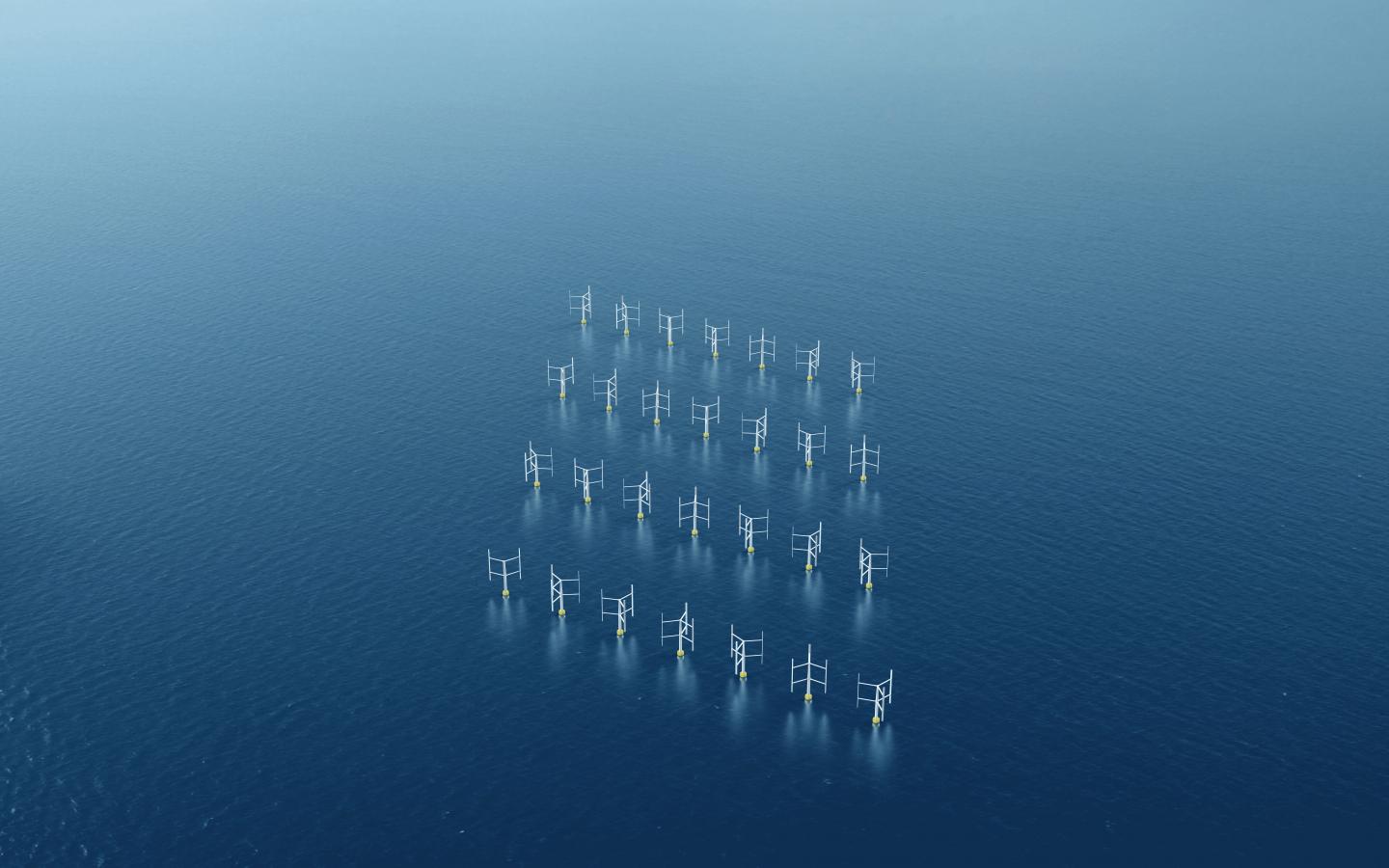
A research team from the School of Engineering, Computing and Mathematics (ECM) at Oxford Brookes led by Professor Iakovos Tzanakis conducted an in-depth study using more than 11,500 hours of supercomputer simulation to show that wind farms can perform more efficiently by substituting the traditional propeller-type Horizontal Axis Wind Turbines (HAWTs), for compact Vertical Axis Wind Turbines (VAWTs).

Vertical turbines are more efficient than traditional windmill turbines Farm of Vertical Axis Wind Turbines

The research demonstrates for the first time at a realistic scale, the potential of large-scale VAWTs to outcompete current HAWT wind farm turbines.

VAWTs spin around an axis vertical to the ground, and they exhibit the opposite behavior of the well-known propeller design (HAWTs). The research found that VAWTs increase each other's performance when arranged in grid formations. Positioning wind turbines to maximize outputs is critical to the design of wind farms.

Professor Tzanakis comments "This study evidences that the future of wind farms should be vertical. Vertical axis wind farm turbines can be designed to be much closer together, increasing their efficiency and ultimately lowering the prices of electricity. In the long run, VAWTs can help accelerate the green transition of our energy systems, so that more clean and sustainable energy comes from renewable sources."

With the UK's wind energy capacity expected to almost double by 2030, the findings are a stepping stone towards designing more efficient wind farms, understanding large-scale wind energy harvesting techniques, and ultimately improving the renewable energy technology to more quickly replace fossil fuels as sources of energy.

A cost-effective way to meet wind power targets

According to the Global Wind Report 2021, the world needs to be installing wind power three times faster over the next decade, to meet net-zero targets and avoid the worst impacts of climate change.

Lead author of the report and Bachelor of Engineering graduate Joachim Toftegaard Hansen commented: "Modern wind farms are one of the most efficient ways to generate green energy, however, they have one major flaw: as the wind approaches the front row of turbines, turbulence will be generated downstream. The turbulence is detrimental to the performance of the subsequent rows.

"In other words, the front row will convert about half the kinetic energy of the wind into electricity, whereas for the back row, that number is down to 25-30%. Each turbine costs more than £2 million/MW. As an engineer, it naturally occurred to me that there must be a more cost-effective way."

The study is the first to comprehensively analyze many aspects of wind turbine performance, with regards to array angle, the direction of rotation, turbine spacing, and the number of rotors. It is also the first research to investigate whether the performance improvements hold for three VAWT turbines set in a series.

Dr. Mahak co-author of the article and Senior Lecturer in ECM comments: "The importance of using computational methods in understanding flow physics can't be underestimated. These types of design and enhancement studies are a fraction of the cost compared to the huge experimental test facilities. This is particularly important at the initial design phase and is extremely useful for the industries trying to achieve maximum design efficiency and power output."