

Silva wins inaugural IEEE Visualization Academy

Claudio Silva, professor of computer science and engineering and member of the Visualization, Imaging, and Data Analysis (VIDA) research center at the New York University Tandon School of Engineering, was inducted into the inaugural cohort of the IEEE Visualization Academy (Vis Academy) during the opening session of The Institute of Electrical and Electronics Engineers Visualization Conference (IEEE VIS 2019) in Vancouver, BC, on Tuesday, October 22, 2019.

Induction into the Academy is among the highest and most prestigious honors in the field of visualization. Silva, who has held positions at AT&T, IBM, Lawrence Livermore, Sandia, and the University of Utah, has made numerous contributions to the field, in areas ranging from point-based modeling to surface reconstruction, visibility computations, and urban data visualization.Professor of Computer Science and Engineering at NYU Tandon. {module In-article}

Established in 2018 by the IEEE Visualization and Graphics Technical Committee, the Academy chose as its first members Visualization Career Awardees and Visualization Technical Achievement Awardees from 2004 to 2019, making it a veritable A-list or hall of fame for those in the field. (Silva won the Technical Achievement Award, given only to those who have made seminal contributions to the field, in 2014.)

With over 200 journal and conference papers, Silva holds 12 U.S. patents and is the co-author of 12 papers that have received "Best Paper Awards" at visualization and geometric computing conferences. He has over 9,900 citations according to Google Scholar.

Silva has contributed to such large-scale technology projects as:

  • VisTrails, an open-source scientific workflow and provenance management system that supports data exploration and visualization, whose development helped earn Silva a Technical Achievement Award
  • Integrated Analytics and Visualization for Multi-Modality Transportation, a new research project in collaboration with NYU Tandon's C2SMART University Transportation Center that examines pedestrian dynamics using tens of millions of images produced by the Brooklyn- based startup Carmera
  • UV-CDAT (Community Data Analysis Tools), a novel climate data analysis tool that won the 2015 Federal Laboratory Consortium Interagency Partnership Award
  • Major League Baseball's Statcast player tracking system, which won the Alpha Award for Best Analytics Innovation/Technology at the 2015 MIT Sloan Sports Analytics Conference, and for which Silva won a 2018 Technology and Engineering Emmy Award from the National Academy of Television Arts & Sciences
  • TaxiVis, an innovative open-source tool for analyzing complex spatial-temporal urban data being used by the NYC Department of Transportation and the Taxi and Limousine Commission (TLC)

Silva is affiliated with several of the top research centers at NYU, including the Courant Institute for Mathematical Sciences, the Center for Data Science (CDS), the Center for Urban Science and Progress (CUSP), the Center for Advanced Technology in Telecommunications (CATT), and C2SMART (Connected Cities with Smart Transportation). The National Science Foundation, the Department of Education, AT&T, IBM, and the Sloan Foundation are among the many funders of his research.

"Claudio Silva's influence in the field of data visualization speaks not only for the reputation of his own research but to the wide recognition he and the VIDA center have garnered as collaborators," said Jelena Kovacevic, Dean of the NYU Tandon School of Engineering. "Claudio and the entire VIDA Center team really are exemplars of how alliances between departments, other NYU schools, the city and beyond are driving breakthroughs at NYU Tandon in artificial intelligence, data science, health, urban science, and other vital areas of research."
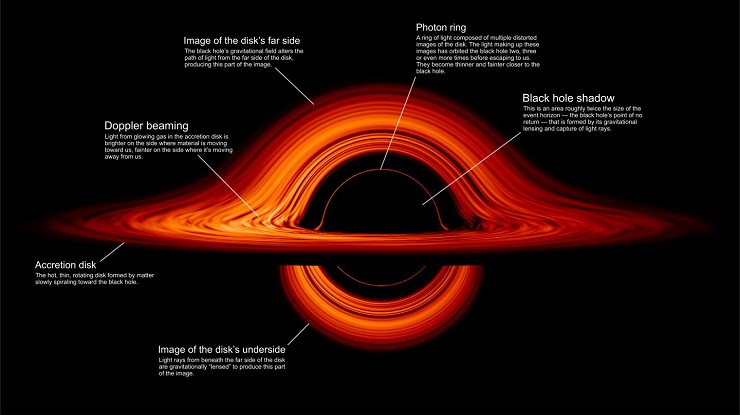
NASA visualization shows a black hole's warped world

This new visualization of a black hole illustrates how its gravity distorts our view, warping its surroundings as if seen in a carnival mirror. The visualization simulates the appearance of a black hole where the infalling matter has collected into a thin, hot structure called an accretion disk. The black hole's extreme gravity skews light emitted by different regions of the disk, producing the misshapen appearance. This new visualization of a black hole illustrates how its gravity distorts our view, warping its surroundings as if seen in a carnival mirror. The visualization simulates the appearance of a black hole where infalling matter has collected into a thin, hot structure called an accretion disk. The black hole's extreme gravity skews light emitted by different regions of the disk, producing the misshapen appearance.  Bright knots constantly form and dissipate in the disk as magnetic fields wind and twist through the churning gas. Nearest the black hole, the gas orbits at close to the speed of light, while the outer portions spin a bit more slowly. This difference stretches and shears the bright knots, producing light and dark lanes in the disk.  Viewed from the side, the disk looks brighter on the left than it does on the right. Glowing gas on the left side of the disk moves toward us so fast that the effects of Einstein's relativity give it a boost in brightness; the opposite happens on the right side, where gas moving away us becomes slightly dimmer. This asymmetry disappears when we see the disk exactly face on because, from that perspective, none of the material is moving along our line of sight.  Closest to the black hole, the gravitational light-bending becomes so excessive that we can see the underside of the disk as a bright ring of light seemingly outlining the black hole. This so-called

Bright knots constantly form and dissipate in the disk as magnetic fields wind and twist through the churning gas. Nearest the black hole, the gas orbits at close to the speed of light, while the outer portions spin a bit more slowly. This difference stretches and shears the bright knots, producing light and dark lanes in the disk.

Viewed from the side, the disk looks brighter on the left than it does on the right. Glowing gas on the left side of the disk moves toward us so fast that the effects of Einstein's relativity give it a boost in brightness; the opposite happens on the right side, where gas moving away us becomes slightly dimmer. This asymmetry disappears when we see the disk exactly face on because, from that perspective, none of the material is moving along our line of sight.

{media id=233,layout=solo}

Closest to the black hole, the gravitational light-bending becomes so excessive that we can see the underside of the disk as a bright ring of light seemingly outlining the black hole. This so-called "photon ring" is composed of multiple rings, which grow progressively fainter and thinner, from light that has circled the black hole two, three, or even more times before escaping to reach our eyes. Because the black hole modeled in this visualization is spherical, the photon ring looks nearly circular and identical from any viewing angle. Inside the photon, the ring is the black hole's shadow, an area roughly twice the size of the event horizon -- its point of no return.

"Simulations and movies like these really help us visualize what Einstein meant when he said that gravity warps the fabric of space and time," explains Jeremy Schnittman, who generated these gorgeous images using custom software at NASA's Goddard Space Flight Center in Greenbelt, Maryland. "Until very recently, these visualizations were limited to our imagination and computer programs. I never thought that it would be possible to see a real black hole." Yet on April 10, the Event Horizon Telescope team released the first-ever image of a black hole's shadow using radio observations of the heart of the galaxy M87.