Global pollution estimates reveal surprises, opportunity

Researchers' hybrid dataset includes satellite images, modeling, and air samples

It is not unusual to come across headlines about pollution or global warming and find that they reach different conclusions depending upon the data source.

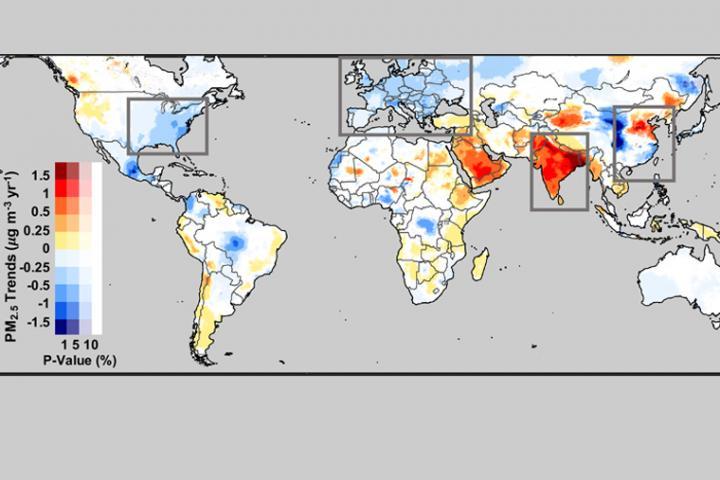
Researchers at Washington University in St. Louis used a harmonized approach, incorporating data from multiple satellites and ground monitors with supercomputer modeling to compile a comprehensive, consistent map of pollution across the globe. Their data spans 1998-2018, providing a current picture of the state of the world's air quality that reveals some surprises, both for better and for worse. CAPTION Calculated trends in geophysical PM2.5 values from 1998-2018. Warm colors indicate positive trends, cool colors indicate negative trends and the opacity of the colors indicates the statistical significance of the trends.{module INSIDE STORY}

The research was led by Melanie Hammer, a postdoctoral research fellow in the lab of Randall Martin, professor of energy, environmental and chemical engineering in the McKelvey School of Engineering.

Results of their study that looked at PM2.5 -- tiny particles that are able to make their way deep into a person's respiratory system -- were published June 3 in Environmental Science & Technology.

"Prior studies that look at long-term PM2.5 haven't used data as recent as we have," Hammer said. Older data can't capture the results of many programs aimed at curbing pollution -- even if they have been in effect for nearly a decade.

That turned out to be the case in China, where a significant drop in pollution in the recent past was the result of strategies begun in earnest around 2011. Other data sets don't capture the drop.

And in India -- another area of concern -- the story was not as positive. "It seems there's a bit of a plateau of PM2.5 levels," Hammer said. Though still, levels are not rising as steeply as other reports may suggest.

PM2.5 refers to the size of particles -- 2.5 microns. These tiny particles are created in nature, but also by human activities, including some manufacturing processes, car exhaust, and the use of wood-burning cookstoves.

It's not easy to measure the amount of PM2.5 on the ground because there isn't any kind of comprehensive monitoring network covering the globe. North America and Europe have extensive monitoring systems, as does China. But, Martin said, "There are large gaps in ground-based monitoring. People can be living hundreds of kilometers away from monitors."

To develop a comprehensive pollution map, then, ground-based monitors are simply insufficient.

To capture a global snapshot, Martin's team started with satellite images of columns of atmosphere that spanned the ground to the edge of space. Using the established GEOS-Chem model, which simulates atmospheric composition, they could infer how much PM2.5 should be on the ground, at the bottom of any given column.

When comparing the predictions to actual levels measured by ground monitors, the agreement was striking. In fact, Martin said, "It's the best level of agreement found to date."

But the researchers still went a step further.

The agreement was great, but not perfect. So Hammer added the differences between the observed and predicted amounts of PM2.5 and expanded the ground-based predictions across the globe, filling in the massive gaps between monitors.

This extra step brought the observed and predicted levels of PM2.5 from 81% to 90% agreement.

Once they were able to take a good look at the most recent pollution levels around the world, the researchers saw some stark changes from previous trends. Particularly in China.

"We're used to seeing just large, increasing trends in pollution," Hammer said. But in China, "What we found, from 2011 to 2018, is that there actually is a particularly large negative trend."

Elsewhere in Asia, the picture wasn't as positive.

While pollution levels did not seem to be increasing in India, the country seems to be in a plateau phase. "The broad plateau of very high concentrations, to which a large population is exposed, is quite concerning," Martin said. "It affects the health of a billion people."

However, the takeaway from this research can be, on the balance, a hopeful one: It seems to show one possible way forward.

"The data Melanie's analysis reveals is a real success story for air quality controls," Martin said. "It shows they can be remarkably effective at reducing PM2.5." Although scientists have known these controls contain the potential to make an impact, he said, "The changes in China are very dramatic, larger than we have seen anywhere in the world over the observational record.

"It illustrates a real opportunity to improve air quality through effective controls."

Pollution, health around the world

In people already sick with illnesses such as asthma, PM2.5 can have immediate health consequences. Long-term, however, breathing in these particles carries consequences for everyone.

"PM2.5 is a major public health concern globally," said Melanie Hammer, a postdoctoral researcher in the lab of Randall Martin in the McKelvey School of Engineering. "It's important to get accurate exposure estimates to estimate health impacts."

That's why organizations, including the World Health Organization and Global Burden of Disease, use data from Martin's lab.

Ocean in Jupiter's moon Europa 'could be habitable'

A new supercomputer model from NASA scientists supports the theory that the interior ocean in Jupiter's moon Europa would be able to sustain life. In addition, they have calculated that this water, believed to be an ocean under the surface ice shell, could have been formed by the breakdown of water-containing minerals due to either tidal forces or radioactive decay. This work, which is not yet peer-reviewed, is presented for the first time at the virtual Goldschmidt conference and may have implications for other moons in the Solar System.

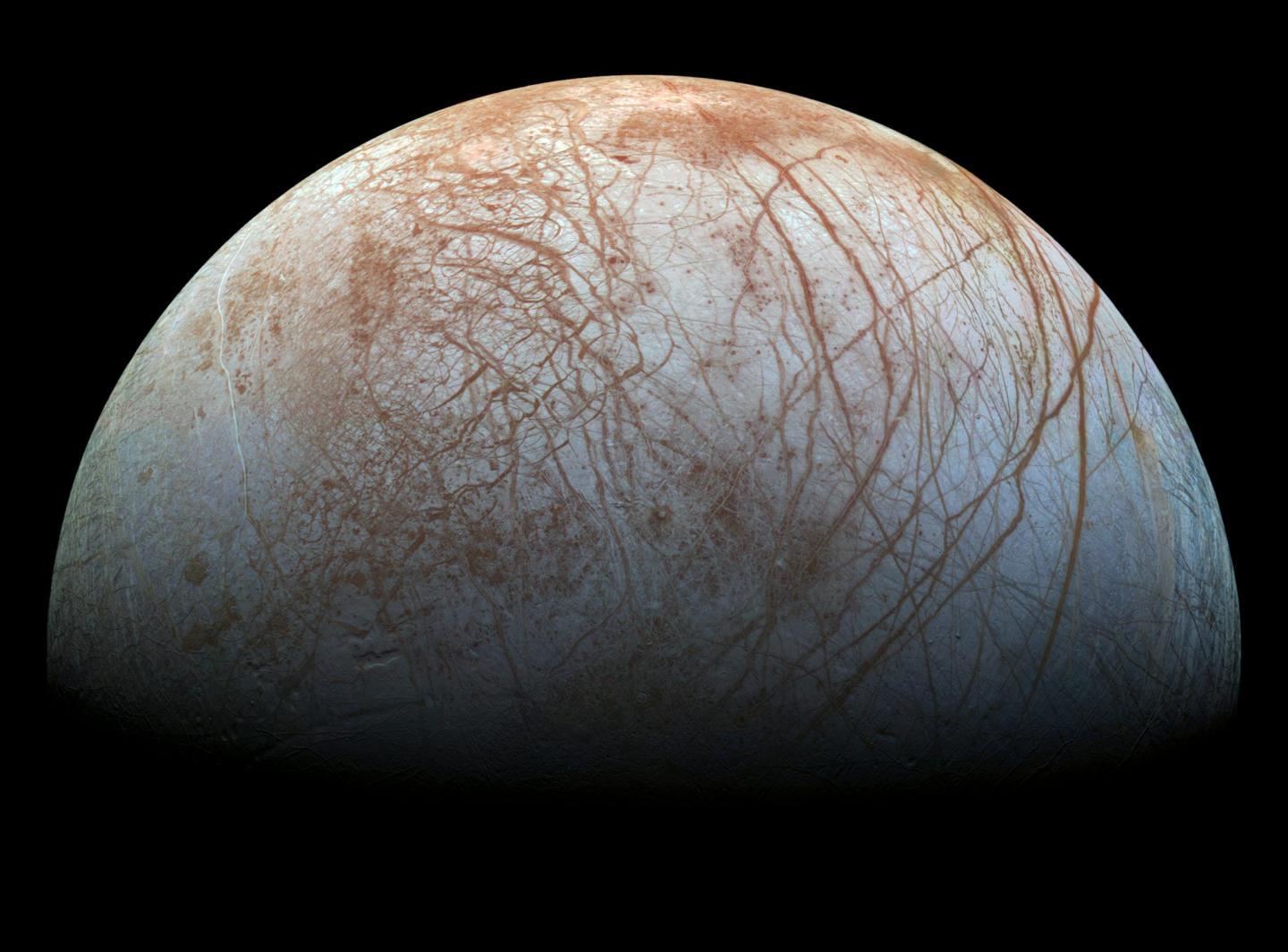
Europa is one of the largest moons in the solar system. Since the flybys of the Voyager and Galileo spacecraft, scientists have held that the surface crust floats on a subsurface ocean. However, the origins and composition of this ocean have been unclear. CAPTION The Stunning surface of Jupiter's moon, Europa. Hi-res image available at https://www.jpl.nasa.gov/spaceimages/details.php?id=PIA19048  CREDIT Image credit: NASA/JPL-Caltech/SETI Institute.{module INSIDE STORY}

The researchers, based at NASA's Jet Propulsion Laboratory in California, modeled geochemical reservoirs within the interior of Europa using data from the Galileo mission. Lead researcher Mohit Melwani Daswani said "We were able to model the composition and physical properties of the core, silicate layer, and ocean. We find that different minerals lose water and volatiles at different depths and temperatures. We added up this volatiles that is estimated to have been lost from the interior, and found that they are consistent with the current ocean's predicted mass, meaning that they are probably present in the ocean".

The researchers found that ocean worlds such as Europa can be formed by metamorphism: in other words, heating and increased pressure caused by early radioactive decay or later subsurface tidal movement would cause the breakdown of water-containing minerals and the release of the trapped water.

They also found that this ocean would originally have been mildly acidic, with high concentrations of carbon dioxide, calcium, and sulfate. "Indeed it was thought that this ocean could still be rather sulfuric," said Mohit Melwani Daswani, "but our simulations, coupled with data from the Hubble Space Telescope*, showing chloride on Europa's surface, suggests that the water most likely became chloride rich. In other words, its composition became more like oceans on Earth. We believe that this ocean could be quite habitable for life."

He continued, "Europa is one of our best chances of finding life in our solar system. NASA's Europa Clipper mission will launch in the next few years, and so our work aims to prepare for the mission, which will investigate Europa's habitability. Our models lead us to think that the oceans in other moons, such as Europa's neighbor Ganymede, and Saturn's moon Titan, may also have formed by similar processes. We still need to understand several points though, such as how fluids migrate through Europa's rocky interior".

The researchers have now teamed up with groups in Nantes and Prague to try to identify if seafloor volcanoes may have contributed to the evolution of the chloride-rich water on Europa. NASA has recently released new high-resolution photos of Europa, showing possible exploration sites to test these findings.

https://www.nasa.gov/feature/jpl/newly-reprocessed-images-of-europa-show-chaos-terrain-in-crisp-detail.

Commenting, Professor Steve Mojzsis, Professor of Geology at the University of Colorado, said:

"A long-standing question over whether a "cloaked ocean" world like Europa could be habitable boils down to whether it can sustain a flow of electrons that might provide the energy to power life. What remains unclear is whether such icy moons could ever generate enough heat to melt rock; certainly, interesting chemistry takes place within these bodies, but what reliable flow of electrons could be used by alien life to power itself in the cold, dark depths? A key aspect that makes the world "habitable" is an intrinsic ability to maintain these chemical disequilibria. Arguably, icy moons lack this ability, so this needs to be tested on any future mission to Europa".

Professor Mojzsis was not involved in this work, this is an independent comment.

With a diameter of 3,100km, Europa is slightly smaller than the Earth's Moon. As Europa orbits Jupiter around 780 million km from the Sun, the surface temperature never rises above minus 160 Celsius; the ocean temperature is still unknown. Galileo is credited with discovering Europa, along with 3 larger moons of Jupiter, on January 8th, 1610.

The Goldschmidt conference thanks to the NASA Jet Propulsion Laboratory for their cooperation in the production of this material and the use of photographs. For more information on the Europa Clipper mission, see https://europa.nasa.gov/

The Goldschmidt conference is the world's main geochemistry conference, hosted by the Geochemical Society and the European Association of Geochemistry. Held annually, it covers such material as climate change, astrobiology, planetary, and stellar development and conditions, the chemistry of Earth materials, pollution, the undersea environment, volcanoes, and many other subjects. For 2020 the scheduled Hawaii congress has been moved online and takes place from 21-26 June, see https://goldschmidt.info/2020/index. Future congresses are in Lyon, France (2021), and the rescheduled Hawaii congress (2022).

WVU students develop AI to detect fast radio bursts

West Virginia University's Duncan Lorimer might be the godfather of the fast radio burst, but a pair of international students have taken exploring these mysterious cosmic flashes to a new level.

In 2007, Lorimer was credited for helping discover fast radio bursts - intense, unexplained pulses of energy, light years away, that pop for mere milliseconds. Ever since only around 100 have been spotted. Kshitij Aggarwal  CREDIT Scott Lituchy/West Virginia Universtiy

But astronomers knew there were more out there. One major obstacle to new discoveries came in the form of researchers having to manually read data plots, recorded by satellite imaging, for hours on end.

Devansh Agarwal and Kshitij Aggarwal, both physics and astronomy graduate students from India, recognized this painstaking task so they developed a quicker, more efficient way to detect fast radio bursts. They created artificial intelligent, machine-learning software that sifts through the endless clutters of data. 

{media id=241,layout=solo}

{module INSIDE STORY}

"Fast radio bursts are hard to find because they're intermittent in nature," said Lorimer, astronomy professor and Eberly College associate dean for research. "We have telescopes collecting data very rapidly in real-time, so we're amassing huge amounts of data, which becomes a data processing and analysis challenge. It's overwhelming, even for an army of students and researchers. You could be sitting there 24 hours a day looking at these plots and that's not an exaggeration."

Through analysis, researchers can identify "candidate events," in which a data point could possibly turn out to be a fast radio burst. Or it could just be interference or noise.

So Agarwal and Aggarwal set out to write computer code and software they've trained to distinguish whether the candidate events are actually fast radio bursts or other types of pulses.

The students dubbed the software FETCH, which stands for "fast extragalactic transient candidate hunter." And they've made it open-source, meaning anyone anywhere is free to use it.

"Our aim off the bat was to use AI to model a task that humans can do with the same precision or better," Agarwal said. "People have been using AI for a myriad of techniques in biological systems, x-rays, cat scans, and MRIs to identify diseases. We wanted to make our system generic enough that anyone can use it anywhere in the world."

Already, scientists have used FETCH in Australia to find new fast radio bursts.

The software will also come in handy for research through the Green Bank Observatory, a partner of WVU, and a key site for the University's astronomy research. The Green Bank Telescope, located in Pocahontas County, is the world's largest fully steerable radio telescope.

"With Green Bank, it has allowed us to operate in an environment where we would normally have thousands of pulses to look through per day down to one or two," Lorimer said.

Lorimer said the idea for this innovation came from the students themselves. The project even gave undergraduate students, such as Olivia Young, of Short Gap, West Virginia, an opportunity to do research.

"It's enabled me to present at conferences and have a really unique learning experience as an undergraduate," said Young, who graduated in May with her bachelor's degree in physics.

"We're really pleased when students take an initiative," Lorimer said. "I see my role nowadays as a few steps away from the research, but I try to give the students the knowledge that they can run with. It's like learning a new language. You teach them a few phrases and then they'll string together full sentences. Or learning music. You teach them a couple of notes and they take it and come up with new tunes."